



AI will not solve global warming. It can, however, make several difficult parts of the climate response faster, cheaper, and more measurable.
That distinction matters. Global warming is not primarily an information shortage. The world already knows that greenhouse-gas emissions must fall rapidly. The hard problems are replacing physical infrastructure, financing the transition, coordinating grids and supply chains, changing incentives, and protecting people from impacts already arriving.
The research-backed answer is therefore conditional:
AI helps when it changes a real decision or physical system and the verified climate benefit exceeds the computing footprint. A more accurate prediction with no action attached is not a climate solution.
Start with the scale of the problem
The World Meteorological Organization reported that 2025 was the second- or third-warmest year observed, at about 1.43°C above the 1850–1900 average. Its report also found record ocean heat and the highest Earth energy imbalance in a 65-year record. These are measurements of accumulated physical change, not forecasts from an AI company.
The policy gap remains large. The UN Environment Programme's 2025 Emissions Gap Report estimated that current policies point toward roughly 2.8°C of warming this century. Full implementation of available national commitments improves that estimate, but still points to about 2.3–2.5°C. AI does not close that gap unless it causes cleaner assets to be deployed or dirty activity to stop.
This gives us a useful denominator. A climate-AI project should not be judged by model accuracy alone. It should be judged by tonnes of carbon-dioxide equivalent avoided, clean megawatts integrated, energy saved, methane stopped, lives protected, or adaptation losses reduced.
Where AI can produce real climate value
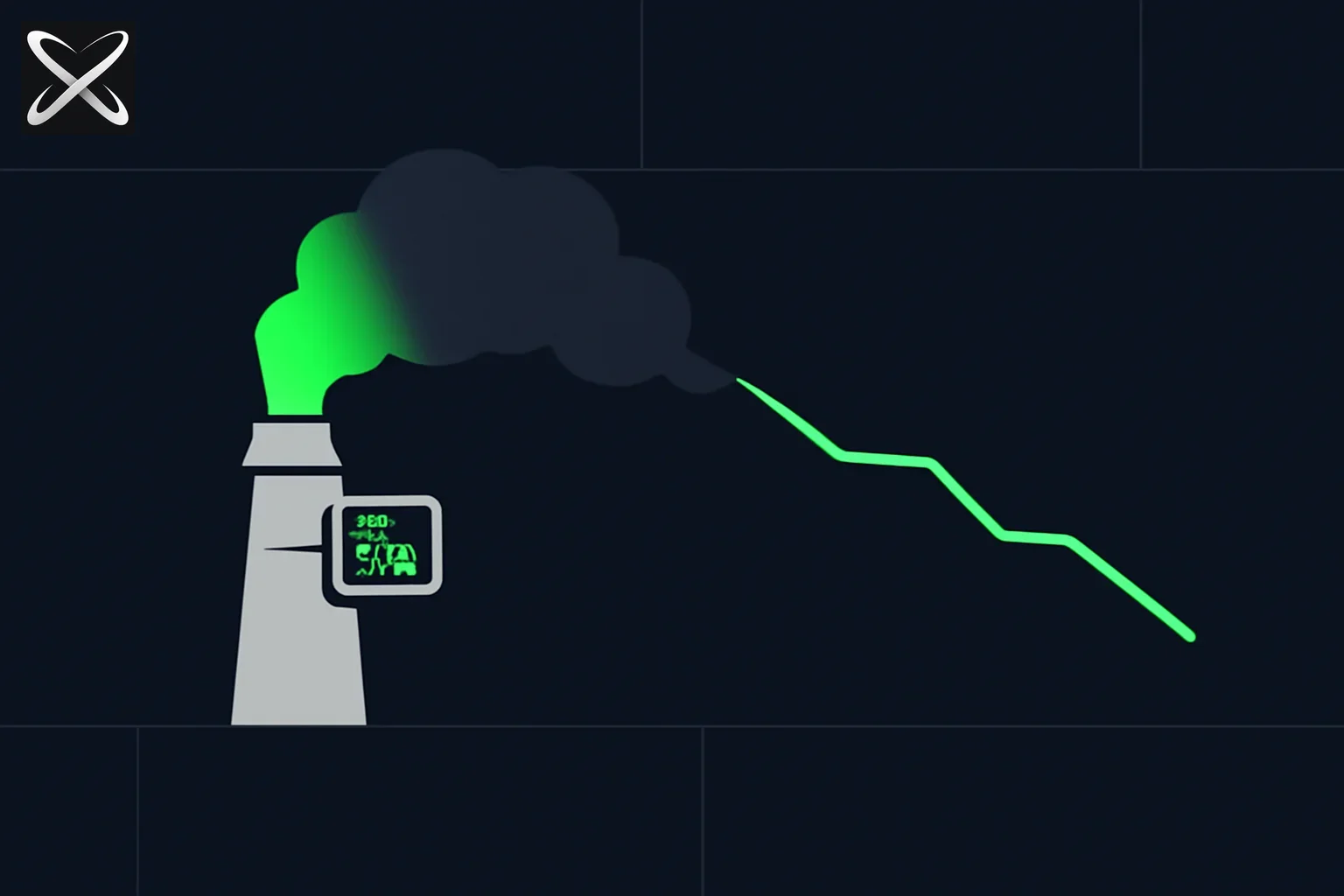 Can AI solve global warming — a factory smokestack plume passing through a sensor node into a declining emissions graph line
| Application | What AI contributes | Useful outcome | Evidence maturity |
|---|---|---|---|
| Renewable forecasting | Predicts wind and solar output | Lower balancing cost and curtailment | Deployed, measurable |
| Grid operations | Estimates demand, congestion, and faults | More capacity from existing assets | Promising, system-specific |
| Buildings and industry | Controls heating, cooling, and processes | Metered energy and emissions savings | Deployed, measurable |
| Methane detection | Finds likely leaks in satellite or sensor data | Faster repair of a potent emissions source | Deployed with field verification |
| Climate and weather models | Accelerates or improves forecasts | Earlier, more local decisions | Strong forecasting progress; impact depends on use |
| Materials discovery | Searches candidates for batteries, catalysts, and cement | Faster laboratory pipeline | Promising; deployment is slow |
| Adaptation planning | Maps flood, heat, fire, and crop risk | Better warnings and investment targeting | Useful when locally validated |
The common pattern is decision support. AI can search a huge action space, detect patterns across sensors, and update predictions faster than manual analysis. It is most credible when an operator can compare a metered before-and-after result.
1. Make a cleaner electricity system easier to operate
Wind and solar output varies with weather. Electricity demand varies by hour, season, price, and human behavior. Grid operators must keep supply and demand balanced while respecting transmission limits and maintaining reserves.
Machine-learning forecasts can help estimate renewable output and load. Optimization can schedule storage, flexible demand, and maintenance. Computer vision can inspect lines and equipment. These capabilities can reduce curtailment, identify failures earlier, and extract more value from existing infrastructure.
But software cannot create a missing transmission corridor. If a region has no interconnection capacity, storage, market reform, or permission to build, a better forecast mainly describes the bottleneck more precisely. The physical and regulatory system sets the ceiling.
The correct evaluation is operational: Did the system reduce fossil dispatch, curtailment, reserve requirements, outage minutes, or total cost under comparable conditions? A benchmark predicting yesterday's grid is not enough.
2. Cut wasted energy in buildings and industry
Buildings and industrial processes have many controllable variables. Heating, ventilation, cooling, pumps, furnaces, compressors, and production schedules interact with weather, occupancy, equipment condition, and tariffs.
AI can forecast demand and select control settings that preserve comfort or output while using less energy. An industrial model can flag a process drifting out of its efficient range. Predictive maintenance can prevent a degraded compressor or motor from wasting energy for months.
This is one of the most defensible climate uses because energy meters provide a direct outcome. Yet even here, measurement needs a baseline adjusted for weather, occupancy, and production. A building that used 10% less electricity during a mild month did not necessarily gain 10% from AI.
The best deployments specify the counterfactual, monitor comfort and safety, and report persistent savings rather than a short pilot.
3. Detect emissions that are otherwise hard to see
Satellites, aircraft, cameras, and fixed sensors produce more environmental data than people can manually inspect. Pattern-recognition systems can prioritize possible methane plumes, illegal deforestation, flaring, land-use change, and equipment faults.
Detection is valuable because methane reductions can have a relatively fast effect on warming. But an image classification is the start of a workflow, not the result. Someone must confirm the event, identify ownership, dispatch repair, and verify that emissions stopped.
A credible methane-AI claim should therefore report confirmed leaks, repair time, recurrence, and estimated avoided emissions—not only detections or pixels analyzed.
4. Improve forecasts and climate-risk decisions
AI weather models have shown that learned systems can generate some forecasts quickly and accurately. Faster models can support larger ensembles: many plausible forecasts that help decision-makers understand uncertainty. Downscaling tools may add local detail to coarser climate projections.
That can improve flood preparation, heat-health alerts, renewable operations, agriculture, and emergency logistics. The value comes from lead time and action. A warning saves lives only if it reaches people, is trusted, and connects to transport, shelters, health services, and local authority.
Climate projections also differ from short-term weather forecasts. A model that predicts the next ten days well has not automatically demonstrated skill at estimating regional conditions decades ahead. Physical consistency, uncertainty calibration, out-of-distribution testing, and comparison with established models remain essential.
5. Accelerate materials and engineering research
New batteries, lower-carbon cement, catalysts, refrigerants, and carbon-removal processes require searching enormous design spaces. AI can rank candidates, approximate expensive simulations, extract results from papers, and guide experiments.
This can shorten the loop between hypothesis and laboratory test. It does not remove chemistry, safety testing, manufacturing scale-up, feedstock constraints, permitting, or cost. A predicted molecule is not a factory-ready material.
The evidence ladder should be explicit:
- model prediction;
- laboratory validation;
- repeatable prototype;
- pilot under realistic conditions;
- commercial performance and durability;
- life-cycle emissions reduction at scale.
Many exciting announcements sit on steps one or two. Climate impact begins much later.
Mix the levers below to see net climate benefit, not just the applied upside — training and running the models isn't free either:
AI also has a climate cost
There is no useful climate accounting that treats computation as weightless. AI requires data centers, chips, power, cooling, water, backup generation, and construction.
The International Energy Agency estimated that all data centers—not AI alone—were responsible for about 180 million tonnes of indirect CO₂ emissions from electricity in 2024, around 0.5% of global fuel-combustion CO₂. In its base case, that share rises toward 1% over the decade. Those figures are smaller than emissions from the largest sectors, but large enough that efficiency and power sourcing matter.
The same AI application can have a different footprint by region and time. Training or inference on a low-carbon grid during surplus renewable hours is not equivalent to adding demand to a constrained fossil-heavy grid. Water stress and local grid effects can also be hidden by global averages.
Our model-selection energy guide explains why right-sizing the model often reduces both cost and energy. The data-center environmental impact guide covers the local electricity and water questions a global carbon figure misses.
The rebound problem
Efficiency does not guarantee lower total emissions. If AI makes a process cheaper, people may use more of it. More efficient freight routing can reduce fuel per delivery while encouraging a larger delivery network. Cheaper computing can lower energy per inference while total inference grows faster.
This is the rebound effect. It means teams should track absolute emissions as well as intensity. “Carbon per prediction fell 40%” can coexist with total emissions doubling.
AI can also optimize fossil-fuel exploration, advertising, extraction, and high-consumption supply chains. Technology is not born with a climate objective. The user, incentives, and governance determine which objective it serves.
A practical test for any “AI for climate” claim
Ask seven questions:
- What physical decision changes? Name the asset, operator, or behavior.
- What is the counterfactual? Compare with the process that would otherwise occur.
- What metric matters? Prefer absolute avoided emissions or reduced losses.
- Was it measured in deployment? A simulation or benchmark is earlier-stage evidence.
- What enables action? Budget, authority, infrastructure, and incentives must exist.
- What is the full footprint? Include computing, equipment, and material effects where material.
- Does it scale without rebound or inequity? Check who benefits and who bears local costs.
An application that cannot answer the first three is probably an AI demonstration wearing climate language.
What would success look like?
AI's best climate role is infrastructure for thousands of narrower decisions:
- a grid accepts more renewable generation without losing reliability;
- a factory reduces energy per unit and total emissions;
- a methane plume becomes a verified repair;
- an early warning becomes an evacuation or cooling-center opening;
- a candidate material survives testing and displaces a higher-carbon alternative;
- climate finance reaches projects with verified results.
None is “solving global warming” alone. Together, deployed across major emitting systems and backed by policy, they can reduce the cost and friction of a solution.
Would AGI change the climate answer?
A hypothetical artificial general intelligence could improve several bottlenecks. It might coordinate research across chemistry, power systems, economics, and climate science; design better experiments; optimize complex grids; and help governments compare thousands of transition pathways. A highly capable system connected to trustworthy sensors and controlled tools could compress years of analysis.
AGI would not repeal thermodynamics or compress every physical timeline. Mines, factories, transmission lines, power plants, building retrofits, and ecosystem restoration still require materials, labor, permits, and land. Communities would still have legitimate disagreements about cost, risk, ownership, and local impact. Governments would still decide law and allocate public money.
It could also optimize the wrong objective. A system told to minimize short-term energy prices might extend fossil use; one told to maximize measured carbon reductions might shift pollution or hardship to poorly measured communities. Greater capability makes governance and measurement more important, not less.
AGI could make the climate transition easier to design and operate. It would not make deployment automatic. Waiting for AGI would be especially irrational because cumulative carbon dioxide persists: emissions avoided now matter more than an imagined perfect plan delivered later.
Verdict: AI is leverage, not the climate plan
Can AI solve global warming? No—not independently. Global warming is stopped by bringing net greenhouse-gas emissions toward zero and managing the warming already locked in. That requires clean electricity, electrification, efficiency, land protection, industrial change, finance, law, and international coordination.
AI can make that portfolio more effective. It can improve forecasts, controls, discovery, verification, and allocation. Its contribution is credible only when connected to physical deployment and measured net impact.
This is the same distinction that applies to other civilizational questions. Read our evidence audits on whether AI can cure cancer, end world hunger, end poverty, or prevent the next pandemic.
Update — August 16, 2026: For companies putting this framework into practice, see Top 10 AI + Climate Tech Startups to Watch in 2026 — which AI climate applications are actually shipping, and where AI is core versus a supporting tool.
Update — August 22, 2026: Meteoric's autonomous cloud-clearing drone launch shows why this framework matters: the prototype has a chamber result, but the projected solar gains and hurricane ambition still need field and causal evidence.
Related reading
- Top 10 AI + Climate Tech Startups to Watch in 2026
- Can AI cure cancer?
- Can AI end world hunger?
- Can AI end poverty?
- Can AI prevent the next pandemic?
- The model-selection energy math
- Japan’s $9,000 “human fridge” (Do Hiemon Box)
Sources and further reading
- WMO: State of the Global Climate 2025
- UNEP: Emissions Gap Report 2025
- IPCC: AR6 Synthesis Report
- IEA: Energy and AI
- IEA: AI and climate change
This article evaluates published evidence and does not predict that any single technology will meet climate targets. Figures and policy projections are dated to their linked sources.