



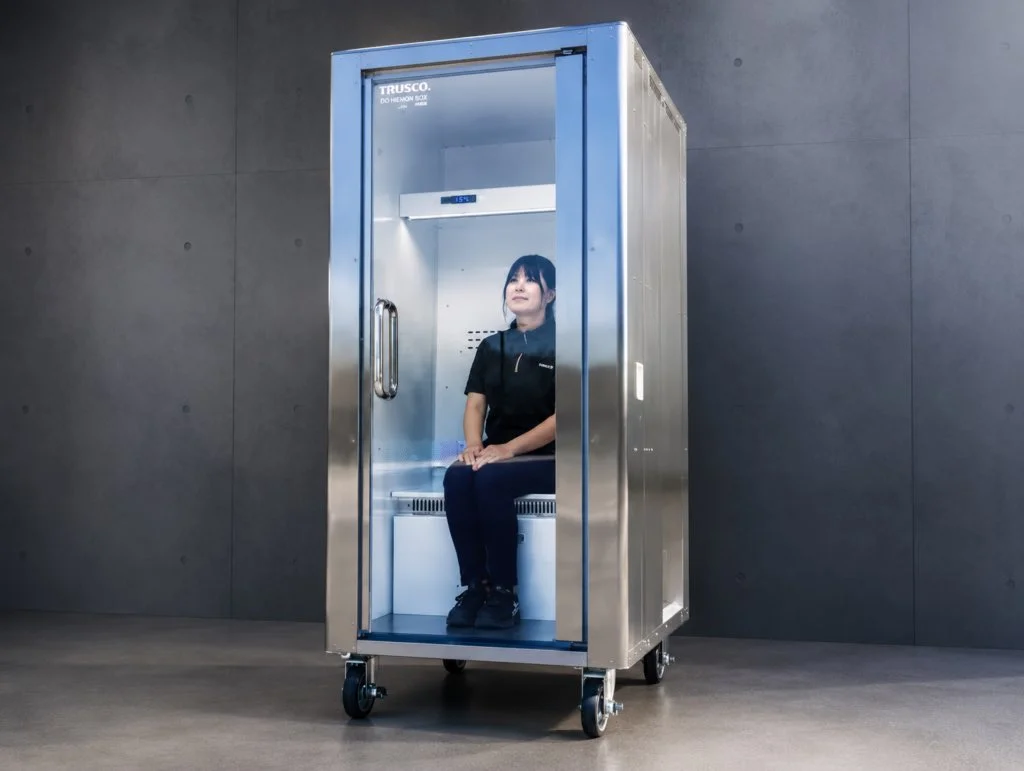
Japan unveiled a ~$9,000 “human fridge” that cools the body in about 10 minutes. That was the Polymarket line that ripped across X on July 27, 2026 — meme energy (“finally my bedroom fan can rest”) meeting a real industrial product: Trusco’s Do Hiemon Box (ど冷えもんBOX / DO HIEMON BOX on the door badge).
It is less sci-fi portal than refrigerated vending machine for one sweaty human. Developed with refrigeration maker SDRS and sold by Trusco Nakayama, the booth is Japan’s workplace answer to summers that keep rewriting heat records: sit down, get blasted with fridge-chiller air, step out less cooked.
TL;DR — What People Are Asking
| Question | Answer |
|---|---|
| Product? | Do Hiemon Box (ど冷えもんBOX) |
| Who? | SDRS + Trusco Nakayama |
| Price? | |
| Cabin? | ~15°C interior |
| Air? | ~5°C at head / neck / back |
| Time claim? | Feel cooler ~5 min · relief pitch ~10 min |
| Safety cut? | Auto off at 20 min |
| Power? | 100V · ~0.51 kWh @ 35°C · ~¥16/hr |
| Audience? | Worksites · factories · events · some city halls |
| Steal? | Full-body cool-down booth ≠ home AC |
| Spec (standard) | Value |
|---|---|
| Size (W×D×H) | ~931 × 1202 × 2031 mm |
| Weight | ~293 kg |
| Occupants | 1 · 150 kg load |
| Power | Single-phase 100V · 3 m cord |
| Exterior | SUS430 stainless hairline |
| Refrigerant (trade press) | R1234yf · ~400 W inverter |
What It Actually Is
Trusco’s pitch is blunt: previous heat gear cooled locally (neck towels, spot fans, ice vests). The Do Hiemon Box aims to cool the whole body in a sealed-ish booth you roll into place — no construction install, indoor or outdoor (with clearance for exhaust heat).
How a session works:
- Open the acrylic/glass door (magnet catch; push from inside).
- Sit on the built-in bench under LED light.
- Cold air (~5°C, chilled-case territory) hits from upper and rear vents aimed at neck and torso.
- Cabin settles around ~15°C (the display in viral photos).
- Three-step airflow and chill controls.
- Unit auto-stops at 20 minutes to limit overcooling.
- Roll away on caster wheels; padlock when idle; eye-bolt model for crane lifts on busy sites.
Official Q&A: you cannot fine-tune cabin °C like a programmable thermostat — structure is “cold air cools the box,” with stepped switches only. Leave ≥20 cm clearance rear/sides for waste heat. Dust resistance is not fully rated (IPX3 rain-ish; filter catches large lint). Forced drain evaporation usually handles condensate; high humidity can still puddle.
Why ~$9,000 Sounds High (And Who Pays)
At ~1.5 million yen, this is CapEx for heat-risk employers, not a TikTok impulse buy. Compare to:
- One heat-related ER visit or lost shift
- Spot AC energy (Trusco claims ~half the operating cost of a typical 100V spot cooler — ~¥16/hr vs ~¥30–38/hr)
- Regulatory and reputational pressure after Japan’s brutal recent summers
Media context (Vice, SoraNews, trade press): 2025 heat drove extreme hospitalization spikes; Japan has been inventing vocabulary for 40°C+ days. One unit was reportedly donated to Maebashi City Hall for free public cool-downs during office hours — the municipal-adaptation version of the same hardware.
Trade specs also list refrigerant R1234yf and a 400 W DC inverter compressor — serious refrigeration, not a glorified swamp cooler.
The Viral Framing vs Reality
Polymarket’s “human fridge” is accurate branding theft from the manufacturers’ own “human refrigerator” language. Replies treat it as bedroom fan comedy. The sober use case is occupational heat illness prevention on construction yards and factory floors where whole-building AC is impossible.
What it is not:
- A climate solution (it spends electricity to create a cold microclimate)
- A medical device with published multi-site RCTs in the viral threads
- Proof Japan “solved” heat waves
- A substitute for shade, hydration, work/rest cycles, or EMS when someone is already in heat stroke
If someone is confused, dizzy, or not sweating, call emergency services — do not DIY fridge therapy.
Climate Adaptation Hardware (And the AI Adjacent Debate)
This product trends in AI feeds because summer 2026 collapses three anxieties: extreme heat, energy cost, and who gets cooled. explainx.ai’s AI and climate and AI energy / sustainability pieces cover the other side of the ledger — models and data centers that add thermal and water load. Data-center water lawsuits are the hyperscale cousin of the same heat-and-water politics.
Do Hiemon Boxes are adaptation: buy localized cooling when outdoor wet-bulb reality outruns building stock. They do not reduce atmospheric CO₂. A city that deploys ten booths at work sites and none at heat-vulnerable apartments has an equity problem the stainless steel will not solve.
Two SKUs: Standard vs Eye-Bolt
Trusco’s LP lists a standard booth and an eye-bolt variant for yards that crane-move gear between floors or zones.
| Standard | Eye-bolt | |
|---|---|---|
| Exterior (W×D×H) | ~931 × 1202 × 2031 mm | ~971 × 1202 × 2138 mm |
| Interior (approx.) | — | ~864 × 1113 × 1750 mm |
| Weight | ~293 kg | ~343 kg |
| Lift points | Casters + padlock | Pre-installed eye bolts |
Both share: SUS430 hairline stainless shell, white painted steel interior with polystyrene insulation boards, three-step airflow, three-step chill, magnet door (acrylic so supervisors can see the occupant), rain-resistant 2/3-pin plug, 3 m cord, and forced drain evaporation. Optional magnets (sold separately) mount inside or out for signage or tool hooks.
Delivery is not a white-glove consumer drop. Trusco describes a 4-tonne power-gate truck, one-man on-truck handoff, and asks for 1–2 people on the receiving end. Budget a forklift or dolly path before the unit arrives — ~300 kg of stainless does not “just roll up the stairs.”
Demo Units, Repairs, and the B2B Funnel
Official Q&A: demo machines exist, routed through dealers and Trusco branch offices (wait times vary). No direct-to-consumer storefront — if you lack a Trusco purchase path, their contact form is for finding a distributor, not Amazon-style checkout.
Repairs go through the manual/warranty help desk, the selling dealer, or Trusco’s branch for that dealer. That supply-chain friction is why $9k feels like CapEx: you are buying into industrial service, not a returnable appliance.
Spec Sheet Builders / Buyers Should Steal
- Power budget first — 100V plug-in beats three-phase fantasies on temporary sites.
- Auto timeout — 20-minute stop is a product safety feature, not a bug.
- Exhaust clearance — leave ≥20 cm rear and sides for waste heat; plan where that heat goes.
- Weight & delivery — ~300 kg + 4t power-gate truck; not a two-person lift.
- Procurement channel — Trusco is B2B distribution; no direct consumer storefront on the LP.
- Protocol, not gadget — pair with hydration, shaded rest, and stop-work rules.
- Measure outcomes — track heat incidents before/after deployment; don’t trust virality.
- Dust expectations — IPX3 rain resistance ≠ dustproof; filters catch large lint, not silica storms.
- Humidity — forced evaporation usually clears condensate; muggy days can still leave puddles.
How This Fits Japan’s Heat Playbook
Japan already sells cooling vests, neck fans, misting stations, and “cool spots” in stations. The Do Hiemon Box sits one notch higher: shared capital equipment that creates a temporary microclimate without renovating a warehouse. That matches construction and event logistics — roll in for summer, padlock after hours, crane the eye-bolt SKU when the job moves.
Municipal deployment (e.g. city-hall free use) is the equity-facing version of the same idea: a public cool-down booth instead of telling vulnerable residents to “stay indoors with AC” they may not have. Private yards will still buy for liability and productivity; cities buy for optics and heat-health triage.
None of that replaces wet-bulb physics. If outdoor conditions approach human physiological limits, a queue of one-person booths is a triage lane, not a climate plan.
Honest Limitations
- Vendor cooling timelines are marketing-adjacent, not FDA-style claims.
- One person at a time — queues form when crews share one box.
- Recommended ambient band (~20–35°C) — extreme outdoor placement still needs judgment.
- Operating cost assumes Japanese electricity rates; your kWh price differs.
- Stainless booth aesthetics invite memes; procurement should ignore the meme tax.
- Cabin °C is not thermostat-settable — stepped chill/airflow only.
- Media “10 minutes cures heat exhaustion” language oversells what is really a rapid cool-down tool.
Related on explainx.ai
- Can AI solve global warming?
- AI climate, energy, and sustainability
- Data centers water lawsuits — Imperial Valley
- AI data center backlash map
- Model-selection energy math
- Can AI end world hunger?
- Hyperscaler nuclear deals
Primary sources: Trusco — ど冷えもんBOX official LP · SDRS / Trusco trade coverage (Refindustry) · SoraNews24 / Vice product explainers (Jul 2026) · Polymarket X amplification
Specs and pricing reflect Trusco’s Japanese product page and contemporaneous July 2026 reporting (~¥1.5M standard). Confirm current list price, tax, and distributor availability before procurement. Follow @explainx_ai for updates.