




AI can help the world see hunger sooner and respond more efficiently. It cannot make conflict stop, give a family income, keep a road open, or compel a government to fund food assistance.
That is the central reality behind the question “Can AI end world hunger?” Hunger is not a single optimization problem. It includes chronic undernourishment, sudden food crises, micronutrient deficiencies, and the inability to afford a healthy diet. Its causes include poverty, conflict, displacement, climate extremes, inflation, fragile supply chains, inequality, and weak public services.
The evidence supports a bounded answer:
AI is useful for prediction, targeting, and operational decisions. Hunger falls only when those signals unlock food, cash, health care, infrastructure, resilient livelihoods, and political action.
The baseline: hunger is still a distribution and access crisis
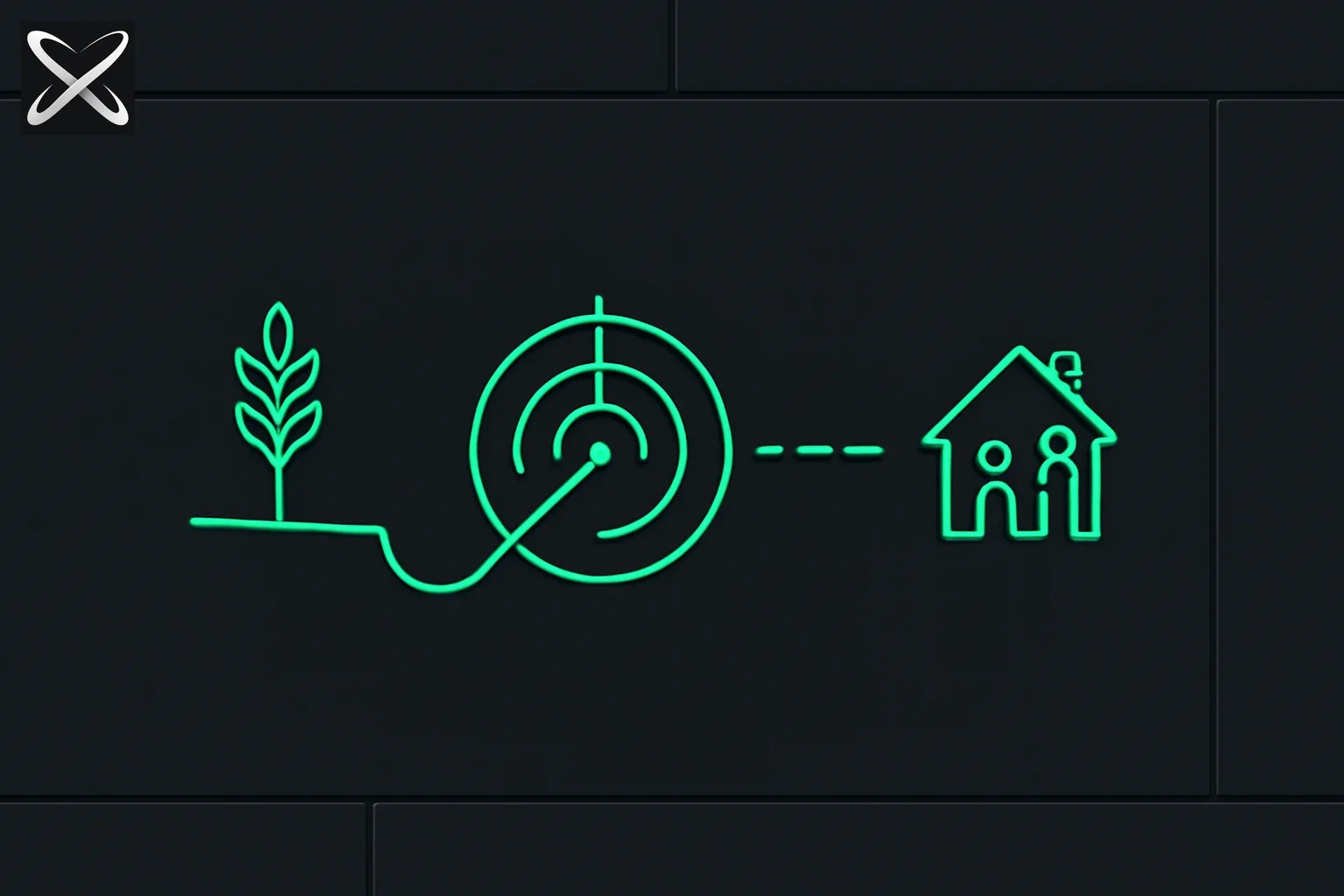 Can AI end world hunger — a wheat stalk connected through a prediction radar toward a distant home via a broken dashed line
The UN's 2025 State of Food Security and Nutrition in the World report estimated that about 673 million people experienced hunger in 2024, or 8.2% of the global population. The global estimate improved modestly, but hunger continued to rise in much of Africa and western Asia.
A related Global Report on Food Crises found that more than 295 million people across 53 countries and territories faced acute hunger in 2024. Conflict, economic shocks, climate extremes, and forced displacement were major drivers.
Those categories reveal why a crop-yield algorithm is not a complete solution. More production may help, but a household can remain hungry because food prices rose, wages disappeared, markets were attacked, transport failed, aid was blocked, or illness increased nutritional needs.
Any serious evaluation of AI must identify which cause it changes.
An evidence map of AI and hunger
| Use | What AI can improve | Outcome that matters | Main constraint |
|---|---|---|---|
| Hunger early warning | Combine prices, weather, conflict, surveys, and satellite data | Earlier funded action | Decision-makers must act |
| Crop advice | Diagnose disease and recommend timing or inputs | Farmer profit and stable yield | Local validation and access to inputs |
| Weather and yield forecasts | Estimate risk and production | Better planting, insurance, and reserves | Forecast uncertainty and last-mile delivery |
| Irrigation and fertilizer control | Target inputs | More output per unit of water or fertilizer | Hardware, maintenance, farm economics |
| Logistics | Route food and plan inventory | Lower spoilage, delay, and cost | Roads, security, storage, customs |
| Social protection | Identify geographic need and delivery gaps | Faster, fairer assistance | Exclusion, privacy, and appeals |
| Food-waste detection | Forecast demand and detect spoilage | Less edible food discarded | Business incentives and redistribution rules |
The best use cases join a prediction to a funded response protocol. The weakest stop at a dashboard.
1. Find emerging crises earlier
Traditional food-security assessments can be expensive and slow. Surveys, market data, rainfall, vegetation, conflict events, currency movements, and satellite imagery arrive at different times and spatial scales. Machine learning can combine these signals to estimate current conditions or forecast deterioration.
The World Food Programme's HungerMap Live is a concrete example. Its platform integrates analyst and partner data with predictive models to monitor vulnerable countries. WFP says the 2026 platform adds AI-assisted forecasting for designated hunger hotspots. Its earlier system used machine learning to produce near-real-time “nowcasts” where conventional data was limited.
This is operationally useful. Earlier warning can let agencies pre-position supplies, release cash, protect livestock, or act before malnutrition becomes severe. WFP reports that each dollar invested in its anticipatory-action programs can produce at least seven dollars in savings, though that is a program-level estimate rather than proof that AI alone caused the return.
The critical metric is not forecast accuracy in isolation. It is lead time gained, false alarms, missed crises, money released, people reached, and harm avoided.
2. Give farmers better decisions—not just more data
AI can analyze phone photos for crop disease, combine soil and weather information, forecast yields, or recommend planting and irrigation decisions. Remote sensing can map crop stress over large regions. Speech interfaces can make advice available in local languages.
These tools can help, especially where extension officers are scarce. But a recommendation is useful only if it fits the farmer's crop variety, soil, microclimate, labor, budget, and risk tolerance. Advice trained on irrigated commercial farms may fail for a rain-fed smallholder.
The proper outcome is not “the model identified leaf disease with 94% accuracy.” It is whether farmers received a correct recommendation in time, could obtain the treatment, avoided harmful input use, improved net income, and did not assume unacceptable debt or risk.
AI programs should be evaluated over multiple seasons and include farmers who do not have perfect phones, connectivity, literacy, or land records.
3. Use scarce water, fertilizer, and energy better
Sensors and forecasting can improve irrigation timing, identify leaks, and target fertilizer. In principle, this can increase output while reducing water use, nutrient runoff, and cost.
Precision systems are easiest to deploy on well-capitalized farms with reliable equipment and connectivity. For small farms, the economics can dominate the algorithm. Sensors break. Batteries fail. A subscription costs money. Replacement parts may be unavailable.
Shared services, cooperatives, public extension, or low-cost phone-based tools can distribute benefits more broadly. The climate connection also matters: our evidence review of whether AI can solve global warming explains why resource efficiency must translate into absolute, measured outcomes.
4. Make food logistics less wasteful
Food can be lost after harvest through poor storage, pests, heat, delay, and mismatched supply. AI can forecast demand, detect spoilage, plan routes, optimize cold storage, and match surplus with buyers or food banks.
These are classic optimization tasks, but physical capacity still controls the result. A routing model cannot preserve food without a passable road, safe border crossing, functioning warehouse, fuel, refrigeration, and staff. In a conflict zone, the route that looks optimal on a map may be inaccessible or dangerous.
Programs should report food delivered in usable condition, cost per beneficiary, delivery time, loss rate, and service reliability—not merely kilometers optimized.
5. Target cash and food assistance more accurately
Governments and aid agencies use household surveys, registries, community knowledge, and geographic indicators to decide where assistance goes. AI can detect changing need between surveys and find administrative gaps.
This is also a high-risk use. A false negative can remove food from a family. Informal workers, displaced people, women, and remote communities may be missing from official data. Phone or financial activity can proxy wealth poorly. A model can turn historical exclusion into an automated rule.
Responsible targeting requires:
- data minimization and clear purpose limits;
- published eligibility logic where possible;
- subgroup error testing;
- community participation;
- human review and a fast appeal channel;
- fallback support when data is missing;
- audits for political manipulation;
- deletion and security policies.
Automation should reduce administrative friction, not make deprivation unchallengeable.
Why AI cannot remove the largest drivers of hunger
Conflict
Conflict destroys farms, markets, water systems, transport, and health services. It displaces people and can restrict humanitarian access. AI may improve risk mapping, but it cannot negotiate peace or guarantee safe passage. Using AI for military advantage can also worsen the same conflicts driving hunger.
Poverty and prices
Food availability does not equal affordability. Families need income or social protection. Better price forecasts help governments plan, but forecasts do not fund transfers or create decent work. Read the companion analysis on whether AI can end poverty.
Political decisions
Authorities may have warning and still delay action. Donors may cut funds. Trade restrictions may amplify shortages. Data can reduce uncertainty; it cannot supply political will.
Health and care
Malnutrition interacts with infection, pregnancy, sanitation, feeding practices, and health care. Calories alone are not adequate nutrition. Effective programs connect food with clean water, maternal and child health, vaccination, and local diets.
The prediction-to-action gap
Imagine a model predicts that one district has a 70% probability of severe food insecurity within eight weeks. What happens next?
- An analyst checks data quality and uncertainty.
- Local organizations confirm what is changing.
- A pre-agreed threshold triggers financing.
- Teams choose cash, food, nutrition, livestock, or market support.
- Procurement and logistics begin before the crisis peaks.
- Monitoring checks prices, coverage, and unintended harm.
- Outcomes update the model and program.
If steps three through six are absent, the prediction becomes a more sophisticated warning that nobody acted on.
A forecast only helps if it's both right and acted on in time — try balancing the two:
How to evaluate an “AI will end hunger” project
Ask:
- Which hunger driver does the intervention address?
- Who was represented in the training and validation data?
- Was performance tested prospectively in the target region?
- What action follows the output, and who has authority and money?
- What are the costs of false positives and false negatives?
- Can affected people correct data or appeal a decision?
- Did food security, nutrition, income, or resilience improve?
- Would a simpler statistical or operational change work as well?
The last question prevents “AI” from absorbing funding that could have paid for storage, staff, transfers, or conventional analytics.
Would AGI end hunger?
A hypothetical artificial general intelligence could integrate weather, crop, market, conflict, nutrition, and logistics data more effectively than today's separate systems. It might generate locally tailored farm advice, anticipate shortages, coordinate procurement, and continually improve delivery plans as conditions change.
It would still face a problem of authority and resources. An AGI cannot open a blocked border, compel combatants to protect civilians, create purchasing power for a household, or distribute food without vehicles, staff, warehouses, and permission. It cannot infer people who are absent from every dataset, and it should not silently decide whose need matters most.
A powerful planner could even make inequitable allocation more efficient if its objective rewards cost per delivery while overlooking remote or politically marginalized groups. Better reasoning does not supply legitimate values. Affected communities and accountable institutions must set priorities and retain appeals.
AGI could lower coordination and knowledge costs. It would not eliminate scarcity, conflict, or distributional choices. Investing in reliable data, anticipatory finance, local organizations, resilient agriculture, and social protection today creates the system in which any future intelligence could be useful.
Verdict: AI can strengthen the food-security system
Can AI end world hunger? No, because hunger is ultimately about power, access, income, peace, and delivery as much as prediction.
AI can still be valuable. It can provide earlier warning, improve farm decisions, reduce waste, target scarce resources, and make logistics more responsive. WFP's live monitoring demonstrates that machine learning can become part of real humanitarian infrastructure.
The standard should remain demanding: did the system help people receive adequate, nutritious food earlier, more fairly, and at sustainable cost? If yes, AI contributed. If the output ended at a model score or map, hunger was measured—not solved.
Continue this research series with AI and cancer, AI and climate change, AI and poverty, and AI and pandemic prevention.
Related reading
- Can AI end poverty?
- Can AI solve global warming?
- Can AI prevent the next pandemic?
- Can AI cure cancer?
- The AI skills employers actually want