



Update — September 11, 2026: For the inference-memory angle — how V4.1 Flash compresses KV cache to 890 bytes/token (~75% less HBM) — see DeepSeek V4.1 Flash KV cache HBM reduction.
DeepSeek shipped V4.1 Flash on September 10, 2026. Venice listed it the same day. The two announcements landed in the same 24-hour window: DeepSeek's official API changelog marked deepseek-flash as GA with native multimodal support and a reported 60% cut to cache-hit input pricing, while Venice's model page went live with model ID deepseek-v4-1-flash, zero-retention Private inference, and OpenAI-compatible routing at https://api.venice.ai/api/v1.
That pairing is the story for practitioners. DeepSeek's direct API is the cheapest path to a model that explainx.ai tracked from a two-day beta through permanent release — a 552B-parameter MoE built on a new Causal Encoder-Decoder architecture with native vision, 1M-token context, and benchmark tables that put it ahead of the retired V4-Pro tier on agentic tasks. Venice is the privacy-first proxy: same model family, different trust boundary. You pay more per token, but your prompts never hit DeepSeek's own logging infrastructure and Venice contractually commits to zero retention.
If you read only one sentence: use Venice when prompt privacy matters more than the lowest token price; use DeepSeek's direct API when cost and first-party routing win; self-host the Hugging Face weights when you already own the GPUs.
TL;DR
| Question | Answer |
|---|---|
| What did Venice add? | DeepSeek V4.1 Flash as deepseek-v4-1-flash, available since September 2026, with Private (zero-retention) inference |
| What did DeepSeek ship the same day? | GA release under deepseek-flash at api.deepseek.com, retiring V4-Flash and V4-Flash-Vision-Exp aliases; V4-Pro routes here from September 14 |
| Venice price (per 1M tokens) | $0.38 input · $1.50 output · $0.01 cached input |
| DeepSeek direct price (off-peak) | $0.15 input (cache miss) · $0.60 output · $0.003 cached input |
| Is Venice cheaper? | No — roughly 2.5× on uncached input/output. You are paying for privacy routing, not raw compute |
| Is Venice E2EE? | No — Private tier only. TEE/E2EE on Venice requires specific model IDs and Venice Pro |
| Who should use Venice? | Sensitive code, security research, regulated drafts, any workload where "don't send this to DeepSeek" is a hard requirement |
| Who should use direct API? | Cost-optimized production, peak/off-peak scheduling, Anthropic SDK compatibility, maximum concurrency |
| Open weights? | Yes — deepseek-ai/DeepSeek-V4.1-Flash on Hugging Face |
What DeepSeek V4.1 Flash actually is
Before comparing access paths, anchor on what shipped. DeepSeek V4.1 Flash is not a point release on the April V4-Flash MoE text model — it is a new architecture family. DeepSeek describes it as the smallest member of the V4.1 line: a 552B-parameter multimodal MoE with a Causal Encoder-Decoder (CED) design, native image+text processing, and KV-cache compression that DeepSeek claims reduces persistent cache footprint to roughly one-quarter of V4-Flash-0731.
The practical specs that matter for builders:
| Spec | Value |
|---|---|
| Model ID (DeepSeek direct) | deepseek-flash |
| Model ID (Venice) | deepseek-v4-1-flash |
| Context window | 1M tokens |
| Max output | 128K on Venice; DeepSeek docs list up to 384K |
| Active parameters | 8B at prefill, 16B at decode (per DeepSeek model card) |
| Modalities | Text + vision natively; speech mentioned in beta coverage |
| Open weights | Published on Hugging Face |
| V4-Pro retirement | After 12:00 Beijing time September 14, 2026, deepseek-v4-pro requests route to V4.1 Flash at Flash pricing |
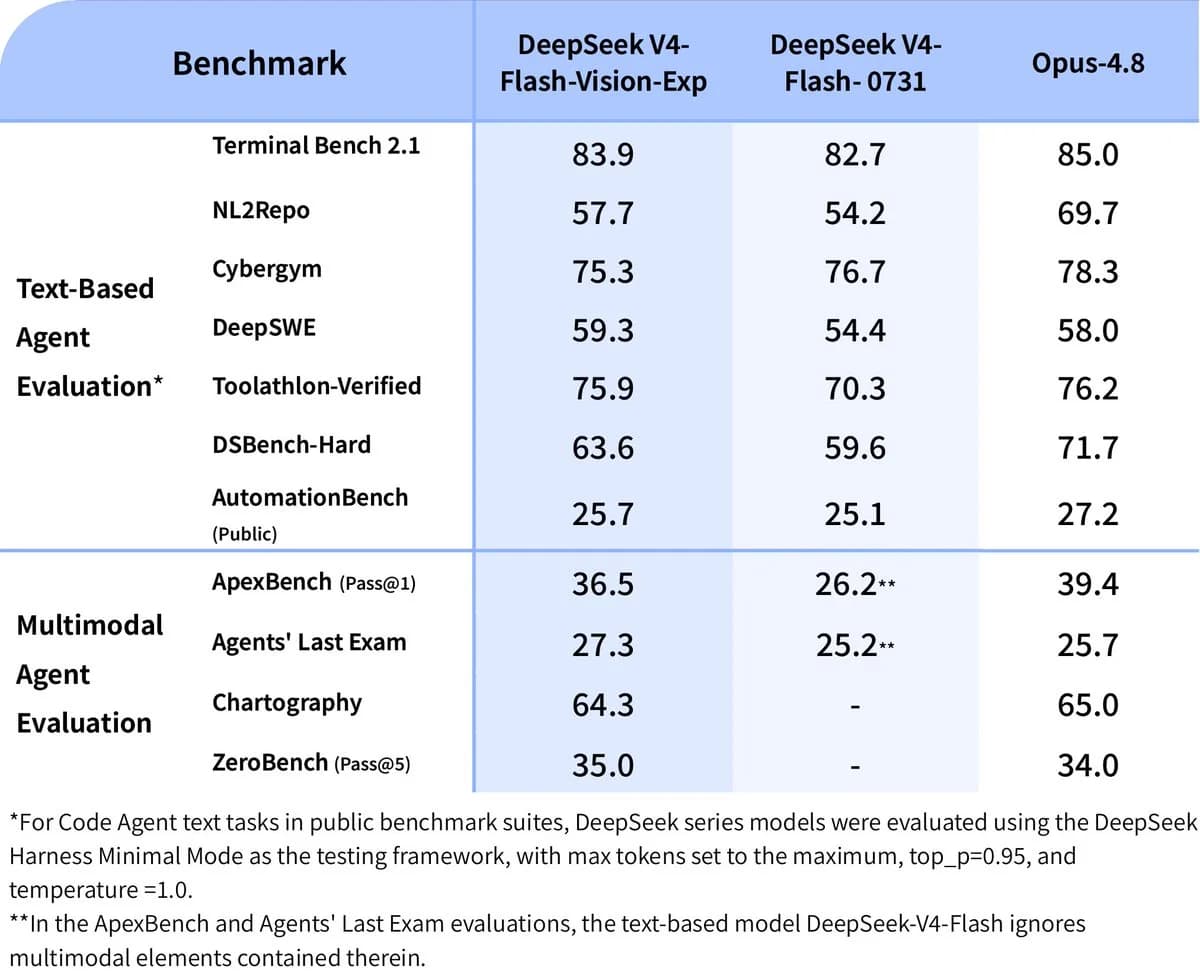
DeepSeek's own release note claims V4.1 Flash beats V4-Pro on performance, cost, speed, and total runtime — and backs that with harness-scored agent benchmarks (Terminal-Bench 2.1 at 90.6, DeepSWE at 74.2, CyberGym at 88.1 on Venice's model page, sourced from DeepSeek's evaluation suite). Treat those as vendor-reported until independent replication, the same caution explainx.ai's benchmark guide applies to any launch-week chart.
The architecture shift also retires the bolt-on pattern from August's V4-Flash-Vision-Exp, which added a vision tower on top of the text backbone. V4.1 Flash bakes vision into the base model — closer to natively multimodal designs than the August release path.
What Venice added, and how its privacy model works
Venice is a private AI platform that proxies requests to frontier and open-weight models through an OpenAI-compatible API. Its pitch is not "we train better models" — it is "we let you run strong models without surveillance." Every request passes through Venice's proxy; conversation history stays on your device; Venice does not persist prompts on its servers for Private-tier models.
Venice operates four privacy modes, documented on its privacy page:
| Mode | What it means | V4.1 Flash? |
|---|---|---|
| Anonymous | Venice obscures your identity from the provider; provider may store content | No |
| Private | Zero retention by contractual commitment — no prompt storage or training | Yes |
| TEE | Inference inside hardware attested enclaves (NEAR AI Cloud, Phala) | No |
| E2EE | Client-side encryption, decrypted only inside verified TEE | No |
DeepSeek V4.1 Flash on Venice sits in Private mode. That is meaningfully stronger than routing through DeepSeek's own API, where prompts are processed on DeepSeek-controlled infrastructure under DeepSeek's retention policies. It is not as strong as Venice's TEE or E2EE tiers, which provide hardware attestation or cryptographic proof — modes that, as of September 2026, cover models like GLM 5 and Gemma 3 27B but not this DeepSeek release.
Venice's model page also lists capabilities that match the GA release: function calling, web search, reasoning mode, structured JSON output, and native vision inputs. The API surface is a straight OpenAI client swap:
import os
from openai import OpenAI

client = OpenAI(
    api_key=os.environ["VENICE_API_KEY"],
    base_url="https://api.venice.ai/api/v1",
)

resp = client.chat.completions.create(
    model="deepseek-v4-1-flash",
    messages=[{"role": "user", "content": "Review this diff for security issues."}],
)
print(resp.choices[0].message.content)
New Venice accounts include a free daily allowance and 500 welcome credits with no credit card — useful for a privacy-path evaluation before committing spend.
Venice vs DeepSeek direct API: the practitioner decision
The choice is not "which model is better" — both paths serve the same weights. The choice is trust boundary and unit economics.
When Venice wins
Regulated or confidential prompts. If your policy says "no customer data to third-party AI providers" but engineering still wants DeepSeek-class agentic coding, Venice's Private tier is the compliant on-ramp. Think internal code review on unreleased features, M&A diligence drafts, security exploit analysis, or healthcare-adjacent prototyping — the scenarios shadow AI guides warn about when employees route around IT with personal ChatGPT accounts.
Vendor diversification without self-hosting. Standing up a 552B MoE cluster is not a weekend project. Venice gives you open-weight model behavior — tool use, long context, vision — with a single API key and a privacy contract, without provisioning GPUs.
Proxy anonymity from the model originator. Venice's architecture obscures your identity from the underlying inference provider. For teams uncomfortable with direct API relationships to certain labs, the proxy layer is the product.
When DeepSeek's direct API wins
Cost at scale. The math is straightforward:
| Token type | DeepSeek off-peak | Venice | Venice premium |
|---|---|---|---|
| Input (cache miss) | $0.15/M | $0.38/M | ~2.5× |
| Output | $0.60/M | $1.50/M | ~2.5× |
| Cached input | $0.003/M | $0.01/M | ~3.3× |
On a million-token agent loop with heavy cache reuse, DeepSeek's $0.003 cache-hit rate is a structural advantage Venice does not match. DeepSeek also offers peak/off-peak scheduling — off-peak is half of peak on weekdays outside 01:00–04:00 and 06:00–10:00 UTC windows.
First-party features and concurrency. DeepSeek's direct API supports 2,500 concurrent requests on the Flash tier, Anthropic-compatible routing at api.deepseek.com/anthropic, and automatic context caching at the lowest published cache-hit rate in the V4 family. Venice caps differ by plan and model.
Production migration from V4-Pro. After September 14, 2026, legacy deepseek-v4-pro integrations silently upgrade to V4.1 Flash at Flash pricing — a 77% input cost drop and 70% output cost drop versus old Pro off-peak rates, per DeepSeek's pricing page. That migration happens on DeepSeek's endpoint regardless of whether third-party proxies like Venice have updated their catalogs.
When self-hosting wins both
If you already run vLLM or SGLang clusters and can absorb an 8B/16B active-parameter MoE, the Hugging Face weights eliminate both the Venice premium and the direct-API trust question. The trade-off is ops: quantization choices, batch sizing, and vision input plumbing are on you. For teams that completed the open-weight V4-Flash-Vision release evaluation in August, V4.1 Flash is the logical next download — but it is a different architecture, not a weight refresh.
What people are asking
"Isn't Private mode on Venice just marketing?"
It is policy-based, not cryptographically proven — the same distinction Venice draws between Private and TEE/E2EE. Private means contractual zero retention enforced by Venice's infrastructure design (proxy relay without storage). That is materially different from "we hope the provider deletes it," but it is not the same as hardware attestation. Teams with formal compliance requirements should read Venice's privacy documentation against their own data-processing agreements, not assume Private equals E2EE.
"Does Venice get V4.1 Flash at the same time as DeepSeek?"
For this release, essentially yes — both went live September 10, 2026. Third-party lag has been a real problem for other models (orchestrators reporting "model not found" days after GA), but Venice's catalog updated in the same window as DeepSeek's changelog entry. Still verify the model ID responds before wiring production traffic; catalog drift happens.
"Should I switch from Venice's older DeepSeek models?"
Venice still lists DeepSeek V4 Flash 0731, V4 Pro 0813, and the E2EE V4 Flash variant. V4.1 Flash supersedes the Flash tier on capability and adds native vision. The E2EE variant of old V4 Flash remains the choice if you need hardware-verified encryption and can accept last-generation architecture. V4.1 Flash is the better default for new agent work unless E2EE is a hard requirement Venice has not yet extended to this model ID.
"What about data retention after I revoke access?"
Venice's zero-retention claim applies per request, not per account lifecycle — a different problem from agent products that cache OAuth tokens. The lesson from Instinct AI's post-revocation email retention still applies if you build agents on top of either API: revoking a key does not retroactively erase logs you already exported to your own systems.
Wiring it into your stack
Evaluation script (Venice):
curl https://api.venice.ai/api/v1/chat/completions \
  -H "Authorization: Bearer $VENICE_API_KEY" \
  -H "Content-Type: application/json" \
  -d '{
    "model": "deepseek-v4-1-flash",
    "messages": [{"role": "user", "content": "Summarize the diff."}]
  }'
Production path (DeepSeek direct):
curl https://api.deepseek.com/chat/completions \
  -H "Authorization: Bearer $DEEPSEEK_API_KEY" \
  -H "Content-Type: application/json" \
  -d '{
    "model": "deepseek-flash",
    "messages": [{"role": "user", "content": "Summarize the diff."}]
  }'
For multi-provider routing with cost optimization across both paths, teams already using aggregator layers should confirm catalog availability before hardcoding — the same pattern covered in OpenRouter enterprise routing.
What this means for what you build or pay
Three takeaways for September 2026:
-
DeepSeek V4.1 Flash is the new default Flash tier — on DeepSeek's API, on Venice, and eventually everywhere third-party catalogs catch up. If you are still on V4-Flash-0731 or V4-Pro model IDs, schedule a re-test before the September 14 Pro reroute changes behavior silently.
-
Venice is the privacy surcharge, not a different model — roughly 2.5× token cost buys zero-retention routing and proxy anonymity. That is rational for confidential workloads; it is expensive for high-volume batch inference.
-
Private ≠ E2EE — if your threat model requires cryptographic proof, V4.1 Flash on Venice does not satisfy it today. Watch whether Venice adds a TEE/E2EE variant the way it did for earlier DeepSeek releases.
The broader pattern matches what explainx.ai has tracked all year: open-weight labs ship capable agent models fast, privacy proxies list them within days, and practitioners split into cost-optimized direct API users versus compliance-sensitive proxy users. V4.1 Flash is the clearest example yet because the model itself is strong enough to replace a flagship tier — the access-path choice is the only decision left.
Related reading
- DeepSeek V4.1 Flash Cuts KV Cache HBM by ~75%
- DeepSeek V4.1 Flash: A Two-Day Beta With a New Multimodal Architecture
- DeepSeek V4-Flash-Vision-Exp: Multimodal Agent Launch
- DeepSeek V4 Pro: Agent Coding Benchmarks and API Economics
- DeepSeek V4 Prices Just Went Up — Does It Match GPT-5.6?
- Shadow AI: The Silent Privacy Risk in Every Workplace
- How Enterprises Use OpenRouter for Model Routing
- How to Read AI Benchmarks Without Getting Fooled
- Official docs: Venice V4.1 Flash model page · DeepSeek API pricing · DeepSeek V4.1 Flash weights
Model IDs, Venice pricing, DeepSeek rate cards, and privacy tier assignments reflect what was published as of September 11, 2026. Verify live catalogs before production deployments — DeepSeek has rerouted retired model names before, and third-party proxies update on their own schedule.