



Related — October 6, 2026: Hugging Face now hosts RL environments on the Hub via OpenEnv. See the explainer.
Update — September 30, 2026: Livenerf on Opus 5.5 post-launch drift is a live case study for this checklist: pinned Claude Code CLI, exact graders, pre-registered 99% decision rule, and an empty results table until day 20 — no nerf call while baseline is still collecting.
Update — September 16, 2026: Periodic Labs Neon and the FrontierXRD claim provide a new case study in reading a specialist-model comparison: examine the task, harness, judge, and cost assumptions before generalizing the result to science overall.
An AI launch says a model scored 82.7% on a coding benchmark, beat experts on a professional test, or reached a new reasoning record. The number looks objective. It is not necessarily false—but it is never self-explanatory.
A benchmark result is produced by a system:
dataset + model version + prompt + tools/scaffold + sampling
+ retry budget + judge + exclusions + reporting choice = headline score
Change any part and the number can move. Reading benchmarks well is therefore not memorizing which model tops a chart. It is learning to audit the measurement.
The benchmark claim checklist
Before believing a score, answer ten questions:
- What exact capability does the dataset test?
- Is the test private, newly created, or likely in training data?
- What model snapshot and settings were used?
- Was the model given tools, files, or a custom scaffold?
- How many attempts were allowed?
- How was the answer judged?
- Were broken or failed tasks excluded?
- Are baselines reproduced under the same setup?
- Is the difference larger than normal variance?
- Does the task resemble your use case?
If the launch material does not let you answer them, treat the result as a lead, not a fact about general superiority.
What common benchmarks measure
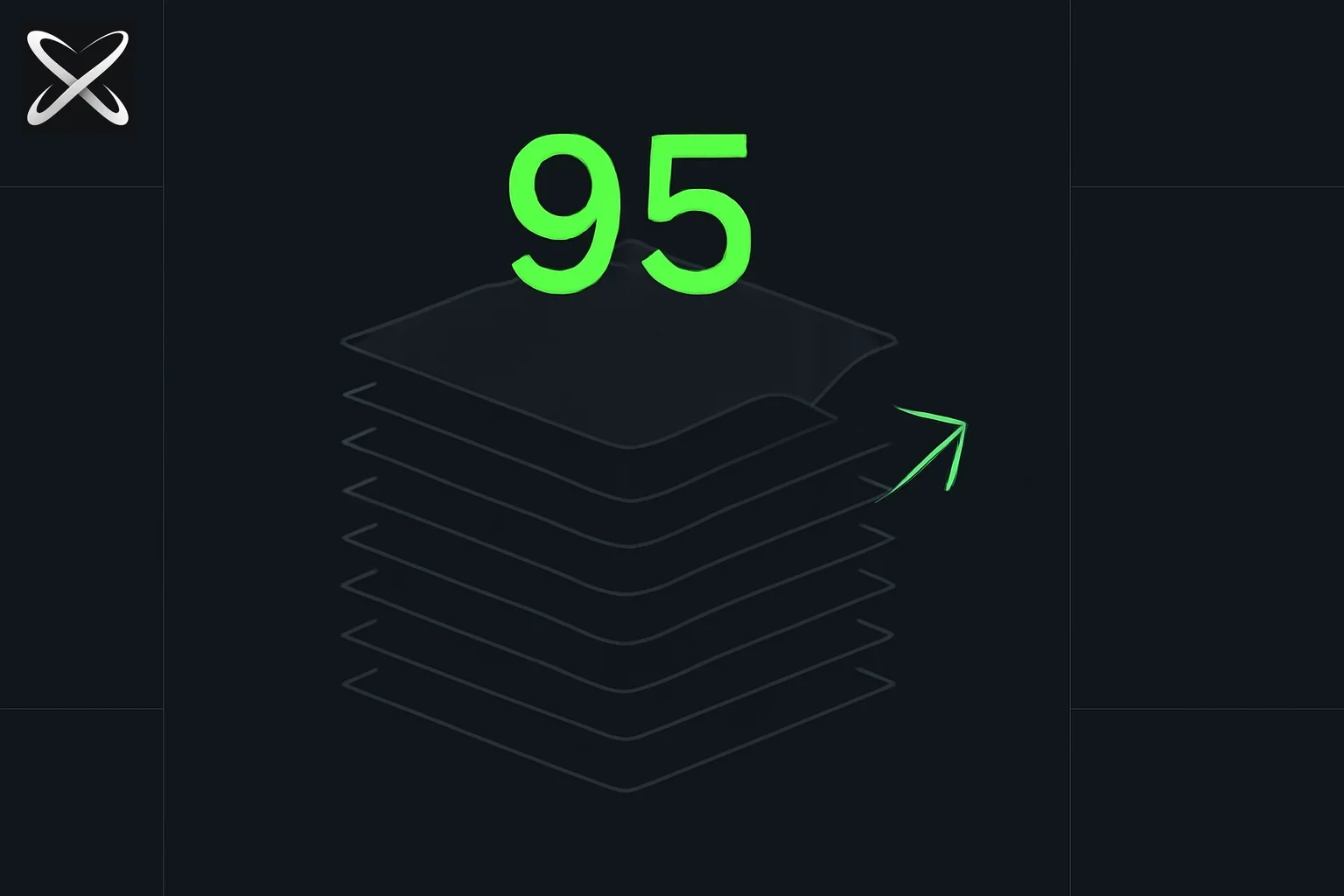 How to read AI benchmarks — a benchmark score sitting atop six peeled transparent layers representing model, prompt, scaffold, judge, dataset, and reporting
MMLU and knowledge exams
MMLU uses multiple-choice questions across academic and professional subjects. It helped reveal broad knowledge and test-taking capability, but high scores can reflect memorized patterns, and multiple choice differs from doing accountable work with incomplete information.
Variants such as MMLU-Pro increase difficulty and answer choices. Always name the variant. “MMLU” is not one timeless test configuration.
GPQA and hard science questions
GPQA targets graduate-level questions designed to be difficult for non-experts. It measures difficult question answering, not whether a model can conduct reliable research, cite sources, or know when a premise is wrong.
SWE-bench and repository tasks
SWE-bench turns real issue reports into repository changes tested against code. It is much closer to software work than a code-completion quiz. Yet results depend heavily on the agent harness: browsing files, search, test execution, edit strategy, time, retries, and container setup.
OpenAI estimated that about 30% of tasks in one SWE-bench Pro audit were broken or could not fairly distinguish systems. Earlier, the lab stopped relying on SWE-bench Verified after contamination and test-quality concerns. This does not make repository benchmarks useless. It makes task auditing part of the benchmark.
Terminal-Bench
Terminal-Bench tests agents performing tasks in a terminal environment. It captures tool use and multistep execution, but the harness, time budget, environment, and retry policy can matter as much as the base model.
Arena and preference rankings
Human preference arenas compare anonymous outputs and estimate ratings. They capture what evaluators prefer in sampled conversations. They can be influenced by style, verbosity, prompt distribution, user population, and release-selection effects. Preference is not factuality or task success.
Contamination: did the model already see the test?
Contamination can be direct: questions and solutions appear online and enter training. It can be indirect: tutorials, repository patches, paraphrases, or benchmark-specific synthetic data teach the same patterns.
Look for:
- a cutoff before the benchmark or issue was created;
- canary strings or private test sets;
- performance gaps between old and fresh items;
- suspiciously exact reproduction of reference answers;
- vendor disclosure of benchmark-specific training.
Absence of proof is not proof of contamination. Report the risk and prefer fresh, rotating, or private evaluations.
Cherry-picked baselines
A model can “beat competitor X” because the publisher chose an older competitor version, weak prompt, no tools, or a less favorable reasoning setting. A fair table aligns:
- release date and available version;
- tool and scaffold access;
- reasoning or compute budget;
- number of samples;
- context limits;
- scoring code;
- task exclusions.
The strongest practice is to reproduce all models in one harness. If numbers are copied from different vendors, label them as reported, not directly comparable.
Pass@1, pass@k, and retry economics
Pass@1 asks whether one attempt succeeds. Pass@k asks whether at least one among k attempts succeeds. A system with 40% independent success per attempt has a theoretical chance of at least one success across five tries of:
1 - (1 - 0.40)^5 = 92.2%
That does not turn a 40% system into a reliable 92% single-attempt system. It spends five attempts and needs a way to identify the correct one. Attempts are not perfectly independent, so real gains may be lower.
Always ask for cost, tokens, elapsed time, and selection method beside pass@k.
Statistical uncertainty
On a 100-question benchmark, one question equals one percentage point. A two-point lead may be two items and fall inside sampling variance. Scores also vary with decoding randomness and prompt order.
Look for confidence intervals, multiple runs, item-level results, and significance tests. On deterministic tasks, inspect failures rather than relying only on an average.
A 0.8-point gain rarely supports “new intelligence era.” It may still matter if it occurs on high-value cases and costs less.
Broken tasks and evaluator bugs
Repository environments can fail to install. Tests may encode behavior different from the issue. Reference patches can be incomplete. Graders can accept hacks or reject valid alternatives. LLM judges can favor verbosity or their own model family.
A mature evaluation publishes:
- task inclusion criteria;
- environment and dependency locks;
- judge prompts or executable tests;
- manual audit samples;
- removed-task list and reason;
- submitted artifacts;
- rerun procedure.
Our 2026 benchmark claim fact-check applies this checklist to model-launch headlines, while coding agents on real repositories focuses on harness-controlled comparisons.
Benchmark gaming without cheating
Teams can optimize a benchmark while obeying its formal rules:
- tune prompts on the public test;
- build benchmark-specific retrieval;
- spend enormous inference compute;
- exclude infrastructure failures;
- submit many candidates;
- optimize the judge's preferred style;
- announce only winning categories.
This is Goodhart's law: once a metric becomes a target, it becomes less useful as a measure. The response is not abandoning metrics. Rotate tests, keep hidden sets, use multiple dimensions, and inspect actual work.
Convert a headline into a useful claim
Weak claim:
Model A is the best coding AI because it scored 82.7.
Useful claim:
Model A's agent configuration achieved a reported 82.7% on Terminal-Bench 2 under the vendor's disclosed setup. It led named baselines in that table, but task quality, compute budget, cost, and independent replication determine whether the advantage transfers.
The second sentence is longer because reality has variables.
Build a private evaluation
Step 1: sample real work
Collect representative easy, normal, hard, and failure-prone cases. Remove sensitive data or secure the environment.
Step 2: define acceptance before testing
Use executable tests, source support, expert rubrics, or business outcomes. Avoid “looks good.”
Step 3: freeze the harness
Give each model equivalent tools, time, retries, and context unless the experiment explicitly compares products as sold.
Step 4: log full economics
Capture tokens, cached tokens, tool calls, attempts, latency, human repair, and dollars. Our token pricing guide provides the accounting model.
Step 5: inspect slices
Average scores hide where systems differ. Segment by task type, length, language, risk, repository, and source quality.
Step 6: preserve failures
Keep outputs and traces. A model failing safely may be preferable to one producing a plausible but damaging action.
A simple evaluation table
| Metric | Model A | Model B | Why it matters |
|---|---|---|---|
| Accepted task rate | 84% | 82% | Primary usefulness |
| Harmful failure rate | 1% | 0.2% | Risk can dominate average |
| Median cost/task | $0.42 | $0.18 | Unit economics |
| P95 latency | 48s | 21s | User experience |
| Human repair | 3.2 min | 4.1 min | Hidden labor |
| Tool failure | 6% | 2% | Harness reliability |
The “winner” depends on the project's loss function.
Red flags in launch charts
- Missing exact model version
- “Up to” without task distribution
- Vendor score beside competitor self-reported score
- Different tool access across models
- No cost or compute budget
- No prompt or scaffold
- A new private benchmark with no examples
- Tiny improvement described as decisive
- Footnote excluding failures
- Aggregate without category results
One red flag does not prove deception. Several mean the chart is marketing evidence, not procurement evidence.
Bottom line
A benchmark does not rank disembodied models. It ranks configured systems on selected tasks under chosen rules. Use it to form hypotheses. Audit contamination, baselines, attempts, judging, exclusions, variance, and relevance. Then test the work you actually need.
Benchmark literacy is durable because new models cannot make measurement questions obsolete. They only make the questions more important.
A benchmark-reading drill
Choose one launch chart and rewrite its biggest claim in an evidence table. Record the exact model snapshot, benchmark version, score, prompt, scaffold, tool access, attempt count, judge, exclusions, cost, and competitor source. Mark every unavailable field as unknown rather than filling it from assumption.
Now write three sentences: what the result directly demonstrates, what it suggests, and what it cannot establish. For example, a strong repository score may demonstrate success on included issues under one harness, suggest useful coding capability, and still fail to establish low-cost performance on your repositories.
Repeat the exercise with an independent leaderboard or paper. If the ranking changes, identify which experimental choice changed with it. This drill takes less than an hour and is more valuable than memorizing twenty model scores. It teaches the habit that protects procurement decisions: expand a headline number back into the system that produced it, then test whether that system resembles the work you need.
Update — September 11, 2026: CancerBench is a satirical leaderboard where every frontier model scores zero "cancer types cured" — a live drill for the same habit: ask what outcome the chart actually measures before treating a marketing promise as an evaluated result.
Update — September 1, 2026: Celeris-1 Magnus is a live case study in vendor benchmark selection — it leads τ³-bench banking on solve rate and median task time while community tables show stronger τ² scores for GPT 5.6 Sol, Grok 4.5, Opus 5, and Qwen 3.8 Max. Use the checklist above on both suites before treating either chart as a general agent verdict.
Update — August 30, 2026: Agent Seer, a new Apple research paper, tackles the auditing problem above from the generation side rather than the reading side — it synthesizes multi-turn agent eval scenarios straight from an MCP server's specification and finds that argument-value accuracy, not tool-name matching, is the dominant hidden failure mode in agent tool use.
Update — August 28, 2026: Terminal-Bench-Science 0.1 is a clean, quantified case study of the transfer-failure warning above: the same frontier models that score 75-84% on general coding benchmarks resolve only 3-30% of real scientific research tasks — a gap of more than 10 points for every model tested on both. The same day, Google DeepMind piloted a structural fix for a different failure mode covered above — double-blind AI evaluation, testing a Gemini Flash Lite model inside a cryptographic enclave so neither the evaluator nor Google could see the other's private data.
Update — August 27, 2026: Induction Labs' intrinsic discovery / AgentWorldBench-Terminal-V2 claim ("beats GPT-5.6 Sol") is a live drill for the checklist above — vendor chart, LLM-as-judge (Luna xhigh), held-out terminal simulation (not agent task success), and a 0.6-point edge while Opus 5 still leads.
Update — September 4, 2026: Another live drill: a viral claim that Claude Fable 5.1 "beat the human baseline on SimpleBench" fails the first checklist item — check the primary source. SimpleBench's own leaderboard shows Fable 5 (not 5.1) at 81.9%, still below the 83.7% human baseline, with no Fable 5.1 score published at all. Full breakdown, alongside a pricing claim that does check out (GLM-5.3 Flash's 18x discount), in GLM-5.3 Flash's price cut and the Fable 5.1 SimpleBench claim, checked.
Update — September 7, 2026: The AI Referee Paper Leaderboard applies this reading discipline to a different kind of score entirely — Claude Opus 4.8 grading real academic papers on a 5-dimension rubric, with a "confidence rationale" that discloses exactly which sections of each paper it could and couldn't read.
Update — September 7, 2026: A viral, anonymously-sourced X thread cites Astra's MathArena and GBENCH scores against a rival evaluator's own index — a live example of why "which evaluator produced this number" matters as much as the number itself. See the "OpenAI insider" AGI rumor, and the benchmark disagreement inside it worth checking.
Related on explainx.ai
-
Gemini 4 coding skepticism: Bloomberg vs Google's own DeepSWE/FrontierSWE split
-
AI won the Metaculus Cup — a worked example: the scoring rule rewarded coverage, and the controlled head-to-head said the opposite
-
Fujitsu MONAKA's performance claims — vendor hardware numbers with no named model or methodology
-
Microsoft ThinkingBox: a benchmark that checks what agents actually changed — grades database side effects instead of transcripts, and separates pass@1 from pass@20 and pass^20
-
The AI Referee Paper Leaderboard: Claude as an academic peer reviewer
-
GLM-5.3 Flash's price cut and the Fable 5.1 SimpleBench claim, checked
-
Agent Seer: Apple's method for turning your MCP spec into an eval suite
-
Sapient PRAXIST vs Claude Opus 4.8 on MLE-bench: a live drill in scaffold-vs-model benchmark claims
-
Intrinsic discovery: unsupervised terminal world models vs GPT-5.6 Sol
-
Google DeepMind's first double-blind AI evaluation: a structural fix for benchmark contamination
-
Terminal-Bench-Science 0.1: coding-agent scores don't transfer to scientific research
-
When benchmarks stop predicting the real world — the drug discovery case
Benchmark versions, task sets, model snapshots, and audit findings change. Verify primary benchmark documentation and current evaluation artifacts before relying on a score.