



Update — September 11, 2026: New coverage — DeepSeek V4.1 Flash cuts KV cache HBM by ~75% (CED, CSA2, FP4, SWA Bounded Replay) · Venice adds DeepSeek V4.1 Flash with zero-retention private access — who should use Venice vs DeepSeek's direct API.
Update — September 10, 2026: The expiration date built into the beta's own name turned out to be a launch date, not a shutdown date. Reporting now says DeepSeek is making V4.1 Flash the permanent replacement for V4-Pro, alongside a reported 60% cut to cache-hit input pricing — the biggest single pricing move DeepSeek has made since the 50-1,100% V4 price hike in August. Separately, DeepSeek is reported to have crossed $500 million in annualized revenue after a roughly 10x jump in its own AI infrastructure spend — consistent with a lab scaling fast enough to justify both a permanent architecture upgrade and an aggressive price cut in the same week. Neither figure (the 60% cut or the $500M ARR) has a named primary source or an audited DeepSeek disclosure at the time of this update; treat both as reported, not confirmed. The original beta writeup below is preserved for context on what actually shipped and how the architecture differs from V4-Flash-Vision-Exp.
The model ID gives away its own lifespan. On or around September 8, 2026, DeepSeek quietly opened an API endpoint called deepseek-v4.1-flash-expires-on-0910 — no blog post, no X announcement, no entry in DeepSeek's own API changelog. Developers found it through a community-group notice, and the name says exactly what it is: a test build that stops working on September 10, 2026, two days after most people learned it existed. What DeepSeek is testing, per that same notice, is described as the largest architecture change to the V4 line since V4 Preview shipped in April — a structure with multimodal support built in from the start, rather than added the way V4-Flash-Vision-Exp was in August.
This is the fourth DeepSeek multimodal move explainx.ai has covered in three weeks, after V4-Flash-Vision-Exp's API debut and its open-weight release on Hugging Face. The pace is the story as much as the architecture claim: DeepSeek is iterating on multimodal support fast enough that a bolted-on vision model shipped in August is already being superseded by a from-scratch redesign in September — before the vision model's own weights had even been out for two weeks.
TL;DR
| Question | Answer |
|---|---|
| Is it available today? | Only as an unofficial, expiring test endpoint — deepseek-v4.1-flash-expires-on-0910, live since roughly September 8, 2026, dead after September 10 |
| Is this an official DeepSeek announcement? | No. No blog post, X post from DeepSeek's own account, model card, or changelog entry exists as of publication — it surfaced via a community notice |
| How does pricing compare to V4-Flash? | Identical — $0.22/M input, $0.66/M output off-peak, same as DeepSeek's post-price-hike V4-Flash rates |
| What's actually new about the architecture? | DeepSeek calls it a new model structure with native multimodal support — text, image, and speech in one unified model, versus the vision-tower-on-top approach V4-Flash-Vision-Exp used |
| Concurrency limit | 20 requests per account, versus roughly 2,500 in DeepSeek's production tier |
| Unverified speed claims | ~350-500 tokens/sec throughput, sub-200ms time-to-first-token, reported by individual testers — not a DeepSeek-published benchmark |
| Context window (per third-party listing) | Up to 1M tokens, 384K max output, per Vercel AI Gateway's model page — not confirmed on DeepSeek's own docs |
| Benchmarks published by DeepSeek | None |
What actually happened, and what didn't
Be precise about the difference between the two, because most of the coverage circulating this week blurs it. What happened: DeepSeek opened a test API endpoint accessible with no special access request — just swap the model parameter to deepseek-v4.1-flash-expires-on-0910, same base_url, same API key. What didn't happen: an official launch. There's no post on DeepSeek's site, no announcement from DeepSeek's own X account matching the pattern of its V4-Flash-Vision-Exp launch thread in August, and nothing in the official API changelog, which as of September 8 still lists the August 21 Vision-Exp release and the August 13 V4-Pro GA as its most recent entries.
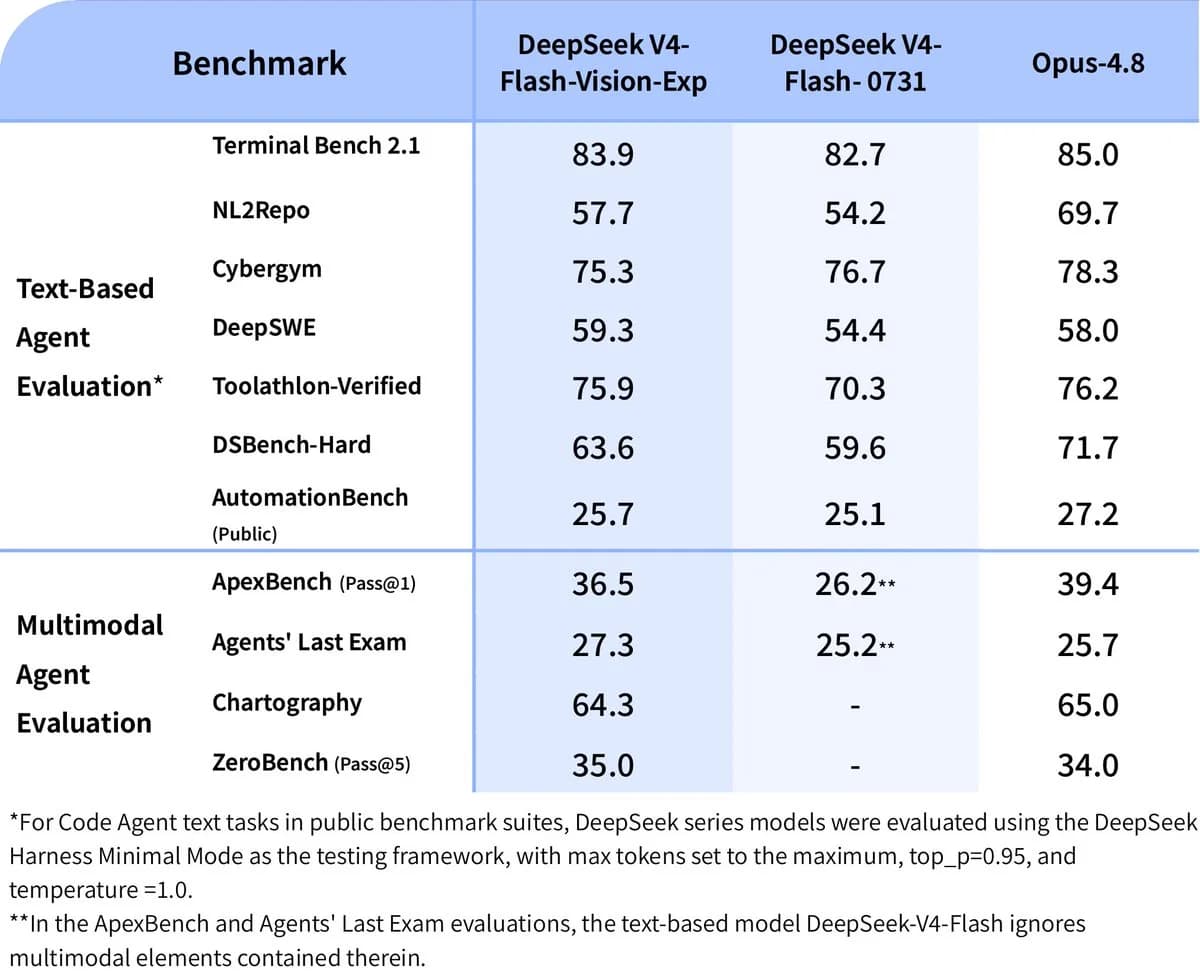
That gap matters for how much weight to put on any number attached to this release. Every spec circulating — throughput, latency, "5.7x faster than V4-Pro," architecture description — traces back to a community-group notice and individual developers' own test runs against the endpoint, not to a DeepSeek-authored model card or benchmark harness result. DeepSeek has a track record of publishing real, sourced benchmark tables for its actual releases — see the harness-scored numbers behind V4-Flash-Vision-Exp's Opus-4.8 comparison or the ARC Prize-verified V4-Flash-0731 numbers. Nothing comparable exists for V4.1 Flash yet, which is itself informative: this reads like an internal test DeepSeek opened to a wider pool of testers than intended to keep private, not a product launch.
What "native multimodal architecture" means, and why it's different from Vision-Exp
The core claim is structural. DeepSeek's V4-Flash-Vision-Exp, released in August, built on the existing V4-Flash MoE text backbone and added a vision tower and image aligner on top — its own Hugging Face model card described the process as "incorporating visual modules and undergoing continued training to unlock visual understanding capabilities." That's a common, proven pattern (most vision-language models are built this way), but it means the text and vision paths are architecturally distinct components stitched together.
V4.1 Flash is described differently: text, image, and speech processed by "one unified" model rather than a text model with a vision component attached. If accurate, that's a meaningfully different design decision — closer to how Gemini's natively multimodal models are built than how most open-weight labs have approached vision so far. It also adds speech as a first-class input, which Vision-Exp never supported.
The catch: DeepSeek hasn't published anything to substantiate "native" beyond the notice's own wording. No parameter count, no attention mechanism details, no training methodology, no comparison to how DFlash attention or Hyper-Connections (the architecture components DeepSeek has documented for other V4-family models) carry over. Until a model card or technical report lands, "native multimodal" is DeepSeek's own characterization of an unreleased architecture — worth taking seriously given DeepSeek's execution record this year, but not yet a verified technical claim.
Pricing: nothing has changed, which is itself notable
DeepSeek is billing the beta at existing V4-Flash rates:
| Token type | Off-peak | Peak |
|---|---|---|
| Input, cache miss | $0.22/M | $0.44/M |
| Input, cache hit | $0.007/M | $0.014/M |
| Output | $0.66/M | $1.32/M |
That's the same schedule explainx.ai covered when DeepSeek raised V4 API prices by 50-1,100% in August — a hike large enough that "still cheap" needed its own caveats at the time. Testing a claimed new architecture at unchanged pricing is a reasonable choice for a two-day beta, but it tells you nothing about what the permanent successor will cost. DeepSeek has demonstrated once already this year that it will change pricing sharply between a preview and a GA release; there is no reason to assume V4.1 Flash's eventual production pricing mirrors this test window's rate card. Teams evaluating DeepSeek against GPT-5.6, Gemini, or Claude on cost should treat this beta's pricing as a snapshot, not a commitment — the same caution that applies to any provider's introductory rate, and the reason teams building multi-provider fallback logic increasingly route through a layer like OpenRouter's model routing and cost optimization rather than hardcoding a single vendor's price into their stack.
Access: no waitlist, but a hard expiration
Unlike most frontier-lab betas, there's no signup form or allowlist. Any existing DeepSeek API key works — change model to deepseek-v4.1-flash-expires-on-0910, keep the same base_url and authentication, and the endpoint responds. The friction is elsewhere:
| Limit | Beta value | Production V4-Flash |
|---|---|---|
| Concurrency per account | 20 requests | ~2,500 requests |
| Expiration | September 10, 2026 | N/A — no expiration |
| Official documentation | None | Full API docs, model card |
| SLA / support | None stated | Standard production terms |
The 20-request concurrency cap rules out any real load testing — it's built for a first look at output quality and latency character, not for validating whether the architecture holds up under production traffic. Anyone building against it for anything beyond a quick evaluation script is building against a model ID that will 404 within days.
What this means for what you build or pay
If you're currently running DeepSeek V4-Flash-Vision-Exp or plan to self-host the open-weight V4-Flash-Vision-305B release, nothing here changes your current stack — V4.1 Flash isn't a drop-in replacement yet, and won't be until DeepSeek ships a permanent model ID. What it does signal is direction: DeepSeek is moving toward a single architecture that natively handles text, image, and speech, rather than continuing to bolt modalities onto the existing MoE text backbone one at a time. If that architecture ships as a GA model with benchmarks that hold up, it would be a genuine step past the "vision tower on a text model" pattern most open-weight multimodal releases (including DeepSeek's own August release) still use.
Until then, the practical guidance is simple: don't build against deepseek-v4.1-flash-expires-on-0910 for anything beyond evaluation, don't repeat the unverified throughput numbers as settled benchmarks, and watch DeepSeek's official API changelog for the permanent release — which, going by DeepSeek's own pattern this year of shipping a preview, then an "-exp" or "-0731"-style revision, then a GA release, is likely to arrive under a different model ID with its own benchmark table and pricing.
Update — October 15, 2026: The API went down for about five hours; see the outage and the 7-day credit refund.
Related reading
-
DeepSeek V4.1 Flash 1017: open weights, MIT license and new benchmarks (October 17 update to the model)
-
ORA: an open harness that lets DeepSeek-V4.1-Flash operate robots zero-shot
-
Update — September 15, 2026: A Flowith.io marketing clip pitted this still-beta model against GPT-6 Astra on a planet-simulation task — we broke down why that "vs" framing is weaker evidence than it looks. DeepSeek 4.1 Flash vs. GPT-6 Astra: what the viral demo actually shows →
-
DeepSeek V4-Flash-Vision-Exp: A Multimodal Model That Nears Opus-4.8
-
DeepSeek Opens Its 305B V4 Flash Vision Model — Free Weights, Opus 4.8 Numbers
-
DeepSeek V4 Prices Just Went Up — Does It Really Match GPT-5.6?
-
DeepSeek V4 Pro: Agent Coding Benchmarks, 1M Context, and API Economics
-
How Enterprises Use OpenRouter for Model Routing and Cost Optimization
-
Gemini 3.7 Flash vs. Grok 4.6 vs. Sonnet 5 vs. GPT-5.6 Comparison
-
Official docs: DeepSeek API Changelog · DeepSeek API Docs
This beta expires September 10, 2026 — the model ID, pricing, and every performance figure in this post reflect the temporary test window as it existed at publication and are likely to change or disappear entirely once DeepSeek ships a permanent release. Verify current model availability against DeepSeek's API docs before building anything beyond a quick evaluation.
Update — October 8, 2026: New comparison — Haiku 5.5 vs GPT-6 Luna vs DeepSeek V4.1 Flash vs Gemini 3.7 Flash vs GLM-5.3-Flash.
Update — October 8, 2026: CrowdStrike's report on an AI-driven campaign against South Korean financial firms, using ARTEX with DeepSeek v4.1-flash as the primary model: what it found.