



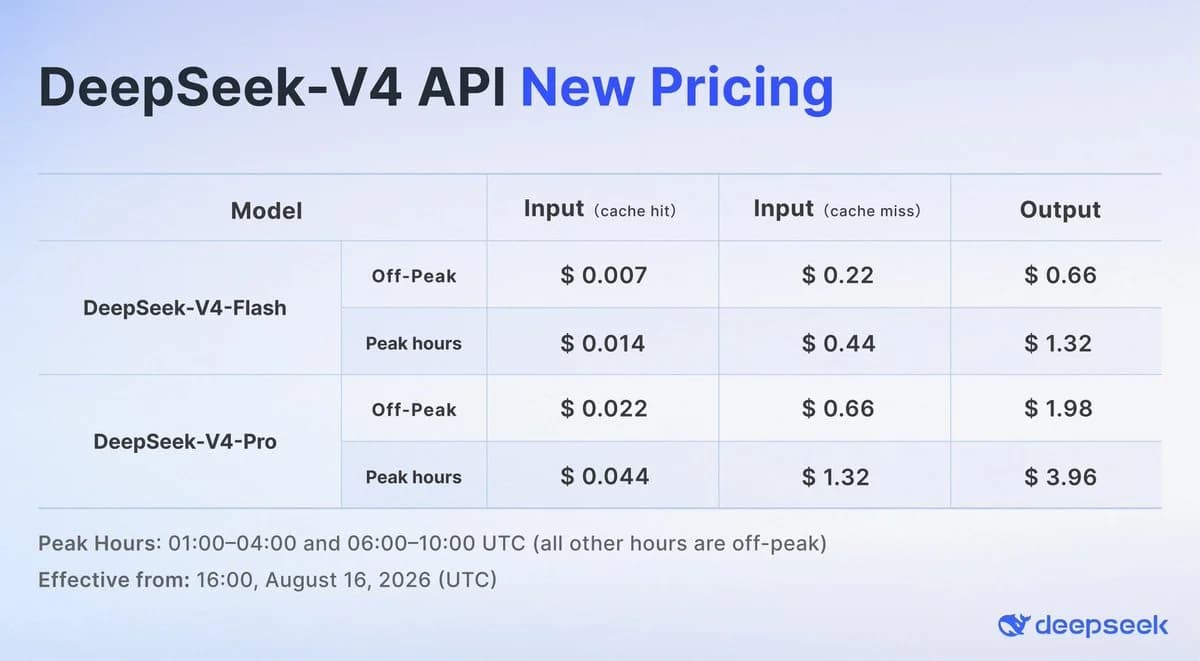
DeepSeek's new API prices are no longer a warning — they're live. At 16:00 UTC on August 16, 2026, DeepSeek replaced its flat per-token rates with a peak/off-peak schedule that raises output pricing by as much as 371% and cache-hit input pricing by more than 1,000% on the smallest tier. Multiple outlets are calling it the largest price increase since DeepSeek's API launched, and headlines framed it as DeepSeek moving to "match GPT-5 unit costs." explainx.ai flagged this coming when DeepSeek first warned of a "significant" hike on August 6, and covered the numbers as DeepSeek published them alongside the V4 Pro 0813 launch on August 13. This piece checks the "matches GPT-5" claim against the actual verified numbers, now that the new rates are live in production.
The short answer: the gap narrowed meaningfully. It did not close.
TL;DR — what actually changed
| Question | Direct answer |
|---|---|
| When did new pricing take effect? | 16:00 UTC, August 16, 2026 |
| How much did output pricing rise? | Up to 371% (V4 Flash) and 355% (V4 Pro) at peak hours |
| How much did cache-hit input rise? | Up to roughly 1,100% on the cheapest tier |
| Did DeepSeek say it's matching GPT-5? | No — that's press framing, not DeepSeek's stated reason |
| DeepSeek's own stated reason | "Allocate resources more reasonably" and encourage usage scheduling |
| Is DeepSeek still cheaper than GPT-5.6 Sol/Terra? | Yes, by a wide margin |
| Is DeepSeek still cheaper than GPT-5.6 Luna? | No — Luna is now cheaper than DeepSeek V4 Pro's peak rate |
| Is DeepSeek still cheaper than Claude? | Yes, cheaper than both Sonnet 5 and Fable 5 |
The verified old-vs-new numbers
DeepSeek's own API pricing documentation confirms the new schedule. Independent reporting from InfoWorld, Bloomberg, and Caixin Global lines up with those published figures, so this is not a single-source claim.
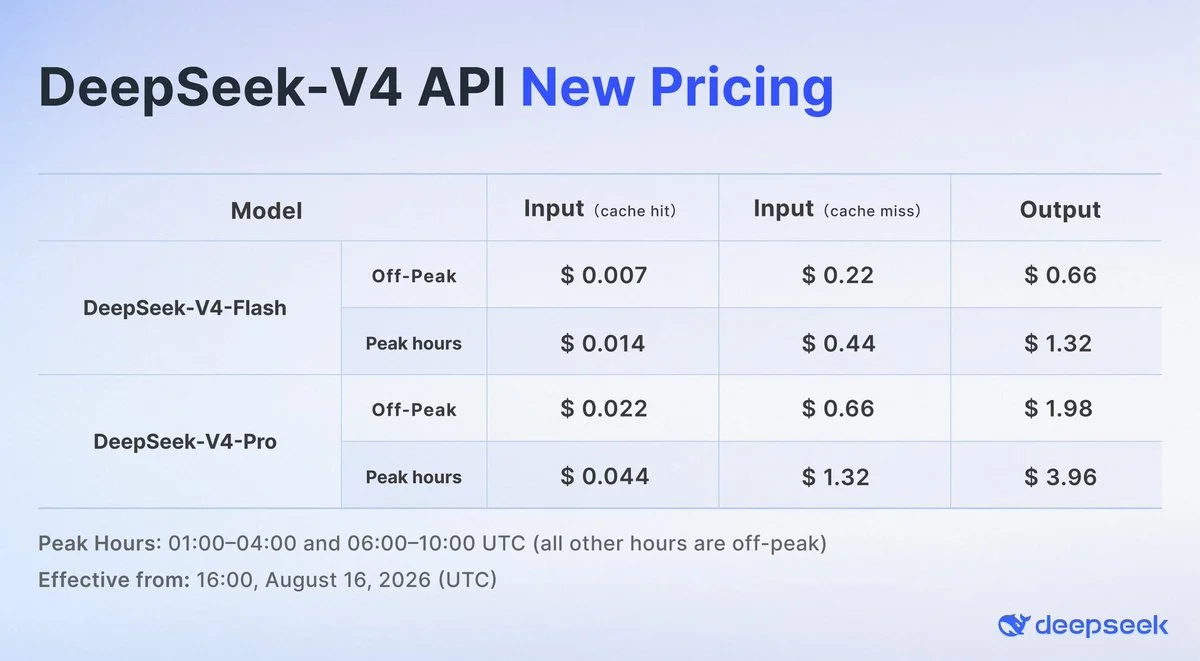
Source: DeepSeek's official API pricing notice. Peak hours are 01:00–04:00 and 06:00–10:00 UTC; all other hours are off-peak, billed at half the peak rate.
DeepSeek V4 Flash (per million tokens):
| Token type | Before Aug 16 | New off-peak | New peak | Peak increase |
|---|---|---|---|---|
| Input, cache hit | $0.0028 | $0.007 | $0.014 | +400% |
| Input, cache miss | $0.14 | $0.22 | $0.44 | +214% |
| Output | $0.28 | $0.66 | $1.32 | +371% |
DeepSeek V4 Pro (per million tokens):
| Token type | Before Aug 16 | New off-peak | New peak | Peak increase |
|---|---|---|---|---|
| Input, cache hit | $0.003625 | $0.022 | $0.044 | +1,114% |
| Input, cache miss | $0.435 | $0.66 | $1.32 | +203% |
| Output | $0.87 | $1.98 | $3.96 | +355% |
Two things are worth being precise about. First, "off-peak is 50% cheaper" only describes the relationship between the two new rates — off-peak V4 Pro output at $1.98/M is still more than double the pre-August-16 flat rate of $0.87/M, not a discount off it. Second, the cache-hit tier posts the largest percentage jump by far, because it started from an unusually low base ($0.003625/M for V4 Pro) — the headline "up to 1,100%" figure comes specifically from that tier, not from the output or standard input rates most builders budget against.
Is this really "matching GPT-5" — or press framing?
DeepSeek's own notice does not say it is pricing to match GPT-5 or any competitor. Its stated rationale, per InfoWorld's reporting, is to "allocate resources more reasonably" and get developers to "schedule their tasks based on actual usage" — language about capacity constraints, not competitive positioning. That's consistent with the demand story explainx.ai covered on August 6: DeepSeek V4 Flash processed 8 trillion tokens in a single day on August 1, a volume spike that plausibly strained serving capacity ahead of the V4 Pro 0813 launch.
"Matching GPT-5 unit costs" is the aggregator and press framing layered on top of DeepSeek's numbers, not a claim DeepSeek made itself. Checked against the actual rates, it also doesn't hold up cleanly. Here's DeepSeek V4 Pro's new peak pricing next to every current GPT-5.6 tier and Anthropic's lineup, all per million tokens:
| Model | Input | Output | vs. DeepSeek V4 Pro peak |
|---|---|---|---|
| DeepSeek V4 Pro (peak, new) | $1.32 | $3.96 | — |
| GPT-5.6 Luna | $0.20 | $1.20 | DeepSeek is now more expensive |
| Claude Sonnet 5 | $2.00 | $10.00 | DeepSeek still ~2.5x cheaper |
| GPT-5.6 Terra | $2.00 | $12.00 | DeepSeek still ~3x cheaper |
| GPT-5.6 Sol | $5.00 | $30.00 | DeepSeek still ~7.6x cheaper |
| Claude Fable 5 | $10.00 | $50.00 | DeepSeek still ~12.6x cheaper |
Rates for GPT-5.6's tiers and Claude Sonnet 5 come from explainx.ai's own coverage of OpenAI's July 30 GPT-5.6 price cuts and the Fable 5 cost comparison against Grok 4.6. The pattern that actually emerges is not "DeepSeek matched GPT-5." It's that DeepSeek's new peak rate landed between OpenAI's cheapest tier and its mid tier — genuinely more expensive than Luna, still comfortably cheaper than Terra, and nowhere close to flagship Sol or Fable 5 pricing. Flattening three OpenAI price points and two Anthropic ones into a single "GPT-5" number is exactly the kind of imprecision that makes a punchy headline and a misleading comparison at the same time.
What's actually driving the narrower gap
The honest 2026 pattern isn't unique to DeepSeek. Open-weight providers out of China — DeepSeek, plus Qwen, GLM, and Kimi K3 — built market share in 2025 and early 2026 on rates that were aggressive relative to their own compute costs, not just relative to closed-model rivals. That's a subsidized-launch pattern, not a stable equilibrium. As usage scales into the trillions of tokens per day and GPU capacity gets genuinely scarce, the economics catch up — a provider either builds out serving capacity fast enough to keep undercutting, or raises prices to manage load. DeepSeek's own stated rationale (resource allocation, usage scheduling) points squarely at the second path.
Meanwhile the closed-model side moved the other direction this year: OpenAI cut GPT-5.6 Luna 80% and Terra 20% in July, and Anthropic made Claude Sonnet 5's introductory $2/$10 pricing permanent instead of letting it step up as planned. Both moves push the cheap end of the closed-model market down at the same time DeepSeek's price is moving up — which is exactly why Luna, not Sol, is the tier DeepSeek now needs to worry about undercutting. The 2026 pricing story isn't "open beats closed" or "closed catches open." It's two curves converging from opposite directions, and the mid-tier is where they're actually meeting.
What this means if you're building on DeepSeek right now
- Re-run your cost-per-task math — don't reuse last month's estimate. A DeepSeek V4 Pro peak-hour bill just went up 3–4.5x on the metrics most workloads actually consume (cache-miss input and output). If your last cost projection used the pre-August-16 flat rate, it's stale.
- Move batchable work off peak hours. Off-peak (all hours outside 01:00–04:00 and 06:00–10:00 UTC) is half the peak rate. Evaluations, index refreshes, and non-interactive agent runs are the easiest candidates to reschedule.
- Stop treating "DeepSeek is cheapest" as a given — check the tier. Against GPT-5.6 Sol, Terra, Sonnet 5, and Fable 5, DeepSeek V4 is still clearly cheaper. Against GPT-5.6 Luna specifically, it no longer is. If your workload could tolerate Luna's capability level, it may now also be the cheaper option.
- Keep the price-performance comparison, not just price. A model that costs less per token but burns more tokens per completed task can still lose on total spend — the same lesson explainx.ai's Sonnet 5 vs GPT-5.6 Luna Max comparison found when comparing sticker price against real session cost.
- Check live pricing before you budget, not this post. DeepSeek has changed its pricing twice in about a month. Confirm current rates at DeepSeek's official API pricing page before committing production spend to either post's numbers.
Honest limitations
- These are DeepSeek's list prices; actual delivered cost per task depends on your prompt structure, cache-hit ratio, and reasoning-effort tier, which this post does not measure directly.
- Competitor pricing (GPT-5.6, Claude) reflects explainx.ai's own prior verified coverage as of publication and can change independently of DeepSeek's schedule.
- "Biggest hike since launch" is a characterization repeated across multiple outlets by percentage size, not a number DeepSeek itself has published as a superlative.
- Kimi K3, Qwen, and GLM pricing is referenced directionally in this piece; exact current per-token rates for those models aren't independently re-verified here — check each provider's own pricing page before comparing.
Related on explainx.ai
- Update — September 9, 2026: DeepSeek opened a two-day beta of a new architecture, billed at these exact V4-Flash rates — see DeepSeek V4.1 Flash: a two-day beta with a new multimodal architecture.
- Update — August 21, 2026: DeepSeek shipped a vision model billed at these same V4-Flash rates — see DeepSeek V4-Flash-Vision-Exp: multimodal agent benchmarks near Opus-4.8.
- Update — August 17, 2026: With DeepSeek's API no longer the cheapest option by default, see the best AI coding subscription under $20/month now for how flat-fee plans compare on intelligence per dollar.
- DeepSeek warns of a "significant" API price increase — no numbers yet
- DeepSeek V4 Pro 0813 launch: Codex, Responses API, and new pricing
- DeepSeek Flash hit 8 trillion tokens in a day — OpenCode's measurement
- Anthropic makes Claude Sonnet 5 pricing permanent at $2/$10
- OpenAI cuts GPT-5.6 Luna 80%, Terra 20%
- Claude Sonnet 5 vs GPT-5.6 Luna Max: the cheaper workhorse
- Perplexity adds Grok 4.6: does 60% cheaper really match Fable 5?
- Databricks on managing AI coding costs at scale
- DeepSeek V4 official release and peak/off-peak pricing
Primary sources: DeepSeek API pricing documentation · InfoWorld, "DeepSeek raises some V4 prices by more than 10x as AI demand strains capacity" · Bloomberg, "DeepSeek Increases Prices for AI Services by Multiple Times" · Caixin Global, "DeepSeek Launches V4-Pro and Raises API Prices by as Much as 1,100%"
Pricing figures reflect DeepSeek's published schedule effective 16:00 UTC, August 16, 2026, and explainx.ai's prior verified coverage of GPT-5.6 and Claude pricing as of publication on August 17, 2026. Rates change; confirm current numbers at each provider's official pricing page before budgeting production workloads. Follow @explainx_ai for updates.