



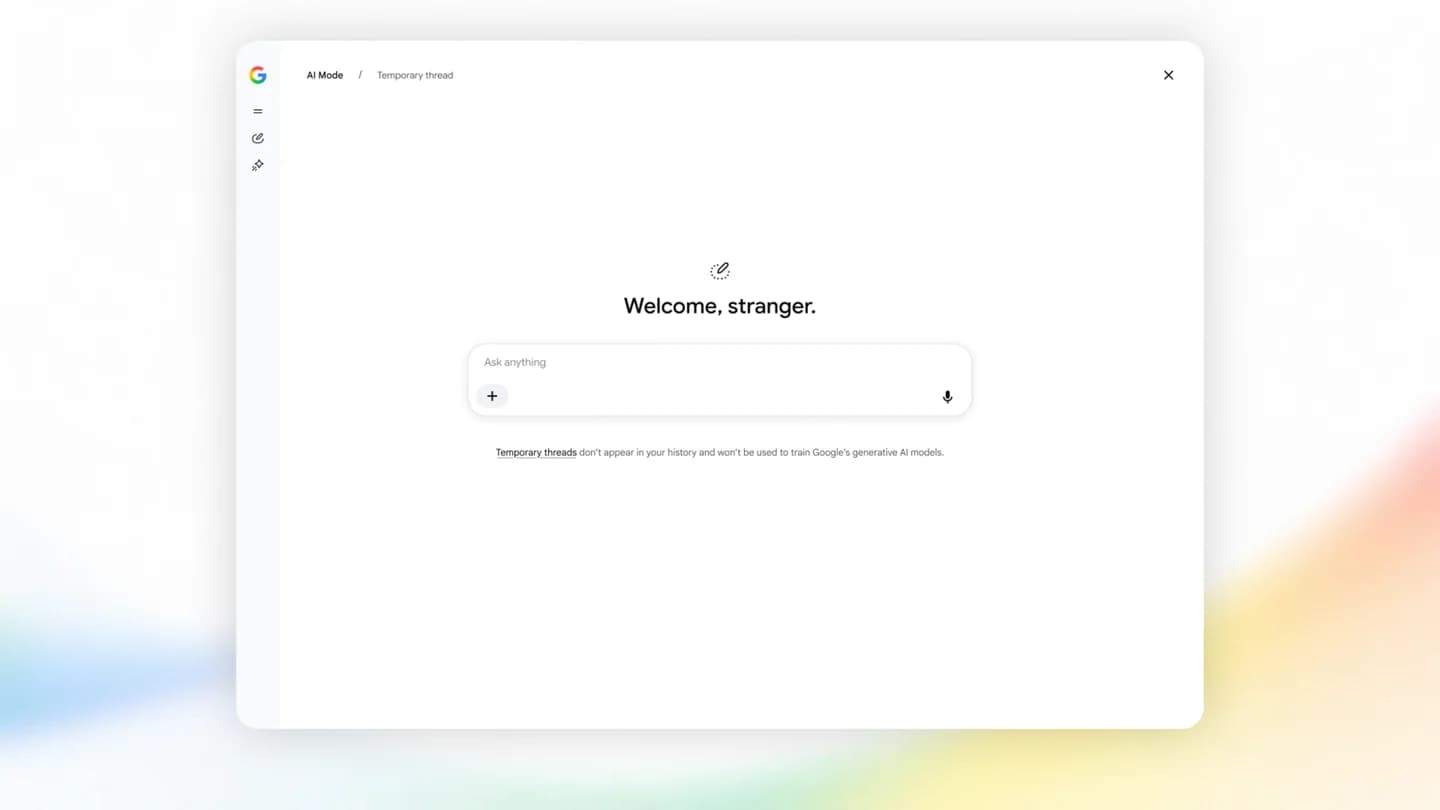
Google shipped temporary threads in AI Mode on November 17, 2026. The feature adds a one-click way to run Search's conversational AI without tying the session to your account history or personalization graph. It is not a new model release. It is a privacy and control layer on top of Gemini 4 Hydrogen in Search, which Google rolled out globally on November 12.
For anyone who already routes buyer research through AI Mode, the practical question is simple: can you ask sensitive questions without them showing up in your history or steering tomorrow's answers? Google's answer is yes for the length of the thread, as long as you start in temporary mode and close it when you are done.
TL;DR
| Question | What Google says |
|---|---|
| What is it? | Detached AI Mode sessions with no saved history and no personalization carry-over |
| How to start | Click the temporary-threads icon in the upper right of AI Mode |
| Platforms | Desktop and mobile browsers where AI Mode works |
| Languages | All languages already supported in AI Mode |
| What it is not | Chrome Incognito, Gemini app's temporary chat, or a guarantee of zero server logs |
How temporary threads work in AI Mode
Google's post walks through four behaviors that matter for daily use.
First, the session is detached from your Google account for personalization purposes. Responses are not informed by past preferences, and the answers you get in the thread are not supposed to affect future personalization elsewhere.
Second, nothing from the thread is saved to Search history. That is the main difference from a normal AI Mode conversation, which can show up alongside your query history and feed into how Google personalizes Search over time.
Third, you switch modes per query. Google says there is no global setting to flip. You jump into a temporary thread when you need privacy, then return to ordinary AI Mode when you are finished.
Fourth, closing ends the thread. When you dismiss it, Google says you go back to searching as usual. There is no archive inside your account for that conversation.
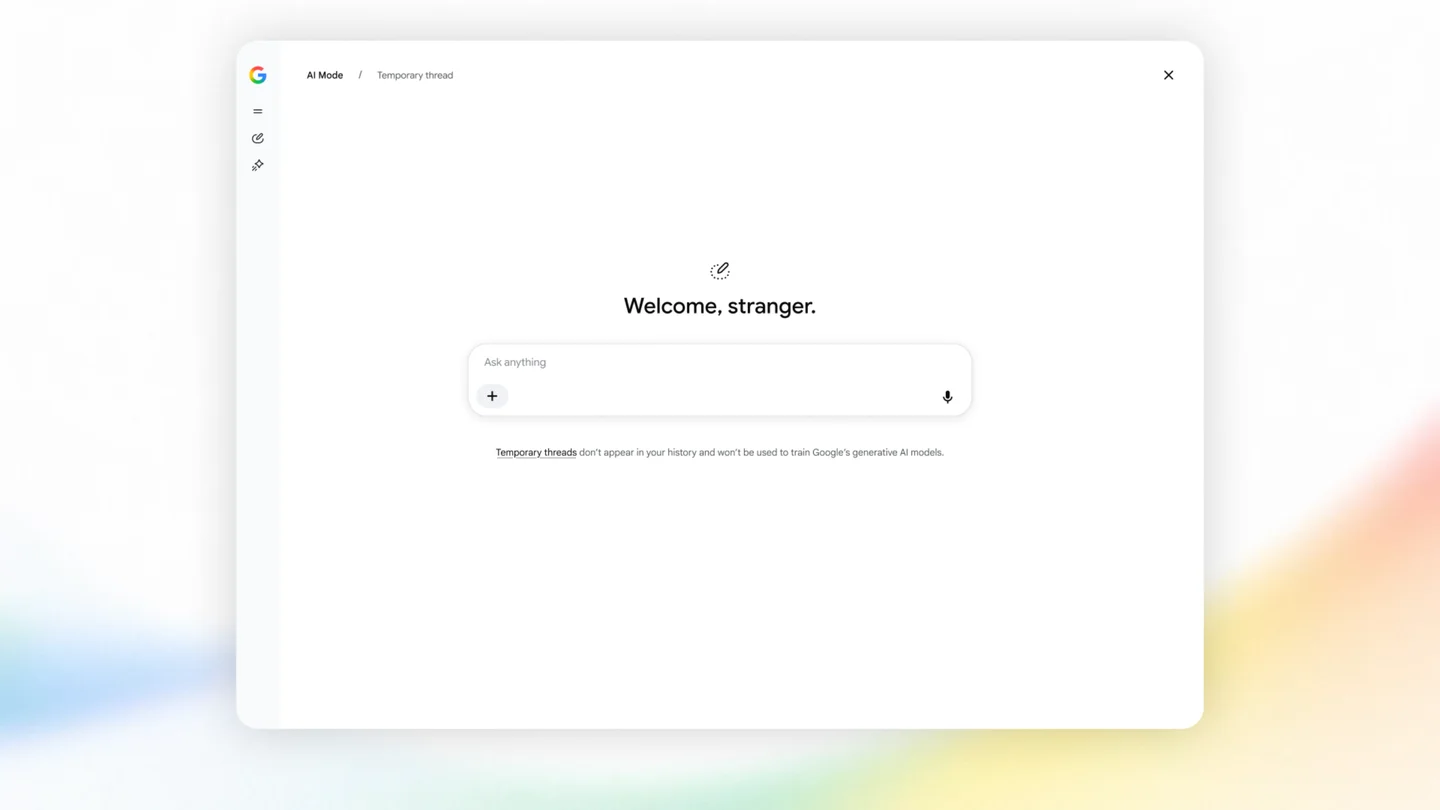 Google AI Mode temporary threads icon in Search for private AI queries
Image: Google
Google's examples are consumer flavored: brainstorming a surprise gift, or looking up something you do not want resurfaced in recommendations. The same mechanism applies to work-adjacent lookups where you do not want a client's name sitting in synced Search history on a shared machine, as long as you understand the limits below.
How this differs from Gemini temporary chat and History off
This week Google also changed how long it keeps some Gemini app chats. Our Gemini temporary chat retention post explains the November 16 Privacy Hub update: temporary and History-off Gemini conversations may be retained about two months on Google's backend for safety and abuse response, even when they are not used for training.
Search AI Mode temporary threads are a different surface. Google's November 17 Search post does not cite the Gemini Privacy Hub numbers. Treat server retention as unspecified for this feature until Google publishes a Search-specific FAQ.
The distinction matters for compliance conversations. A privacy officer asking "is this ephemeral?" needs to know which product you mean. Gemini app controls, Gemini Tasks agent payments, and Search AI Mode each carry separate help-center language.
Relationship to Gemini 4 Hydrogen in Search
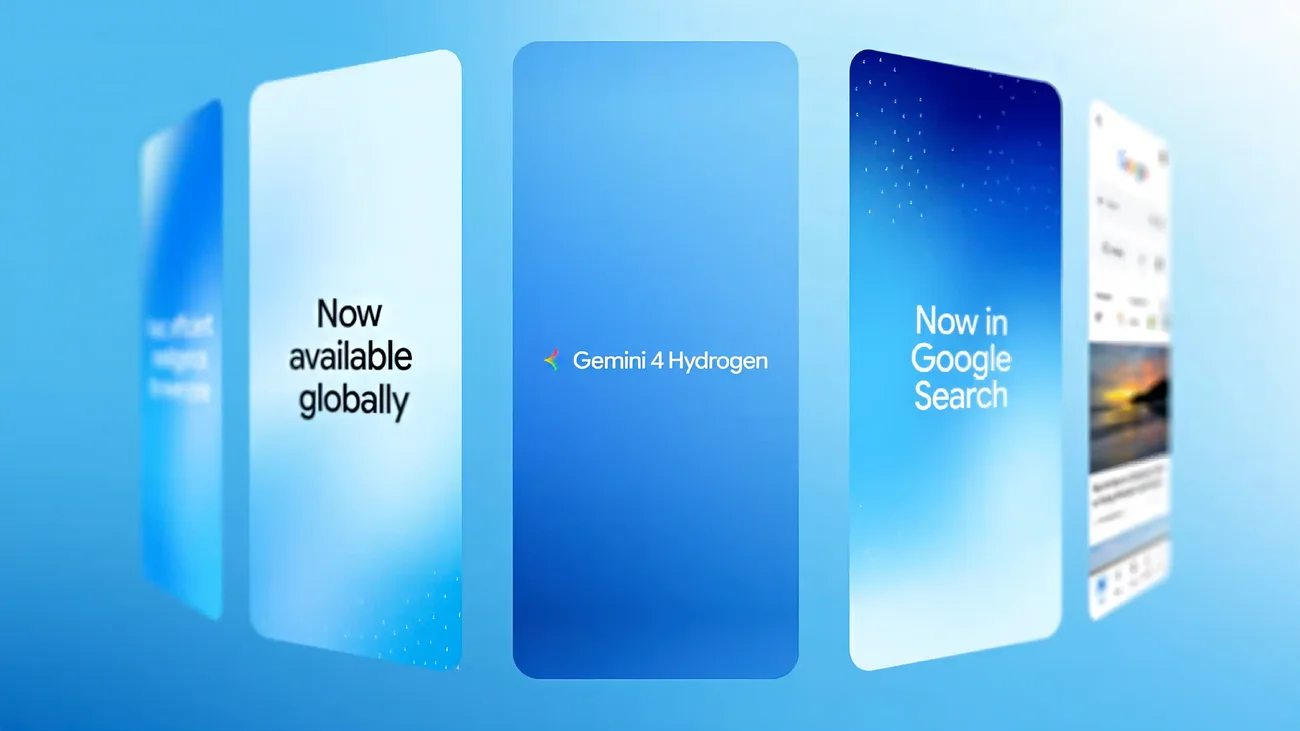 Gemini 4 Hydrogen features in Google Search AI Mode
Image: Google
Temporary threads do not change which model answers you. They change what Google remembers about the session.
Hydrogen is now the default intelligence layer for Search AI answers, with stronger instruction following, query fan-out, and visual responses, per Google's Hydrogen post. Builders comparing latency and quality against Gemini 4 Hydrogen benchmarks should still run tests in both thread types, because personalization off may change which links fan-out retrieves even when the model weights are identical.
Why marketers and SEO teams should care
Independent studies this week show AI shopping answers move day to day. Supercite's follow-up study reports that 84% of brand lists changed across 210 buying questions when repeated on ChatGPT, Gemini, Google AI Overviews, and AI Mode. Only 42% of cited pages stayed the same.
Temporary threads attack the user side of that instability (history and personalization), not the source side (which listicles the model reads today). If you audit whether AI recommends your product, you still need repeated sampling, as we argued in Supercite's first listicle study context and in tooling posts about AI search visibility.
For founders, the takeaway is dual. Users gain a cleaner way to run sensitive queries. Your brand's AI visibility metric remains noisy unless you track distributions over time.
What Google does not promise
Read Google's wording literally. Temporary threads remove account-linked history and personalization effects for that session. They do not, by themselves, prove:
- zero server-side logging;
- exemption from legal process;
- protection on managed Workspace accounts with admin logging;
- consistent answers tomorrow (models and retrieved pages still drift).
TechCrunch's November 18 report describes the feature as an incognito mode for Google's AI search experience. That is a useful shorthand for readers, but Google's official name is temporary threads, and the blog post never uses the word Incognito.
If you need device-local isolation, you still use browser Incognito or a separate profile. If you need contractual data-processing terms, you still route work through Workspace or Vertex products with a DPA, not consumer Search AI Mode.
Step by step: try temporary threads
- Open google.com in a browser where AI Mode is available for your account and region.
- Enter a query and switch into AI Mode if Google offers it for that search.
- Click the temporary threads icon in the upper right of the AI Mode UI.
- Ask your questions. Expect no carry-over from prior personalized Search behavior for that thread.
- Close the thread when finished so Google says the session ends.
- For API or agent builders, use Vertex Gemini models with your own retention and logging policies instead of consumer Search.
Enterprise and developer alternatives
Teams building customer-facing agents should not confuse this consumer control with production privacy architecture. Patterns we cover elsewhere still apply:
- Grounding and logging on Gemini Decisions API for cheap routing without stuffing PII into every frontier call.
- Managed sandboxes in Gemini managed agents when tools touch customer data.
- Policy layers in California's AI safety framework for deployers auditing automated decisions.
Temporary threads are a consumer relief valve, not an enterprise compliance control.
What to watch next
Google's post says global rollout is underway. Watch for three follow-ups:
- A Search help-center article that states retention and ** abuse-review** handling for temporary threads explicitly.
- Whether AI Overviews get a parallel mode, or only full AI Mode.
- How EU AI Act transparency expectations interact with ephemeral consumer Search features in regulated markets.
We will update this post if Google publishes retention numbers or Workspace-specific rules.
Is Search AI Mode the same as the Gemini app?
No. AI Mode is a Search experience that uses Gemini-family models for grounded answers with query fan-out and links. The Gemini app is a separate product with its own chat history, Gems, and agent features such as Tasks and payments.
Temporary threads apply to Search AI Mode in the browser, per Google's November 17 post. They do not automatically change retention in the Gemini mobile app or in Android Go deployments. If your team standardizes on one Google AI surface, document which product employees use for which task so privacy reviews stay accurate.
Workspace, school, and supervised accounts
Google's announcement targets consumer Search in browsers. Workspace administrators may still enforce logging, SafeSearch, or restricted AI features through admin consoles. A supervised minor account may have different AI Mode availability by region.
Before you tell a classroom or clinic to "just use temporary threads," confirm whether your organization's Google contract covers Search AI Mode at all. Many regulated workflows belong on Vertex or Workspace Gemini with audit logs, not on a consumer Search toggle.
Comparison table: privacy modes in Google's stack
 Sticky note fading with a save pin, echoing temporary chat retention elsewhere in Google's stack
| Mode | Product | History saved? | Personalization? | Official Nov 2026 source |
|---|---|---|---|---|
| Normal AI Mode thread | Search | Yes, per usual Search history rules | Yes | Hydrogen upgrade post |
| Temporary thread | Search | No, per Google | No carry-over for thread | Temporary threads post |
| Gemini temporary chat | Gemini app | Not in user history UI | Limited features | Privacy Hub |
| History off in Gemini | Gemini app | Hidden from user; ~2 mo backend | Training opt-out paths | Privacy Hub update |
| Chrome Incognito | Browser | Local session only | N/A | Google Chrome help |
Use the row that matches the surface you are training users on. Mixing them in policy documents creates audit findings.
Why this launched the week after Hydrogen
Google shipped Gemini 4 Hydrogen as the biggest Search model upgrade first, then added temporary threads days later. The sequence suggests Google wants power users to adopt richer AI answers without fear that every experiment will stain long-term personalization.
That is also why marketers should not treat AI Mode as a static billboard. Hydrogen increased link fan-out and visual responses. Temporary threads remove one source of user-specific drift but not source-page drift. Your monitoring stack still needs daily or weekly samples, as independent studies now demonstrate.
Related reading
- Gemini temporary chat two-month retention
- Gemini 4 Hydrogen vs Argon and Carbon
- Gemini Tasks and agent payments expansion
- Google AI Overviews traffic and SEO lessons
- OpenAI GPT-6.2 launch context for the same news week
Sources: Google, temporary threads in AI Mode, Google, Gemini 4 Hydrogen in Search, and TechCrunch, November 18 report.