



Nicolas Bouliane says Google AI Overviews deleted about three quarters of the traffic to All About Berlin, the English guide he has maintained since 2017 for expats navigating Berlin bureaucracy. His May 26, 2026 post went viral again on Hacker News November 18, 2026 with more than 130 points, turning one chart into a case study in does Google AI overview reduce website traffic.
You do not need to live in Berlin to care. If you ship documentation, API guides, or course content that ranks on Google, Bouliane’s story is a revenue warning: AI summaries sit above your URL.
What Bouliane published
On his blog, Bouliane charts seven years of growth, then a sharp decline he attributes to Google AI Overviews:
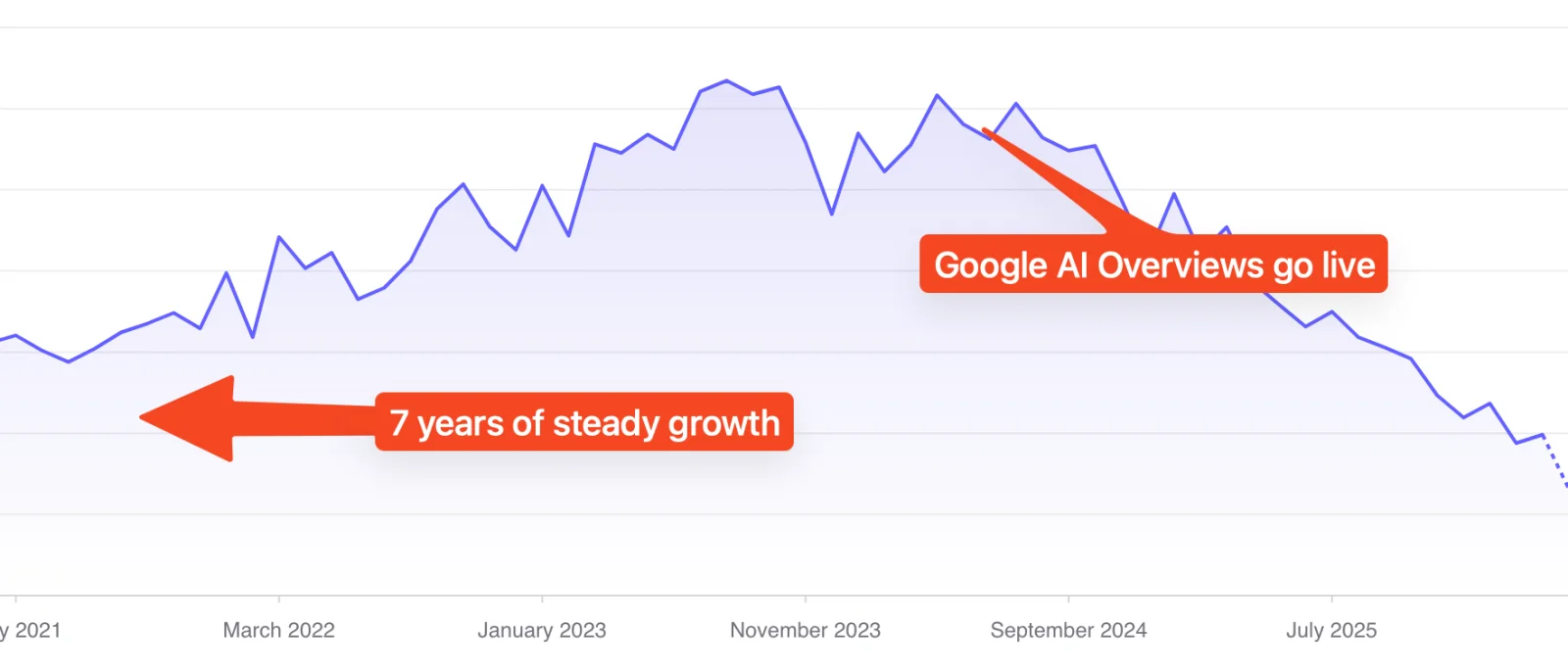 All About Berlin traffic loss chart after Google AI Overviews reduced referral clicks
Image: Nicolas Bouliane
He writes that when users searched, they used to land on All About Berlin first. Now they see ads, an AI-generated answer trained on his work, and only then a link to the site. He estimates 75% traffic loss (updated from an earlier 70% figure in the same post).
The site is not a generic travel blog. Bouliane notes government offices refer readers, the Berlin immigration office uses his data, and his guides inspired government portals and similar city sites. Losing traffic is not only ad revenue; it is loss of feedback, reputation, and motivation to keep guides current.
Does Google AI overview reduce website traffic?
Bouliane’s answer for his property is yes, massively. explainx.ai previously covered publisher traffic experiments and Reddit’s referral drop after AI search modes. Those pieces studied platform-level trends; Bouliane supplies a named site, a timeline, and a livelihood at stake.
| Claim | Source | Verified? |
|---|---|---|
| ~75% traffic loss | Bouliane blog chart | Self-reported analytics — we have not seen raw server logs |
| AI answer before organic link | Bouliane description | Matches Google AI Overviews UX described in Google announcements |
| Government use of guides | Bouliane narrative | Anecdotal unless an agency cites the site officially |
| May 2026 Google AI ads in answers | Bouliane footnote to TechCrunch | Cross-check Google’s own search marketing posts |
Treat the percentage as one publisher’s measurement, not a global average. The direction aligns with other independent publishers quoted in Google Zero coverage.
What Google changed in search UX
Bouliane’s second illustration shows being first on Google still leaves you below sponsored results:
He argues the next step is AI answers with ads inside, citing May 2026 Google announcements linked from his footnotes. Whether or not you agree with his forecast, the present pain is fewer clicks when Overviews satisfy the query.
For builders hosting technical docs, the parallel is GitHub README content surfacing in Copilot answers or Perplexity citations without repo visits. The discovery funnel narrows even when attribution links exist.
Why Hacker News revived a May post
Commenter ShadowOfThePit asked why a May 2026 article hit the front page in November. Likely reasons:
- New Google rollout waves kept the topic fresh.
- Broader AI-search backlash after publisher opt-out fights.
- Personal stake — many HN readers are founders or staff whose docs and blogs feed models.
Useful threads inside item 50542705:
| Commenter | Point |
|---|---|
| ainiriand | Used All About Berlin during 2020 pandemic relocation; suggests relocation-agency partnerships instead of pure SEO |
| adamddev1 | Warns AI eats Stack Overflow and human code, shrinking future training sources |
| darkmatriarch | Suggests paywalls and lawsuits; cites German court liability for fake AI answers |
| benoliver999 | Knows a journalist laid off after traffic collapse, not because AI wrote the stories |
| cleansy | Notes affiliate banking links on the site — business model risk beyond AI |
None of these comments verify Bouliane’s 75% number; they show why the story resonated.
What Bouliane says he will do next
He already spends days preparing for a future without search traffic instead of writing new guides. He invites affected publishers to email contact@nicolasbouliane.com.
That mirrors eBay blocking third-party shopping agents — platforms and publishers both try to reclaim margins when agents and overviews intermediate demand.
Implications for AI builders and educators
If you teach SEO, content marketing, or developer advocacy, update curricula:
- Measure assisted conversions, not only last-click organic.
- Ship email and community loops early; search is a rented channel.
- Negotiate syndication when government or partners already cite your work — ainiriand’s relocation-agency idea is a concrete lead-gen path.
- Document licensing if you fine-tune on your own guides so your AI product does not cannibalize the site that funds it.
explainx.ai’s search without generative AI overviews guide helps readers find non-Google options; it does not solve Berlin visa questions, but it shows distribution diversification thinkers like Bouliane are forced toward.
How this connects to wider publisher policy fights
Bouliane’s post landed between Zyppy’s opt-out experiment and Reddit’s earnings commentary on AI search referrals. None of those pieces name All About Berlin, but together they sketch a platform strategy: Google, Reddit, and eBay each try to control how much cost-free text agents and overviews can extract.
For indie operators, the strategic choice is not “block AI” versus “embrace AI” alone. It is whether you still have a customer relationship when the search click disappears:
| Model | Example from HN or Bouliane | Tradeoff |
|---|---|---|
| Pure SEO content | All About Berlin guides | Huge top-of-funnel, fragile when Overviews answer the query |
| Partner referrals | Relocation agencies (ainiriand) | Lower volume, higher intent |
| Paid app | mertbio building a Hamburg app instead of a blog | Harder distribution, no Google middleman |
| Paywall + litigation | darkmatriarch suggestions | Legal cost; may zero out discovery |
Bouliane has not announced a paywall. He says he is rethinking rent money, not abandoning the site overnight.
Lessons for technical writers and devrel teams
Developer blogs face the same summarization squeeze:
- Framework docs that answer “how do I install X” lose clicks when AI Overviews paste install steps.
- Benchmark posts lose visits when tables appear inside Google’s box without methodology.
- Release notes still drive traffic when readers need version-specific diffs Overviews flatten.
Mitigations that do not require blocking Googlebot:
- Interactive tools (calculators, visa timelines) Overviews cannot fully replicate — Bouliane’s site already had practical tools government offices cited.
- Newsletter or RSS with update alerts when laws change — Berlin bureaucracy does change; email is a direct channel.
- Workshop or consulting offers for high-stakes moves — aligns with explainx.ai’s workshops model for AI skills, adaptable to relocation services.
European legal angles commenters raised
HN user microtonal linked a Deutsche Welle report on a German court holding Google liable for fake AI answers. That is not Bouliane’s lawsuit, but it shows EU courts may treat generated summaries differently from classic ten-blue-links SEO.
Publishers weighing EU audience should track:
- Transparency obligations under the EU AI Act for general-purpose models used in search.
- Press publisher rights debates overlapping Google Zero crawler threats.
We are not lawyers; this is context, not advice.
Should you still publish free guides in 2026?
Bouliane’s honest answer is maybe not at this scale. That conflicts with open-knowledge ideals many AI developers share. A pragmatic middle path:
- Keep free reference pages for credibility, but move deep updates to paid tiers or office hours.
- Publish machine-readable changelogs so partners (agencies, employers) subscribe even when casual searchers do not click.
- Track
summarysatisfaction in your own assistant if you ship one — do not let Google’s summary be the only interface.
explainx.ai still publishes long explainers because searchers ask precise questions our posts answer in the first paragraph. Niche how-to with verifiable steps can outrank generic Overviews when E-E-A-T signals are strong. Bouliane’s case shows even strong guides are not immune when the query is informational and Google keeps the reader on the results page.
Annual visa rule updates and downloadable PDF checklists remain formats Overviews struggle to replicate without losing trust signals government offices already recognized on All About Berlin worldwide.
What is not proven
- That every All About Berlin page lost traffic equally (long-tail vs head terms).
- That AI Overviews are the sole cause — core updates, seasonality, and competition could contribute; Bouliane blames Overviews explicitly.
- That paywalls restore income — HN debate, not settled economics.
- That blocking AI crawlers helps revenue without killing legitimate discovery — see Zyppy experiment limits.
Related reading
- Google publisher opt-out traffic experiment
- Google Zero publisher crawler threats
- Reddit search referrals and AI modes
- Search engines without generative overviews
- Americans negative AI sentiment polls
- AI relationships and companionship apps
Traffic percentages come from Nicolas Bouliane’s self-reported chart unless independently verified.