



Hao AI Lab at UC San Diego has released ORA, an open robot-use agent harness that lets open-weight language models operate robots with no vision-language-action (VLA) model, no robot-specific training and no task memory. Paired with DeepSeek-V4.1-Flash, it reports 69.2 percent on RoboTwin and 81.4 percent on LIBERO-Pro by the benchmarks' official success checks. The project post was published October 15, 2026, and the code is on GitHub.
The headline is interesting, but it needs reading with the authors' own caveats: nearly everything is simulated, episodes take minutes, and compared systems are not like-for-like. This post covers how ORA works, what the numbers do and do not show, and what builders can take from it.
TL;DR
| Question | Answer (from Hao AI Lab's post) |
|---|---|
| What is it? | An open harness that turns a language model into a robot controller via tool calls |
| Which model? | DeepSeek-V4.1-Flash, an open-weight model |
| What does it avoid? | VLAs, robot training data, task-specific memory |
| RoboTwin C2R | 69.2% (173 of 250 cases) |
| LIBERO-Pro | 81.4% (651 of 800 cases) |
| Cost | About $0.35 per solved case at DeepSeek off-peak API rates; GPU and simulator excluded |
| Real robot | Two tasks with operator approval of every motion; no success rate |
| License | Not stated on the page |
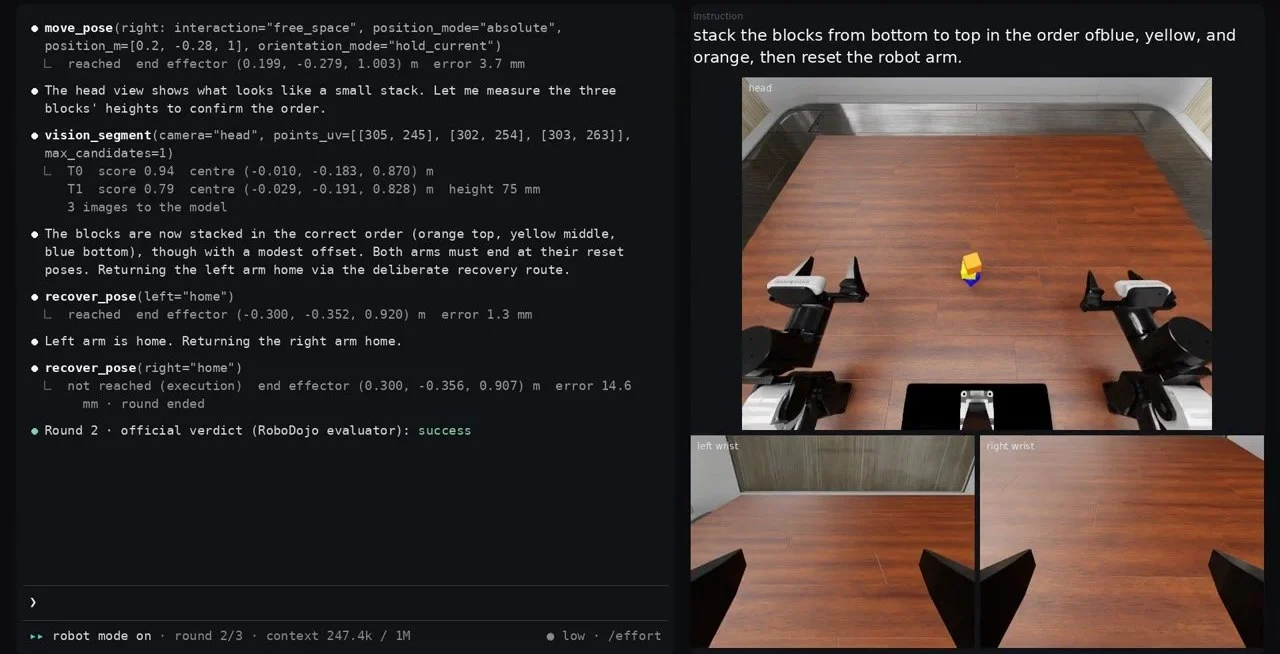 ORA open robot-use agents harness running DeepSeek-V4.1-Flash on robot tasks
Image: Hao AI Lab @ UCSD
ORA open robot-use agents harness running DeepSeek-V4.1-Flash on robot tasks
Image: Hao AI Lab @ UCSD
What is a robot-use agent?
The idea borrows from coding and computer-use agents. A language model sees an observation, reasons, and makes a tool call; the action changes the world, and the next camera frame starts the next turn. Most robot policies instead use VLAs trained on teleoperated demonstrations, handheld-gripper data or egocentric video. The authors ask whether a strong enough agent could operate a robot "from its manual alone."
Frontier models have already shown zero-shot robot control, as in our coverage of GPT-6 Astra on a robot control benchmark and the robotics benchmark that compared frontier models on arms and humanoids. ORA's contribution is to do it with an open-weight model, for two reasons the authors give: researchers need reproducible data from a model they can serve themselves at acceptable cost, and a deployed LLM-driven robot has to run on local hardware, which needs an open model small enough to deploy.
How does ORA work?
ORA runs a ReAct-style loop. Each turn the model reads its input, reasons, and makes one tool call. Three design parts do most of the work.
Prompt bundle. Seven layers: system policy, evidence rules, benchmark boundary, robot card, task and completion contract, tool schemas, and round facts. It describes how to look and move but contains no solutions, object coordinates or success tests.
Tool suite. Twenty tools in the reported run, grouped as:
- Looking:
vision_ground,vision_segment,mark_point - Measuring:
geometry_query,compute,grasp_plan - Acting:
move_pose,set_gripper,grasp_execute - Episode control:
check_task,finish_episode,report_issue
Context management. Four layers, newest first: the current turn in full; recent turns verbatim; older turns with images replaced by exact references the model can reopen; and, once input passes about 150,000 tokens, completed rounds folded into roughly 1,200-token summaries.
What are the results, and how should you read them?
On RoboTwin C2R (50 tasks, 5 seeds, randomized scenes) ORA with DeepSeek-V4.1-Flash scores 69.2 percent. The comparison systems, as published by the RPent leaderboard, are RPent with GPT-5.5 at 62.4 percent and with Opus-4.7 at 58.4 percent, plus VLAs such as LingBot-VLA at 50.4, pi0.5 at 47.9 and GR00T-N1.7 at 20.7.
On LIBERO-Pro (800 cases) ORA scores 81.4 percent. RPent with GPT-6 Astra reports 92.63, with Opus-4.7 82.4, with GPT-5.5 75.13, and with Qwen3.6 27B 70.63. So ORA leads on RoboTwin and comes close but does not beat the best frontier result on LIBERO-Pro.
The authors state the comparison limits plainly: these are "comparisons of complete systems with different tools, memory and protocols." RPent combines a language model, a VLA and task-specific memory from an earlier exploration pass; ORA uses none of the latter two. Baseline numbers are copied from RPent's leaderboard, not rerun. Some use frozen memory batches or best-of-ten seeds. Treat the chart as indicative, not as a controlled benchmark.
The authors also report a first scan on RoboDojo: 42 multi-stage tasks, 3 rounds each, with an earlier ORA version. 18 of 126 rounds were solved and 9 of 42 tasks at least once. Of 108 failed rounds, 64 were motion failures, 29 strategy, 7 perception, 3 simulator anomalies, 3 early give-ups and 2 undetermined. They call this a first scan, not an evaluation.
What does it cost?
Using DeepSeek's off-peak API rates ($0.003 per million cached input tokens, $0.15 uncached, $0.60 output; peak is double), the authors estimate:
| Benchmark | Attempts | Solved | Total cost | Per solved case |
|---|---|---|---|---|
| RoboTwin | 250 | 173 | $60.2 | $0.35 |
| LIBERO-Pro | 800 | 651 | $227.4 | $0.35 |
| LIBERO | 405 | 334 | $100.2 | $0.30 |
| RoboDojo | 126 | 18 | $49.2 | $2.74 |
Uncached input is the largest cost, for example $157 of $227 on LIBERO-Pro, with estimated cache hit rates of 84 to 86 percent. These are API-equivalent estimates that exclude GPU and simulator costs, not self-hosting costs. For context on the model's pricing and capabilities, see our posts on DeepSeek V4.1 Flash's API beta and a comparison of small models including V4.1 Flash.
What did the authors learn about harness design?
The most reusable part of the post is its analysis, which the authors label as mostly drawn from reading failed runs, not controlled ablations:
- Learning from experience. Across 148 two-round sessions, round 2 succeeded 72 times and round 1 63 times. This does not isolate retained context from the benefit of a second try.
- Exact instructions matter. Using the benchmark's own wording succeeded on 10 of 10 seeds, versus 2 of 10 for a paraphrase. A completion contract raised RoboTwin success from 53.4 to 64.1 percent on 206 paired cases.
- Perception tools help but do not solve it. They expose pointing and identity errors; choosing the right object among look-alikes is still the hardest step.
- Exact measurements help. Returning mask centres as seen from above rather than the angled camera raised success on two task families from 29 to 42 of 59 test states.
- Explain refused motions. In an offline replay of 77 refused moves, a refusal that names the nearest reachable orientation resolved 69.
The common thread echoes lessons from coding agents: precise task specs, good tools and clear error messages matter as much as the model. It is the same "harness matters" argument we have followed in agent engineering.
What are the limitations?
The authors list them candidly:
- Slow. A median episode takes 14 to 25 minutes, and the simulator pauses while the model thinks, so results do not reflect real-time control.
- Long tasks are weaker. Long-horizon suites succeed 52 to 64 percent of the time.
- Hand-written tools. ORA cannot yet revise its own tools.
- Narrow evidence. Nearly all results are simulated and from one model. The real-robot test used two demonstrations with an operator approving every motion.
- Metrics can flatter. Official checks can end episodes early or be looser than the instruction. In a sample of 46 RoboTwin episodes, 7 did not do what the instruction asked.
Real robot: how much should you read into it?
On a low-cost table-mounted arm with a fixed RGB-D camera and a wrist camera, DeepSeek-V4.1-Flash completed two household tasks: opening a small drawer by its knob and placing a candy bar in a small open box. Every motion was approved by an operator before it ran. The authors did not measure success rates, and the arm model is not named. This shows the pipeline can connect to hardware, nothing more.
What does it mean for builders?
- Robotics research gets cheaper to reproduce. An open model plus an open harness gives academic labs a baseline that does not require frontier API budgets.
- Safety remains the operator's job. Human approval of each motion in the real-robot run is the sensible default. Our post on robot-agent harm benchmarks shows why guardrails on physical agents matter.
- Latency is the blocker. Minutes per episode is fine for a research benchmark and unusable for a kitchen. Expect progress to come from faster models and local inference.
- Harness design is a lever you control. Even with a fixed model, task contracts and measurement tools moved success by double digits in the authors' sessions.
How to try it
- Read the project post and the appendix and gallery of 153 solved episodes it links.
- Clone the ORA repository and check its license before reuse, since the page does not state one.
- Reproduce a simulator benchmark first (LIBERO uses a one-arm Franka Panda in MuJoCo; RoboTwin uses a two-arm ALOHA-AgileX in SAPIEN) before touching hardware.
- If you go to a real arm, keep an operator approving every motion, as the authors did.
Related reading
- GPT-6 Astra on a robot control benchmark
- Robotics benchmark of frontier models on arms and humanoids
- DeepSeek V4.1 Flash API beta
- Small models comparison including DeepSeek V4.1 Flash
- Gemini 4 Argon for robotics
- Robot-agent harm benchmark
Based on Hao AI Lab's October 15, 2026 post; benchmark figures are the authors' and have not been independently reproduced.