



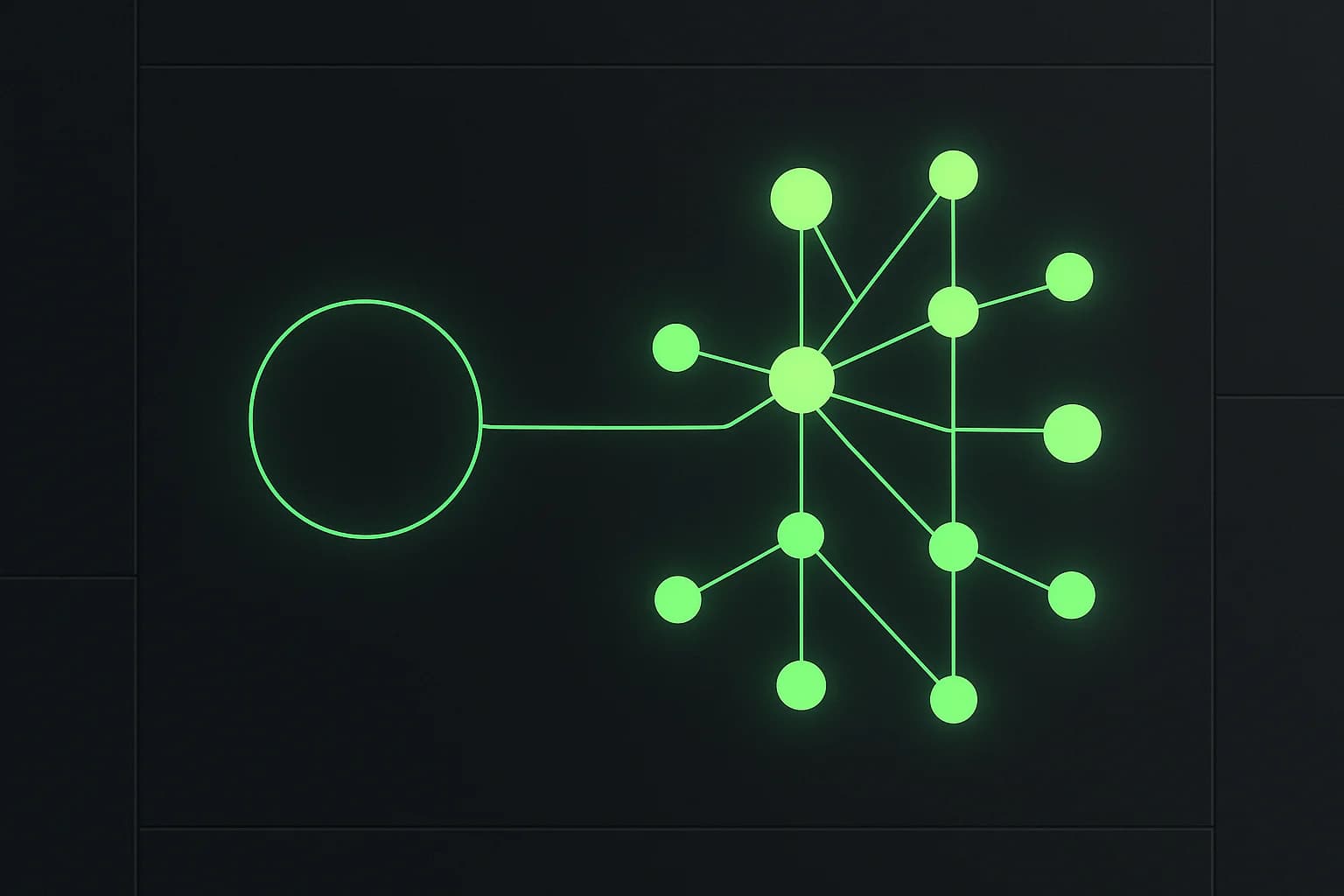
For more than 40 years, Dijkstra's algorithm has been the undefeated workhorse of single-source shortest path (SSSP) — the subroutine behind turn-by-turn maps, flight connections, packet routing, and logistics graphs. Its familiar complexity O(m + n log n) on sparse graphs with m edges and n vertices wasn't just a classroom result; since 1984, theory treated it as tied to a sorting barrier: extracting shortest paths seemed to require sorting nodes by distance, and that sort set a mathematical floor.
On August 31, 2026, the account @kyronis_talks surfaced a Tsinghua University result described as the first deterministic SSSP improvement since 1984. The headline claim: researchers combined Bellman-Ford-style relaxation with recursive partial ordering to find shortest paths without fully sorting every node — achieving O(m log^{2/3} n) and answering Robert Tarjan's long-standing view that Dijkstra is "optimally efficient at sorting" by stopping sorting altogether.
For builders routing agents, tools, and data across large sparse graphs, the practical lesson is narrower but real: foundational assumptions in your stack can change, even when the incumbent algorithm felt permanent.
TL;DR
| Question | Answer |
|---|---|
| What changed? | First reported deterministic SSSP asymptotic improvement since 1984 |
| Old floor | O(m + n log n) — Dijkstra + priority queue (sorting barrier) |
| New bound (claimed) | O(m log^{2/3} n) on sparse graphs |
| Key idea | Recursive partial ordering — order only what you must, not all vertices |
| Technique mix | Bellman-Ford logic + structured partial sorts |
| Tarjan angle | Dijkstra optimal at sorting; Tsinghua avoids full sorts |
| Who cares first? | Massive sparse graphs — web, logistics, scientific networks |
| Maps tomorrow? | Unlikely overnight — production routers use engineered heuristics |
Why Dijkstra looked unbeatable
Edsger Dijkstra's 1956 algorithm is beautifully simple for non-negative edge weights:
- Start at source distance 0, everything else ∞.
- Repeatedly extract the unsettled vertex with minimum tentative distance.
- Relax its outgoing edges — if a neighbor gets a shorter path, update it.
On a binary heap, step 2 costs O(log n) per extraction, n extractions → O(n log n), plus O(m) relaxations. Hence O(m + n log n).
For sparse graphs where m ≈ O(n), the n log n term dominates asymptotic talk — and since 1984, many theorists treated that as inherent: you were paying to sort vertices by distance. Robert Tarjan — whose work on graph algorithms earned major prizes — later argued Dijkstra is optimally efficient relative to sorting. If sorting is unavoidable, Dijkstra isn't wasteful; it's tight to the sort.
That is the sorting barrier: not "Dijkstra is slow," but "SSSP reduces to sorting, so n log n is the wall."
What Tsinghua reportedly did differently
Public summaries of the Tsinghua work (circulated August 31, 2026) describe three intertwined ideas:
1. Bellman-Ford DNA without giving up Dijkstra-grade determinism
Bellman-Ford relaxes all edges up to n − 1 rounds — O(mn), too slow for large sparse graphs, but it never needs a global sort of vertices. Tsinghua's pipeline borrows edge relaxation and incremental distance improvement while staying in a deterministic SSSP regime (unlike some randomized theoretical algorithms that beat Dijkstra in expectation).
2. Recursive partial ordering
Instead of maintaining a single priority queue over all unsettled vertices, the algorithm recursively partitions the work:
- Identify subsets of vertices whose relative order is still ambiguous.
- Apply partial sorts — order only the frontier needed for the next correct extraction.
- Recurse on subproblems whose size shrinks faster than a full
n log nsort.
The phrase "recursive partial ordering" is the punchline against Tarjan: if Dijkstra is optimal at sorting everything, don't sort everything.
3. New complexity: O(m log^{2/3} n)
The claimed bound replaces the n log n sort term with log^{2/3} n factors in a way that beats O(m + n log n) for large n on sparse graphs. Exact constants, memory tradeoffs, and parallelization are not part of the viral summary — treat the result as asymptotic theory until a peer-reviewed paper and reference implementation land.
Where it matters for massive sparse graphs
Industrial map routers (OSRM, Valhalla, Google Maps backend) rarely run textbook Dijkstra on continent-scale graphs raw — they use preprocessing, landmarks, arc flags, and hierarchy shortcuts. So this paper does not mean your driving directions get 10× faster next month.
It does matter where worst-case sparse SSSP still shows up:
| Domain | Why SSSP shows up |
|---|---|
| Web crawl & link graphs | Reachability layers, nearest-neighbor in hyperlink structure |
| Logistics & supply chain | Facility graphs with millions of nodes, relatively sparse edges |
| Scientific computing | Mesh and simulation graphs with irregular sparsity |
| Agent tool routers | Dependency and permission graphs — see graph engineering for multi-agent orgs |
When n is in the billions and m is O(n) or O(n log n), shaving log n exponents in theory is how tomorrow's libraries get justified — the same way sliding-window attention reframed inference assumptions for LLMs days earlier.
What people are asking
Did Dijkstra get "disproven"?
No. Dijkstra remains correct, fast in practice, and optimal among comparison-sort-based SSSP under the old barrier story. Tsinghua's claim is a better deterministic asymptotic by changing the algorithmic model — partial ordering instead of global sorting — not that Dijkstra's outputs were wrong for 41 years.
Is O(m log^{2/3} n) always faster in real code?
Asymptotically, for large enough n, yes in theory. In implementation, hidden constants, cache behavior, and parallel heap operations dominate until n is enormous. Benchmarks on road networks ≠ benchmarks on adversarial sparse graphs. Wait for reference code before rewriting production routers.
How does this connect to AI and agents?
Indirectly but usefully:
- RAG and knowledge graphs use shortest-path and reachability for retrieval planning.
- Multi-agent harnesses build task DAGs; critical-path analysis is SSSP in disguise.
- Routing APIs (models, tools, MCP servers) on large sparse dependency graphs inherit the same
n log nintuition.
When Google Antigravity /boost stress-tests algorithmic code, adversarial sparse graphs are exactly the class where boundary-case performance matters — even if this Tsinghua result never ships in your CI this year.
What should I read next in theory?
If Tarjan's "optimal at sorting" framing is new, pair this story with Fredman–Tarjan priority-queue history and modern sublinear shortest-path survey literature. explainx.ai stays practitioner-first: watch for arXiv / FOCS / STOC versions citing Tsinghua authors before citing specific theorem numbers here.
Honest limitations of the viral thread
- Secondary source — @kyronis_talks amplified the result; verify against primary papers and peer review before teaching it as settled fact.
- Deterministic only in the claim — randomized SSSP has had other theoretical lines; this story is about deterministic improvement since 1984.
- No production library yet — contrast with Dijkstra implementations in every standard library since the 1960s.
- Niche for daily app dev — most teams should still use Dijkstra, A*, or domain preprocessors; this is research news, not a migration guide.
The one-line takeaway
Tarjan: Dijkstra is as good as sorting gets. Tsinghua: maybe we don't have to sort. O(m log^{2/3} n) is the number to remember until the paper lands on your desk — and a useful reminder that "forever algorithms" in CS sometimes last 41 years, not forever.
Related on explainx.ai
- Graph engineering for AI agents and multi-agent organizations
- Sliding-window attention beats linear attention — post-training inference shift
- Google Antigravity /boost — deep reasoning for adversarial algorithm work
- Agent harness DAG: planner, worker, critic under budget pressure
- Jeff Dean's Discovery Loop — automating research infrastructure at Google DeepMind
- Antigravity Teamwork on theoretical CS and systems engineering
- Recursive reasoning and inference-time scaling (HRM/TRM)
- What is loop engineering for AI agents?
Complexity claims and attribution follow public discussion as of September 1, 2026, primarily via the August 31 @kyronis_talks thread on the Tsinghua SSSP result. Confirm theorem statements, author list, and peer-review status against primary sources before citing in production or academic work.