



On August 28, 2026, Google Antigravity announced that researchers at Google Research and Google DeepMind used Teamwork — Antigravity's multi-agent orchestration framework — on frontier work in theoretical computer science, research mathematics, and systems engineering. The product framing is blunt: agents propose, stress-test, and build solutions autonomously over hours or days, it uses a lot of tokens, and it is overkill for everyday tasks. If you already follow Antigravity's CLI subagents, Remote Control, and Interactive Generative UI Artifacts, Teamwork is the layer above single-session delegation — a full campaign harness, not another chat panel.
For builders, the useful takeaway is not "Google solved Knuth overnight." It is that Google shipped a configurable multi-pattern orchestrator inside a mainstream coding harness, with an explicit cost warning and a stealable blueprint for long-horizon agent harness design.
Same day — August 28, 2026: Sapient Intelligence open-sourced PRAXIST Beta — a cumulative research-agent harness (Research Peers + PI Panel + evidence lineage) aimed at multi-generation experimental R&D rather than Antigravity's first-party /teamwork-preview patterns.
TL;DR
| Question | Answer |
|---|---|
| What is Teamwork? | Multi-agent orchestration in Antigravity: agents propose, critique, refine over hours/days |
| How do you invoke it? | /teamwork-preview slash command |
| Who can use it? | All paid Antigravity plans (per Google's Aug 2026 Teamwork blog) |
| Is it GA? | No — still named and framed as a research preview |
| Five patterns? | Iterative Coding, Distributed Coding, Long Proof, Self-Verification, Document Review |
| Everyday tasks? | No — Google says it is overkill and token-heavy |
| Best for? | Frontier / long-horizon math, research CS, systems engineering, hard open-ended SE |
| Models? | Publicly available Gemini models (updates build on Gemini 3.7 Flash era) |
What is Teamwork in Antigravity?
Per Google's Teamwork blog post (dated August 27, 2026 on the site; widely discussed August 28), Teamwork is a multi-agent orchestration framework first announced at Google I/O and now updated inside Antigravity. The design target is problems that are too large, too uncertain, or too open-ended for a single agent loop.
The shared structure Google names is familiar to anyone doing loop engineering:
- Generate candidate solutions
- Stress-test them (adversarial critique / falsification)
- Combine the strongest pieces into a better candidate
- Repeat — with humans owning objectives and final acceptance
Google contrasts this with "loosely organized" multi-agent setups that agree with early mistakes and build confidently on flawed ideas. Teamwork's pitch is structured challenge: agents actively look for flaws before the campaign builds further.
Antigravity's subagents docs place Teamwork under multi-agent teamwork (/teamwork-preview) — coordination for large engineering tasks, complex simulations, and deep research campaigns — on top of the ordinary invoke_subagent primitives already covered in explainx.ai's Antigravity CLI reference.
What are the five Teamwork workflow patterns?
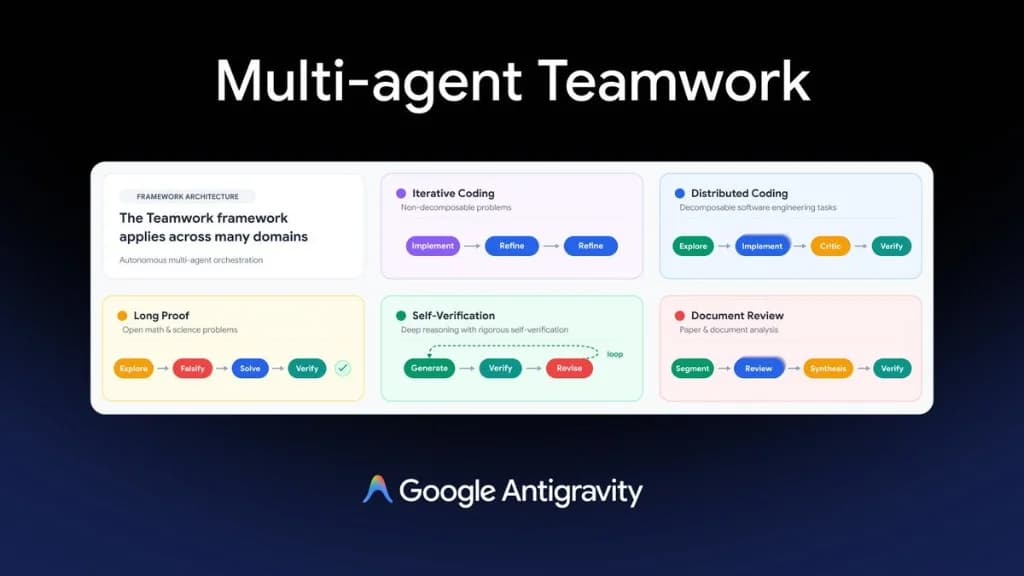
Teamwork is not one fixed five-agent roster. Google calls each configuration a pattern: a blueprint for which roles participate, what moves work forward, and how many agents to spawn. Orchestration logic is decoupled from agent descriptions, patterns are adaptive at runtime, and when you run /teamwork-preview, Gemini analyzes the prompt and selects a pattern.
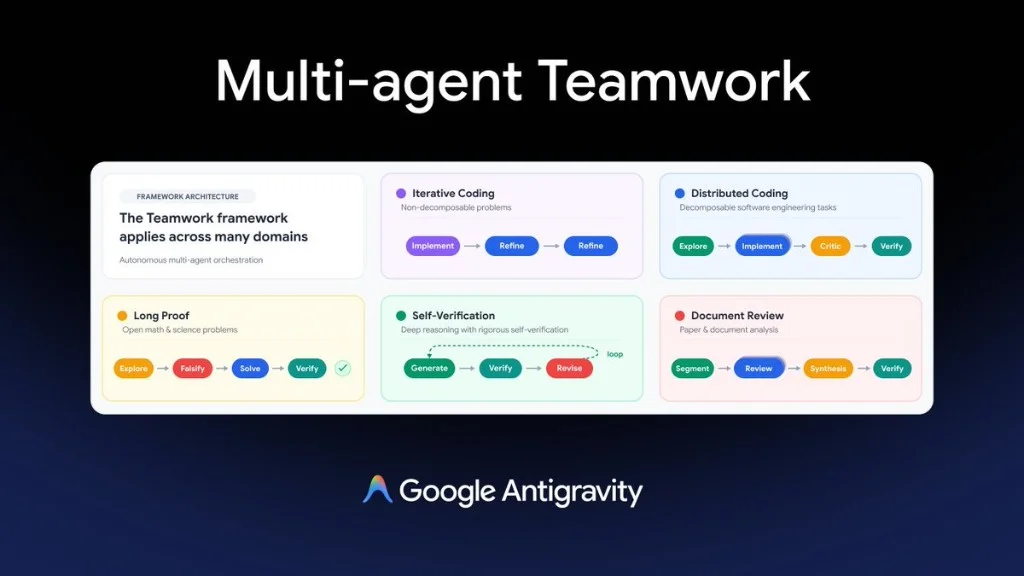 Multi-agent Teamwork framework architecture diagram from Google Antigravity showing five patterns: Iterative Coding, Distributed Coding, Long Proof, Self-Verification, and Document Review
Figure: Multi-agent Teamwork architecture — Google Antigravity marketing diagram from the Teamwork announcement. Attribution: Google Antigravity / Teamwork.
| Pattern | Domain | Pipeline (marketing figure) |
|---|---|---|
| Iterative Coding | Non-decomposable problems | Implement → Refine → Refine |
| Distributed Coding | Decomposable software engineering | Explore → Implement → Critic → Verify |
| Long Proof | Open math & science | Explore → Falsify → Solve → Verify ✓ |
| Self-Verification | Deep reasoning with rigorous checks | Generate → Verify → Revise (loop) |
| Document Review | Paper & document analysis | Segment → Review → Synthesis → Verify |
Iterative vs Distributed Coding — when to use which?
| If your task… | Prefer |
|---|---|
| Cannot cleanly split into independent subproblems (tight feedback with tests) | Iterative Coding |
| Fans out into parallel workstreams that need critic review + verification | Distributed Coding |
| Is an open conjecture / proof search with dead ends | Long Proof |
| Needs depth-first math with check-at-every-step | Self-Verification |
| Is "read this paper / doc set and produce a structured critique" | Document Review |
You usually do not pick the pattern by hand — /teamwork-preview does — but knowing the map helps you write prompts that steer selection (e.g. "decomposable multi-module refactor with independent verification" vs "single algorithm, refine until benchmarks pass").
When is Teamwork overkill vs worth the tokens?
Google's own announcement copy is the best filter: Teamwork uses a lot of tokens and is overkill for everyday tasks. Earlier Antigravity material on /teamwork-preview also warned that even strong Flash-tier runs can burn weekly Ultra quota mid-task and that you may need to buy credits and tell the team to Continue. Treat that as a budget reality, not fine print.
Worth trying when:
- The problem is open-ended or research-grade (proofs, novel systems, hard optimization)
- A single agent keeps agreeing with itself into a dead end
- You can leave a machine awake for hours or days (local execution still needs an awake host; pair with Remote Control if you will not sit at the desk)
- You have quota/credits sized for multi-agent campaigns, not a quick edit
Stay on a normal agent / subagent loop when:
- The change is a small PR, bugfix, or UI polish
- You need predictable cost per task
- You want one specialist subagent for search/tests, not a full team campaign
That split matches how explainx.ai talks about production harness primitives: Planner/Worker/Critic and verification budgets are powerful — and expensive — when the goal justifies them.
Is this /teamwork-preview GA?
No. Google still ships the feature as /teamwork-preview, documents it as a research preview, and says improvements to orchestration and UI continue over the coming weeks.
What did change in the August 2026 Teamwork update:
- Framed as updates to Teamwork (not a first-ever invent)
- Availability stated as all paid Antigravity plans (broader than older Ultra-only messaging in earlier
/teamwork-previewposts) - Pattern catalog and research results published for Long Proof, Self-Verification, systems, and open-source engineering
Community threads asking "is this the release of /teamwork-preview?" are half-right: the command was already in Antigravity; this wave is a capability and availability update, not a quiet GA rename. Praise for finally getting stronger multi-subagent orchestration is fair; treating it as "finished product" is not.
Maturity notes (community feedback, not the lead)
Builders also flag practical gaps that matter when you decide whether to invest: requests for BYOK / different models per subject, comparisons of Antigravity's MCP store surface vs other IDEs, and a lingering CLI vs desktop capability gap. Those do not cancel Teamwork's research results — they are reminders that preview orchestration and day-to-day ergonomics are still converging. Bug reports should go through Google's Antigravity channels; do not expect a research-preview slash command to feel polished for every workflow.
What breakthroughs does Google claim — and what should you trust?
Google's Teamwork post attributes concrete results to Gemini models with Teamwork. On explainx.ai we treat these as Google-reported outcomes, many with public artifacts, not as independent peer review of every claim:
| Area | Google's stated outcome (summarized) |
|---|---|
| Research math & theoretical CS | Seven open problems addressed; five papers on arXiv; Knuth Cycles constructions verified in Lean; 71% on TCSBench (Google-internal suite; highest in their internal testing with 3.7 Flash + 3.1 Pro) |
| Systems | Cycle-accurate out-of-order RISC-V CPU simulator that boots xv6 and aligns cycles (~0.71% average error vs BOOM ground truth on unseen workloads, per Google) |
| Open-source engineering | Upstream-accepted optimizations to Eigen and ideation/optimizations for ParlayHash / Swiss Parlay |
Long Proof details Google emphasizes: competitive strategy search with falsifiers, decomposition into dependency graphs, tournament networks per subproblem, and a pitfall registry across rounds. Self-Verification is described as inspired by the earlier Aletheia math-research harness. Three of the math results are claimed to reproduce on Gemini 3.7 Flash with the right orchestration — Google's point that harness quality can lift Flash-tier models on PhD-level work.
We are not inventing extra paper titles beyond what Google lists; follow their arXiv / GitHub links from the official Teamwork post if you need the primary artifacts.
How does Teamwork compare to other multi-agent harnesses we cover?
Keep comparisons on the explainx.ai corpus — same problem space, different products:
| Dimension | Antigravity Teamwork | Broader explainx.ai framing |
|---|---|---|
| Product surface | First-party /teamwork-preview inside Antigravity | Category of agent harnesses |
| Orchestration style | Pattern-selected teams; adaptive agent count | Planner / Worker / Critic + budgets |
| Time horizon | Hours to days (stated) | Loop engineering — cron + verify + stop conditions |
| Everyday coding | Explicitly discouraged | Use skills + single-agent loops; see agent skills |
| Under the hood | Builds on Antigravity subagents / sandbox | Same primitives: isolation, tools, verification |
Teamwork is Google's answer to "multi-agent campaigns that do not cheerlead their own bugs." It is not a free replacement for designing your own agent harness if you need portability across vendors.
Can builders apply these patterns outside Antigravity?
Yes — as patterns, not as a portable command.
Stealable ideas you can encode in skills, agents.md, or a custom harness today:
- Falsify before commit — give at least one agent the sole job of breaking the proposal (Long Proof).
- Decompose only when the graph is real — Distributed Coding when subproblems are independent; Iterative Coding when they are not.
- Self-verification loops — generate → verify → revise with a hard budget, matching loop engineering stop conditions.
- Document pipelines — segment → review → synthesis → verify for paper or RFC analysis.
- Human owns acceptance — Google keeps experts on objectives and final merge; you should too.
What you cannot steal without Antigravity: the /teamwork-preview runtime, Google's pattern auto-selector, and their paid-plan quota packaging. For Antigravity users, start from antigravity.google, open a paid-plan session, and run /teamwork-preview with a frontier-shaped prompt — then watch quota like a hawk.
Actionable: which pattern for which task?
| Your task | Prompt shape that steers the right pattern |
|---|---|
| Single hard algorithm + tests | "Non-decomposable; iterate implement/refine until suite green" |
| Multi-module feature with parallel owners | "Decomposable SE; explore, implement in parallel, critic, verify" |
| Open conjecture / formal proof | "Open math problem; explore strategies, falsify, solve, verify" |
| Deep derivation with checkable steps | "Depth-first reasoning; generate, verify, revise until checks pass" |
| Lit review / design doc critique | "Segment the document, review sections, synthesize, verify claims" |
Related reading
- Update — September 8, 2026: Google Antigravity shipped an AlphaGenome Atlas Skill — connecting agents to DeepMind's 1-petabyte genomic variant dataset for prioritization and hypothesis generation inside the scientific workbench.
- Update — September 1, 2026: Google added
/boost— a Pro/Ultra deep-reasoning slash command for hard bugs and algorithm work with execution-and-verification loops. See /boost coverage. - Update — September 1, 2026: See Google's Gemini 3.7 Flash showcase for internal demos built on Antigravity and AI Studio — including a one-shot Kerr black hole Three.js simulation.
- PRAXIST Beta: Sapient Intelligence cumulative research agents (Aug 28, 2026)
- Antigravity CLI: sandbox, plugins, and subagents reference
- Google Antigravity Remote Control launch (Aug 2026)
- Antigravity Interactive Generative UI Artifacts
- What is an agent harness? Complete guide
- Top 10 open and closed-source agent harnesses (2026)
- From ReAct to production harness: DAG, Planner/Worker/Critic, budgets
- Loop engineering for coding agents (2026 guide)
Official sources: Teamwork: When AI Becomes a Research Partner · Antigravity home · Subagents docs (Teamwork section) · Earlier /teamwork-preview context
Details on /teamwork-preview availability, pattern selection, reported research results, and pricing/quota behavior are accurate as of August 28, 2026, based on Google Antigravity's published Teamwork blog and docs. Preview features and plan entitlements can change — confirm against antigravity.google before planning a multi-day campaign.