



Anthropic published The AI expectations gap on October 16, 2026, a survey comparing what its own employees and the American public expect from AI by 2030. The core result: they largely agree on what AI can do today, but staff expect far faster progress. 91% of staff expect a Nobel-level scientific discovery by AI by 2030, against 39% of US adults, and staff expect AI to handle 75% of their current work hours versus 28% for the average US worker.
The finding worth keeping is less the gap itself than its shape. Both groups connect "AI does more of my job" to "unemployment goes up" in nearly the same way. The disagreement is about how capable AI will be, which, the authors argue, tracks personal experience with the tools. It is the demand side of the story in our companion post on how employment is changing inside Anthropic, and Anthropic introduced both in Working at the frontier shapes expectations for the future.
The numbers at a glance
| Question | US adults | Anthropic staff |
|---|---|---|
| Nobel-level discovery by 2030 | 39% | 91% |
| Says AI will never manage a given task | 19-40% depending on task | at most 2% |
| Share of feasible work tasks done with AI by 2030 | 42% | 65% |
| Share of own work hours AI handles by 2030 | 28% (workers) | 75% |
| Task takes a quarter of the time or less with AI | 26% of AI users at work, 21% of non-users | 59% |
| AI takes as long or longer on suited tasks | 29% of US AI users at work | 5% |
| Model-implied 2030 GDP growth (median) | 5.4% | 17.1% |
Source for all rows: Anthropic's report. The staff column reflects 1,334 unweighted internal respondents; the US column reflects 10,980 Morning Consult respondents weighted to be nationally representative.
How was the survey run, and can you trust it?
- US adults: Morning Consult online opt-in panel, August 11-23, 2026, N = 10,980. Future questions were split between 2027 and 2030 horizons; the 2030 answers are reported. The authors note that it excludes adults without internet and that weighting may not fix every difference.
- Anthropic staff: internal poll, August 9-12, 2026, 1,334 respondents, unweighted.
- Follow-up: September 17-24, 2026, N = 7,613 US adults. Results barely moved (median implied GDP growth 5.6%, unemployment forecast 4.7%), but the share expecting a Nobel-level discovery rose to 44%.
- Web quiz: a scenario explorer launched September 9; 23,075 visitors completed it within 48 hours from more than 140 countries. They are self-selected and likely more interested in AI than average.
Treat the staff numbers with the obvious caution: employees of an AI lab are not a neutral sample, and the authors stress the figures are personal views, not a company forecast. Even so, the public side is a large, weighted sample, which gives the gap more weight than a typical opinion poll.
What is the gap on capabilities?
Both groups agree on what AI can do now. The split opens on the future. Staff were far likelier to say AI will design, conduct and publish scientific studies by 2027 (about 9 in 10 staff versus 38% of US adults). Among the public, 19-40% say AI will never manage a given task on the list, versus at most 2% of staff.
Experience matters. The share expecting AI to handle at least 7 of 8 named tasks by 2030 was 96% for staff, 56% for regular AI users at work, 41% for all US adults and 28% for people who have never used AI. That gradient is the paper's main hint that the gap closes as use spreads. It is consistent with our reporting that most households barely use AI at all.
What stops adoption, according to the public?
Asked to rank obstacles to AI use at work in 2030, US adults named customer preference for dealing with a person first, then data privacy and security, AI reliability, and laws, regulation or liability. Regular AI users rank privacy first (42% in their top three versus 37% of others) and rate customer preference lower (37% versus 42%). Anthropic did not ask staff this question.
On autonomy, most staff expect AI to work alone or with a person checking by 2030, while about 4 in 10 US adults expect humans to do most of the work themselves or with some AI help.
Time savings: where staff and users disagree
This is a practical number for anyone building with AI. For a task AI is well suited to, such as summarizing a document or drafting an email, respondents counted the time spent checking and fixing output. 85% of staff said it takes half the time or less; 59% said a quarter or less. Among US workers who use AI at work, only 26% said a quarter or less, and 29% said it takes as long or longer, against 5% of staff.
That 29% is the "verification tax" showing up in survey form. It echoes the limits we noted in benchmark coverage of real working hours. If your users are in the 29% camp, the product problem is reliability and review cost, not raw capability.
Their own jobs and the unemployment link
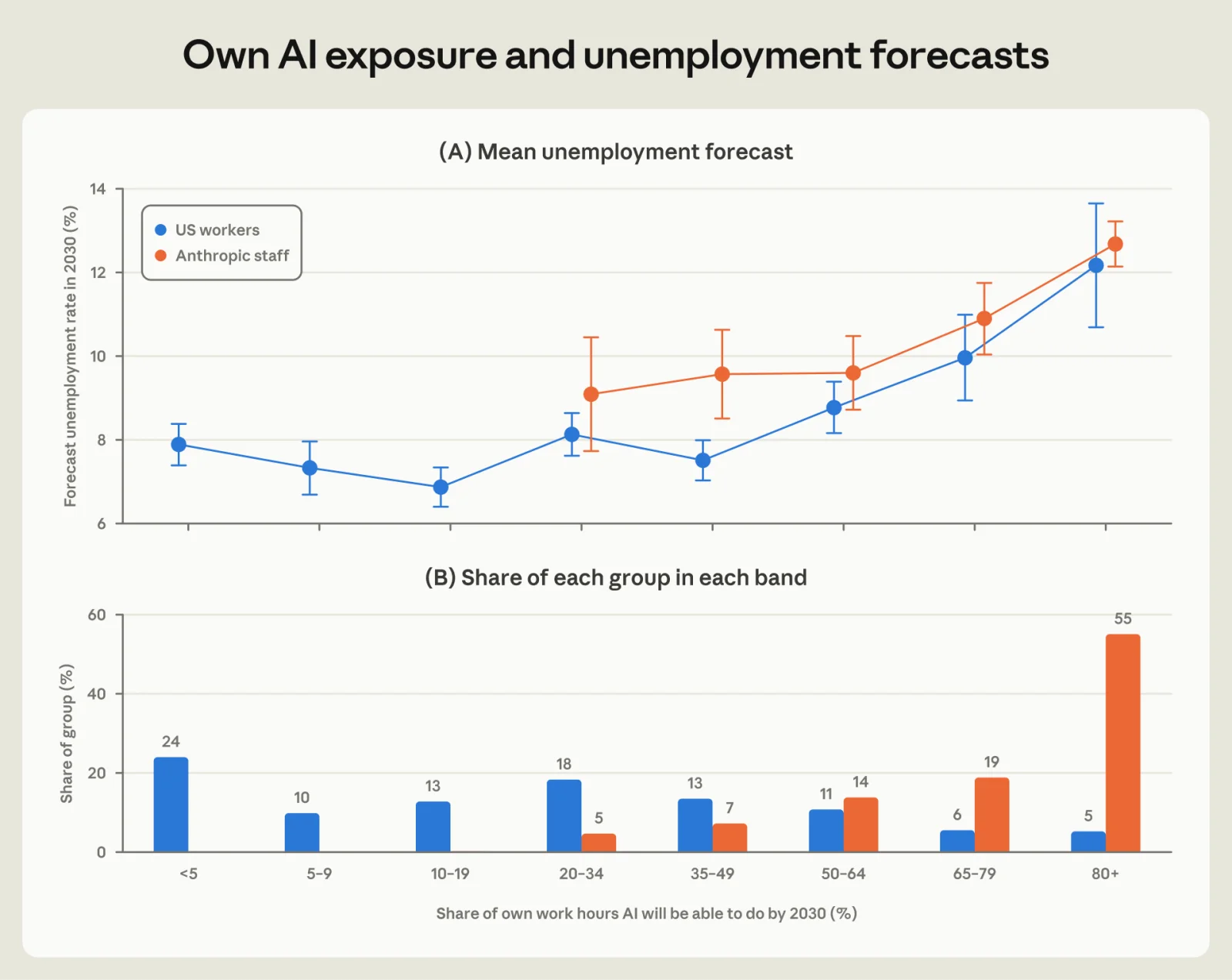 Anthropic AI expectations gap chart: 2030 unemployment forecast by share of own work AI can do
Image: Anthropic
Anthropic AI expectations gap chart: 2030 unemployment forecast by share of own work AI can do
Image: Anthropic
On their own work, staff averaged 75% of current hours handled by AI by 2030, and more than half expect at least 80%. Only about 1 in 20 US workers expect 80% or more. By occupation, US workers in manual trades, production and transport expect 25%, computer, engineering and science workers expect 33%, and regular AI users in that last group say 40%.
The unemployment forecasts (the current rate was given as 4.2%) are the shared ground:
- Workers expecting AI to do under half their work forecast 7-8% unemployment in 2030.
- Those expecting 80% or more forecast 12.2%, above the Great Financial Crisis peak.
- Each extra 10 points of exposed work is associated with about 0.4 points more forecast unemployment among US workers.
- Staff show the same gradient, and at equal exposure both groups forecast similar unemployment.
Anthropic's conclusion is that the groups hold similar models of how AI affects labor markets and differ in beliefs about capability. On reemployment, staff think a displaced worker needs a median of 12 months to move to a new occupation, versus a 7-12 month range for the median US adult.
What does it imply for GDP?
The authors ran each respondent's answers on capabilities, diffusion, automation, productivity and transition frictions through the model from "Economic Scenarios for Transformative AI", holding other parameters at the "Substantial" scenario. The scenarios in that paper are Modest (2.4% annual growth), Substantial (5.4%) and Extreme (15.4%).
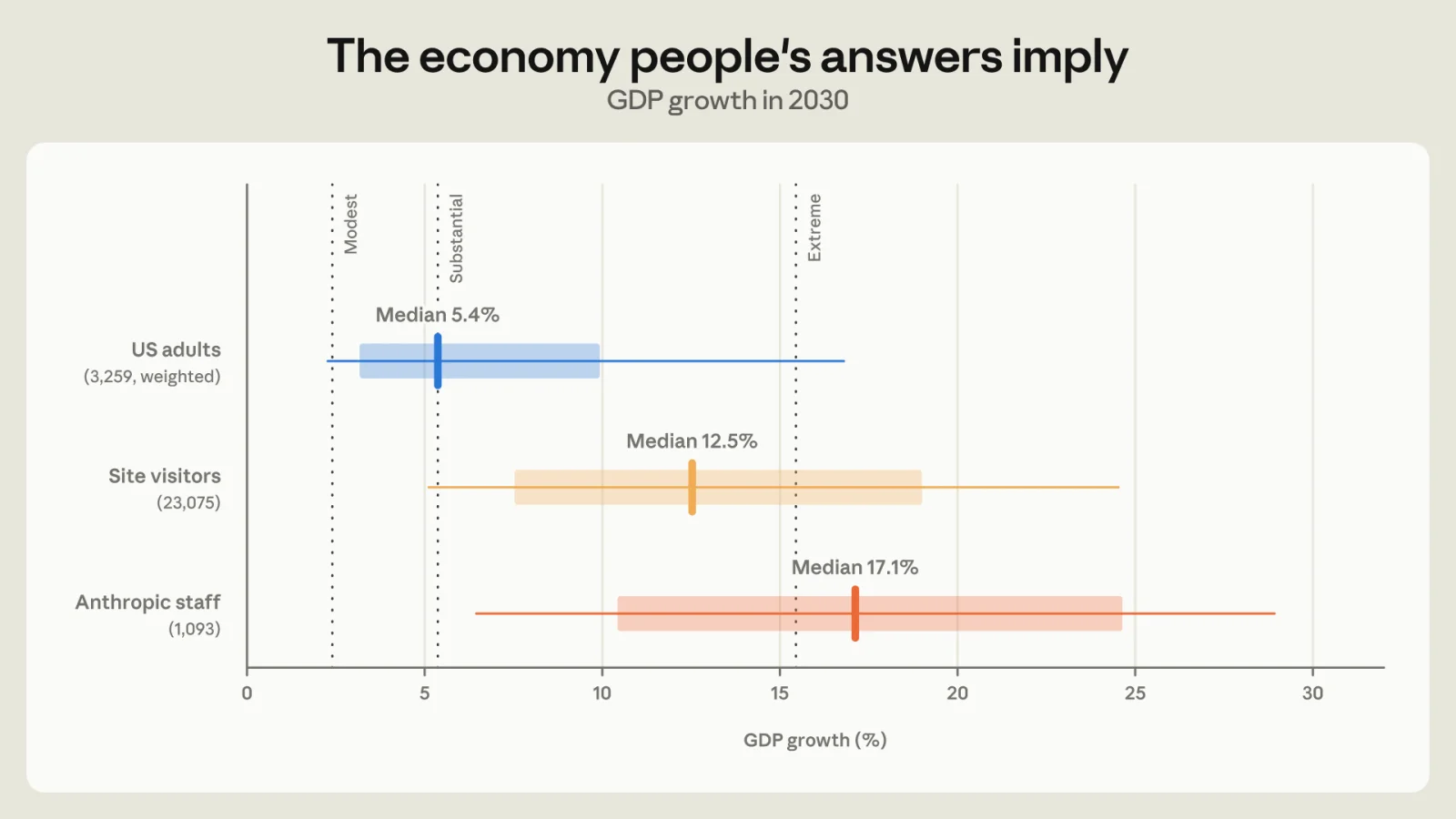 Chart of model-implied 2030 GDP growth from US adults, website visitors and Anthropic staff expectations
Image: Anthropic
Chart of model-implied 2030 GDP growth from US adults, website visitors and Anthropic staff expectations
Image: Anthropic
The medians: 5.4% for US adults, 12.5% for web-quiz visitors, and 17.1% for staff. The staff median implies GDP roughly doubling every four and a half years by 2030, which the authors call historically unprecedented. We covered the scenario framework itself in Anthropic's GDP scenarios for 2030; for the opposing view, see Acemoglu's 1.5% growth forecast.
Inside the lab: how much of AI is built by AI?
Staff estimated the share of work in building a frontier model that AI does today at a median of 51%, rising to 80% by end of 2027 and 95% by end of 2030. Research teams put today's share at 60%, versus 53% for other respondents. Those are opinions in an internal poll, not a measurement, and the authors say so. Separately, 95% of staff expect Anthropic's headcount to grow in the next 12 months, with a median guess of 66% growth and 27% expecting it to at least double; the authors emphasize these are personal views and not company plans.
Limits and how to read the results
- Different answer formats: staff used a slider, US adults chose ranges, and the paper uses midpoints.
- Self-selection and opt-in panels can skew toward people comfortable online.
- The staff sample is unweighted and from a single, highly exposed employer.
- Stated expectations are not forecasts; people are poor at predicting both technology and labor markets.
- The company that wrote the paper sells AI. The data is useful, but independent replication would strengthen it.
What this means for builders and learners
If your customers are the general public, expect them to be less convinced and more privacy-minded than your team. Design for verifiability and keep a human review path, since the "verification tax" is the part many regular users report. If you are deciding how to learn or hire, note the one actionable lead in the data: regular users hold views closer to staff, so hands-on use changes expectations faster than reading about it. For teams deploying autonomous agents, AgentBeam, the agent security platform from the explainx.ai team, stops AI agents before they take dangerous actions.
Related reading
- How employment is changing at Anthropic
- Anthropic AI GDP scenarios for 2030
- Fact check: Anthropic's "81% of US jobs" claim
- Acemoglu's bearish AI forecast
- Why 98% of households do not pay for AI
- Mercor benchmark map of working hours
Figures are accurate as of October 16, 2026 and come from Anthropic's published report.