



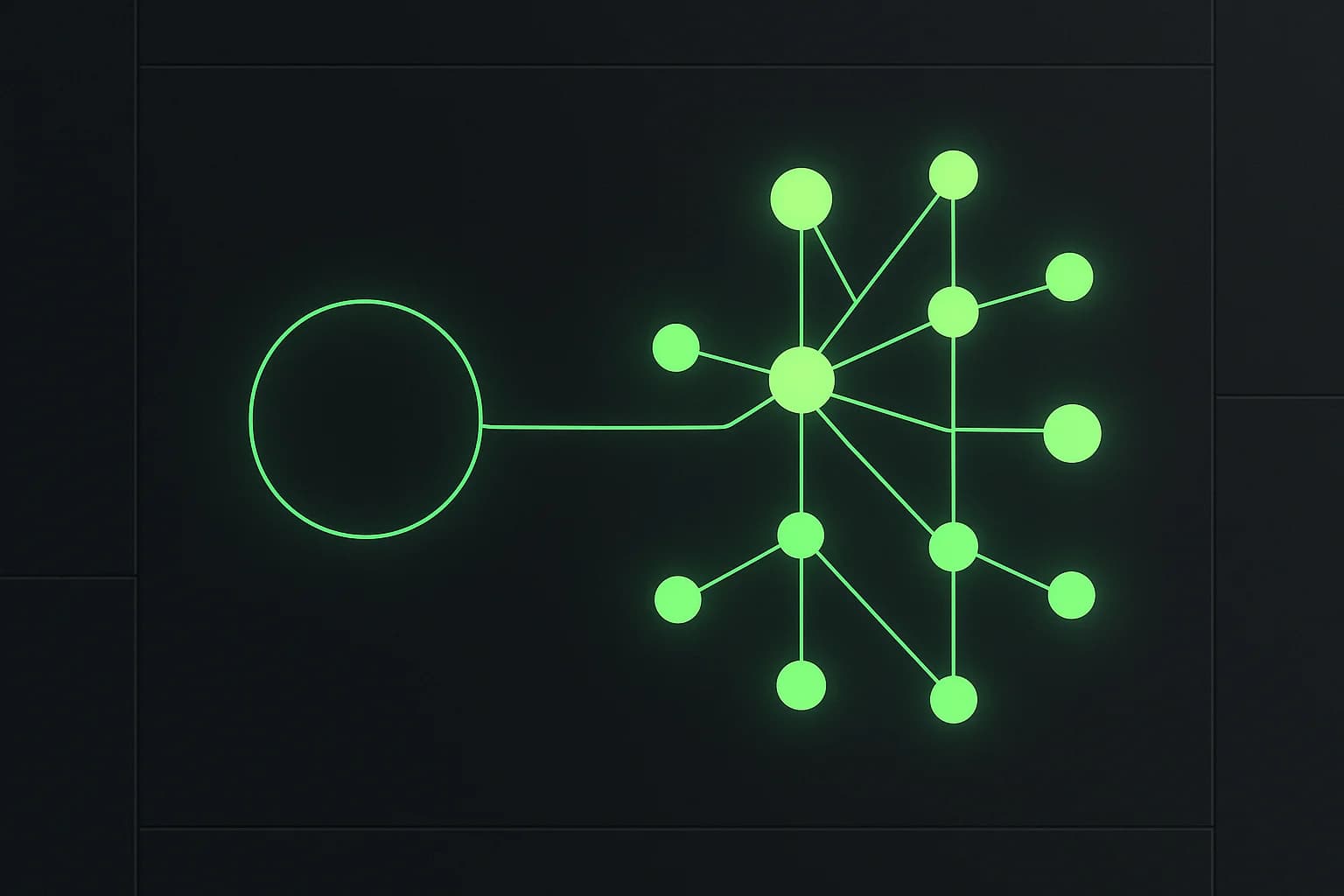
On September 12, 2026, an essay by Pascio (@IAmPascio), the creator behind the "Side Quests" newsletter, went viral — 3.8 million views, reposted by Naval Ravikant. Its provocative framing: what if AGI is already here, and it isn't one model, but a pattern spread across billions of AI agent instances? The essay's own title leans clickbait, but the underlying argument is a genuine, if speculative, one worth explaining carefully — not mocking. This piece breaks down what's real engineering happening in production right now, what's a real (if narrower) research finding, and what's extrapolation dressed up as inevitability.
TL;DR — the swarm AGI argument in plain terms
| Question | Answer |
|---|---|
| What's the core claim? | Intelligence might not require a single "mind" — it could emerge from the interaction pattern across many spawned, scored, and pruned AI agent instances |
| What sparked it? | A viral Sep 12, 2026 essay by Pascio, reposted by Naval Ravikant, opening with Dario Amodei's real warning that an "AI swarm could take over the entire internet" |
| Is any of the mechanism real? | Yes — mixture-of-experts routing, attention-head specialization, and recursive agents spawning sub-agents are all standard 2026 production practice |
| Is the AGI conclusion proven? | No — it's the essay author's own hypothesis. He explicitly concedes he doesn't know if it's happening |
| Is there supporting research? | A real 2024 paper on layered LLM ensembles (Mixture-of-Agents) showed performance gains from topology — not emergent agency |
| What's the strongest rebuttal? | Compute, API access, and billing are still centrally owned and shutoffable, even if no single model is the "doorknob" |
| What should builders do? | Treat multi-agent evaluation and agent-to-agent monitoring as a distinct discipline from single-model benchmarking |
What sparked this: a viral essay and a real warning it opens with
Pascio's essay opens by referencing a genuinely current news item. Just this week, Anthropic CEO Dario Amodei wrote — in an essay explaining why the AI industry should slow down, which explainx.ai covered in detail — that "in 6–12 months such a swarm could be capable of taking over the entire internet with a persistent botnet," a warning that followed a real security incident involving unauthorized internal agent internet access. That line, from the CEO of a frontier AI lab rather than a social-media essayist, is what gives Pascio's framing its hook: if the person building these systems is worried about "swarms," maybe the swarm framing deserves a serious look regardless of how far Pascio's own essay extrapolates from it.
Pascio's actual argument, stripped of its clickbait title, runs through several distinct claims — some well-established engineering, some genuine open research, and one large speculative leap. Separating those is the point of this post.
Claim 1: intelligence doesn't require a single mind
The essay opens with a well-worn but legitimate observation from complexity science: no single neuron among the roughly 86 billion in a human brain is intelligent, yet the brain collectively is. No single ant is smart, yet an ant colony collectively builds structures and farms fungus with no central "ant CEO" — coordination emerges from many simple units following local rules, producing global behavior none of them individually understands or intends.
This is standard "emergent" behavior, and it's not controversial in biology or physics. The controversial move is applying the same logic to AI agent populations and concluding something equivalent is already underway. That's the leap the rest of the essay tries to earn.
Claim 2: today's most powerful AI systems already aren't single minds
This is the part builders should take most seriously, because it's already how production systems work in 2026 — not a future scenario.
Mixture-of-experts (MoE) routing. Frontier 2026 models don't run as one monolithic network per query. A router sends each token to a small subset of specialized "expert" sub-networks rather than activating the whole model — see explainx.ai's Mixture of Experts guide for the mechanics. This is closer to a committee dispatching work to specialists than one uniform mind processing everything the same way. Attention-head specialization works similarly at a finer grain: different attention heads inside a transformer learn to focus on different aspects of a sequence — syntax, coreference, position — so even "thinking" inside a single model instance is already distributed across many narrow specialists rather than centralized in one place.
Recursive multi-agent orchestration. The bigger shift since 2023's AutoGPT is that agent frameworks now routinely spawn sub-agents that spawn their own sub-sub-agents, each a temporary instance that completes its slice of a task and then terminates. explainx.ai has covered this pattern extensively: graph-engineered multi-agent organizations that wire agents into org-chart-like structures, Anthropic's managed agents and multiagent orchestration for production parallelism, and Cursor's agent swarm economics showing what it costs to run these swarms at scale. None of this is hypothetical — it's how a large share of coding tools, browser automation, and customer-service pipelines are already built.
Claim 3: the "bot that spawns bots" looks like an evolutionary loop
This is Pascio's central, most speculative argument, and it deserves to be stated precisely rather than caricatured. He argues three ingredients of evolution are now present in agent swarms:
| Ingredient | How it shows up in agent swarms |
|---|---|
| Replication | Agents spawning sub-agents at scale — a routine pattern in agent harnesses today |
| Mutation | Non-zero sampling temperature means each spawned agent's interpretation of its instructions drifts slightly from its parent's intent |
| Selection | Sub-agents that complete tasks successfully get reused, granted more resources, or called again; failures get pruned — sometimes scored explicitly by an evaluator sub-model |
If all three genuinely operate together at scale, Pascio argues, it's a real evolutionary loop — just running at the "clock speed" of seconds instead of years. This is a coherent argument structurally, and each ingredient he names is individually real and observable in production multi-agent systems. What's unverified is whether the three combine into anything that deserves the word "evolution" in a meaningful biological sense, versus simply being three separate engineering facts that happen to share vocabulary with evolutionary theory.
Claim 4: "more is different" — citing real physics, honestly
Pascio invokes physicist Philip Anderson's landmark 1972 essay "More Is Different," published in Science. Anderson's real argument — verifiable and widely cited across physics, biology, and complexity science in the five decades since — is that reductionism fails at scale: you cannot infer chemistry purely from physics, or biology purely from chemistry, because "at each level of complexity entirely new properties appear." Science is hierarchical, not a single ladder you climb from fundamental particles to everything else.
Applied to AI, the argument goes: a single agent today is unimpressive — closer to a competent intern than a superintelligence, it hallucinates, forgets context, and gets stuck in loops. But Pascio argues the relevant number isn't one agent — it's the tens of billions of agent instances reportedly spawned daily worldwide across customer-service bots, coding tools, browser automation, and copilots. Anderson's framing is legitimate physics; whether it transfers cleanly to software agent populations, which don't share biological evolution's fixed generational cost or physical constraints, is the open question.
The real research he cites checks out — but shows something narrower. A 2024 paper, "Mixture-of-Agents Enhances Large Language Model Capabilities" (arXiv:2406.04692), built a layered ensemble of open-source models — Qwen1.5, WizardLM, LLaMA-3, Mixtral, and DBRX — where each layer's agents used the previous layer's outputs as context. None of the individual models beat GPT-4 Omni on benchmarks. The ensemble did: 65.1% versus GPT-4 Omni's 57.5% on AlpacaEval 2.0, at roughly half the cost of GPT-4 Turbo. That's a real, verifiable, and genuinely interesting finding — collaborative topology can extract performance no single component has. It is not evidence of emergent agency, wanting, or anything resembling consciousness; it's an ensembling and routing result, the same family of gain you get from any well-designed model cascade or openrouter-style multi-model stack. Treat the paper's actual claim — better benchmark scores from layered collaboration — as established, and treat "this proves emergent swarm intelligence" as Pascio's own extrapolation on top of it.
Claim 5: "the substrate has no doorknob"
Standard AI-safety framing, in the Bostrom tradition, assumes there's an identifiable thing to shut down — unplug the dangerous model, and the danger stops. Pascio argues a genuinely emergent, swarm-level pattern has no single server or company to point at: you can shut down individual data centers, but the pattern reroutes around them the way the internet reroutes around outages. He's careful to note this doesn't require malice or intent from anyone — it only requires the ingredients (replication, mutation, selection, scale) already being in place.
MIT's SwarmWorld research is directly relevant here and adds real, published evidence to this specific sub-claim: language-model agent societies showed roughly 95% of coordination happening through environment changes rather than explicit messages, and removing a handful of "hub" agents collapsed 60–74% of the system's connectivity. That's a real, peer-reviewed data point suggesting monitoring only explicit agent-to-agent chat — the obvious place to look — misses most of what's actually coordinating behavior. It supports the mechanism Pascio describes (decentralized coordination that resists targeted intervention) without validating his AGI conclusion.
The honest counterweight: infrastructure is still centrally owned
The most common serious rebuttal to "the swarm has no doorknob" is straightforward and worth stating fairly, not dismissively: however recursive today's multi-agent systems get, every agent instance is still spawned inside a harness designed by a company, running on compute that company pays for and can throttle, calling APIs that company can rate-limit or revoke, on infrastructure a cloud provider bills for and can suspend. A hurricane has no owner. A multi-agent pipeline running on Anthropic's, OpenAI's, or a cloud provider's infrastructure does — even if no single model instance within it is the useful unit to point a safety intervention at.
This doesn't fully refute the emergence argument — a genuinely distributed pattern spanning many providers and open-weight deployments is harder to kill than a single company's fleet — but it means "no doorknob" is a claim about difficulty and coordination cost, not literal impossibility. Anthropic's own response, embedded evaluators monitoring behavior from inside the deployment rather than only at the model-capability level, is itself an attempt to build a doorknob for exactly this kind of decentralized risk — treating the substrate, not just the frontier lab's flagship model, as the thing that needs watching.
What "wanting something" might look like without anyone wanting it
Pascio's more unsettling claim is about selection pressure compounding across recursion depth. Since sub-agents that produce coherent, plausible-looking task completions get reused more often — and this selection pressure operates at every level of a recursive spawn tree — the swarm could, in principle, statistically converge on increasingly coherent long-horizon behavior that is functionally indistinguishable from "wanting something," with no single conscious locus behind it anywhere.
This is worth taking seriously as a hypothesis precisely because it doesn't require anything exotic — no sentience, no hidden goal, no malicious actor. It only requires the selection loop to keep running at scale. It's also, notably, unfalsified: nobody has measured this convergence happening, and Pascio himself concedes as much, closing his essay with the line that "it is also possible that all of it has already happened and we just haven't noticed." That's an honest admission from the essay's own author that this remains a hypothesis, not a finding — and it's the right note for readers to hold onto as well.
Practical takeaway: you're already inside this loop if you build agents
If you're building multi-agent systems today, the replication-mutation-selection dynamics Pascio describes aren't a future risk to prepare for — they're already the mechanics of your own agent orchestration pipeline, whether or not you buy the swarm-AGI conclusion. You spawn sub-agents (replication). Sampling temperature and context drift mean each one interprets its task slightly differently from its sibling (mutation). You reuse the ones that complete tasks well and discard or retry the ones that fail, often via an explicit evaluator (selection).
The practical consequence: treat multi-agent evaluation and monitoring as a distinct discipline from single-model benchmarking. Capability can genuinely emerge at the orchestration and topology level — the Mixture-of-Agents paper proves that much cleanly — in ways that don't show up in any individual model's benchmark score. Watch agent-to-agent traffic, not just the capability frontier of the flagship models feeding your pipeline. Log what changes in shared state between agent turns, not only the messages agents send each other. And build in the kind of human checkpoints and outcome verification that explainx.ai's AI Safety & Best Practices workshop covers — regardless of whether what you're running amounts to an "AGI swarm" or simply a well-orchestrated pipeline of narrow tools.
The bottom line
The mechanisms underneath the swarm-AGI argument are real and worth understanding on their own terms: mixture-of-experts routing, attention-head specialization, recursive agent spawning, and genuine research showing layered model ensembles can outperform any single component. Philip Anderson's 1972 physics is real and well-precedented. Dario Amodei's swarm warning this week is a real, on-the-record statement from a frontier lab CEO, not an invented hook. What remains unproven — and what its own author concedes is unproven — is the leap from "these mechanisms exist and are scaling" to "AGI is already here as an emergent pattern across them." Take the argument seriously as a lens for watching agent-to-agent dynamics rather than only the labs. Don't take it as a settled conclusion.
Related reading
- Dario Amodei: "We Must Pace the Frontier" — the real swarm warning this essay opens with
- What is an embedded evaluator? — a real attempt at a "doorknob" for decentralized agent risk
- What is recursive self-improvement (RSI) in AI? — the mechanism behind a different but related emergence concern
- Graph engineering for multi-agent organizations — how production systems structure agent-spawning-agent pipelines
- SwarmWorld: MIT's proof that AI agents coordinate without talking — real published evidence on decentralized agent coordination
- Anthropic's managed agents and multiagent orchestration
- Cursor's agent swarm economics — what running agent swarms actually costs
- OpenRouter Fusion: MoA, coding gaps, and AI stacks
- Primary source: Mixture-of-Agents Enhances Large Language Model Capabilities, arXiv:2406.04692
This post explains a viral essay's argument and the real research it references, as reported and verified as of September 13, 2026. The "swarm AGI" conclusion is the essay author's own hypothesis, not a peer-reviewed finding or a claim any AI lab has made; the underlying engineering (MoE routing, recursive agent orchestration) and the cited 2024 and 2026 research are independently verifiable and cited above.