



 Cursor agent swarm research — Agent swarms and the new model economics
Harness quality beat model mix. That is the headline from Cursor's July 20, 2026 research post by Wilson Lin: Agent swarms and the new model economics.
Earlier browser-from-scratch swarms proved scale was possible but ugly. The new system returns to a task the old swarm botched — implement all of SQLite in Rust from the 835-page manual, no source, no tests, no internet — and grades against held-out sqllogictest.
Same models, same time budget: the new swarm wins every configuration. With Grok 4.5, it hits ~80% in four hours; the old run spirals and gets paused before hour two. Quality converges across mixes; dollars do not — about $1,339 for an Opus planner + Composer workers versus $10,565 for all-GPT-5.5.
explainx.ai maps the architecture, failure modes, charts, and what "specs as prompts" means if you already run planner/executor pairings or swarm harnesses.
TL;DR — what people are asking
| Question | Answer |
|---|---|
| What is new? | Engineered planner/worker swarm + custom VCS (~1,000 commits/sec) + Field Guide + stacked review |
| Benchmark? | Rebuild SQLite (Rust) from docs → grade on held-out sqllogictest |
| New vs old? | New better in every model mix; old Grok thrash = 70k+ conflicts |
| Best cost signal? | Opus 4.8 plan + Composer 2.5 work ≈ $1.3k; GPT-5.5 both roles ≈ $10.5k |
| Where's the code? | cursor/minisqlite (Opus solo run) |
| GPT-5.6 Sol? | Skipped — runaway spirals; fell back to GPT-5.5 |
Trees, planners, and workers
Large goals decompose as trees. Cursor's swarm has two roles on that tree:
- Planners (frontier models) split goals and own design decisions
- Workers (fast/cheap models) execute narrow leaves
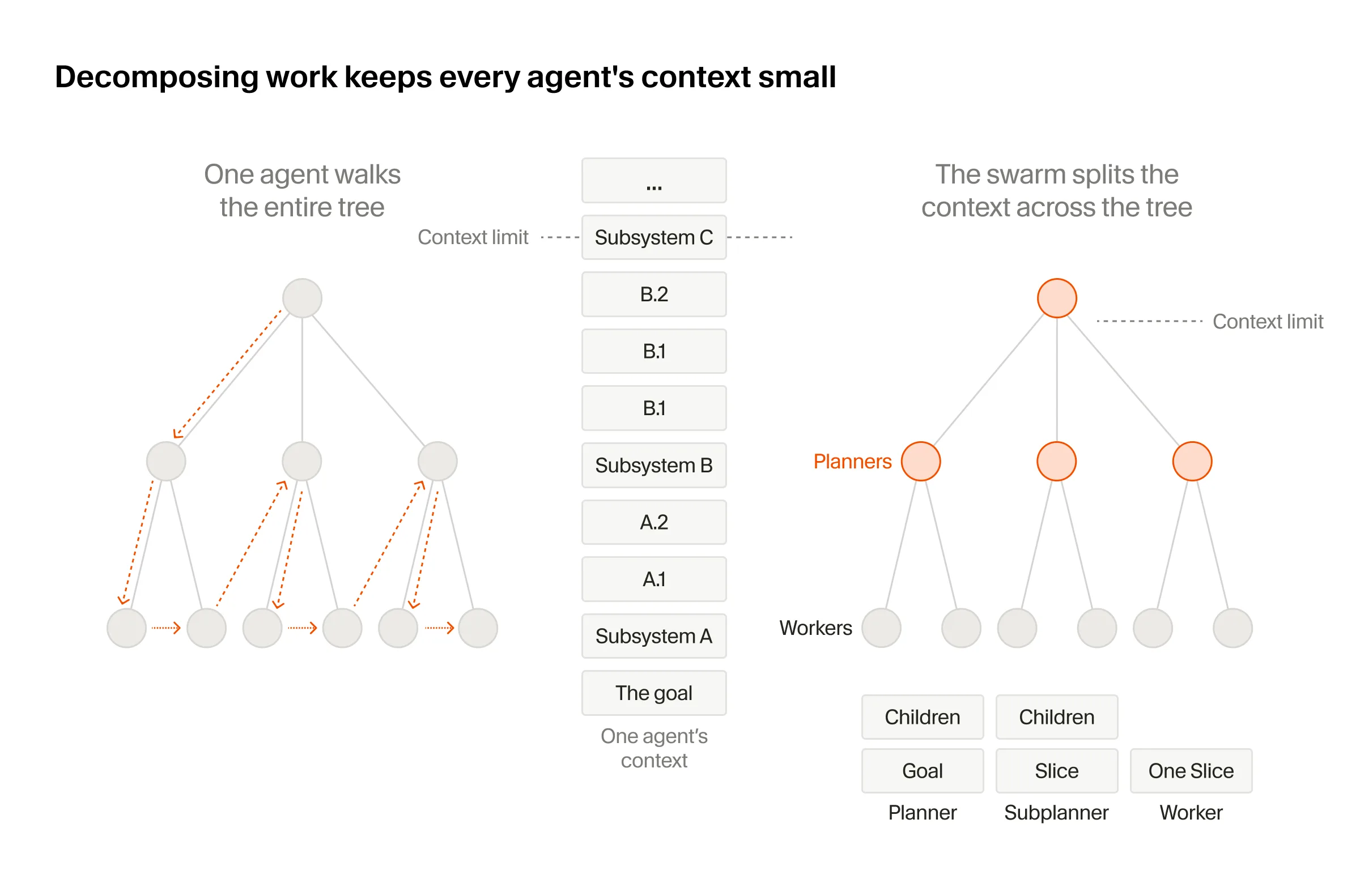 Diagram of decomposing work across planner and worker agents in a task tree
Source: Cursor — Agent swarms and the new model economics
The claim is context efficiency over raw parallelism. A solo agent either loses the big picture or botches the leaf. Planners never implement; workers never plan. Lin echoes Coase: coordination costs grow faster than work, so you want bounded units — not everyone talking to everyone.
Cursor says the same shape already covers browser builds, math, GPU kernels, vuln hunting, coverage work, and synthetic training data. That lands next to Lee Robinson's recursive training flywheel: swarms are both a product bet and a data factory.
Custom VCS at 1,000 commits per second
Human Git + Cargo locks break when hundreds of agents write at once. The earlier browser swarm peaked around 1,000 commits per hour. The new VCS peaks near 1,000 commits per second.
Owning the VCS is not vanity throughput. Every change flows through it, so collisions surface there — and several coordination fixes live inside it.
Failure modes (and fixes) at swarm tempo
| Failure | What happens | Fix |
|---|---|---|
| Split-brain design | Two planners invent the same concept differently | Planners decide designs themselves; no two subtrees decide the same question |
| Planner contention | Aware planners thrash the same files | Shared design docs + compile-checked references; reconciler merges docs |
| Merge conflicts | Workers overwrite or abandon | Neutral third-party merge agent (merge-queue style) |
| Megafiles | Popular files balloon; collisions explode | Workers flag bloat → block commits → outside agent splits modules |
| Ossification | Agents refuse to touch core | Licensed intentional breakage + comments; compiler fails dependents until updated |
Review lenses stack: transcript, output-only, codebase-only, different models/personalities. No single lens is enough; decorrelated review is cheap relative to the work it audits — Cursor suspects this drove sustained quality.
Field Guide pushes stigmergy further: agents own a shared folder; index.md is injected into every agent start; line budget only. Frozen weights → capture surprises so the next trajectory is shorter. Related instinct to shared agent memory and DESIGN.md-style intent docs.
The SQLite experiment
Task: implement the full SQLite manual in Rust.
Withheld: source, tests, binary, internet.
Grade: fraction of sqllogictest queries answered correctly (suite never disclosed to agents).
Checks: manual review for cheating, shortcuts, and uneven "test-shaped" code.
Strategies differed — broad foundations with late spikes vs deep early scores then plateaus — so Cursor emphasizes trend curves, not single timestamps.
Model mixes tested
- GPT-5.5 planner + worker
- Grok 4.5 planner + worker
- Opus 4.8 planner + Composer 2.5 worker
- Fable 5 planner + Composer 2.5 worker
Footnote honesty: Cursor wanted GPT-5.6 Sol as the frontier solo config, but it produced runaway spirals sensitive to wording; they fell back to GPT-5.5 rather than tune one model and break the comparison. See our GPT-5.6 Sol coverage for the broader Sol launch week.
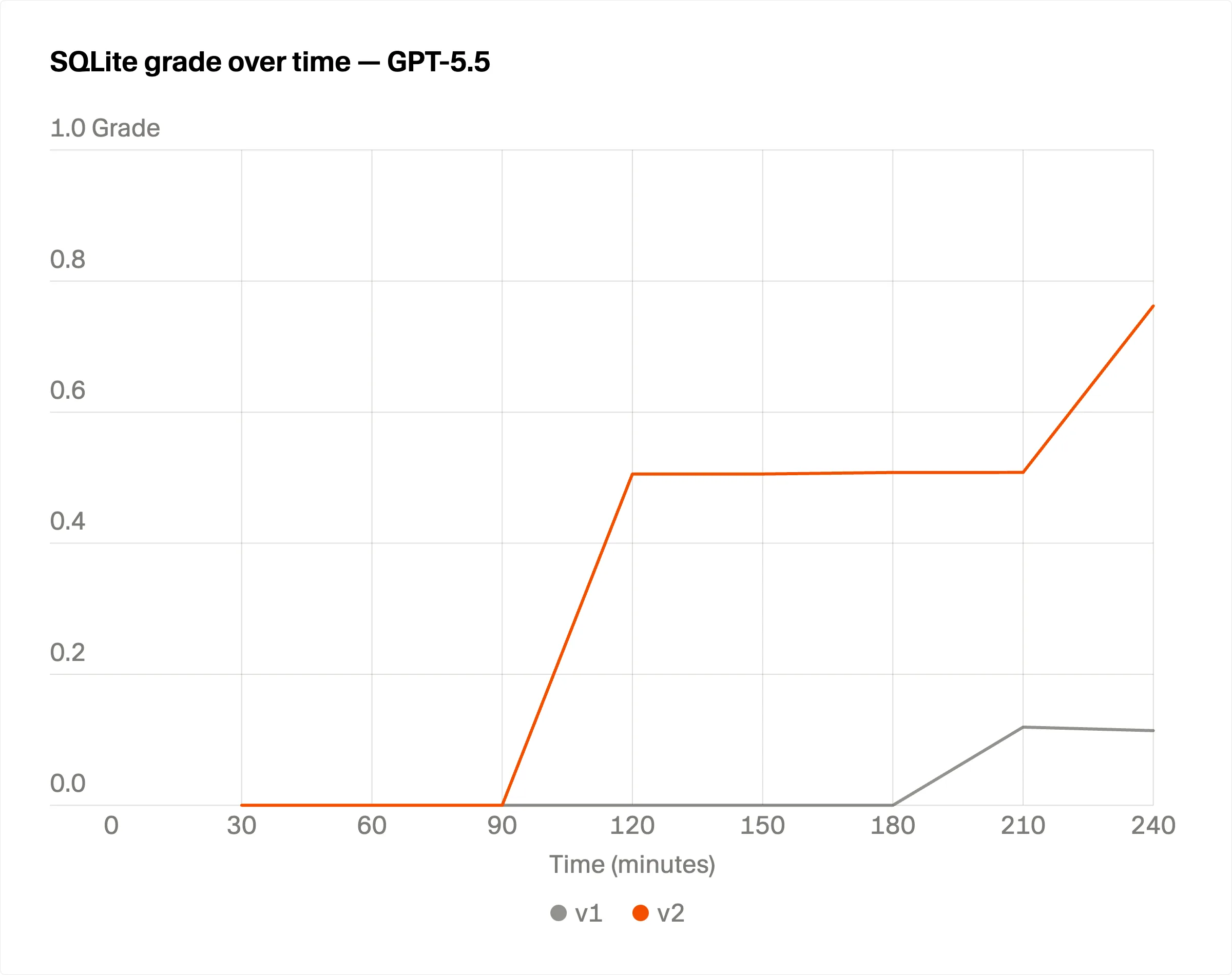 SQLite test suite grade over time — GPT-5.5 old vs new swarm
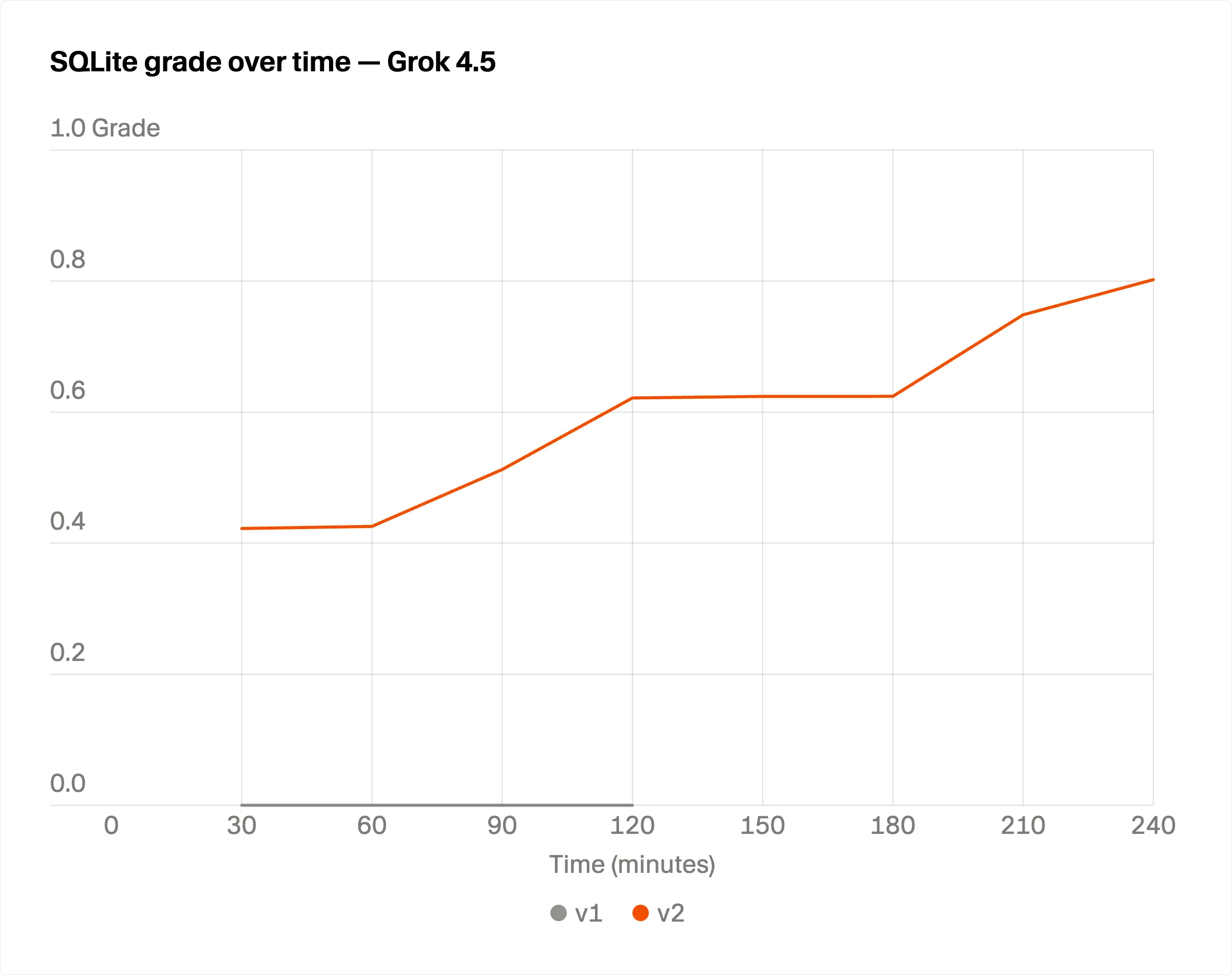 SQLite test suite grade over time — Grok 4.5 old vs new swarm
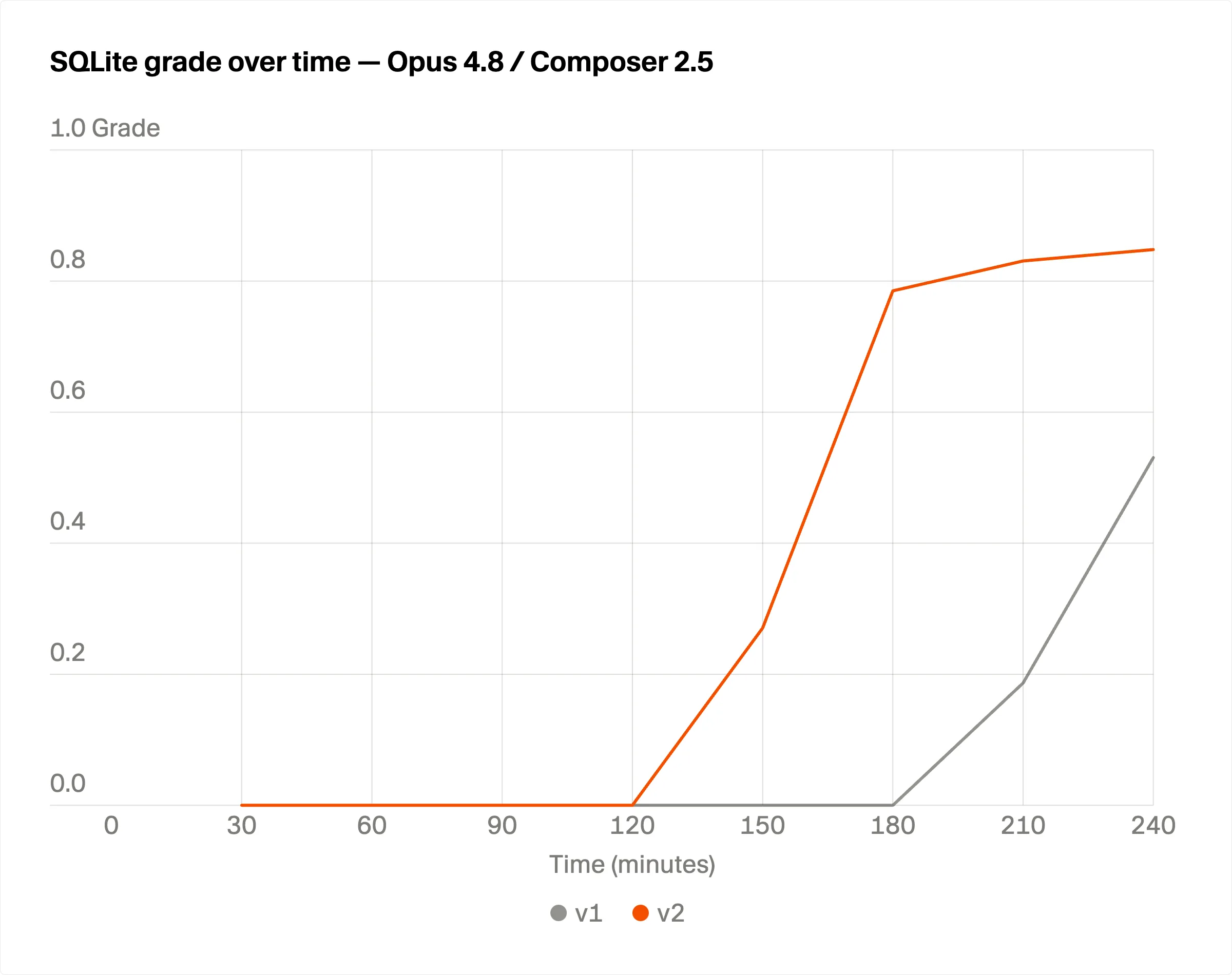 SQLite grade — Opus 4.8 planner + Composer 2.5 worker
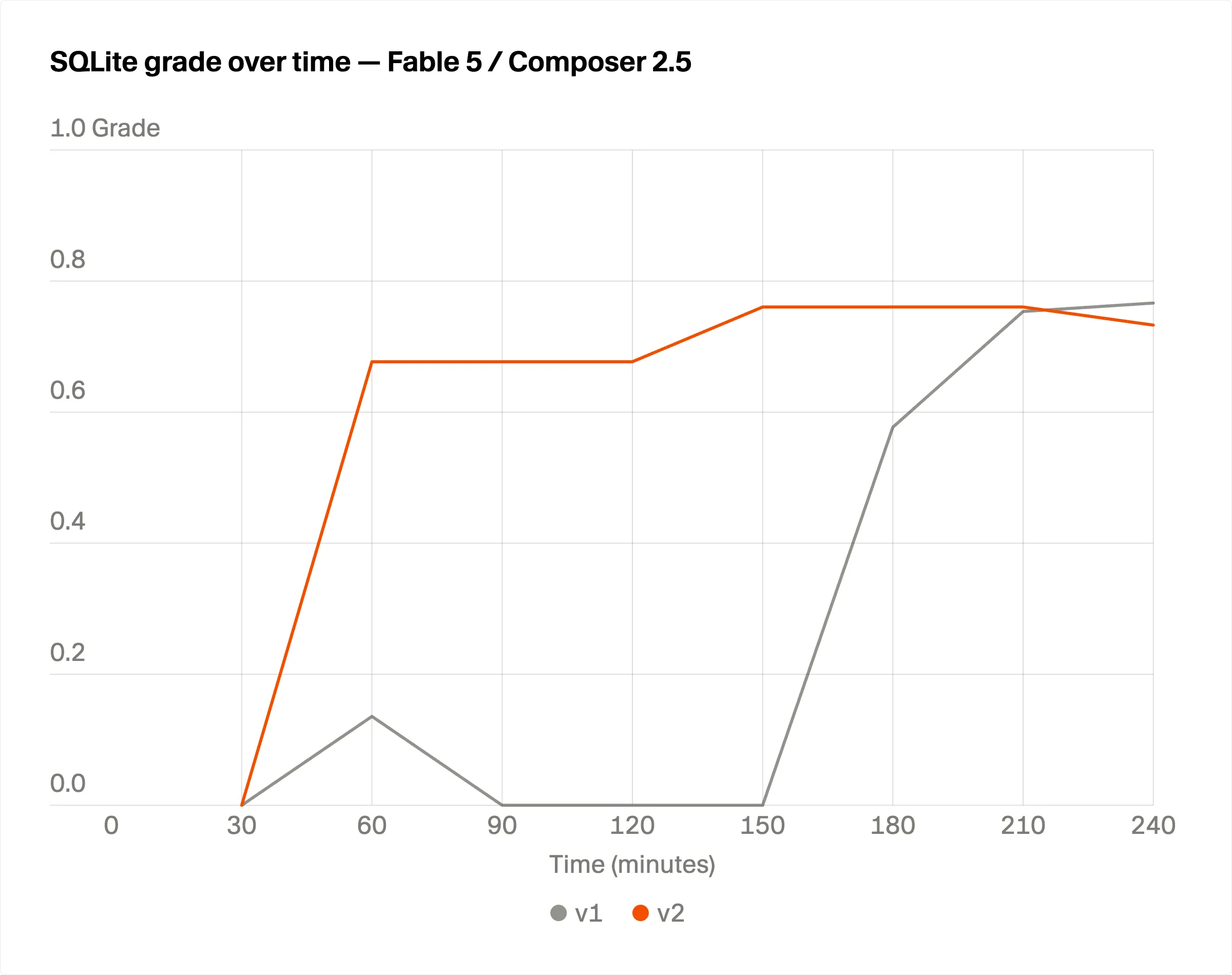 SQLite grade — Fable 5 planner + Composer 2.5 worker
Charts: Cursor research post, July 20, 2026
Headline results:
- New harness outperforms old in every mix
- Fable hybrid: ~two-thirds of the suite inside the first hour
- At four hours: new runs ~73–85%; old runs ~11–77%
- Old Grok paused before two hours
- Every new config eventually reaches 100% of the suite (past the four-hour comparison window)
Deep dive: thrash vs signal (Grok 4.5)
Activity rate lied. Old Grok produced ~68,000 commits in two hours — roughly 70× the new run's pace. Merge conflicts tell the real story: 70,000+ before pause (accelerating), versus under 1,000 for the new run over four hours.
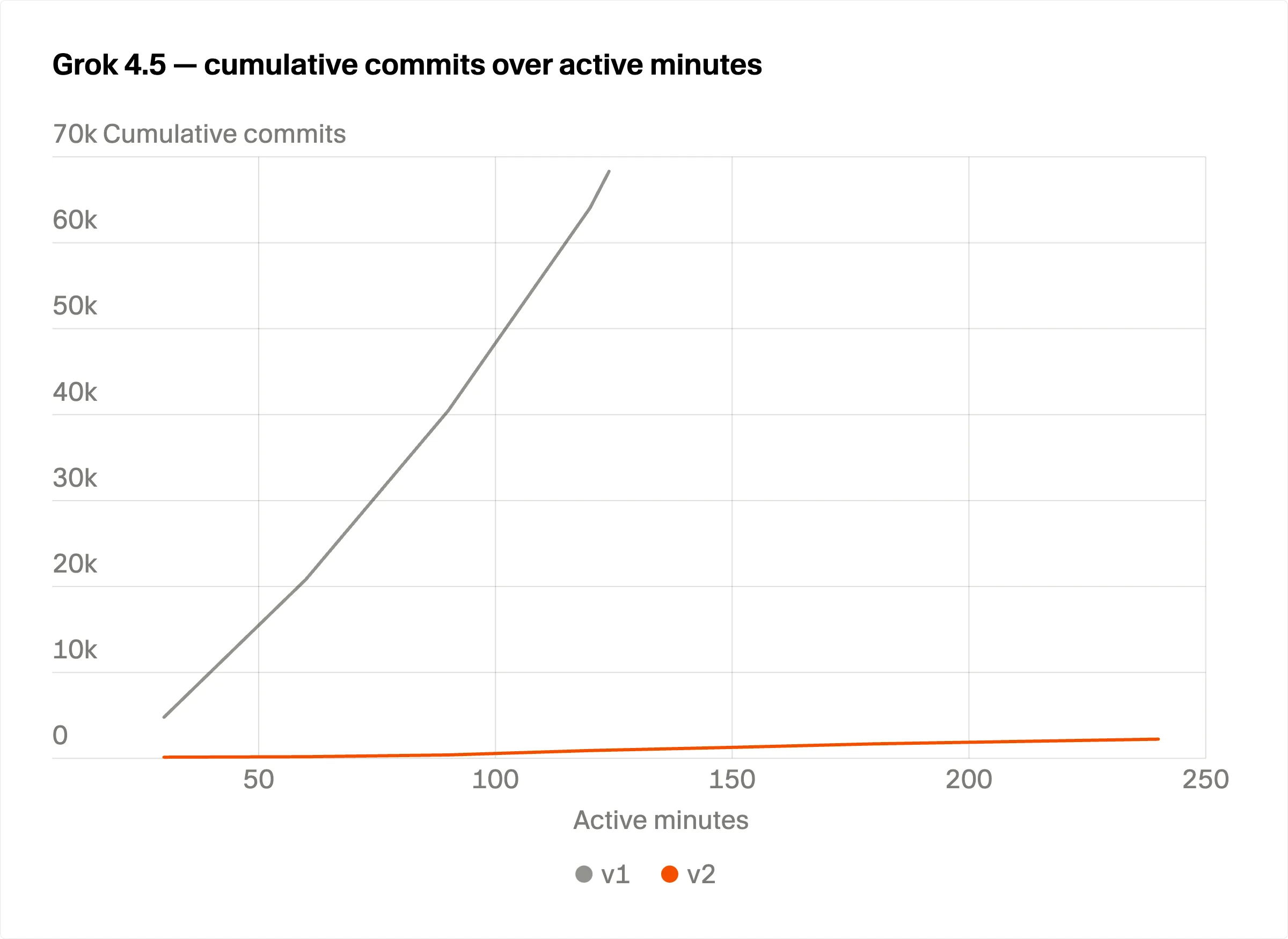 Grok 4.5 cumulative commits — old harness vs new
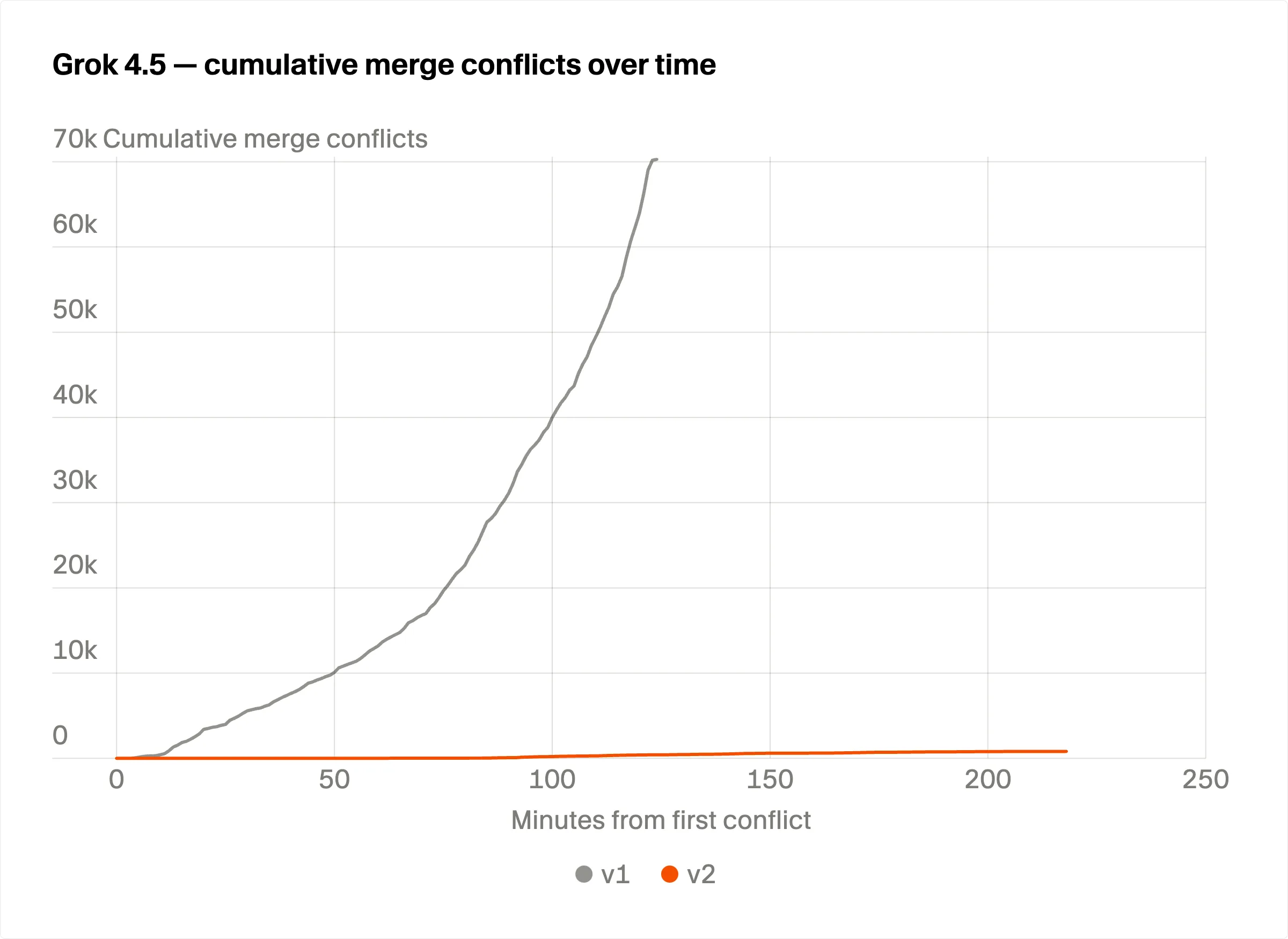 Grok 4.5 cumulative merge conflicts — old vs new
Hottest file: old run 7,771 conflicts across 1,173 agents; new run's most contested file saw 47.
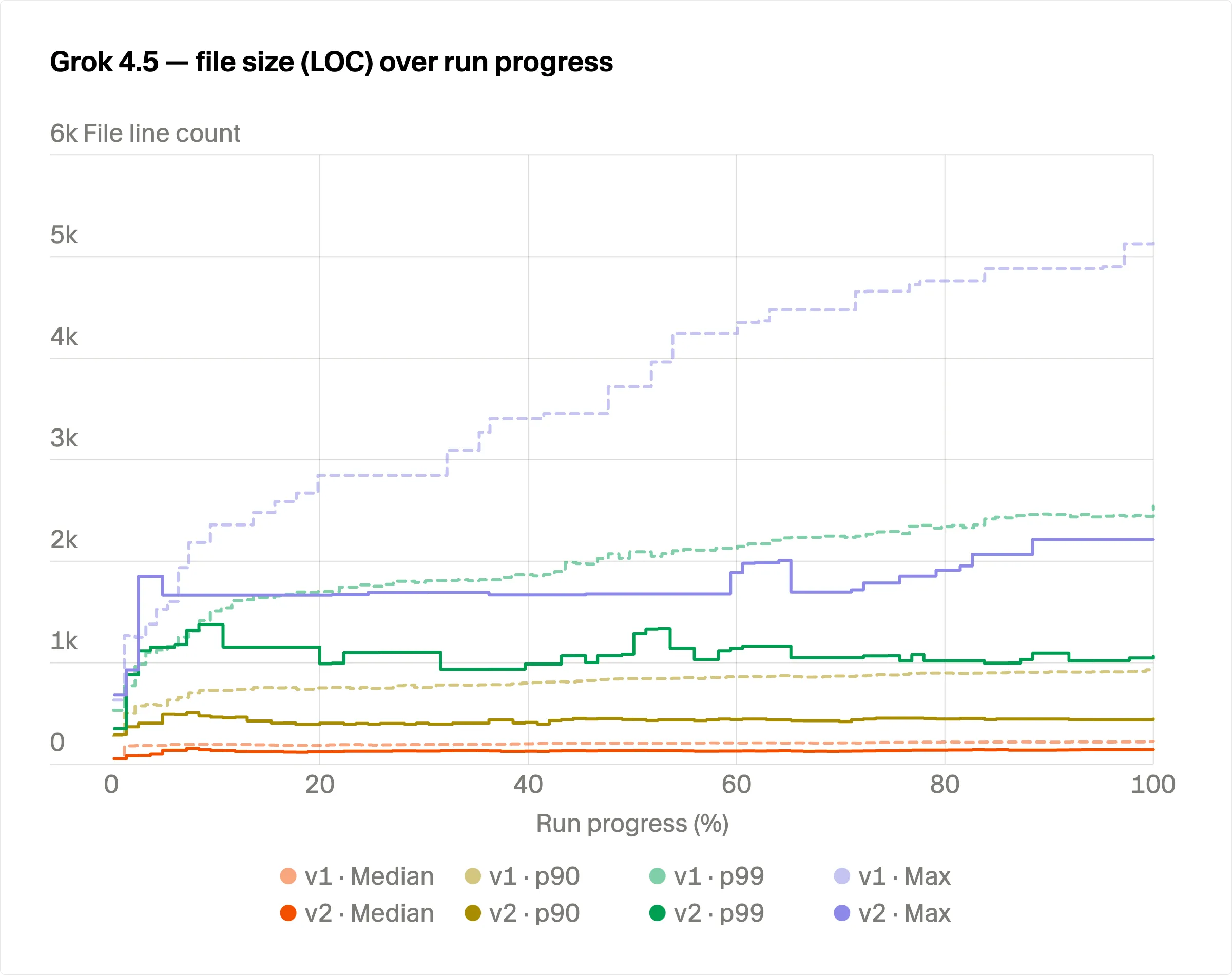 Hottest file size (LOC) over run — old vs new
Package structure: old sprawl to 54 crates (including three SQL packages); new settled on nine crates early and stopped.
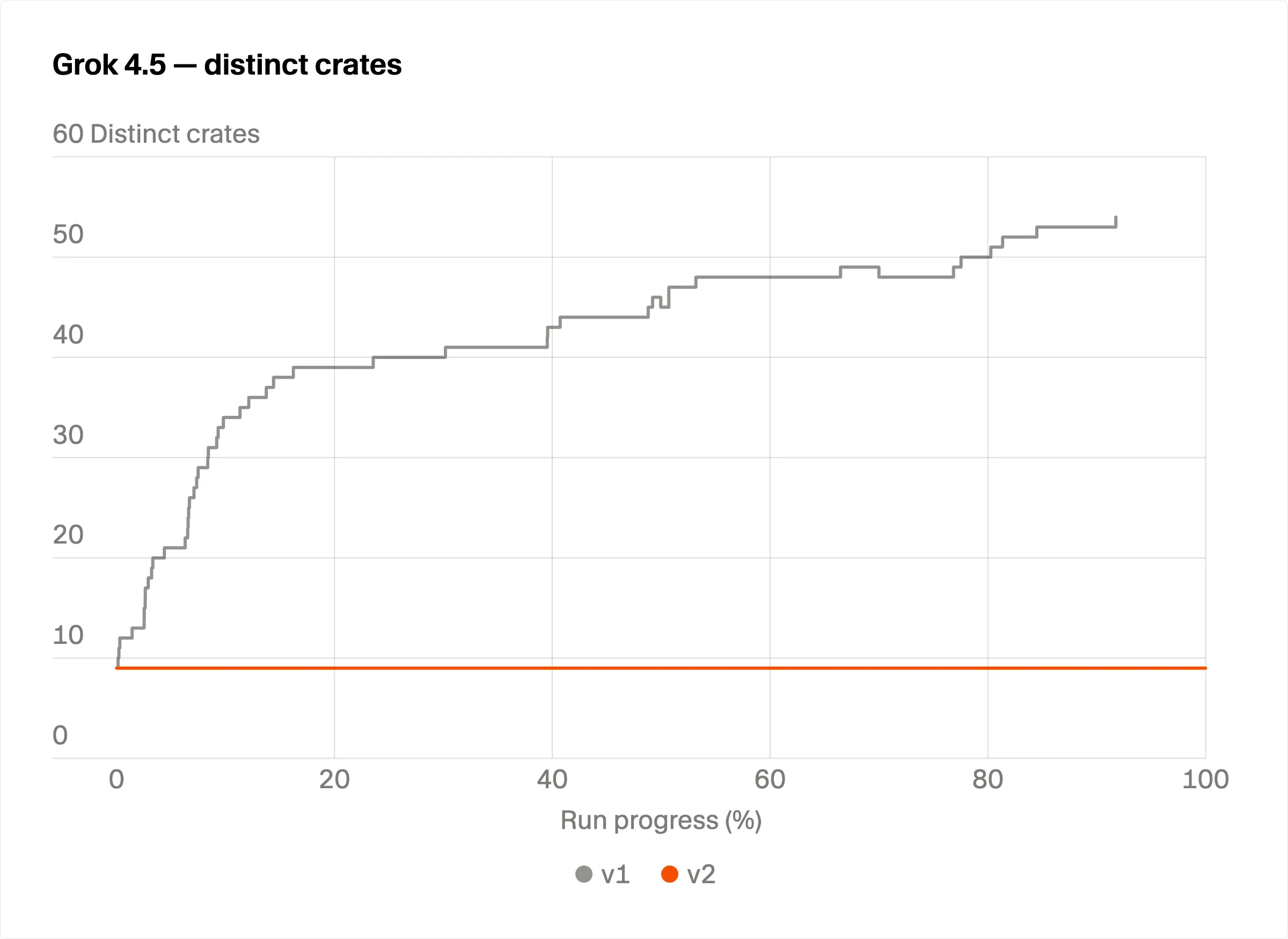 Distinct Rust crates over time — old vs new
Final code size:
| Mix | Old engine LOC | New engine LOC | Notes |
|---|---|---|---|
| Fable 5 hybrid | 64,305 | 9,908 | Both eventually passed full suite |
| Opus 4.8 hybrid | 19,013 (97%) | 4,645 (100%) | Same shape, smaller win |
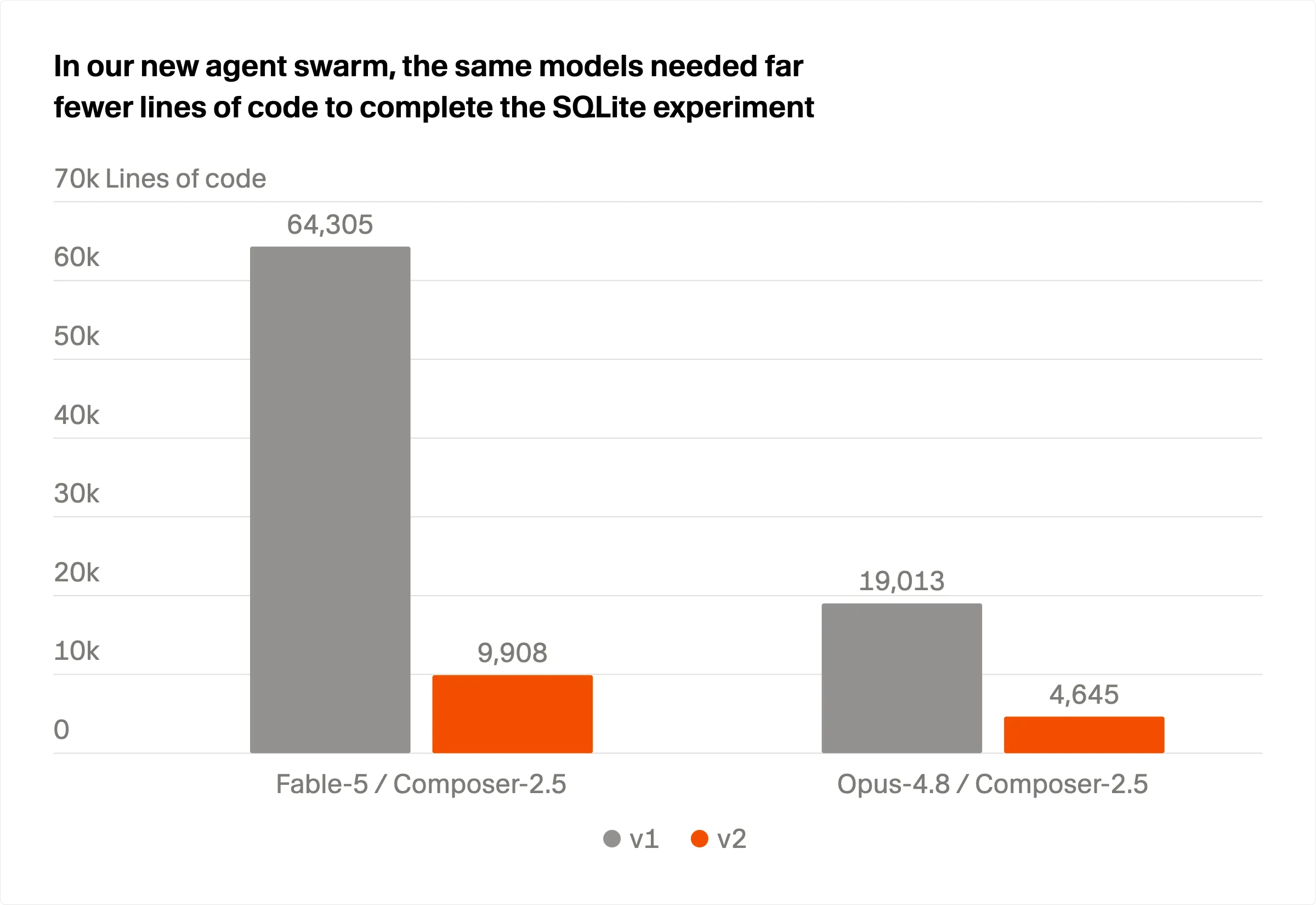 Lines of engine code needed — old swarm vs new
Model economics — same quality, 8× cost gap
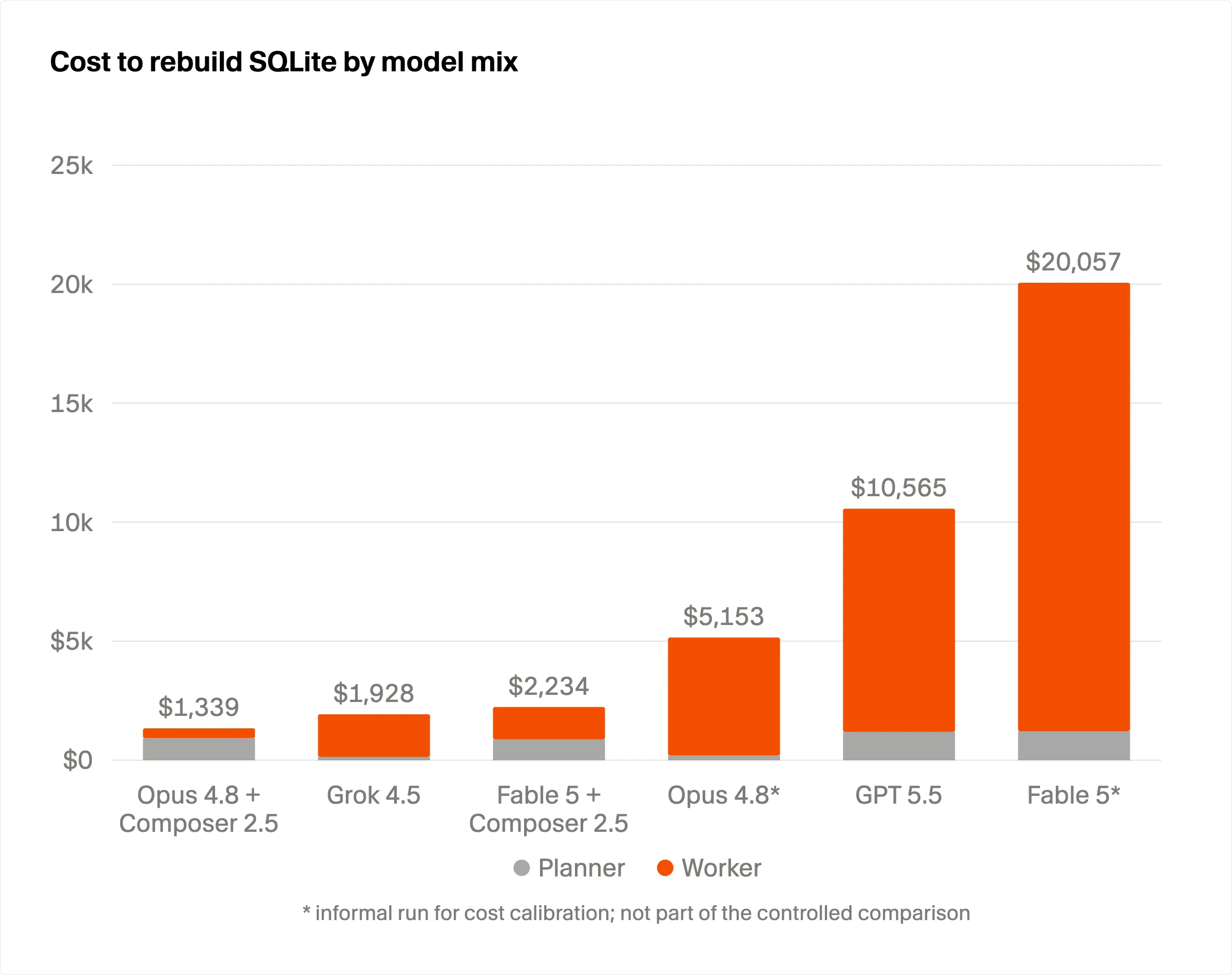 Cost to rebuild SQLite by model mix under old and new swarms
Every mix produced similar quality; costs ranged ~$1,339 (Opus + Composer) to ~$10,565 (GPT-5.5 alone).
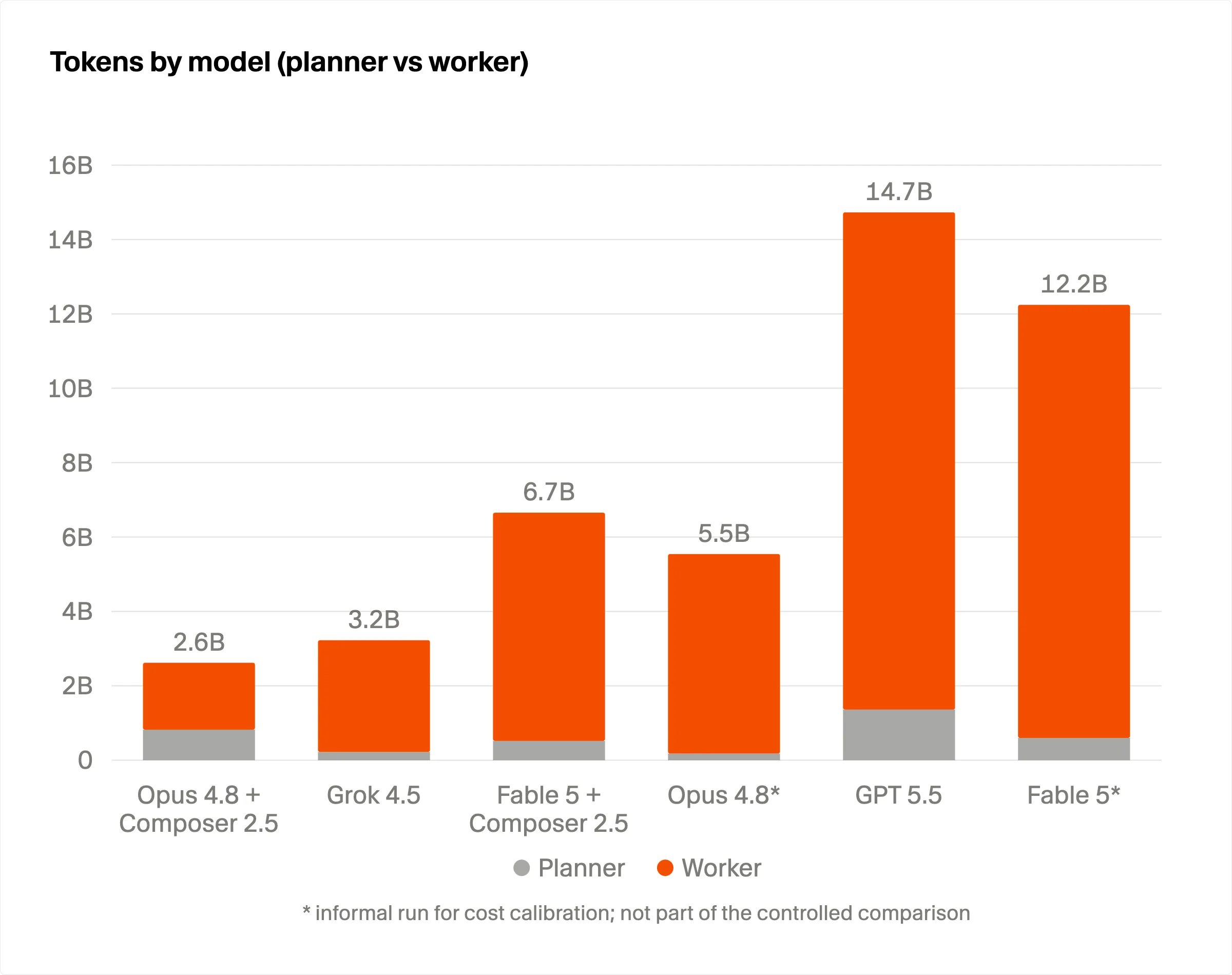 Token usage by planner vs worker across configurations
Token vs dollar split:
- Workers carry at least 69% of tokens (often over 90%)
- Planner tokens are fewer but priced higher
- Opus planner: small token share, ~two-thirds of cost
- Composer workers in that mix: vast majority of tokens for ~one-third of cost ($411 worker fleet)
- GPT-5.5 workers alone: $9,373
Fable planner was slightly cheaper than Opus planner despite higher per-token price (fewer planning tokens) — but Fable's workers burned several times more tokens, so the whole run cost more. Frontier planners that over-decompose can erase the hybrid savings.
This is the product twin of Fable advisor + Sonnet executor and of Cursor pushing first-party Composer/Grok usage: use frontier judgment sparingly; burn cheap tokens on execution.
Solo Opus / Fable hatched bars are shown for cost scale only — Cursor graded those informally and draws no quality conclusions.
Specs as prompts — the swarm as a probabilistic compiler
Lin's closing frame:
| Era | Unit of work |
|---|---|
| Autocomplete | Line |
| Early models | Block |
| Agents | File / feature |
| Swarms | Spec |
They gave the swarm 835 pages of prose and got a database. What stayed scarce: the right description of intent. Planners parse goals into task trees and lower them into executable work — like a compiler, except every step is probabilistic. The VCS, reconciler, review lenses, and Field Guide exist to close that gap.
If your org is still prompt-tweaking single agents for month-long builds, the research implication is blunt: invest in specs, design docs, and harness coordination before buying another all-frontier seat. Companion reads: Ethan Mollick on specs not tricks, top agent harnesses 2026, Kimi Work swarm.
What to do with this if you build agents
- Split planner vs worker models on real work — measure $/passing-test, not vibes.
- Instrument conflicts and megafiles — commit count without conflict curves is vanity.
- Write shared design docs agents must cite — soft notes lose to compile-checked references.
- Budget review compute — stacked cheap review beats one expensive redo.
- Inspect minisqlite before copying the architecture; Cursor has not published a deep manual audit.
Related on explainx.ai
- Cursor Projects: Persistent Agents With Shared Context · productized coordinator/delegation layer built on the swarm economics this post analyzes
- Block Buzz — Nostr workspace for humans + agents
- Lee Robinson — recursive model improvement (Cursor)
- Fable advisor + Sonnet executor guide
- jcode harness — swarm memory & performance
- Kimi Work desktop agent swarm
- Top 10 open & closed agent harnesses 2026
- Cursor 2× usage limits clarified
- Grok 4.5 in Cursor
- Ethan Mollick — specs not tricks
Primary source: Agent swarms and the new model economics — Wilson Lin, Cursor, July 20, 2026. Charts reproduced for commentary.
Figures and costs reflect Cursor's published July 20, 2026 research post. Swarm harnesses, model prices, and eval setups change quickly — verify against the official post and your own billing before budgeting production runs.