



Prime Intellect launched Model Factory on November 18, 2026 as a single control plane for training, evaluation, deployment, and continuous improvement of open-weight models. The announcement blog and Model Factory overview describe a loop frontier labs already run internally: RL or SFT on hosted GPUs, benchmark on verifiers environments, promote checkpoints to dedicated endpoints, and feed Prime Traces from production back into the next run.
If you already used Prime Inference for serverless open models, Model Factory is the bring-your-own-specialist path: train a model on your tasks, serve it on the same API surface, and keep iterating without exporting weights through manual Hugging Face conversion for every step.
TL;DR
| Stage | Prime Intellect surface |
|---|---|
| Train | Hosted RL, SFT, or pretraining via prime train |
| Evaluate | Environments Hub / verifiers |
| Deploy | Dedicated endpoints; deploy-checkpoint from a run |
| Improve | Prime Traces from endpoints and runs |
| Compute choice | On-demand GPU hours or dedicated clusters |
The loop Prime documents
The overview table is explicit:
| Step | Action | Where |
|---|---|---|
| Train | RL, SFT, or pretraining on an open model | Hosted Training |
| Evaluate | Environments Hub or custom evals | Hosted Evaluations |
| Deploy | Dedicated OpenAI-compatible endpoint | Dedicated Endpoints |
| Improve | Capture failures and traces | Prime Traces |
Prime argues checkpoints stay compatible across steps, so a pause-and-deploy workflow does not break the research trail.
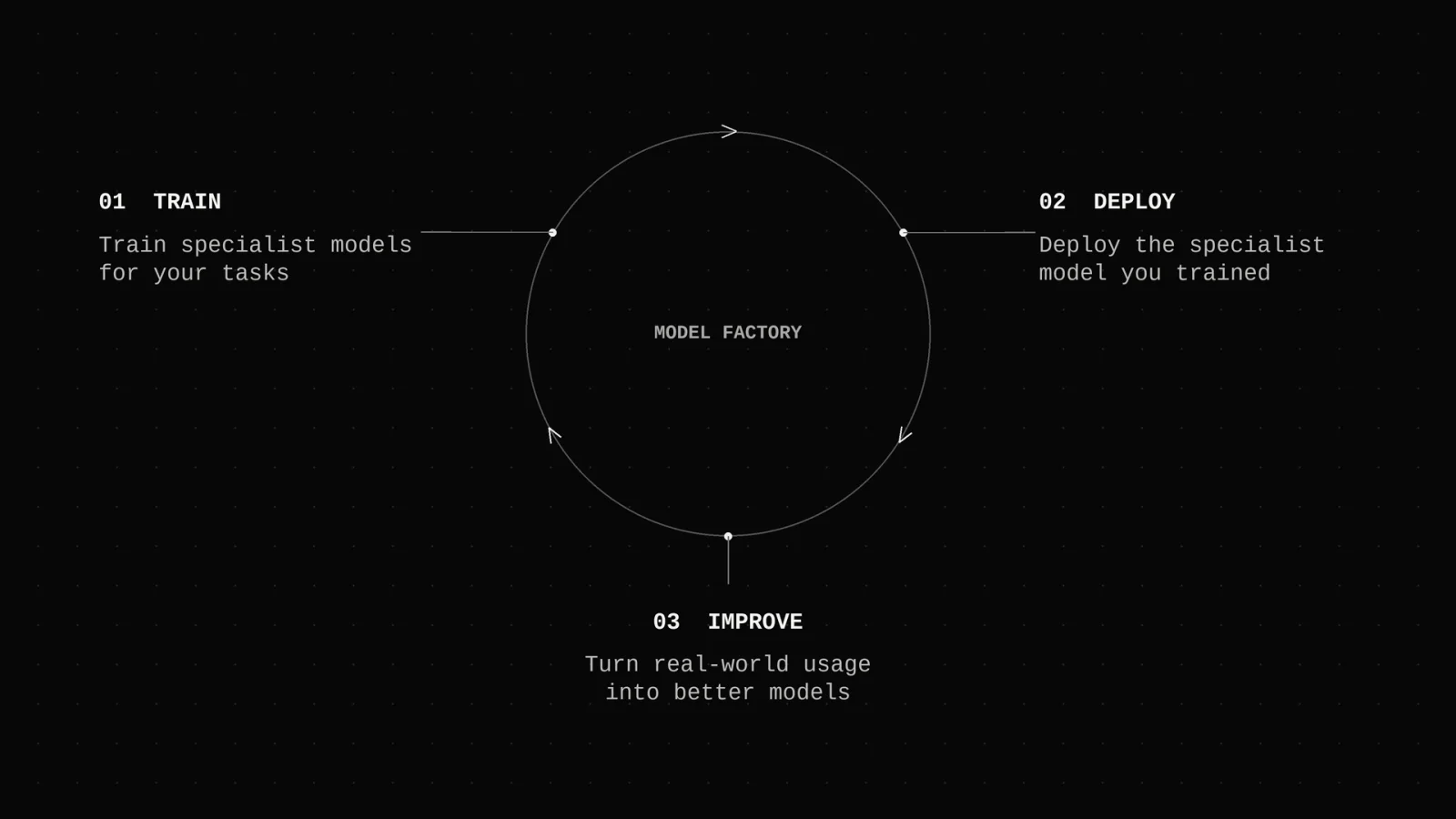 Model Factory train, deploy, and improve loop diagram
Image: Prime Intellect
That design responds to a pain explainx.ai tracks across agent RL sandboxes and Moondream vision acquisitions: teams stitch together separate train, eval, and serve vendors, then lose lineage when weights move between formats.
On-demand versus dedicated clusters
Model Factory offers two operating modes:
On-demand hosted training is self-serve: submit a TOML config, pay per GPU-hour prorated to the second, and start without reserving a cluster.
Dedicated Model Factory clusters add reserved capacity, Slurm, and Kubernetes beside managed training and inference. Prime docs say clusters are arranged with the team (contact@primeintellect.ai), not purely click-to-buy.
Use on-demand when you experiment with prime-rl configs on Prime hardware. Use dedicated when you must pin framework commits or colocate training with private data paths, similar to how some labs pair custom RL stacks with owned sandboxes.
Training: RL, SFT, and pretraining
Hosted Training supports three dispatch types via prime train and TOML configs:
| Mode | Purpose |
|---|---|
| Reinforcement learning | Full-parameter RL against a verifiers environment |
| Supervised fine-tuning | Imitation on curated examples |
| Pretraining | Corpus from scratch |
The launch blog highlights tens of thousands of concurrent microVM sandboxes inside RL for tool and code agents, aligning Model Factory with production agent training rather than static multiple-choice sets alone.
Environments integrate verifiers, the Environments Hub, and Harbor support per Prime’s post. If you already publish environments for community evals, Model Factory is the hosted executor.
Deploy checkpoints without manual weight export
The checkpoint deployment doc is the builder-critical path.
Prerequisites include:
- Team access to the training run
- Checkpoint status READY after volume sync (pause a running job to sync without waiting for full completion)
- Base model supported in the inference catalog
- Funded wallet for on-demand placement
CLI flow:
prime train checkpoints <run-id> --status READY
prime inference deploy-checkpoint <run-id> --step 100 --wait
There is no default checkpoint step; you must pass an explicit step from the READY list. The command returns a deployment whose endpointUrl and servedModelAlias become your OpenAI-compatible client target.
Dashboard flow mirrors the same steps under Dedicated Endpoints → Create → Custom weights.
Prime Traces and production feedback
Model Factory’s fourth step, Prime Traces, is what turns a one-shot fine-tune into a production flywheel. Prime positions traces from endpoints and training runs as inputs that reveal where the deployed model fails in the wild, then feed the next training configuration.
That matches the industry narrative in OpenAI’s frontier risk deployment post and Together agent eval claims, but routes through open-weight training you control.
How Model Factory compares for founders
| Question | Model Factory answer |
|---|---|
| Can I serve what I train? | Yes, via deploy-checkpoint to dedicated endpoints |
| Do I need my own cluster? | No for on-demand; yes if you buy dedicated capacity |
| Is it only for huge models? | Catalog lists warm-start models; docs emphasize open models of varied sizes |
| What about serverless APIs? | Prime Inference remains for per-token shared models |
Competitors in the train-serve loop space include cloud-specific pipelines (SageMaker customization) and DIY stacks on Modal. Prime’s pitch is open models plus verifiers on one bill.
Getting started this week
- Read the getting started guide linked from the announcement.
- Run
prime train modelsto see warm models and GPU prices before you pick a base checkpoint. - Define a verifiers environment that scores real outcomes, not only format compliance.
- After a short SFT smoke test, deploy with
deploy-checkpointto a staging endpoint before wide rollout. - Wire Prime Traces or your own logging to capture failure modes for pass two.
If you acquired Moondream vision models through Prime’s ecosystem, Model Factory is the path to specialize those stacks on proprietary datasets without rebuilding export scripts.
Risks and limits
- Cluster sales friction: Dedicated mode is not instant checkout; plan lead time.
- Catalog gaps: If your base model lacks a serving config, docs say to email support to add it.
- Cost visibility: On-demand RL with massive sandbox concurrency can spike GPU bills faster than SFT.
- Eval honesty: Environments must reward true task completion, as RadixArk emphasized when curating DaisyRose tasks.
Volumes, pauses, and READY checkpoints
Prime’s checkpoint deployment doc stresses a detail easy to miss: checkpoints on an actively training run may not be READY until volumes sync. Pausing a run syncs disks and releases GPUs without waiting for full training completion.
Operationally:
| State | What you can deploy |
|---|---|
| Running | Usually wait; volumes may be inconsistent |
| Paused | Sync finishes; eligible steps may become READY |
| Stopped or completed | Final volume sync; READY list stabilizes |
Teams coming from Hugging Face upload workflows should treat servedModelAlias as the production model name while keeping the training run id in internal lineage tables.
Open-source alignment: prime-rl and verifiers
Model Factory is not a black box trainer. Prime documents prime-rl as the training engine and verifiers for evaluation environments. That matters for reproducibility: you can inspect training code, compare against self-hosted Miles-style RL, or contribute environments to the hub.
Harbor support in the announcement signals compatibility with external agent benchmarks growing around coding agents, overlapping explainx.ai coverage of SWE-Bench experiments and MIT harness research.
Security and compliance for RL sandboxes
RL with tens of thousands of microVMs increases attack surface: untrusted tool output, arbitrary code in environments, and credential leakage from badly scoped secrets. Model Factory sandboxes are Prime-operated; your policies still govern what data enters prompts and what endpoints agents can call.
Pair hosted RL with the same controls you use for Codex sandbox profiles: network egress lists, secret scanners on environment definitions, and human review before promoting checkpoints.
Commercial positioning versus hyperscalers
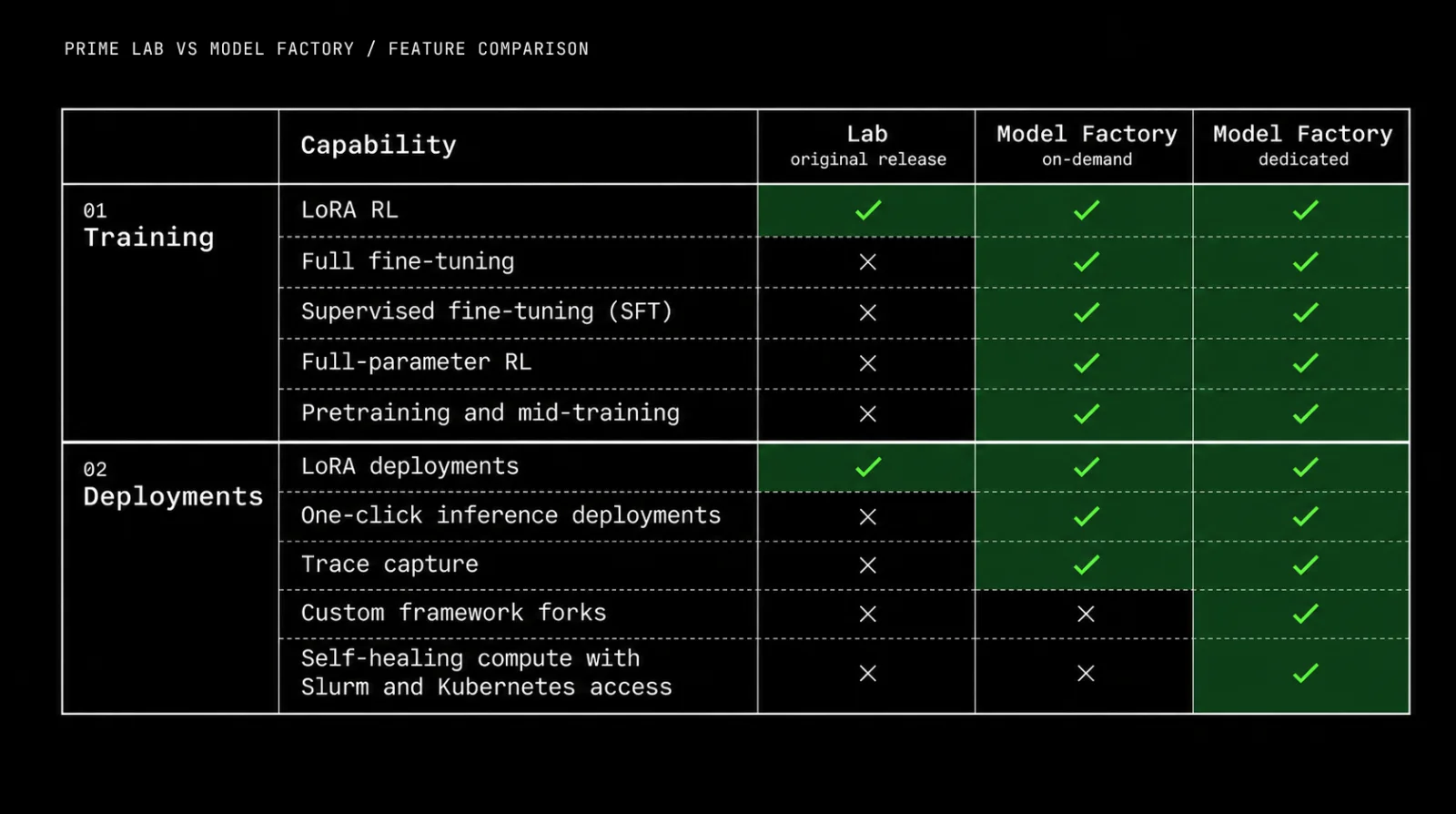 Prime Lab versus Model Factory training and deployment comparison
Image: Prime Intellect
Prime’s blog frames Model Factory as the loop frontier labs run, productized for companies. Hyperscalers sell pieces—Bedrock customization, proprietary APIs, managed notebooks—often without an open-weight-centric Environments Hub.
Model Factory’s wedge is open models you can export, verifiers-native evals, and deploy-checkpoint serving without re-exporting tensors yourself. Whether that beats integrated cloud AI suites depends on whether you need model sovereignty and RL iteration speed more than a single-vendor invoice.
Who should adopt first
| Persona | Fit |
|---|---|
| Applied lab with proprietary env | High; loop closes on your reward |
| Fine-tune-only shop | Medium; SFT path is enough until drift appears |
| API reseller | Low unless you need custom weights |
| Regulated enterprise | Medium; dedicated clusters plus audit logs required |
If you are already on Prime for Moondream vision, Model Factory is the natural second product to specialize photon models on private imagery.
FAQ-style operations teams will ask
Will Model Factory replace our labeling vendor? Not automatically. RL still needs reward design; SFT still needs curated tuples. Model Factory hosts execution; your task designers define quality.
Can we mix Prime Inference and dedicated endpoints? Yes per product split: serverless for baselines, dedicated for your checkpoint, traces feeding the next train job.
What breaks first at scale? Sandbox scheduler limits, environment bugs that allow reward hacking, and wallet limits on on-demand deploy if finance caps GPU spend without alerting ML engineers.
How does this relate to Maritime per-user VMs? Maritime hosts customer-facing agent computers; Model Factory trains model weights. They solve adjacent layers in an agent product stack.
Document CLI versions (prime 0.21.0+ for deploy-checkpoint) in your internal runbooks so on-call does not debug permission errors during a Friday deploy.
Schedule a quarterly review of Environments Hub dependencies so upstream harness changes do not silently alter reward signals between training runs you thought were comparable.
When finance asks leadership for unit economics, split training GPU-hours, sandbox hours, and inference GPU-hours in separate cost centers so Model Factory savings do not disappear inside a single undifferentiated AI budget line item each formal quarter review cycle.
Keep a pinned internal doc that links each run id to the business OKR it was supposed to improve.