



RadixArk released DaisyRose-27B on November 18, 2026 as its first open model: Qwen3.8-27B post-trained with reinforcement learning on roughly 1,200 long-horizon agent tasks. The Hugging Face announcement and model card publish Apache 2.0 weights in BF16, FP8, and NVFP4.
The headline metric for builders is Terminal-Bench 4.1 pass@1 rising from 5.6% to 12.0% versus the base Qwen3.8-27B checkpoint. That is still a hard benchmark, but the delta shows what task-specific RL buys when sandboxes allow hundreds of tool calls and 256K+ output tokens per attempt.
TL;DR benchmark table
RadixArk published this comparison on the Hugging Face blog:
| Benchmark | Qwen3.8-27B | DaisyRose-27B |
|---|---|---|
| Terminal Bench 4.1 | 5.6 | 12.0 |
| Terminal Bench 2.1 | 73.0 | 75.5 |
| DeepSWE v1.1 | 42.2 | 46.2 |
| SWE Bench Pro v2 | 91.3 | 94.7 |
| HLE (text-only) | 33.9 | 34.3 |
| IFBench | 79.5 | 82.4 |
| GPQA Diamond | 89.2 | 90.7 |
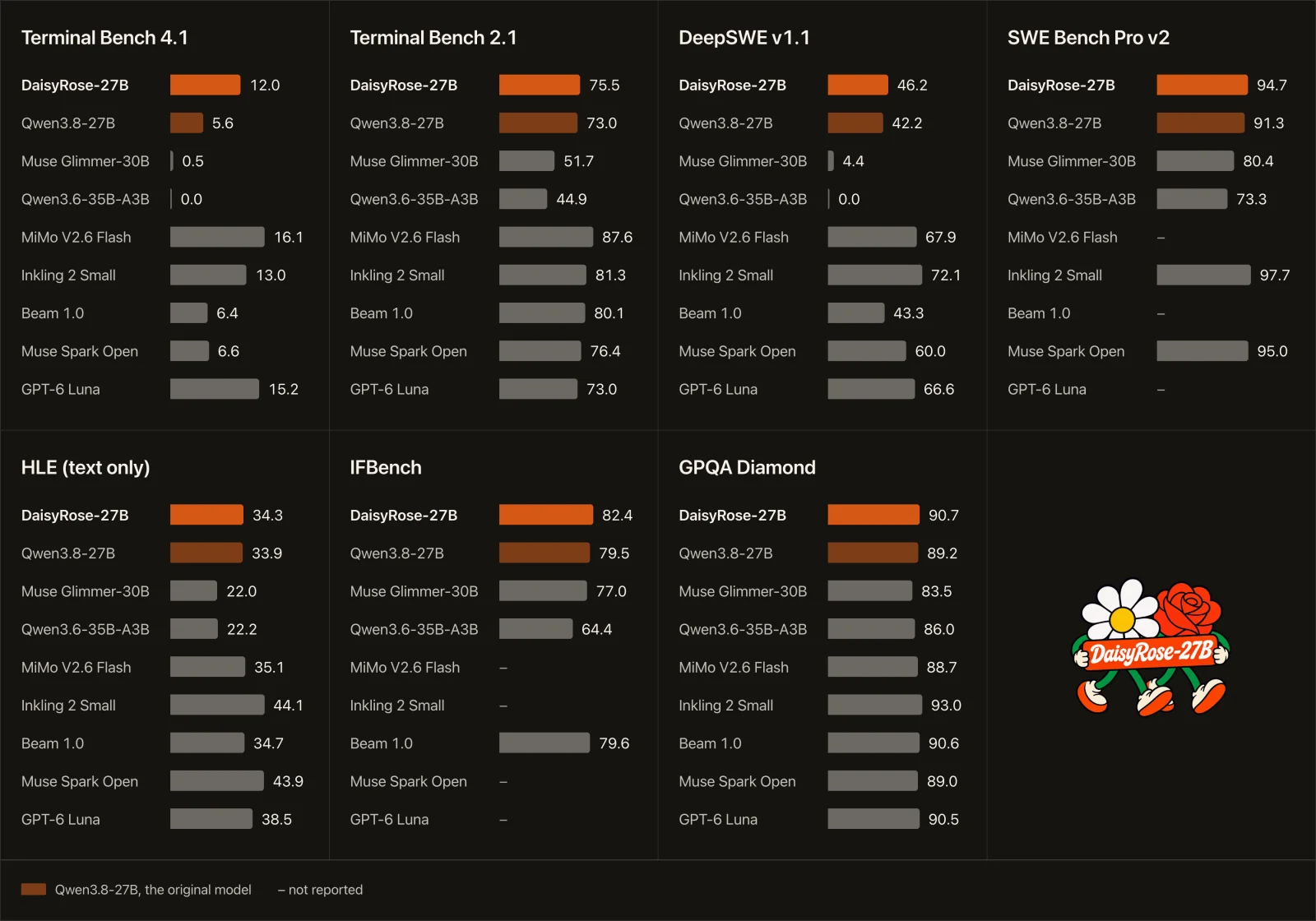 DaisyRose-27B benchmark gains on Terminal-Bench and SWE tasks versus Qwen3.8-27B
Image: RadixArk
Scores use the higher of BF16 and FP8 runs where both were evaluated; the blog says they differ by less than one point in those cases.
Training recipe: tasks, sandboxes, and async RL
Three ingredients made the run feasible, per RadixArk:
Curated tasks with Eigent AI. Thousands of candidates collapsed to about 1,200 kept tasks. Selection rules included targeting concrete base-model mistakes, requiring multi-step dependent work (up to 1.5 hours per sandbox attempt, 100+ tool calls, 256K+ output tokens), and ensuring rewards require actually solving the intended problem.
Miles RL in async mode. 128 H200s ran inference rollouts while 16 trained the policy, pushing updated weights back after each step. RadixArk claims ~16,800 tokens/s end-to-end across 144 GPUs versus ~8,300 on a Megatron-class open trainer on comparable runs, and 57% lower training cost on MFU metrics for this release.
AgentENV sandboxes. About 944,000 sandboxes between mid-September and mid-November 2026, peaking around 1,566 concurrent, with 99%+ creation success (above 99.95% since late October per the post). RadixArk says cloud costs were about 80% lower than popular hosted sandbox vendors, partly via elastic memory allocation.
That infrastructure story matters if you are comparing Prime Intellect sandboxes or MIT self-improvement harness research for your own RL loop.
How to serve DaisyRose-27B
RadixArk recommends SGLang with DSpark speculative decoding. After launch with served name DaisyRose-27B on port 30000, use the OpenAI Python client against http://localhost:30000/v1 with api_key="none".
The model thinks by default. Responses split reasoning_content and final content, matching Qwen-style reasoning templates. Temperature 1.0, top_p 0.95, and extra_body top_k: 20 follow the model card quickstart cited on Hugging Face.
If you run Qwen3.5 adapters elsewhere, confirm harness compatibility before you swap weights in production.
Open weights: what you get on Hugging Face
Checkpoints ship as:
- BF16 full precision
- FP8 and NVFP4 for NVIDIA-friendly serving
Architecture, tokenizer, 256K context, and image understanding stay aligned with Qwen3.8-27B, lowering migration friction.
For evaluators, reproduce Terminal-Bench with the same harness versions RadixArk cites in the model card. Community scores on different harness configs will not match the table above.
Why DaisyRose matters in the agent model lane
Frontier labs chase coding agents with proprietary RL stacks. DaisyRose is evidence that mid-size open bases can gain agentic terminal skills when training data enforces long jobs and honest graders.
It also highlights training systems competition:
| Layer | DaisyRose story |
|---|---|
| Data | Eigent-partnered mistake-targeted tasks |
| RL framework | Miles (open source) |
| Sandboxes | AgentENV at million-task scale |
| Serving | SGLang plus DSpark |
Teams betting on higher SWE-Bench merge rates should still run their repos through DaisyRose before trusting leaderboard deltas.
Miles and async RL: what the system diagram implies
RadixArk trained with Miles, its open reinforcement learning framework, in fully asynchronous mode: agent environments keep producing trajectories while the trainer consumes them without lockstep barriers. That design targets agentic workloads where environment time dominates backward pass time.
The blog contrasts RadixArk’s internal training backend with a Megatron-based open trainer on comparable runs:
| Metric (per RadixArk blog) | Internal backend | Open Megatron-class trainer cited |
|---|---|---|
| Model FLOPs utilization | 37% peak MFU | 16% on comparable runs |
| GPU cost for same work | 57% lower GPU time claimed | baseline |
| End-to-end tokens/s on 144 H200s | ~16,800 | ~8,300 |
| MoE scaling claim | 6.2× on Qwen3.6-35B-A3B | not independently verified |
| Large GLM MoE claim | >10× on ~300B GLM-5.3-Flash | not independently verified |
Those are vendor train-stack benchmarks, not application-level guarantees. They matter if you operate your own RL farm and pay for GPU-hours directly.
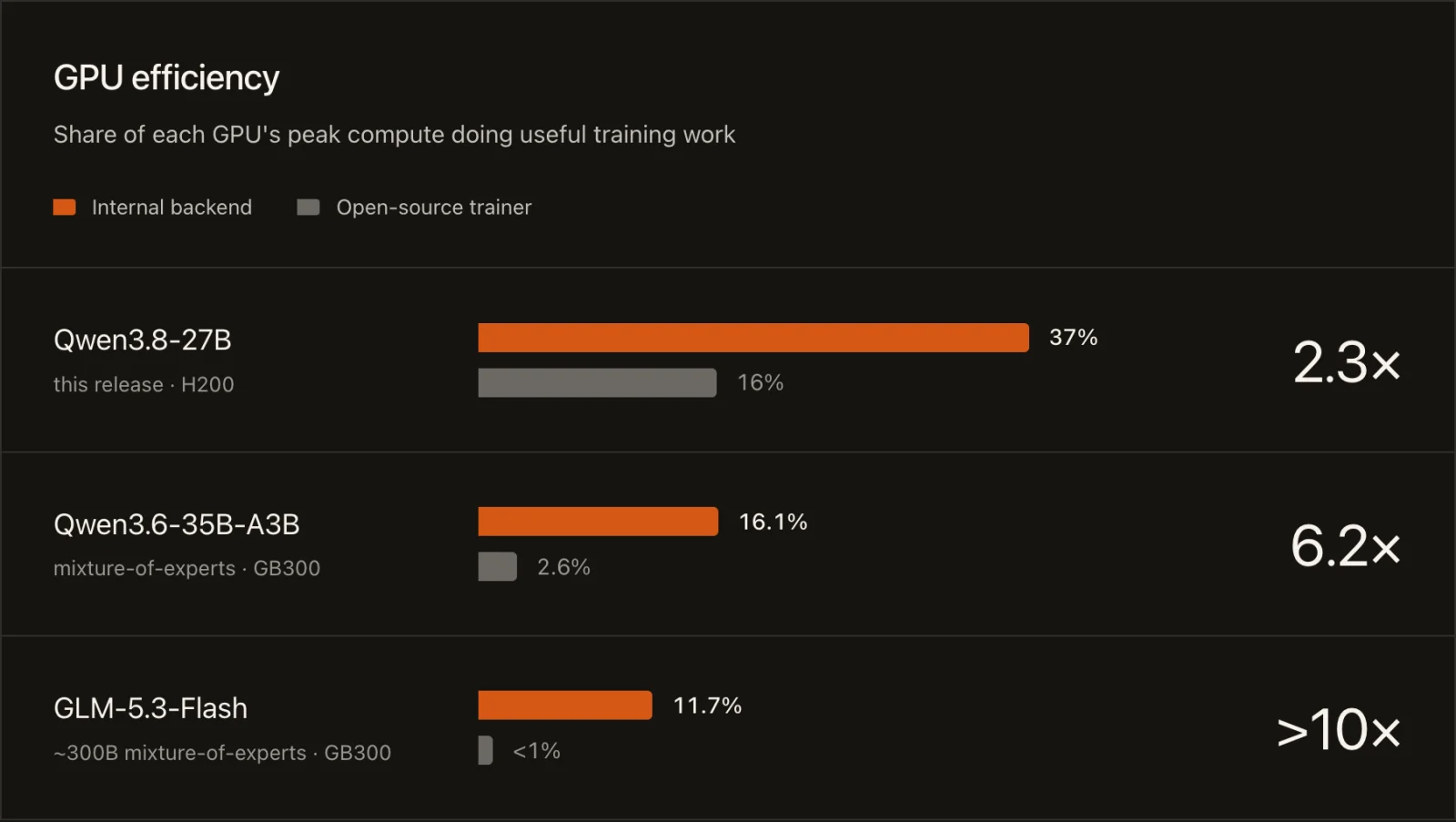 GPU efficiency comparing RadixArk backend with Megatron-class open trainer
Image: RadixArk
Million-token sessions and harness summarization
Tasks allowed extremely long agent jobs. The blog mentions sessions up to 1M tokens, folded into multiple trajectories via harness summarization so learning remains tractable.
That pattern aligns with research explainx.ai tracks on latent reasoning monitorability and long-context agent harnesses: the model is not necessarily generating one monologue; the harness compresses prior segments so RL credit assignment still works.
If you fine-tune agents on OpenCode-style harnesses, study how DaisyRose’s SGLang plus DSpark serving path exposes reasoning_content separately from answers. Downstream apps must not strip reasoning traces when they replay user-visible chats.
Sandbox reliability at RL scale
 AgentENV sandbox scale during DaisyRose-27B training
Image: RadixArk
AgentENV statistics in the post are a supply-chain signal for anyone copying this recipe:
- ~944,000 sandboxes between mid-September and mid-November 2026
- ~1,566 peak concurrent sandboxes
- 99%+ creation success overall, >99.95% since late October
- Infrastructure scaling from one machine to 12 with ten upgrades during training
RadixArk contributes fixes upstream to AgentENV and cites Harbor support in the ecosystem thank-you list. If your RL loop stalls on sandbox flakes, DaisyRose’s run is a useful reference for what “good enough” reliability looks like at six nines-ish creation rates.
Compare with hosted options in agent sandbox guides when you choose between building AgentENV yourself and renting sandboxes.
Download, eval, and ship checklist
- Pull BF16, FP8, or NVFP4 weights from Hugging Face listings linked in the announcement.
- Stand up SGLang using RadixArk’s cookbook paths for your GPU generation.
- Enable DSpark speculative decoding if your hardware matches the documented configs.
- Run Terminal-Bench 4.1 with the harness versions named on the model card before you publish internal scorecards.
- Log failures with repro steps in the Hugging Face Community tab so RadixArk can distinguish harness bugs from model bugs.
For teams comparing against Microsoft MAI Code 2 or OpenAI Codex profiles, DaisyRose is an open-weight alternative you can host, not a drop-in API with the same safety envelopes.
Research lineage and open-source stack
RadixArk explicitly thanks Eigent AI for training data partnership, the Qwen team for the base model, and communities around Miles, SGLang, slime, AgentENV, and Harbor.
If you want to train your own variant:
- Miles provides the RL orchestration layer (open source).
- AgentENV supplies sandbox isolation (open source with RadixArk contributions).
- Qwen3.8-27B supplies tokenizer and multimodal hooks preserved in DaisyRose.
That is a full stack story similar in spirit to Prime Intellect’s Model Factory loop, but DaisyRose is a finished checkpoint you can download today.
Limitations
Terminal-Bench 4.1 at 12% pass@1 is improvement, not solved. DaisyRose can still fail long-horizon plans, mis-handle novel tools, or drift on out-of-distribution tasks not represented in the 1,200 training set.
RadixArk invites failure reports in the model Community tab. Treat social hype about "frontier killer" narratives as unverified unless you replicate benchmarks.
SWE-Bench Pro v2 gains (91.3 to 94.7) are incremental on an already strong base. The interesting signal is agentic terminal lift where Qwen3.8 was weakest, not universal dominance across every coding metric.
When to pick DaisyRose over API-only coding models
Choose DaisyRose when you need self-hosted weights, Apache 2.0 terms, and terminal-heavy agents without routing customer code through a proprietary API. Stick with hosted frontier APIs when you need vendor-managed safety filters, enterprise DPAs, or turnkey IDE integrations.
Hybrid teams sometimes route planning to a frontier model and execution to DaisyRose on private GPUs. Watch token costs on 256K contexts and instrument sandbox failures the way OpenAI’s misalignment harness post recommends for long-horizon agents.
Read the Hugging Face model card for inference hyperparameters and benchmark provenance before you cite DaisyRose in customer-facing security questionnaires. Open weights shift compliance burden to your deployment: you own patching, logging, and abuse monitoring on the inference host the way you would for any other self-hosted Qwen-family derivative.
For capacity planning, RadixArk’s 144 H200 footprint is a useful order-of-magnitude anchor when you negotiate cluster rentals for your own Miles runs, even if your task count is smaller than 1,200.
Document NVFP4 versus BF16 quality in your own eval suite before you pick a production quantization. RadixArk reports sub-one-point benchmark gaps between formats on several tasks, but your prompts may behave differently on tool-calling edges.
If you also depend on image understanding inherited from Qwen3.8, regression-test vision-heavy agent tasks separately from Terminal-Bench text shells today so multimodal regressions do not hide behind averaged coding scores on leaderboards.