



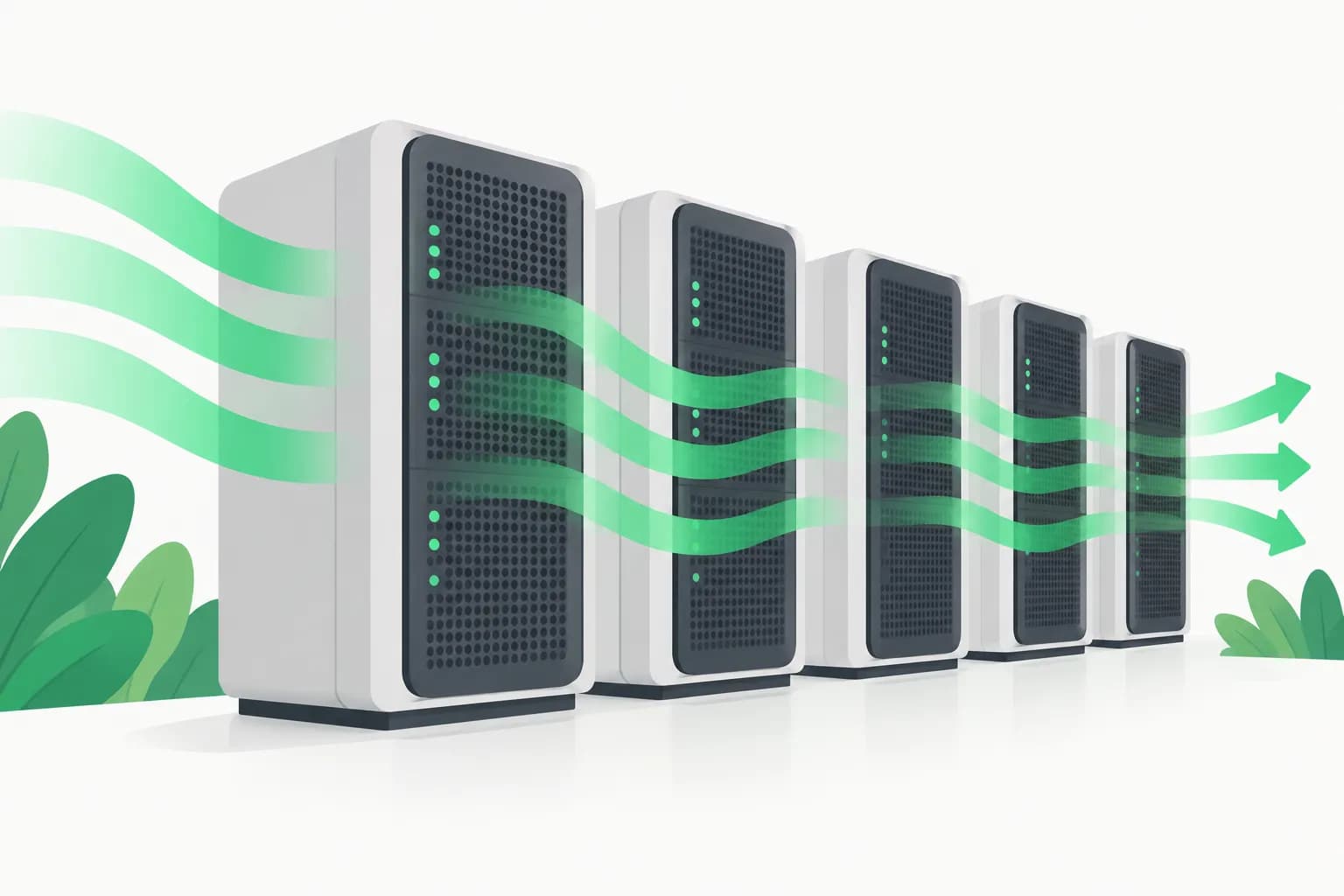
NVIDIA has put a name on the idea of shipping an AI data center in a box. NVIDIA DSX POD, described in an October 21, 2026 post on the NVIDIA Technical Blog, is a reference design that lets partners install Vera Rubin rack-scale systems in containers at a factory, test them as a unit, ship them, and plug them into a prepared site. Trade press, including DatacenterDynamics as relayed by Techmeme, summarized the pitch as cutting deployment from six months to 14 days.
The platform it is built around is covered in NVIDIA's Vera Rubin full-production announcement. That headline number is the part to handle carefully. NVIDIA's own technical post never states a day count. This article separates what NVIDIA actually published from what the headline claims, explains how the design works, and says what it means for anyone planning AI capacity.
TL;DR: claimed versus confirmed
| Claim | Status |
|---|---|
| DSX POD is a factory-built, container-based reference design for Vera Rubin | Confirmed in NVIDIA's technical blog |
| Partners, not NVIDIA, build and ship the containers | Confirmed: NVIDIA describes OEM, ODM and modular-builder roles |
| Standard 800 VDC power input | Confirmed in the post |
| Deployment drops from six months to 14 days | Reported by trade press; not in the NVIDIA post we read |
| Containerization replaces conventional builds | Contradicted by NVIDIA: it says conventional builds remain important options |
| Onsite work disappears | Contradicted by NVIDIA: it says the model does not remove onsite work |
We could not open the DatacenterDynamics article itself (the site blocked our fetch), so the 14-day figure is attributed to the headline as relayed by Techmeme, and we could not check the source of that number. No independent customer deployment has been published that tests it.
What did NVIDIA actually announce?
According to the post by NVIDIA's Premal Savla, DSX POD is "the standardized, factory-built implementation" among the multiple AI factory implementation models supported by the NVIDIA DSX AI Factory Platform. It lets partners "build standardized containers that pre-integrate AI infrastructure, complete critical validation before shipment, and connect to prepared site infrastructure after delivery."
The design is "aligned with the NVIDIA Vera Rubin platform and its rack-scale systems" and describes a complete AI factory rather than a compute box on its own. It covers compute, service and management functions, scale-out networking, storage, power, cooling and cabling. If you have followed the platform, the earlier building blocks are in our coverage of NVIDIA's open Vera Rubin MGX designs and DSX grid resilience and the open-sourced Run:ai stack under DSX.
How does a conventional build compare with DSX POD?
NVIDIA describes the usual sequence this way: select a site, design power and cooling, lay out the hall, plan and install racks and cables, then "validate the network and cluster incrementally and bring service online." Each step depends on specialized labor and on the previous step, so delays push back the date the hardware produces its first token.
DSX POD changes the order. Partners integrate and test containers at a factory while site teams prepare land, foundations, power and external connectivity in parallel. After delivery, the work is placement, connecting containers to each other, and hooking up external power, cooling and network.
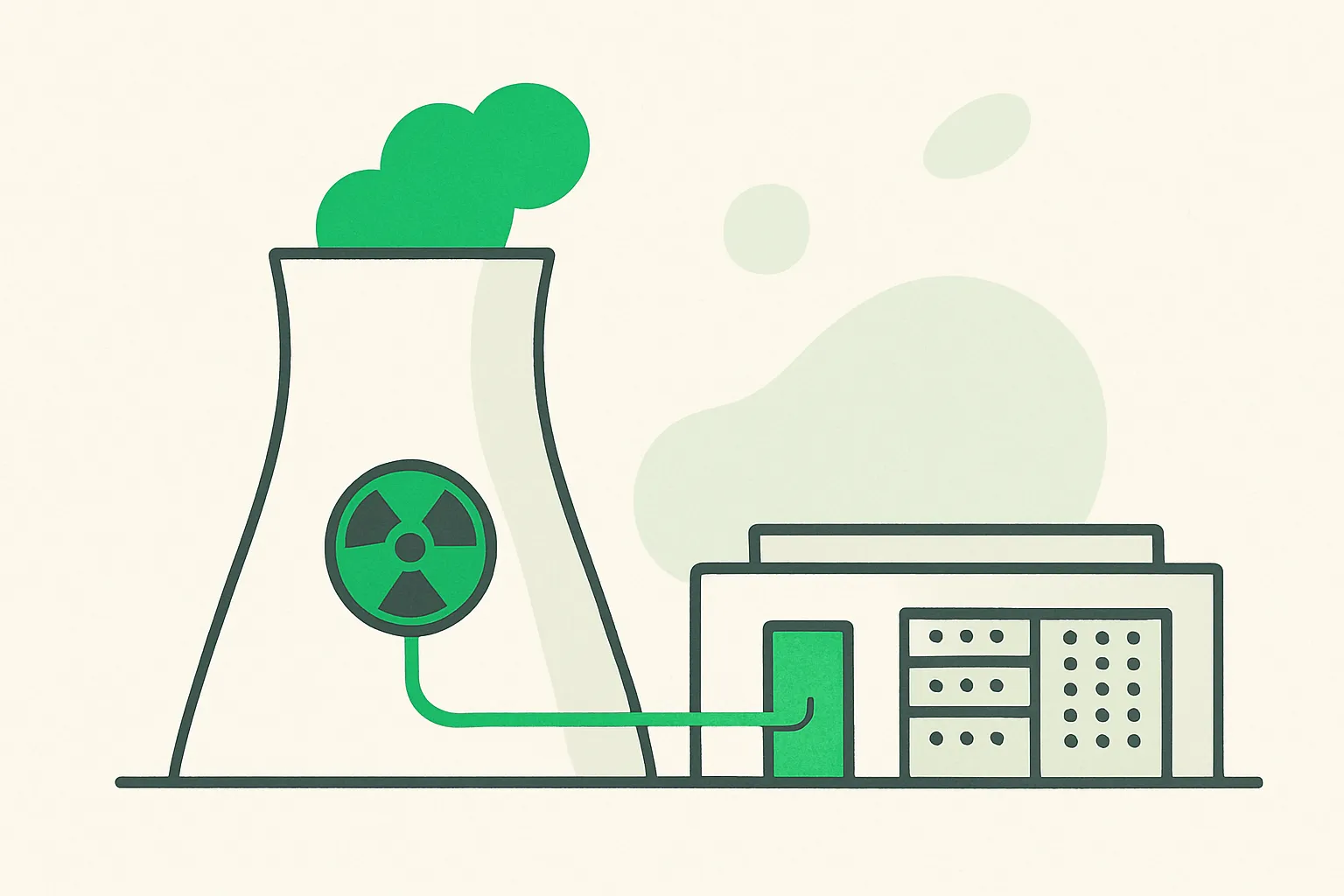 A cooling tower linked by a power line to a data hall, the site infrastructure a NVIDIA DSX POD container still depends on
That parallelism is where any time saving would come from. How much depends on how long your power interconnect, permitting and water loop take, none of which a container can shorten.
What is inside the reference design?
NVIDIA breaks the requirements into six areas.
| Area | What the design defines |
|---|---|
| Compute integration | How Vera Rubin racks fit the enclosure: structure, weight distribution, restraint, service clearance, airflow and liquid access, rack power, network |
| Networking and storage | Links inside a container, between containers and to the customer network; fiber entry points, trunk cabling, labeling and bend radius; storage capacity, performance and management |
| Cabling and controls | Rack-to-rack network cabling, power wiring, control wiring and sensor integration moved into the factory where practical |
| Power delivery | A standard 800 VDC input from the electrical entry through protection, distribution, grounding, rack connections, controls and telemetry |
| Liquid cooling | In-container plumbing, manifolds, isolation, leak detection and pressure integrity; the loop is flushed and pressure-tested at the factory |
| Mechanical and transport | Container structure, center of gravity, lifting points and transport conditions tied to factory quality gates |
The validation boundary also changes. Instead of shipping each rack separately and assembling a cluster on site, partners validate "the installed compute environment as a deployment unit": rack inventory, firmware and configuration baselines, power-on checks, fabric connectivity, sensors, cooling integrity and system-level functional tests before the container leaves.
Why 800 VDC matters
The most consequential engineering choice is the 800 VDC input. Higher-voltage DC distribution reduces conversion stages and copper in dense racks, which is why it keeps appearing in next-generation AI rack designs. NVIDIA positions it as a common interface at the container boundary: partners still engineer "the upstream generation, conversion, and regional electrical solution", but the core container sees a standard input.
NVIDIA explains why that split is useful: "utility conditions, codes, equipment availability, and grid architectures differ across regions." A fixed interface lets the inside of the box repeat while the outside adapts. Power is also the real bottleneck for many projects. Our reporting on FERC rejecting PJM's curtail-first data center plan shows how grid rules, not hardware assembly, can set the pace of a build.
What does the 14-day claim leave out?
NVIDIA is explicit about limits, which is a good reason to treat the headline with caution:
- Site work stays. "NVIDIA DSX POD changes where integration occurs. It does not eliminate the supporting facility infrastructure." You still need a prepared site, foundations, power, water and heat rejection.
- Onsite work stays. "This model does not remove onsite work." It reduces the amount of complex repeatable integration done in the field.
- Containers are optional. The reference design "does not make containerization mandatory for every AI factory."
- Commissioning stays. After delivery teams confirm transport integrity, validate connections and commission the complete cooling loop.
So a plausible reading of "14 days" is the time from container delivery on a fully prepared pad to a commissioned unit, not from decision to first token. No source we found defines the 14 days. If you are quoting the figure to a board, ask a vendor which milestones it spans.
What are the costs and risks nobody has priced yet?
NVIDIA's post says nothing about price, lead times for containers, or which partners are building them. Three questions follow.
- Cost. Factory integration moves labor, not cost, to a different line item. Pre-integrated high-density liquid-cooled containers also carry shipping and handling risk for very expensive hardware.
- Supply. The binding constraint for Vera Rubin capacity has been components, not floor space. Dell's CEO called the memory shortage a multi-year problem in our report on Michael Dell and the memory shortage, and a container cannot be completed if the memory or optics are not available.
- Lock-in. A standard interface helps repeatability, but a standard defined by one chip vendor also shapes who can compete on the surrounding equipment. NVIDIA says the design preserves "room for differentiation in implementation and service," which is the vendor's framing.
Who is this for?
NVIDIA targets "large-scale deployments where schedule predictability, repeatability, and reduced onsite work are priorities." In practice that means hyperscalers, neoclouds and sovereign AI projects building tens of megawatts at a time, such as the Meta Prometheus supercluster. A team renting GPUs by the hour is not the buyer; the effect on them shows up, if at all, as faster capacity arriving at cloud providers.
What should you do with this?
- If you buy capacity: ask providers whether their next expansion uses factory-integrated containers, and what delivery dates are contractually committed rather than marketed.
- If you build capacity: request the milestone definitions behind any "days" figure, and price power interconnect and cooling separately from the container.
- If you follow the market: watch for named partner builds and a first deployment with measured dates. That, not a reference design, is the evidence that turns "reported" into "verified".
Bottom line
DSX POD is real and the engineering logic is sound: move complex integration into a factory, define clean interfaces, and test before shipping. NVIDIA's own wording is measured. The dramatic "six months to 14 days" framing comes from trade-press coverage, and the source post does not support it as a general claim. We will update this post if NVIDIA or a partner publishes a measured deployment timeline.
Details reflect NVIDIA's technical blog of October 21, 2026 and secondary reporting at the time of writing.
Related reading
- NVIDIA OCP: Vera Rubin MGX open designs and DSX grid resilience
- NVIDIA open-sources Run:ai and KAI Scheduler
- FERC rejects PJM's curtail-first data center plan
- Michael Dell: the memory shortage is a four-year problem
- Meta Prometheus supercluster: what is confirmed
- NVIDIA Vera CPU measured: memory bandwidth and latency
- Official: NVIDIA Technical Blog on DSX POD