




Google and Voltus said on October 22, 2026 that they are expanding their PJM virtual power plant to about 1 gigawatt, a tenfold increase on the 100 MW agreement the pair signed in June. In Google's announcement, the company calls it "one of the largest known distributed capacity portfolios deployed by a hyperscaler to date." The PJM region serves 67 million people across 13 states and Washington, D.C., and it is where AI data center demand is colliding hardest with grid supply.
This is not a generator and it is not a new data center. It is a software-run pool of batteries, thermostats and industrial loads that agree to use less power on the worst days. The interesting part for anyone following AI infrastructure is who is paying for it: the company whose data centers add to the strain.
TL;DR
| Question | Answer |
|---|---|
| Who announced it? | Google and Voltus, a San Francisco demand response company |
| How big? | About 1 GW; Utility Dive reports 1,070 MW added to the 100 MW June deal |
| Where? | The PJM grid region: 13 states and D.C., 67 million people |
| What is in it? | Batteries, smart thermostats, on-site generation, industrial process adjustments |
| Who pays? | Google pays Voltus to aggregate; Voltus pays enrolled customers |
| Price? | Not disclosed |
| Timeline? | Ramp to full capacity over 3 to 4 years, contract through 2040, per a Voltus spokesperson |
| Is it new power? | It is new flexible capacity, not new generation |
What exactly was announced?
According to Google's post, Voltus aggregates flexible capacity from local businesses and homes, "like smart thermostats, batteries, and industrial assets," into a Google-funded virtual power plant. During peak demand these assets temporarily reduce energy use to support reliability, and participating customers receive "bill savings and cash payments."
Utility Dive adds the numbers the press release leaves out. The expansion is 1,070 MW on top of the first 100 MW. Voltus will offer the combined resources into PJM's market when the grid is strained. Voltus expects the full capacity to arrive over three to four years and to operate it under the Google contract through 2040. Ellen Zuckerman, Google's head of energy market development for North and South America, is quoted saying that expanding the initial commitment tenfold "demonstrates our core effort to actively bring our own capacity to the grids that serve us."
A note on the headline number: some outlets write "1 GW," while the arithmetic is 100 MW plus 1,070 MW, or about 1.17 GW. Google's own post uses 1 GW. Either way it is a ceiling that Voltus has to build toward, not capacity that exists today.
How does a virtual power plant work?
A conventional plant produces electricity. A virtual power plant (VPP) produces headroom. Voltus signs up many small and mid-sized customers, installs or connects controls, and then promises the grid operator it can cut a certain amount of demand, or push stored energy back, on request. Because thousands of small assets are coordinated by software, the grid sees one dependable block.
The assets named in the announcement are:
- Batteries, at homes and businesses, that discharge during a peak.
- Smart thermostats, which pre-cool or briefly raise a setpoint so air conditioning load drops when the grid is tight.
- On-site generation that can run when called on.
- Industrial process adjustments, where a factory shifts a pump, furnace or compressor schedule for a few hours.
Customers get paid for being available and for responding. Voltus says energy users in PJM can earn up to $350,000 per MW-year through demand response related payments, per Utility Dive. That is the participant-side ceiling for the market, not what Google pays Voltus.
Why is Google doing this?
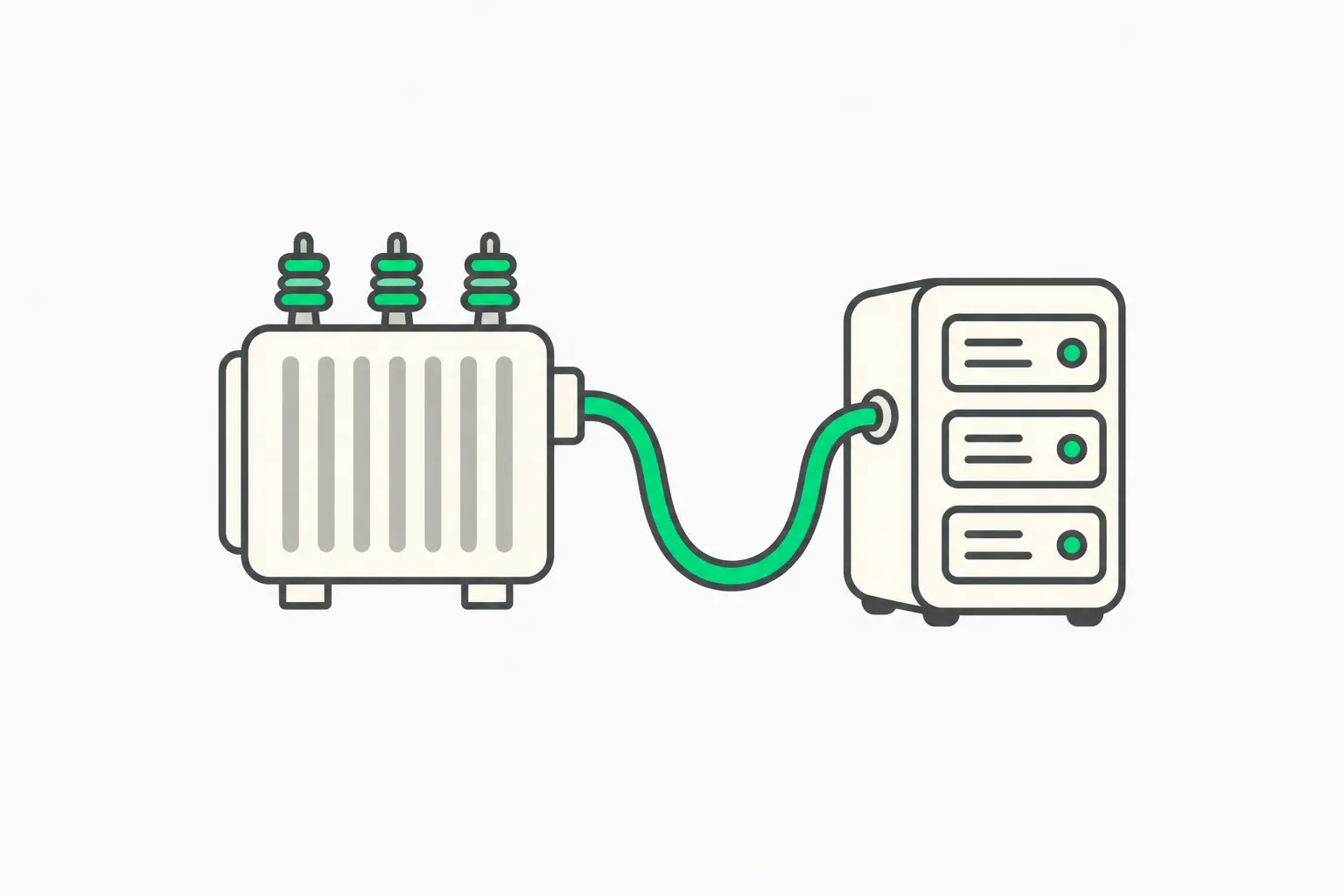 A transformer feeding a server cabinet, showing how a Google Voltus virtual power plant adds grid capacity for data centers
PJM is the largest US wholesale power market, and Utility Dive notes it has "recently fallen short of its reliability margins despite skyrocketing capacity auction prices, due in large part to rising demand from data centers." The market monitor, Monitoring Analytics, reported that demand response revenue in PJM jumped 240% from 2024 to 2025, to about $523.5 million, with emergency demand response making up 88% of it.
Into that situation comes a political and regulatory push to make data centers supply their own capacity. Monitoring Analytics has pressed for requirements that large loads bring new generation before connecting. PJM itself proposed a "bring your own new capacity" framework that included curtailing deliveries to large loads without new supply during grid stress, and FERC largely rejected it earlier in October, a decision we covered in FERC rejects PJM's curtail-first data center plan.
Zuckerman's "bring our own capacity" phrasing echoes that same idea. A VPP is the quickest way for a hyperscaler to show it is adding to supply rather than only taking from it, because it can be enrolled in months instead of the years a generator or transmission line needs. Our earlier post on Google's 890 MW nuclear uprates with Constellation shows the other half of the strategy: long-dated firm generation on the same PJM grid.
What is not known
Treat the following as open questions, because neither company has answered them publicly in the sources we read:
- Price. Utility Dive reports neither company disclosed financial terms.
- How much of the capacity is firm. Demand response is only valuable if assets actually respond. Reporting so far does not give response rates or penalties for non-performance.
- Where the capacity will be, state by state. Google says the VPP spans the PJM region but gives no split.
- Whether Google's own data centers will curtail. The agreement is about customers' assets, not Google reducing its own load.5. Verification. There is no independent measurement of delivered capacity yet.
Voltus has said, per Utility Dive, that it has about 8.5 GW of distributed assets under contract across North America and aims for 20 GW by the end of the decade, after raising $225 million in its latest funding round. Those are company figures.
How this compares with other big data center power moves
| Approach | Example | Delivery risk | Speed |
|---|---|---|---|
| Uprates at existing nuclear plants | Google and Constellation, 890 MW | Medium | Years, first by 2028 |
| Restarts and new reactors | See hyperscaler nuclear deals | Higher | Years to a decade |
| Virtual power plant | Google and Voltus, about 1 GW | Depends on customer response | Ramp to full capacity over 3 to 4 years |
| Self-supplied generation on site | Gas turbines and batteries at campuses | Permitting and fuel | Varies |
The VPP is the cheapest and fastest of the options to start, and the least certain in what it delivers on a bad day. That tradeoff is why it is usually bought alongside firm generation rather than instead of it.
The pressure from communities and regulators
The Google and Voltus announcement lands in a month dense with infrastructure politics. A Senate inquiry questioned whether hyperscalers misled the public on data center costs. A Truth Social post about requiring data centers to supply their own electricity prompted a claimed-versus-verified review. Amazon dropped data center NDAs as local moratoriums spread, and Microsoft pulled out of an Essex data center project over grid power. In that setting, a deal that pays households and businesses directly, and that Google describes as supporting affordability, is as much about local license to operate as it is about megawatts.
Reporting also cites a Brattle Group report this month that scaling residential VPPs could put downward pressure on electric rates by reducing peak demand. That is a third-party analysis of VPPs in general, not a finding about this deal.
What this means for what you build or pay
For most builders, nothing changes in an API price tomorrow. The relevance is indirect:
- Capacity timing. Where hyperscalers can secure power faster, new AI capacity lands sooner. A 3 to 4 year ramp is slow compared with model release cycles, so this is a signal about the late 2020s, not next quarter.
- Siting. Flexibility-friendly grids may attract more capacity. If you choose cloud regions for latency or cost, expect PJM states (Virginia, Ohio, Pennsylvania and neighbors) to stay central, with more conditions attached to new loads.
- Cost pass-through. If regulators force data centers to pay for their own capacity, that cost sits somewhere in the stack. A VPP is a relatively cheap way to meet the requirement.
- A template. If this works, expect copycat deals from other hyperscalers in other grid regions.
If you run your own infrastructure, the same logic applies at small scale: batch jobs, training runs and cooling schedules can be made flexible, and some utilities pay for it.
What to watch next
- Whether Voltus or Google publish enrollment numbers and performance data as capacity comes online.
- Whether PJM revisits requirements for large loads after FERC's October ruling.
- Whether other hyperscalers announce VPP or demand response contracts of similar size.
- Whether price terms leak or are filed anywhere public.
Bottom line
Google and Voltus have agreed to build about a gigawatt of distributed flexible capacity in PJM, paid for by Google and run by Voltus under a contract through 2040. The scale is notable, the price is unknown, and the capacity is a promise that is mostly still to be built. It is best read as one piece of how AI companies are trying to answer the question of where their power comes from.
Related reading
- Google and Constellation: 890 MW of nuclear uprates
- Hyperscaler nuclear deals for AI data centers
- FERC rejects PJM's curtail-first data center plan
- Senate investigation: hyperscalers and AI data center costs
- Amazon drops data center NDAs
- Microsoft pulls out of an Essex AI datacentre
- Trump on data centers supplying their own electricity: claimed vs verified
Details are accurate as of October 23, 2026, based on Google's announcement and Utility Dive's reporting; financial terms were not disclosed.