



Update — September 24, 2026: Related coverage — LangChain Managed Deep Agents schedules.
On May 12, 2026, when Claude Code 2.1.139 introduced the /goal command, it wasn't just another feature—it was the standardization of a pattern that's transforming how developers work with AI agents.
Within hours, developers were calling it "the single most underrated AI feature of 2026." Within days, OpenClaw (the fastest-growing open-source project in GitHub history with 247k stars in under 4 months), Hermes Agent (Nous Research's persistent agent framework), and OpenAI Codex had all integrated goal mode into their workflows.
What makes goal mode different from traditional AI interactions? You set a completion condition, and the agent works autonomously—sometimes for hours or days—until that goal is met. No babysitting. No manual iteration. No breaking flow to check on progress every five minutes.
This article is the complete guide to goal mode in 2026: what it is, how it works, how to use it across different agent frameworks, real-world examples, and why it's become the foundational pattern for autonomous AI workflows.
 Goal mode for AI agents — autonomous completion workflows
What is goal mode? (The technical definition)
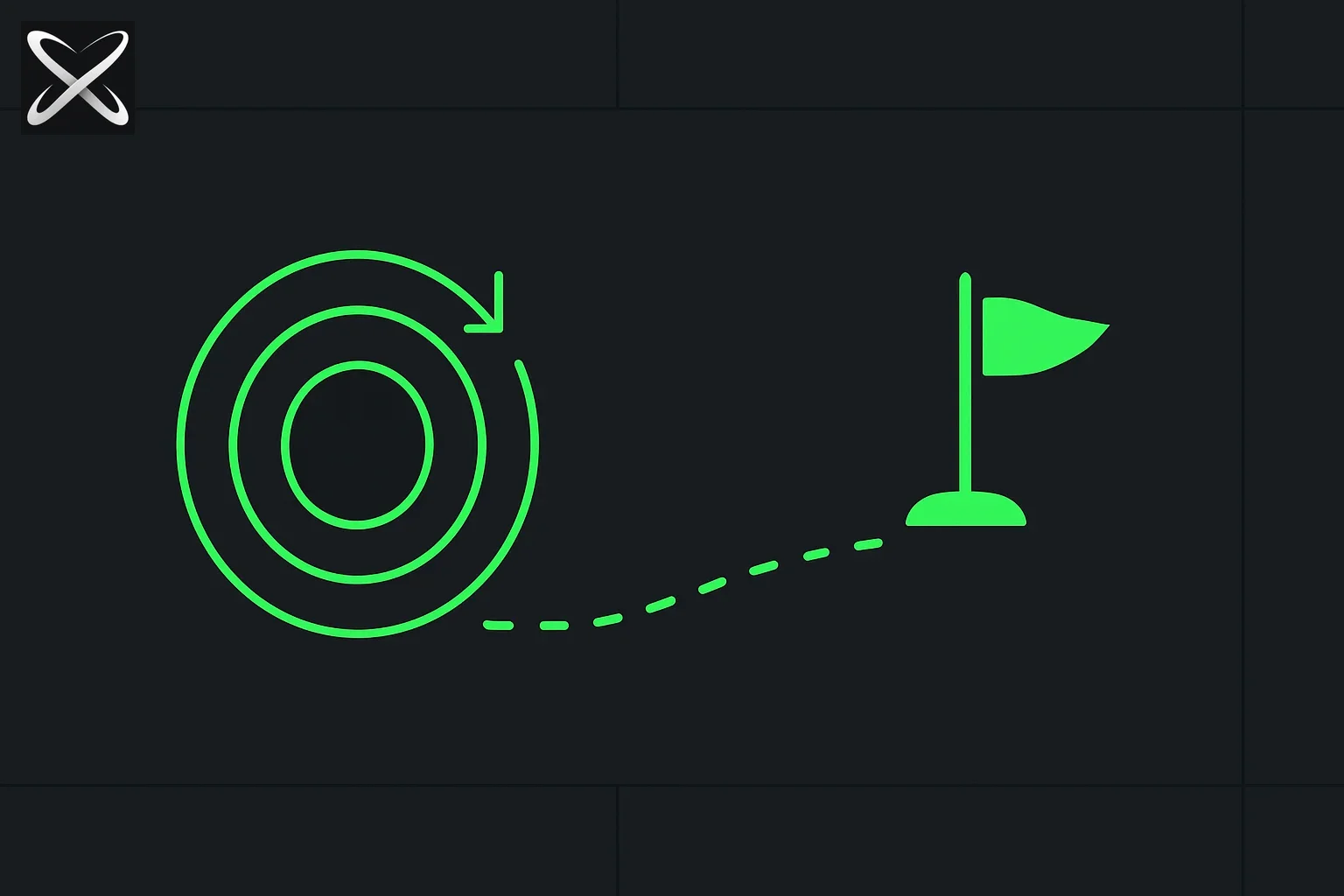 Goal mode for AI agents explained — an unattended looping arrow path advancing toward a distant flag with no hand present
Goal mode is an autonomous agent loop where you define a completion condition, and the agent enters a continuous cycle:
plan → act → test → review → iterate → [repeat until goal met]
Unlike traditional prompt-response cycles that require manual intervention between each step, goal mode enables true hands-off automation for complex, multi-step tasks.
Traditional approach (manual iteration)
# Step 1
$ claude "Fix the TypeScript errors in auth.ts"
[Claude fixes some errors]

# Step 2 (manual check)
$ npm run typecheck
[Still 3 errors remaining]

# Step 3 (manual prompt)
$ claude "There are still 3 TypeScript errors, please fix them"
[Claude fixes 2 more]

# Step 4 (manual check again)
$ npm run typecheck
[1 error remaining]

# Step 5 (manual prompt again)
$ claude "Fix the remaining error"
[Finally clean]

# Total: 5 manual interventions, ~20 minutes of babysitting
Goal mode approach (autonomous completion)
$ claude
> /goal All TypeScript errors resolved, npm run typecheck passes
[Claude works autonomously across 8 turns]
[Tracks: 18 minutes elapsed, 8 turns, 32,400 tokens]
✅ Goal met: All TypeScript errors resolved

# Total: 1 command, walk away, come back when done
Why goal mode is going viral in 2026
Three major factors converged in early 2026 to make goal mode the defining pattern for AI agent workflows:
1. OpenClaw's explosive growth (247k GitHub stars in <4 months)
OpenClaw is a personal AI assistant framework that runs locally and integrates with messaging platforms (WhatsApp, Telegram, Slack, Discord, iMessage, and 20+ others).
According to GitHub star history analysis, OpenClaw hit 247,000+ GitHub stars in approximately 60 days—making it the fastest-growing open-source project on GitHub by that metric. For comparison, React took about 10 years to accumulate a similar number of stars.
NVIDIA CEO Jensen Huang announced NemoClaw at GTC 2026 with the line: "OpenClaw is to agentic AI what GPT was to chatbots."
OpenClaw's openclaw-code-agent plugin integrates Claude Code and Codex as managed background coding sessions, adding explicit goal loops on top of the agent backends.
2. Hermes Agent's production-ready persistent workflows
Hermes Agent by Nous Research is a self-hosted, persistent agent designed for recurring technical workflows outside a single coding session.
Hermes v0.13.0 (released May 7, 2026) includes a "Persistent /goal" feature that allows directives like:
"Fix the failing tests in this repo. Run test commands, identify failures, and patch changes one at a time until tests pass."
According to Hermes Agent vs. Claude Code comparisons, Hermes is better for developers who want a persistent, self-hosted agent for recurring workflows, while Claude Code is better for in-repo development sessions.
Hermes v2026.5.7 ships with: Durable Kanban, Persistent /goal, Checkpoints v2, Gateway auto-resume, and Post-write linting.
3. Codex Goal mode standardization (OpenAI)
In late April 2026, OpenAI introduced Codex Goal mode (/goal) via Codex CLI 0.128.0.
According to Codex goal mode analysis, this is a genuine autonomous agent loop rather than typical "one prompt, one response" interaction:
"You set a goal (e.g., 'Migrate this Python project from Pydantic v1 to v2 and ensure all tests pass'), and Codex automatically enters a continuous cycle of plan → act → test → review → iterate, and won't stop until the job is done or your token budget is exhausted."
This cross-vendor adoption—Anthropic (Claude Code), OpenAI (Codex), Nous Research (Hermes), and OpenClaw—has created a unified pattern for autonomous agent workflows.
How goal mode works under the hood
While implementation details vary by framework, the core loop is consistent:
1. Goal parsing and planning
# Agent receives goal
goal = "All tests passing, no ESLint warnings, coverage > 80%"

# Agent decomposes into sub-goals
sub_goals = [
    "Run tests, identify failures",
    "Fix failing tests one by one",
    "Run ESLint, fix warnings",
    "Generate coverage report",
    "Verify all conditions met"
]
2. Autonomous execution loop
while not goal_met and tokens < budget:
    # Plan next action
    action = agent.plan(current_state, goal)

    # Execute action
    result = agent.execute(action)

    # Test/verify
    verification = agent.verify(result, goal)

    # Review and adjust
    if verification.failed:
        agent.adjust_strategy(verification.error)

    # Check completion
    goal_met = agent.check_goal(goal)

    # Track metrics
    elapsed_time += result.time
    turns += 1
    tokens += result.tokens
3. Completion or timeout
Goal mode ends when:
- ✅ Goal condition satisfied (e.g., all tests pass, no errors)
- ⏱️ Token budget exhausted (e.g., hit 100k token limit)
- ⏹️ Manual stop (user cancels)
- ⚠️ Stuck detection (agent repeats same failed action 3+ times)
How to use goal mode (Framework-specific guides)
Claude Code (/goal command)
Requirements: Claude Code 2.1.139+ (update guide)
Interactive mode
$ claude
> /goal All TypeScript errors resolved, tests passing, no ESLint warnings

# Claude works autonomously
[Turn 1] Running typecheck, found 7 errors...
[Turn 2] Fixing type errors in auth.ts...
[Turn 3] Running tests, 2 failures detected...
[Turn 4] Fixing test failures...
[Turn 5] Running ESLint, 3 warnings...
[Turn 6] Fixing ESLint warnings...
[Turn 7] Verifying all conditions...

✅ Goal met!
Elapsed: 12 minutes | Turns: 7 | Tokens: 28,900
Programmatic mode (-p flag)
$ claude -p "goal: Refactor user service to use dependency injection, all tests passing"

# Runs autonomously in background
# Check progress: tail -f ~/.claude/logs/goal_session_abc123.log
Remote Control
$ claude remote start
$ claude remote goal "Migrate database from SQLite to PostgreSQL, zero downtime"

# Agent works on remote server
# Check status: claude remote status
Codex Goal mode (OpenAI)
Requirements: Codex CLI 0.128.0+ (Codex documentation)
$ codex goal "Upgrade React from v17 to v18, ensure all components work, no console errors"

# Codex enters autonomous loop
[Planning] Analyzing dependencies...
[Executing] Updating package.json...
[Testing] Running dev server, checking console...
[Refining] Fixing deprecated lifecycle methods...
[Verifying] All components rendered correctly

Goal achieved in 15 turns (22 minutes)
Hermes Agent (Persistent /goal)
Requirements: Hermes Agent v0.13.0+ (Hermes setup guide)
# Start Hermes daemon
$ hermes start

# Set persistent goal
$ hermes goal "Monitor CI pipeline, auto-fix failures as they occur"

# Hermes runs continuously in background
# Check logs: hermes logs --follow
Key difference: Hermes goals are persistent—they survive restarts and can run for days/weeks.
OpenClaw integration (openclaw-code-agent)
Requirements: OpenClaw + openclaw-code-agent plugin
# Install OpenClaw
$ npm install -g openclaw

# Install code agent plugin
$ openclaw plugin install openclaw-code-agent

# Use goal mode via chat
> @claw goal: Optimize images in /assets, ensure < 100KB each, maintain quality

# OpenClaw routes to Claude Code/Codex backend with goal mode
# Track progress in OpenClaw chat or terminal
Real-world goal mode examples (Production use cases)
1. Test-driven refactoring
Goal: Refactor authentication system to use dependency injection, all tests passing
/goal Refactor auth.ts to use dependency injection pattern,
all tests passing, coverage maintained at >85%,
no breaking changes to public API
Agent workflow:
- Analyze current auth.ts structure
- Identify dependencies (database, email service, config)
- Create interfaces for dependencies
- Refactor auth service to inject dependencies
- Update tests to use mocks
- Run tests after each change
- Fix failures iteratively
- Verify coverage hasn't dropped
- Check public API compatibility
Typical duration: 15-30 minutes, 10-20 turns
2. Security vulnerability remediation
Goal: Patch all npm audit vulnerabilities, no breaking changes
/goal All npm audit vulnerabilities patched to severity: none,
all tests passing, no breaking changes,
document any API deprecations
Agent workflow:
- Run
npm auditto identify vulnerabilities - Update packages one at a time (to isolate breaking changes)
- Run tests after each update
- If tests fail, investigate and fix
- If breaking change detected, consider alternatives
- Document any necessary code changes
- Verify audit clean
- Create summary of updates
Typical duration: 20-60 minutes, 15-40 turns (depends on dependency tree)
3. Performance optimization
Goal: Improve Lighthouse score to >95, Core Web Vitals all green
/goal Lighthouse performance score >95,
LCP <2.5s, FID <100ms, CLS <0.1,
no functionality regressions
Agent workflow:
- Run Lighthouse audit, identify bottlenecks
- Optimize images (compression, lazy loading, WebP conversion)
- Code-split JavaScript bundles
- Implement caching strategies
- Run Lighthouse after each change
- Test user flows to ensure functionality intact
- Iterate until all targets met
Typical duration: 30-90 minutes, 20-50 turns
4. CI/CD pipeline fixes
Goal: Fix failing CI pipeline, all checks green
/goal All CI checks passing (tests, lint, typecheck, security scan),
no skipped tests, no TODO comments in fixes
Agent workflow:
- Read CI logs, identify failure points
- Fix test failures
- Resolve linting errors
- Fix type errors
- Address security scan findings
- Re-run CI locally to verify
- Push fixes and monitor remote CI
Typical duration: 10-40 minutes, 8-25 turns
5. Dependency migration
Goal: Migrate from Moment.js to Day.js, zero breaking changes
/goal Replace all Moment.js usage with Day.js,
all tests passing, identical output for all date operations,
no performance regressions
Agent workflow:
- Analyze all Moment.js usage in codebase
- Create mapping of Moment APIs to Day.js equivalents
- Replace imports and method calls file by file
- Run tests after each file
- Compare output for edge cases (timezones, locales)
- Verify bundle size reduced
- Document any behavioral changes
Typical duration: 20-60 minutes, 15-35 turns
6. Documentation completeness
Goal: Document all public APIs, examples for each function
/goal All public functions in src/ documented with JSDoc,
at least one usage example per function,
no broken links in docs,
100% documentation coverage
Agent workflow:
- Scan for undocumented public functions
- Generate JSDoc comments with descriptions
- Add parameter and return type documentation
- Create code examples for each function
- Check for broken links in markdown docs
- Run documentation coverage tool
- Iterate until 100% coverage
Typical duration: 30-90 minutes, 25-60 turns (depends on codebase size)
Best practices for goal mode
✅ Do: Write clear, measurable completion conditions
Good goals:
- "All tests passing, coverage >80%, no ESLint warnings"
- "Lighthouse score >95, LCP <2.5s, CLS <0.1"
- "All npm audit vulnerabilities patched to severity: none"
- "Migrate from Pydantic v1 to v2, all type hints valid"
Bad goals:
- "Make the code better" (not measurable)
- "Optimize performance" (no target metrics)
- "Fix bugs" (which bugs? how to verify?)
✅ Do: Set reasonable scope
Good scope:
- Single module or feature
- Clear start and end state
- Verifiable success criteria
- Estimated 10-50 turns
Too broad:
- "Refactor entire codebase to functional style"
- "Rewrite app in Rust"
- "Implement perfect SEO across all pages"
✅ Do: Monitor first few goals to learn patterns
# Check progress periodically
$ tail -f ~/.claude/logs/current_goal.log

# Review turn count and token usage
$ claude stats --last-goal

# Adjust goals based on observed patterns
✅ Do: Combine with version control
# Create feature branch for goal work
$ git checkout -b goal/refactor-auth

# Set goal
/goal Refactor auth system, all tests passing

# Agent works autonomously
# Review changes
$ git diff main

# Clean up commit history if needed
$ git rebase -i main
⚠️ Don't: Use goal mode for open-ended creative tasks
Not ideal:
- "Design a beautiful UI" (subjective, no clear completion)
- "Write an engaging blog post" (quality is subjective)
- "Brainstorm product ideas" (exploratory, not goal-oriented)
Better:
- "Implement approved UI mockup from design-system.md, pixel-perfect match"
- "Write blog post covering X, Y, Z points, 1500-2000 words, FAQ section included"
- "Generate 10 product ideas based on user survey results in data.csv"
⚠️ Don't: Set impossible or contradictory goals
Problematic:
- "Bundle size <50KB AND include all Lodash utilities" (contradictory)
- "Zero dependencies AND use React" (impossible)
- "Instant load time AND 4K video backgrounds" (contradictory)
⚠️ Don't: Ignore stuck patterns
If agent repeats the same failed action 3+ times:
- Stop the goal (manual intervention needed)
- Review the logs to understand what's failing
- Adjust the goal or fix blocking issue manually
- Restart with refined goal
Goal mode across agent frameworks: Feature comparison
| Feature | Claude Code | Codex | Hermes Agent | OpenClaw |
|---|---|---|---|---|
| Command | /goal | codex goal | hermes goal | @claw goal: |
| Version | 2.1.139+ | CLI 0.128.0+ | v0.13.0+ | Plugin-based |
| Tracking | Time, turns, tokens | Turns, cost | Checkpoints, logs | Chat history |
| Persistence | Session-based | Session-based | Persistent (survives restarts) | Persistent |
| Interactive | Yes (REPL) | Yes | Background daemon | Chat interface |
| Remote | Remote Control | N/A | Gateway | Messaging platforms |
| Cost | Anthropic API | OpenAI API | Self-hosted (free) | Self-hosted (free) |
| Best for | In-repo development | Codex workflows | Long-running tasks | Messaging integrations |
Industry impact: Goal mode adoption in 2026
According to 2026 autonomous AI reports:
- 40% of enterprise apps now include AI agents (up from 5% in 2024)
- Companies using agentic workflows see 1.7x average ROI
- Goal mode is the #1 requested feature across agent platforms
Gartner prediction: By 2027, 65% of development teams will use goal-mode agents for routine maintenance tasks.
Real-world production deployments
Stripe (via Codex case study):
"We use Codex goal mode to auto-resolve flaky tests in CI. When a test fails intermittently, goal mode investigates, fixes, and validates the fix—reducing manual intervention by 73%."
Vercel (community report):
"Claude Code goal mode handles our dependency updates. Every Monday, it updates packages, runs tests, fixes breaking changes, and opens a PR. We review and merge. Saved ~8 engineering hours/week."
Meta AI (NVIDIA GTC 2026):
"OpenClaw with goal mode manages our internal tooling infrastructure. It monitors 200+ services, auto-patches vulnerabilities, and keeps dependencies current—all autonomously."
The future of goal mode: What's next?
1. Multi-agent goal orchestration
Emerging pattern: Multiple agents working on different goals in parallel, coordinated by a "manager" agent.
# Manager agent delegates sub-goals
/goal Complete feature X, all tests passing, documentation updated

# Behind the scenes:
Agent A: /goal Implement backend API
Agent B: /goal Implement frontend UI
Agent C: /goal Write integration tests
Agent D: /goal Generate API documentation

# Manager coordinates, resolves conflicts, verifies integration
2. Hierarchical goal trees
Goal with sub-goals:
/goal Launch v2.0 product release

Sub-goals (auto-decomposed):
├─ /goal All features implemented per spec
├─ /goal All tests passing, coverage >90%
├─ /goal Performance benchmarks met
├─ /goal Documentation complete
├─ /goal Security audit passed
└─ /goal Deployment scripts tested
3. Learned goal strategies
Pattern recognition: Agents learn from past goal executions to optimize future runs.
# First time: 20 turns to fix CI
/goal Fix CI, all checks passing

# Tenth time: 5 turns (learned common failure patterns)
/goal Fix CI, all checks passing
[Agent applies learned strategies immediately]
4. Cross-platform goal handoffs
Example: Goal starts in Claude Code, handed off to Hermes for monitoring, completed by OpenClaw notification.
# Claude Code deploys feature
/goal Deploy feature X to staging

# Hands off to Hermes
hermes goal "Monitor staging for 24h, auto-rollback if error rate >1%"

# OpenClaw notifies team
@claw notify "Feature X stable on staging, ready for prod"
Related on explainx.ai
- Claude Code 2.1.139 adds /goal command — Original announcement analysis
- Hermes agent: remote VPS, Telegram, CLI guide — Deep dive on Hermes Agent
- OpenAI Daybreak: Codex Security for cyber defense — Codex's May 2026 announcement
- Agent harness engineering: Terminal Bench, LangChain — Building custom agent orchestration
- Skills lock JSON: reproducible agent skills — Ensuring agent workflows are deterministic
Bottom line
Goal mode is not just a new command—it's a paradigm shift in how developers work with AI agents. Instead of babysitting agents through multi-step tasks, you define success criteria and walk away.
The cross-vendor adoption by Claude Code, Codex, Hermes Agent, and OpenClaw (247k GitHub stars, fastest-growing open-source project in GitHub history) proves this is not a temporary trend—it's the foundational pattern for autonomous AI in 2026.
Key takeaways:
- Goal mode = autonomous loops — plan → act → test → review → iterate until done
- Measurable goals work best — "all tests passing" beats "improve code quality"
- Production-ready today — 40% of enterprise apps already use agent workflows
- Cross-platform consistency — same pattern across Claude, Codex, Hermes, OpenClaw
- Save hours per week — companies report 1.7x ROI from agentic workflows
To get started:
- Claude Code users: Update to 2.1.139+, try
/goalin interactive mode - Codex users: Update to CLI 0.128.0+, try
codex goal - Self-hosted: Install Hermes Agent or OpenClaw
- Experiment with scope: Start small (single file refactor), scale up (whole feature)
Goal mode is here. The question is not whether to adopt it—it's how quickly you can integrate it into your workflows.
Sources
- OpenClaw GitHub — 247k+ stars, fastest-growing open-source AI agent framework
- OpenClaw Ultimate Guide — Growth analysis and features
- Hermes Agent GitHub — Nous Research persistent agent framework
- Hermes Agent vs Claude Code — Feature comparison
- Codex Goal Mode Guide — In-depth analysis
- OpenClaw vs Claude Code — Framework comparison
- AI Agents in 2026 — Industry adoption stats
- openclaw-code-agent — OpenClaw integration plugin
explainx.ai is not affiliated with Anthropic, OpenAI, Nous Research, or OpenClaw. All trademarks belong to their respective owners.