



Update — September 11, 2026: Companion — Cohere North Small Translate WMT26 scores — dedicated MT model from the same vendor; pair with Parse 5 for multilingual document ingestion pipelines.
High-volume document pipelines no longer have to pick between frontier VLM quality and hyperscaler OCR prices. On August 27, 2026, Cohere announced Cohere Parse 5 (parse-v5.0): a 2.3B vision parser that scores 79.2 on ParseBench's three-dimension average at $1.50 per 1,000 pages — Cohere's claimed up to 95% less than GPT-5.5 / Opus 4.8 / Gemini 3.5 Flash parsing, and 63% less than Mistral OCR.
That is the practitioner stake. If you ingest claims, contracts, 10-Ks, or slide decks into RAG, you can now buy table structure, reading-order Markdown, and table/image bounding boxes at a price that looks like specialized OCR, not like calling a frontier multimodal model on every page.
| Question | Answer (as of August 27, 2026) |
|---|---|
| What shipped? | parse-v5.0 generally available on the Cohere API, Model Vault, Microsoft Foundry, and AWS SageMaker |
| ParseBench (3-dim avg) | 79.2 (tables 87.0, faithfulness 86.6, semantic formatting 64.0) |
| API price | $1.50 / 1,000 pages |
| vs frontier VLMs | GPT-5.5 84.4, Opus 4.8 84.3, Gemini 3.5 Flash 81.8 — at ~$40–80 / 1k pages on Cohere's scatter |
| vs specialized OCR | Mistral OCR 4 74.5; LlamaParse Cost Effective 78.3; Azure Document Intelligence 69.3 |
| Try today | Free Hugging Face Space |
| Best for | High-volume RAG ingestion, forms/tables, agent context — not chart-to-table extraction |
How much does Cohere Parse cost per 1,000 pages?
$1.50 on the Cohere API. That is the only published per-page list price in the announcement and it is the number to use in a cost model until you are on Vault.
Cohere's "up to 95% less than frontier LLMs and hyperscalers" claim is directionally right against the scatter they published: GPT-5.5 sits near $60 / 1k pages, Gemini 3.5 Flash near $40, Opus 4.8 near $80. $1.50 versus $40 is a 96% cut; versus $60 it is 97.5%. The "63% less than Mistral" line matches $1.50 versus ~$4 (Mistral OCR 4's API price on explainx.ai's earlier OCR 4 / 4.1 write-up is $4 / 1k pages, or €3.50 for OCR 4.1).
Model Vault is not a $0.50 list price. Cohere's price/performance scatter plots a "Cohere Parse (Model Vault)" point near $0.50 / 1k pages. The pricing page actually bills Vault per instance: Parse 5 Medium $4/hour or $2,500/month; Parse 5 XL $7/hour or $4,300/month. The announcement translates utilization into API-relative savings — 23% cheaper at 50% GPU utilization, up to 61% at full hourly utilization. $1.50 × (1 − 0.61) = $0.585 / 1k, which is the same neighborhood as the scatter, not a second SKU.
Their worked example: 13 million pages/month, Vault versus API ≈ $12,000/month saved; versus a $10 / 1k hyperscaler ≈ $1.47 million/year on that one workflow. Treat those as Cohere's arithmetic on their own rates, then plug in your page mix — document-pipeline FinOps still depends on retries, re-parses, and the downstream embed/LLM bill.
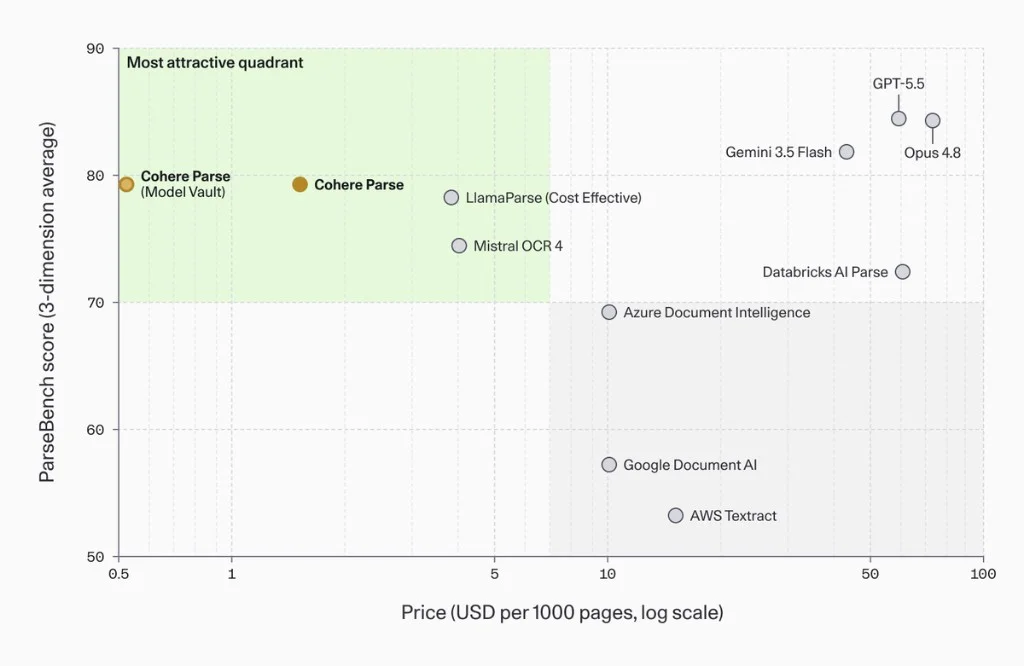 Cohere Parse 5 price versus ParseBench score on a log-scale scatter, with Parse and Model Vault in the cheap high-quality quadrant
Price/performance scatter from Cohere's Parse 5 announcement (August 27, 2026). Green band is Cohere's "most attractive quadrant" (score above ~70, price below ~$7.50 / 1k pages). Model Vault's x-position is an implied per-page cost, not the instance list price.
What does 79.2 on ParseBench actually measure?
Agent-ready parsing here is not "OCR accuracy." ParseBench (Zhang et al., 2026) is a ~2,000-page enterprise set (insurance, finance, government) scored on semantic correctness: table structure, chart data, content faithfulness, semantic formatting, and visual grounding. Full five-dimension results in the original paper are a different comparison — LlamaParse Agentic led that study at 84.9%.
Cohere reports a three-dimension average and is explicit about the cut. From the announcement footnotes:
- Tables — structural extraction of grids and cells.
- Content faithfulness — omissions, hallucinations, broken reading order.
- Semantic formatting — styles that change meaning (strike-throughs, italics). August 2026 eval rules include a bold/heading-detection fix; Cohere says it re-scored competitors on the updated rules.
- Excluded: charts and layout/visual grounding. Parse treats charts as visuals with descriptive metadata, not as data-series extraction. It emits reading-order Markdown and bounding boxes for tables or images only, not per-text-element boxes. Low layout scores would reflect that product choice, not a transcription failure.
So 79.2 is "good at tables + faithful text + middling semantic formatting," not "best at everything ParseBench can test." Semantic formatting is the weak leg: 64.0 versus GPT-5.5's 76.5. If your corpus lives on strike-throughs, heading hierarchy, or "this number is void," test that slice yourself. For how to read a vendor subset of a public bench, see how to read AI benchmarks.
Official three-dimension averages (Cohere blog table, August 2026 rules):
| Model | Average | Tables | Faithfulness | Semantic formatting |
|---|---|---|---|---|
| GPT-5.5 | 84.4 | 89.3 | 87.5 | 76.5 |
| Opus 4.8 | 84.3 | 89.7 | 89.0 | 74.1 |
| Gemini 3.5 Flash | 81.8 | 87.6 | 84.7 | 73.2 |
| Cohere Parse | 79.2 | 87.0 | 86.6 | 64.0 |
| LlamaParse (Cost Effective) | 78.3 | 81.4 | 90.9 | 62.7 |
| Chandra OCR 2 (open) | 77.7 | 89.2 | 83.7 | 60.3 |
| Mistral OCR 4 | 74.5 | 73.9 | 89.5 | 60.1 |
| Databricks AI Parse | 72.4 | 83.7 | 88.3 | 45.3 |
| Azure Document Intelligence | 69.3 | 86.0 | 84.9 | 37.0 |
| Deepseek-OCR 2 (open) | 65.9 | 61.7 | 82.0 | 54.0 |
| dots.mocr (open) | 63.2 | 85.2 | 89.5 | 14.9 |
| Google Document AI | 57.3 | 55.1 | 83.7 | 33.0 |
| AWS Textract | 53.3 | 82.3 | 74.8 | 2.8 |
Chart vs table conflict: Cohere's announcement bar chart labels Azure Document Intelligence at 74.3. The same post's numeric table — and the scatter's y-position around 69.5 — use 69.3. explainx.ai uses 69.3 from the table. Do not average the two.
LlamaParse Cost Effective at 78.3 is a point behind Parse on the average and ahead on faithfulness (90.9 vs 86.6). "Beats Mistral / Azure / Textract" is earned. "Beats every specialized parser" is not.
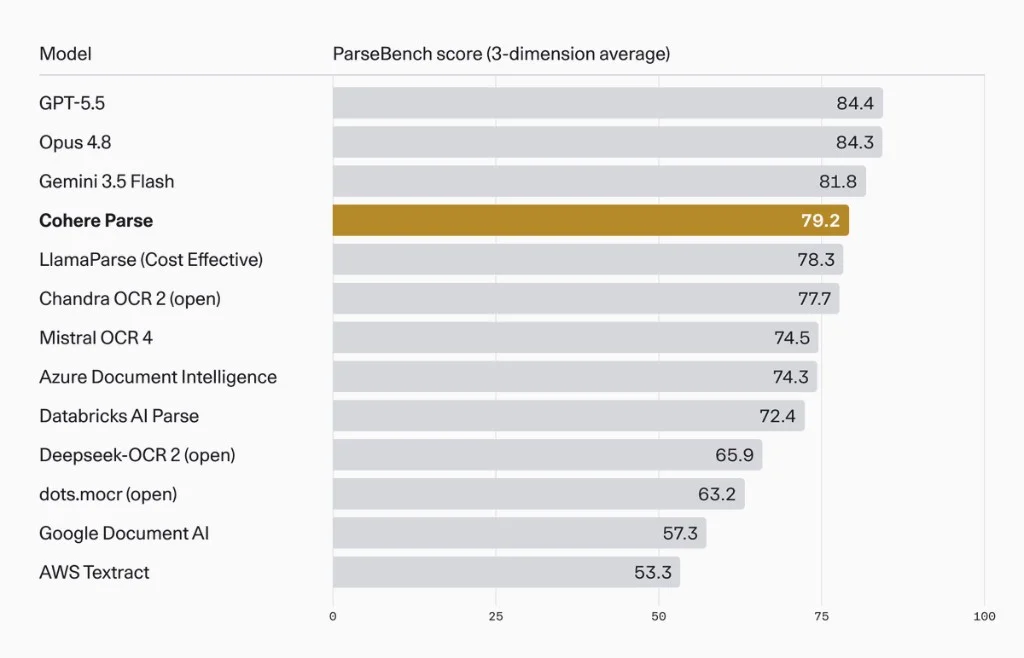 ParseBench three-dimension average bar chart from Cohere's Parse 5 announcement, Cohere Parse highlighted at 79.2
ParseBench 3-dimension average chart from Cohere's Parse 5 announcement (August 27, 2026). Azure's bar is labeled 74.3; Cohere's accompanying table lists 69.3 — use the table.
How does Cohere Parse compare to Mistral, Azure, Textract, and GPT-5.5?
Name the job, then pick the tool:
- Need near-frontier quality and you can pay VLM rates — GPT-5.5 / Opus 4.8 / Gemini 3.5 Flash still win ParseBench. You are buying the last 2–5 average points, mostly on semantic formatting, at ~25–50× Parse's API price.
- Need managed OCR with bounding boxes and you already standardized on Mistral — Mistral OCR 4 / 4.1 is the honest comparison. Parse leads the three-dimension average (79.2 vs 74.5) and is cheaper per page. Mistral still has the features Parse's docs say they do not ship: block confidence scores, broader language coverage (Mistral claims 170 languages; Parse is stable on nine), and Document AI JSON-schema extraction on the same endpoint.
- Need hyperscaler procurement — Azure 69.3, Google Document AI 57.3, Textract 53.3 on this subset. Semantic formatting is where they fall over (Azure 37.0, Google 33.0, Textract 2.8). Fine for "get the words off the page"; poor for "preserve meaning for an agent."
- Need self-hosted / no per-page bill — MinerU 3.4 and Baidu Unlimited-OCR remain the open stacks. Parse is a 2.3B proprietary serving story (~4.6 GB), not an Apache drop-in of the North Micro Vision Instruct weights (that Hub card is 2.4B Apache-2.0; docs call Parse's architecture proprietary
north-micro-vision-instruct— related, not a verified identical checkpoint). - Need to skip OCR on native-text PDFs — classify first with Firecrawl pdf-inspector, then send only scans to Parse.
- Need offline, no-upload OCR on a paginated viewer — OCR It (local Tesseract). Different job.
What should I evaluate for a RAG pipeline?
Parse is aimed at structure-aware retrieval, not at replacing your embedder. After you have Markdown, you still chunk, embed, and retrieve — Sentence Transformers v6 if you want late interaction; dense embeddings if you do not.
 Diagram of retrieval-augmented generation versus agentic RAG, the downstream stack Cohere Parse 5 is meant to feed
Run a 20–50 page gold set that matches production, not ParseBench's insurance/finance/government mix alone:
- Tables — merged cells, multi-row headers, numeric totals. Parse's table score (87.0) is close to GPT-5.5 (89.3). Check that HTML tables survive chunking without splitting a row across passages.
- Faithfulness — missing footnotes, hallucinated line items, column-order swaps. 86.6 is strong and still not 100%. Spot-check numbers against the PDF.
- Semantic formatting — 64.0 is the gap. If "void" is communicated by strike-through, this is your failure mode.
- Bounding boxes — useful for table/image grounding and citations. Do not expect word-level boxes for every paragraph.
- Charts — out of scope. If the value is in the figure, you need a different extractor or a VLM. PixelRAG is the "keep the page as an image" alternative.
- JSON schemas — Parse does not emit structured JSON. If you need fields, you add a downstream extractor. That is the opposite of Mistral Document AI; see structured output / JSON mode for the extra hop.
Official docs (Parse details): PDF, PPT, JPEG (base64); 8192 context; Markdown out; tables as HTML; nine stable languages (ar, en, fr, de, ja, ko, it, pt, es) plus weaker zero-shot on others. Throughput claim: 4.5 pages/sec, or 36 pages/sec on an 8×H100 node — measured against open models (dots.mocr, Chandra OCR 2) under vLLM, not against GPT-5.5.
It also sits in Compass next to Embed and Rerank if you want Cohere's managed ingest → index path (including formats Compass claims beyond Parse's raw endpoint, such as xlsx/docx/html).
How do I try the Hugging Face demo today?
- Open the CohereLabs Parse Space. Docs call this the free try-before-you-wire path.
- Use your worst page, not a clean typeset essay: a scanned table, a form with checkboxes, a slide with a dense footer.
- Read the Markdown as an agent would. Are merged cells one record or soup? Did strike-through survive? Are image captions useful or generic?
- If the Space is enough signal, hit the API. Cohere's announcement snippet (verified on their blog — not an invented SDK):
import base64
import os
import requests

API_KEY = os.environ["CO_API_KEY"]
IMAGE_PATH = "YOUR_IMAGE.png"

with open(IMAGE_PATH, "rb") as f:
    image = base64.b64encode(f.read()).decode("utf-8")

response = requests.post(
    "https://api.cohere.com/v2/parse",
    headers={"Authorization": f"Bearer {API_KEY}"},
    json={
        "model": "parse-v5.0",
        "document": {
            "type": "image_url",
            "image_url": f"data:image/png;base64,{image}",
        },
        "output_format": "markdown",
    },
)
response.raise_for_status()
pages = response.json()["pages"]
markdown = "\n\n".join(page["markdown"]["content"] for page in pages)
Set output_format to "blocks" when you want typed blocks (text vs table) and table bounding boxes — that path is in Cohere's quickstart, not something we inferred.
Trial keys are free and rate-limited; production keys are pay-as-you-go. Vault is the high-volume / single-tenant path.
What are the honest limitations?
Cohere's docs are unusually direct. Quote them into your eval notes:
- No confidence scores. You cannot threshold bad regions the way Mistral OCR 4.1 can.
- No header/footer/font-hierarchy tags. Reading-order Markdown is the product; layout class labels are not.
- No structured JSON from Parse itself.
- Text bounding boxes are out of scope. Tables and images only.
- Charts are captions, not series extraction. Next parser version, per the announcement.
- Nine stable languages, not a 100+ OCR catalog.
- ParseBench subset. Three dimensions, vendor-rescored under August 2026 formatting rules. Compare like-for-like; do not mix with the original five-dimension LlamaParse Agentic 84.9 headline from the paper.
- Azure 74.3 vs 69.3 on Cohere's own assets. Always prefer the table.
Self-host vs API is a real fork: closed vs open-weight still applies. Parse on Vault keeps data in a Cohere-managed single tenant; MinerU keeps it on your GPU. Neither is free of ops.
Related reading
-
Tencent Youtu-Parsing-Omni: a 5B open model for documents, audio and video
-
Update — September 21, 2026: DocJev: LlamaIndex's Jerry Liu puts Jev on document classification and splitting — a decision-model layer built on top of parsers like this one, for the classify/split step after OCR.
-
Cohere North Small Translate — WMT26 machine translation model (Sep 2026)
-
Mistral OCR 4 / 4.1 — bounding boxes, confidence, Document AI
Primary sources: Introducing Parse · Parse docs · Parse quickstart · Cohere pricing (Model Vault) · Hugging Face Space · ParseBench paper (arXiv:2604.08538)
Scores, prices, file types, and API shapes are as published by Cohere on August 27, 2026. ParseBench methodology is Zhang et al., 2026; Cohere's leaderboard is a three-dimension, August-2026-rules rescore. Re-run on your corpus before you switch ingestion. Follow @explainx_ai for document-pipeline coverage.