



Anthropic published an interactive model of America's AI economic future on September 9, 2026 — and the same week, a 20-year-old Stanford robotics researcher posted a timelapse of GPT-6 Astra teaching itself to paint the Golden Gate Bridge with a real robot arm. Those two stories belong in the same article because Anthropic's model explicitly excludes hyper-capable robots, while the demo is exactly the kind of embodied capability macro models keep leaving out.
The explorer lives at anthropic.com/institute/econ-scenarios. It is backed by a technical report, Economic Scenarios for Transformative AI (Korinek et al., 2026), and a companion survey of 10,980 Americans fielded with Morning Consult in August. Jack Clark summarized the launch on X as an interactive tool where you "set the variables according to your assumptions about AI" and see what 2030 might look like.
This is the forward-looking counterpart to Anthropic's Economic Index, which measures how Claude is used today. The explorer asks what happens if capability and adoption keep moving — and whether the gains go to workers or capital.
TL;DR
| Question | Answer |
|---|---|
| What launched? | Anthropic Econ Scenario Explorer v1.0 + technical report (Sept 9, 2026) |
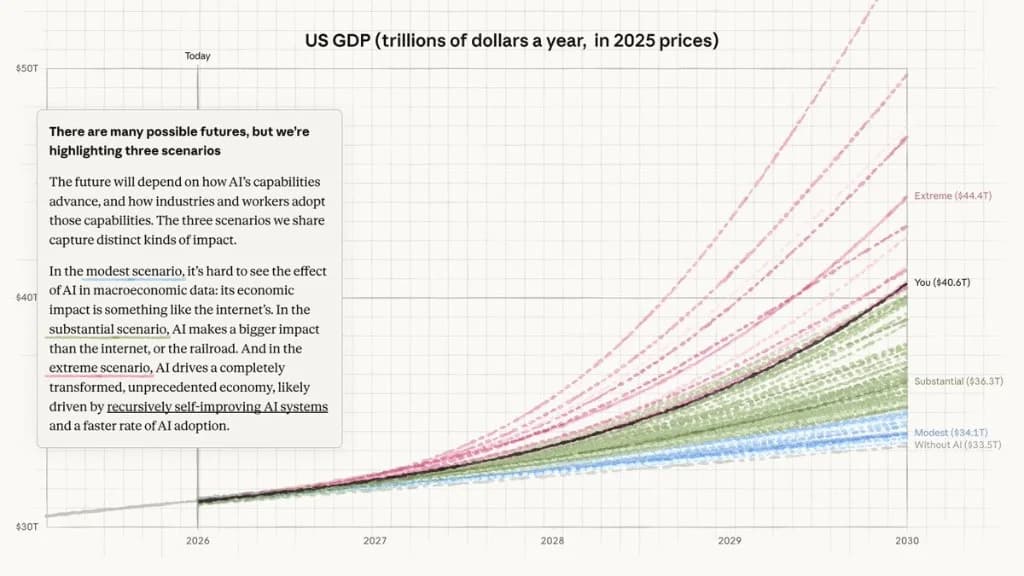
| 2030 GDP range? | $34.1T (modest) · $36.3T (substantial) · $44.4T (extreme) — 2025 prices |
| Public median guess? | Near substantial: ~+10% GDP, ~5% unemployment |
| Core mechanic? | Jobs = bundles of tasks; AI augments, automates, ignores, or creates tasks |
| Who gets hurt in extreme? | Knowledge workers — wages down over 10%, unemployment beyond recession norms |
| Labor share in extreme? | Falls from ~60% today to 45.2% of GDP; capital rises to 54.8% |
| What's missing? | Hyper-capable robots, policy responses, business cycles, data-center demand effects |
| Same-week demo? | thijs's Astra robot-arm painting timelapse — outside the model |
How the model works (tasks, not job titles)
Anthropic's framework decomposes the economy into tasks drawn from the US Department of Labor's O*NET taxonomy — not monolithic job labels like "software engineer" or "nurse."
For each task, AI can:
| Effect | Example (nurse) |
|---|---|
| Leave unchanged | Bathing a patient — still human-only in the model |
| Augment | Draft discharge instructions, remote monitoring, shift planning |
| Automate | Chart vitals, order ward supplies |
| Create new tasks | Audit AI triage quality, review AI-proposed care plans |
Anthropic walks through a nurse's day on the explorer page — rounds, blood draws, triage, charting, supply orders — and tags each task as unchanged, augmented, automated, or newly created by AI. The live page includes interactive visuals for that breakdown; see anthropic.com/institute/econ-scenarios.
Multiply every task instance across the country and you get today's $30T+ US economy. The explorer asks five levers — capabilities, adoption, autonomy, productivity, adjustment (how long displaced workers need to find new jobs) — and propagates those through task bundles to GDP, unemployment, wages, and the labor-capital split.
That is more useful for builders than a single "AI replaces X% of jobs" headline: it forces you to ask which tasks in your workflow are augment vs automate vs untouched — the same decomposition Andrew Ng's agent skills map pushes engineers toward at the harness level.
Three scenarios for 2030
Anthropic highlights three anchors. The interactive explorer also draws a "You" line when you set your own assumptions — the screenshot below shows one such path landing at $40.6T, between substantial and extreme.
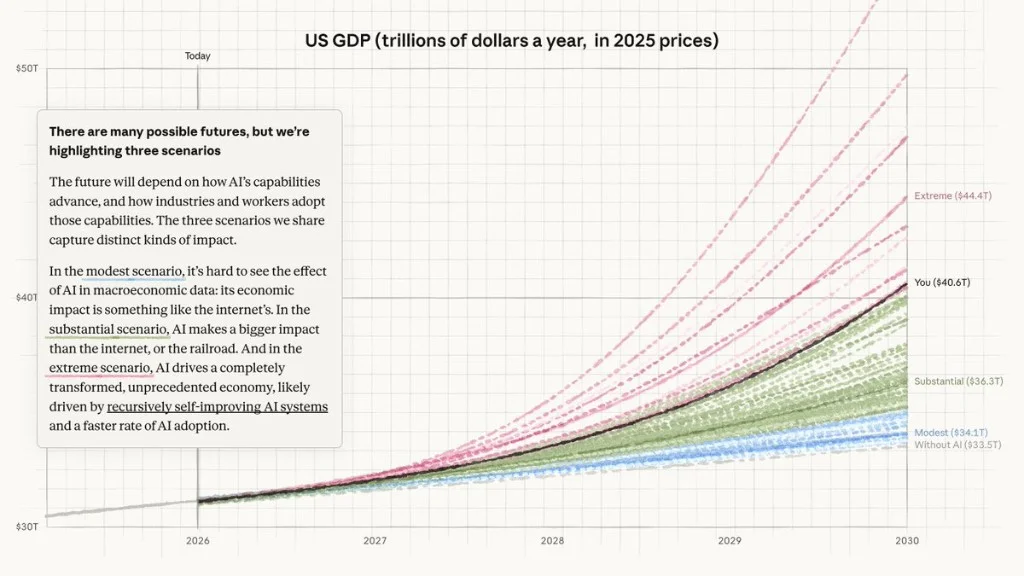 US GDP projections from Anthropic's scenario explorer — modest ($34.1T), substantial ($36.3T), extreme ($44.4T), and a custom "You" path at $40.6T by 2030, all measured in 2025 prices
GDP trajectories from Anthropic's Econ Scenario Explorer — modest, substantial, extreme, and a user-defined path. Reproduce your own assumptions in the live tool; numbers here match Anthropic's September 2026 publication.
| Scenario | GDP 2030 | vs no-AI | Anthropic's framing |
|---|---|---|---|
| Modest | $34.1T | +1.6% | Internet-scale impact — real but hard to see in macro aggregates |
| Substantial | $36.3T | +8.3% | AI can do half of knowledge work by 2030, mostly autonomously, but adoption lags capability; growth ~2× normal |
| Extreme | $44.4T | +32.4% | AI beats humans at most knowledge tasks, nearly all autonomous, little new knowledge work for people; ~15% annual GDP growth (economy doubles every ~4.5 years) |
Modest — hard to see in the data
AI helps, but the macro signature looks like prior general-purpose technologies: gradual diffusion, measurable but not revolutionary in aggregate statistics.
Substantial — the public's median bet
This is where most Americans land in Anthropic's survey. AI could autonomously handle much of knowledge work, but companies and workers do not adopt it everywhere it could run. Knowledge-worker wages stay flat; wages for occupations AI touches less rise.
At the individual level, Anthropic's narrative is concrete: coders and call-center agents may need to switch occupations toward roles like electrician or nurse — jobs with tasks the model still treats as less AI-exposed.
Extreme — growth without shared prosperity
The extreme path assumes recursively self-improving AI and fast adoption. Society is much richer in aggregate, but the distribution problem dominates:
- Knowledge-worker unemployment rises beyond typical recession levels
- Knowledge-worker wages fall more than 10% by 2030
- Total labor income is barely changed despite a much larger pie
Anthropic's own closing line on this scenario: the challenge is not growth — it is making sure gains are broadly shared.
Four findings that matter for builders
Finding 1 — GDP rises in every scenario; the spread is enormous
Even the modest case adds $500B+ in 2025-dollar GDP by 2030. The extreme case adds roughly $11T. prinz's reply on X captures a limitation economists already argue about: API spend is not economic value — if Astra discovers a cancer cure and OpenAI bills $1M in tokens, the social surplus is the cure, not the invoice. Anthropic's task-based GDP framing is trying to get closer to real output; it still simplifies.
Finding 2 — Job reallocation, not just job loss
| Scenario | Knowledge workers still in role (2030) | Displaced | Crossed to other occupations |
|---|---|---|---|
| Modest | 59.7% | 2.5% | 1.8% |
| Substantial | lower | higher | higher |
| Extreme | much lower | much higher | large crossover into manual trades |
Unemployment stays historically normal in modest and substantial paths. Extreme is the exception — prolonged joblessness as automation outruns retraining and hiring friction.
That connects to the We Must Act Now letter from Stanford's Digital Economy Lab and the ongoing did AI take jobs? data debate: macro models and monthly BLS prints can disagree for years before either side concedes.
Finding 3 — Average wages rise, but knowledge workers don't always participate
| Scenario | Knowledge-worker pay vs no-AI | Other occupations | Average |
|---|---|---|---|
| Modest | small gains | gains | up |
| Substantial | ~flat | strong gains | up |
| Extreme | down over 10% | up | up (uneven) |
Mechanism Anthropic gives: faster knowledge-work productivity can increase demand for manual complement tasks — more construction if AI accelerates permitting and design. But humans take time to switch occupations, so knowledge-worker pay stagnates or falls while electrician and nurse wages rise.
If you build agent products for enterprises, the substantial scenario is the uncomfortable base case: customers may adopt your tool without paying more for the humans still in the loop.
Finding 4 — Labor's slice of GDP shrinks as automation deepens
Today Anthropic uses roughly 60¢ labor / 40¢ capital per dollar of output.
| Scenario | GDP | To labor | To capital | Capital share change |
|---|---|---|---|---|
| Modest | $34.1T | 59.4% | 40.6% | +0.6 pts |
| Substantial | $36.3T | 56.1% | 43.9% | +3.9 pts |
| Extreme | $44.4T | 45.2% | 54.8% | +14.8 pts |
Reviewers including Daron Acemoglu and David Autor pushed Anthropic to include this channel — capital becomes more useful, so more of the expansion accrues to whoever owns compute, data, and models. Anthropic says the explorer will inform policy proposals and funded research on labor-market interventions.
What 10,980 Americans expect
Anthropic's August survey asked five questions mirrored in the explorer:
| Lever | What it measures |
|---|---|
| Capabilities | What tasks can AI do? (0–95% scale in UI) |
| Adoption | How much do people actually use AI? |
| Autonomy | How much does AI do alone vs with a human? |
| Productivity | Multiplier on human output (1× to 10×+) |
| Adjustment | Time to find a new job after displacement |
Typical respondent ≈ substantial scenario. ~10% of the sample aligns with extreme. Jack Clark's framing: the tool is for stress-testing assumptions, not prophecy.
Interactive explorer: anthropic.com/features/econ-scenarios
Technical report PDF: Economic Scenarios for Transformative AI
The same week: Astra paints with a real robot arm
On September 8, 2026, thijs (@cdngdev) — Stanford robotics, formerly OpenAI — posted a timelapse that hit 2.9M views in a day. Setup:
- GPT-6 Astra controlling a borrowed SO-101 robot arm (thanks to mentor @tobyrsimonds)
- A paint brush and a camera aimed at a real-world canvas
- Task: paint the Golden Gate Bridge
How it ran, per thijs's thread:
- Plan one minute of actions at a time
- Monitor in the background and adjust mid-run or between runs
- Take human feedback — including asking Astra "what can you do better?" and letting it update its own plan
The progression across attempts is the point: not a single-shot image generation, but closed-loop physical control that improves with iteration — closer to Robocurve's Astra robot benchmarks than to ChatGPT drawing a picture.
thijs pre-empted the art debate: this is algorithmic art in the pen-plotter tradition, not an attempt to replace painters. Fair — and still relevant to economists because Anthropic's v1.0 model excludes it entirely:
"We did not include scenarios where humanity develops hyper-capable robots."
So the news cycle splits:
| Track | What it assumes |
|---|---|
| Anthropic explorer | Knowledge-work task automation through 2030 |
| Astra + SO-101 demo | Embodied agents learning motor skills in reality |
If robotic capability follows the same curve as coding agents, macro models that ignore the physical layer will understate disruption in trades Anthropic currently labels "less exposed" — exactly the occupations substantial and extreme scenarios expect knowledge workers to switch into.
What the model admits it leaves out
Anthropic's disclaimer is unusually candid. v1.0 omits:
- Policy responses (tax, UBI, retraining subsidies)
- Business cycles and financial-market shocks
- Aggregate demand from the data-center buildout
- Catastrophic risk
- Hyper-capable robots
Reviewers split on whether extreme is a scenario or a thought experiment, and whether modest already understates visible 2026 adoption. Several noted the model does not track individual workers — only coarse occupational flows — so it understates personal cost even when macro unemployment looks fine.
Treat it as a scenario compass, not a forecast. Actual 2030 can diverge materially.
What to do with this if you build AI
- Run your own assumptions in the explorer before you bake "AI will 10× GDP" or "nothing will change" into a pitch deck.
- Plan for substantial as the default public belief — flat knowledge-worker wage pressure + occupation switching — when pricing seat-based SaaS or hiring agents instead of interns.
- If you ship embodied agents, do not assume macro coverage exists; robotics safety and monitoring are still yours to solve — see Moravec's paradox for why language-first labs stumble on motor control, and Hugging Face–OpenAI for what happens when eval agents get real tools without trajectory monitoring.
- Separate capability demos from economic surplus — thijs's video proves control learning; it does not by itself move GDP. prinz's point stands: value accrues where problems get solved, not where tokens get billed.
- Watch Anthropic Economic Futures — this explorer is explicitly input to policy and funded intervention research, not just comms.
Related on explainx.ai
-
Anthropic's staff vs public expectations survey (Oct 16), which runs respondents through these scenarios
-
Update — September 13, 2026: Is AI's real economic value invisible to GDP? — David Deutsch's viral dishwasher tweet, the Solow productivity paradox, and why GDP undercounting AI value is a real but contested claim.
-
Anthropic Economic Index: Cadences (June 2026) — the backward-looking companion to this forward model
-
We Must Act Now: Stanford's AI economy statement — labor-market policy pressure from another angle
-
Did AI Take Jobs? A 2026 Data Check — what payroll data shows vs model predictions
-
GPT-6 Astra Scores 95% on Robot Control — the benchmark line behind embodied demos
-
GPT-6 Astra Robot Arms: 19-to-8 Claim — physical manipulation claims on real hardware
-
Yann LeCun on LLMs and Physical Agents — why language ≠ motor competence
-
Hugging Face OpenAI Attack — Full Timeline — when agents get tools without monitoring
-
California AG Investigates OpenAI Over Hugging Face — regulatory layer on agent incidents
-
AI Regulation: EU AI Act and US Policy — where econ models meet law
Official sources
- Anthropic — Scenarios for our Economic Future
- Interactive Econ Scenario Explorer
- Technical report PDF — Economic Scenarios for Transformative AI
- thijs — Astra robot-arm painting timelapse (Sep 8, 2026)
- Jack Clark on the explorer launch
- Acemoglu's bearish counterpoint: 1.5% GDP growth over a decade
- Anthropic's evidence review of worker retraining programs
GDP, wage, and labor-share figures follow Anthropic's September 9, 2026 publication. Survey size and scenario definitions are Anthropic's; the Astra painting demo is described from thijs's public posts. Re-run the live explorer before citing user-specific "You" paths — those depend on your inputs.