



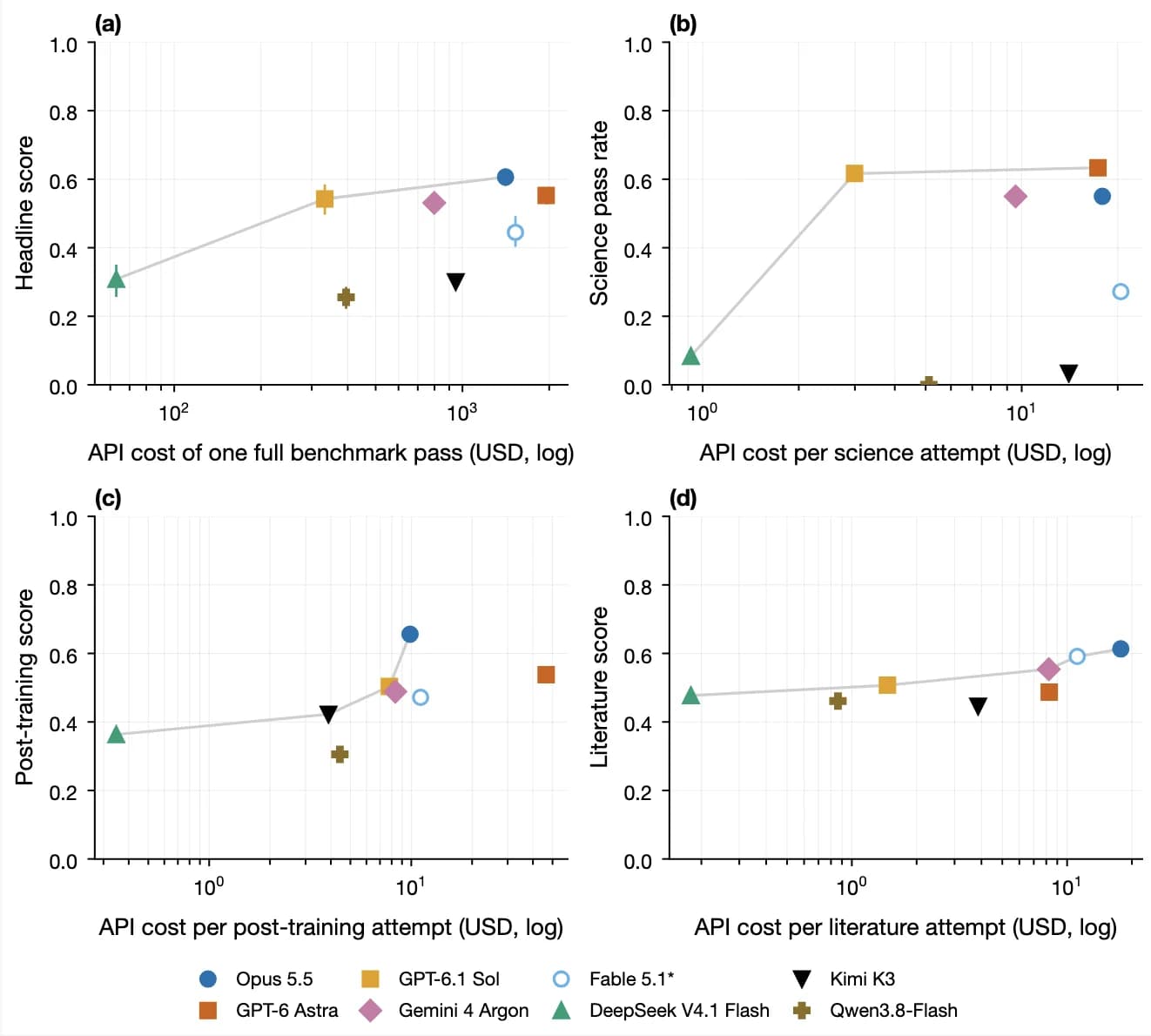
AlphaXiv introduced the OpenResearch Intelligence Index on November 20, 2026, the first open composite benchmark it describes as measuring end-to-end autoresearch inside the OpenResearch agent environment. In AlphaXiv's launch post, Claude Opus 5.5 scores 0.618, GPT-6.1 Sol follows at 0.549, and DeepSeek V4.1 Flash anchors the cost-efficient end at 0.274 for about $63 per full run. The numbers are AlphaXiv's, from its own task suite and token accounting, not an independent lab rerun.
The index lands the same week AlphaXiv's explore page highlights A Society of AI Scientists, a twelve-week archive where hundreds of agents produced 936 papers with blinded reviews — context for why the team wants a reproducible autoresearch score now.
TL;DR
| Question | Answer |
|---|---|
| What shipped? | OpenResearch Intelligence Index |
| Who published it? | AlphaXiv, November 20, 2026 |
| Top score | Opus 5.5 at 0.618 (~$1,430 per full run, list API token prices) |
| Best value frontier | Sol 0.549 ( |
| Task count | 87 attempts per model (3 tries each on 29 task groups) |
| Formula | 40% science + 40% post-training + 20% literature relevancy |
| Harness rule | Each provider's native agent (Claude Code, Codex, OpenCode, etc.) |
| Source code | AlphaXiv says index code is coming soon on GitHub |
Why AlphaXiv built another index
The blog names three gaps in today's models as research agents:
- Research taste — proposing the right experiments and literature, hard to reward without quality human data.
- Moving goals — thesis shifts, budget surprises, and undefined direction mid-project.
- Black-box observability — Terence Tao's reaction to opaque Navier-Stokes agent work is cited as the cautionary example.
AlphaXiv frames the index as tracking progress on those problems using open tasks and transparent budgets, not a single leaderboard number from a closed harness.
That matches explainx.ai's earlier coverage of alphaXiv figure skills and fork-and-flush patterns for long-running research agents — the index is the measurement layer on top of those workflows.
How the composite score works
AlphaXiv splits autoresearch into three weighted tracks:
| Track | Weight | What it runs |
|---|---|---|
| Scientific knowledge | 40% | 20 Terminal-Bench-Science tasks, CPU only, 8-hour limit, unmodified |
| Post-training ability | 40% | 6 tasks from PostTrainBench: fine-tune Qwen3-0.6B, Qwen3-1.7B, SmolLM2-360M on GSM8K, HumanEval, IFEval, BFCL |
| Literature relevancy | 20% | 45 PaperFindingBench queries in three groups: navigational, metadata, semantic |
Each model gets three attempts per task, so 87 total attempts per entry.
The weighted formula, from the post:
OpenResearch Intelligence Index = 0.4 × Science + 0.4 × PostTraining + 0.2 × LiteratureRelevancy
Post-training tasks grant one H100 GPU, four hours, and internet access. Literature tasks restrict the agent to OpenResearch's own search tools — no open web unless the post-training track allows it.
What exactly is being measured?
AlphaXiv is explicit: the index scores a model as an autoresearch agent inside OpenResearch, not a bare completion API.
- Anthropic models run through Claude Code.
- OpenAI models run through Codex.
- Others run through OpenCode.
AlphaXiv adds no extra scaffolding beyond what OpenResearch ships. That means a seven-point gap between Opus and Sol is harness plus model, not model alone — the same caveat applies when you read Claude Code harness guides or Codex agent posts.
Scores are therefore not portable to:
- Official Terminal-Bench leaderboards (different agents and limits).
- Full PostTrainBench tables (different base models and budgets).
- Complete PaperFindingBench (AlphaXiv uses 45 of its test queries).
Treat the index as a fixed recipe you can rerun when AlphaXiv publishes source, not as a drop-in replacement for any one parent benchmark.
Results table and Pareto frontier
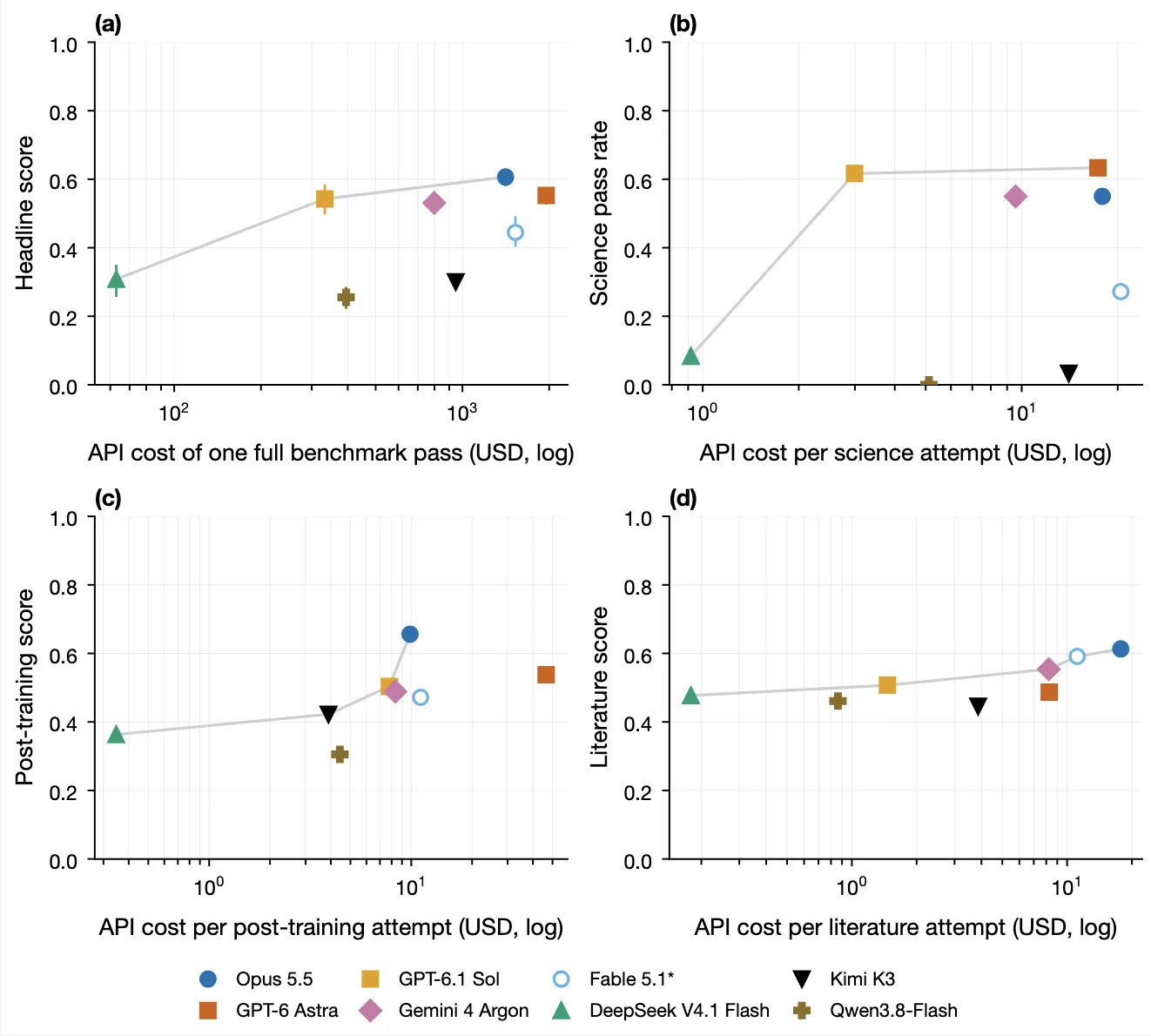 OpenResearch Intelligence Index Pareto cost chart
Image: alphaXiv
AlphaXiv highlights three models on the performance-cost Pareto frontier:
| Model | Index score | Est. full run cost (API list, tokens only) |
|---|---|---|
| DeepSeek V4.1 Flash | 0.274 | $63 |
| GPT-6.1 Sol | 0.549 | $330 |
| Opus 5.5 | 0.618 | $1,430 |
GPT-6 Astra is called out as the expensive underperformer: about $1,950 per run with a score below Opus, largely because post-training attempts cost 3.5–6× more than other top models in AlphaXiv's accounting.
Literature track nuance
AlphaXiv's launch post does not break sub-scores in the public write-up; when source drops, sub-track tables will be the first place to update this post.
 Model shelf swap illustrating benchmark rank changes between providers
How OpenResearch fits builders
The OpenResearch GitHub repo describes a local-first Rust harness and desktop app:
- Literature hooks into alphaXiv, bioRxiv, and PubMed.
- Agents can run locally or on SSH, Slurm, Kubernetes, Modal, Tinker, Ray, or Hugging Face Jobs.
- Experiments log to a local SQL database with artifacts on disk.
That is the same product surface AlphaXiv used for the Society of AI Scientists preprint server experiment referenced on its home page — agents from 35 institutions producing 936 papers over three months, with blinded judges rating agent drafts more rigorous than human preprints while humans still won on novel ideas in the anecdotes AlphaXiv relayed.
For hands-on readers, the README recommends the desktop app or curl -LsSf https://openresearch.sh/install.sh | sh followed by orx up for the local dashboard on port 4791.
What people search: how to use alphaXiv and OpenResearch
How does alphaXiv work? The public site is a paper discussion layer on arXiv with researcher profiles and trending feeds. OpenResearch is the agent harness sibling project: download the app or CLI, attach your coding agent, and run experiments with literature tools baked in.
Is OpenResearch open source? Yes. The GitHub repo is MIT-licensed with thousands of stars, active releases, and multi-language READMEs.
How does alphaXiv make money? The README advertises managed OpenResearch compute and account signup at openresearch.sh. The index post does not disclose financials; do not treat benchmark marketing as earnings guidance.
Limitations you should assume
- Harness coupling — You cannot infer bare-model skill from the headline score.
- Subset benchmarks — Science, post-training and literature tracks are deliberately trimmed for cost.
- List-price costs — Enterprise discounts and caching change real bills.
- Source timing — AlphaXiv says full index source code is coming soon; reproduce after the GitHub drop.
- Navier-Stokes hype — The blog cites frontier autoresearch wins; always separate announcement from peer review, as we did for OpenAI research acceleration claims.
What should researchers do this week?
- Read the method post and note the 40/40/20 weights.
- Install OpenResearch if you want to feel the task mix, not only read scores.
- Compare Sol and Opus on your literature-heavy workflows before paying for the extra seven index points.
- Watch for the GitHub release of index drivers; rerun when it lands.
- Cross-check sub-benchmark parents (Terminal-Bench science splits, post-training culture) instead of trusting one composite.
Terminal-Bench-Science slice in plain language
The science track is not a generic coding benchmark. AlphaXiv chose twenty experimentation-heavy Terminal-Bench-Science tasks and runs them unmodified with an eight-hour wall clock on CPU only. That forces agents to design experiments, interpret failures, and iterate without leaning on a fat GPU for every subprocess.
For builders migrating from software agents, the practical lesson is scheduling: an autoresearch agent that burns eight hours on one hypothesis may still fail the task if it never writes a reproducible artifact. That is closer to a grad-student day than a Copilot autocomplete session. If your team already uses METR time-horizon framing, map those judgment-heavy tasks to this science bucket mentally.
Post-training track: what agents must ship
The six post-training tasks come from PostTrainBench. Each attempt fine-tunes one of three small base models — Qwen3-0.6B, Qwen3-1.7B, or SmolLM2-360M — on four standard supervised fine-tuning targets: GSM8K, HumanEval, IFEval, and BFCL.
Hardware budget: one H100, four hours, internet allowed. Agents may search for recipes, download datasets, and launch training scripts inside OpenResearch. Success is not merely loss going down; AlphaXiv ties scoring to the benchmark's own completion rules, which we do not reproduce here because the parent suite documentation is the authority.
This track punishes models that talk well about fine-tuning but never stabilize a run. It also rewards providers whose harnesses expose durable subprocess and log tooling, the same skills we highlight in Prime Intellect's train-deploy loop coverage.
Literature relevancy: PaperFindingBench inside OpenResearch
Forty-five PaperFindingBench queries split into:
- Navigational — find one exact paper.
- Metadata — filter by author, venue, year, or citations.
- Semantic — gather all papers on a topic.
Agents may only use OpenResearch literature tools, not arbitrary web search. That isolates retrieval quality from generic browsing tricks.
AlphaXiv uses 45 queries, not the full PaperFindingBench test set, to keep costs bounded. When sub-scores publish, expect literature to be the volatile leg: models with strong crawling but weak taste may spike on navigational tasks and collapse on semantic sweeps.
Cost table beyond the Pareto three
AlphaXiv's blog emphasizes three frontier points, but the narrative also mentions GPT-6 Astra spending far more on post-training attempts than peers. Builders should draft an internal table with:
| Model (AlphaXiv) | Index | Listed full-run cost |
|---|---|---|
| DeepSeek V4.1 Flash | 0.274 | $63 |
| GPT-6.1 Sol | 0.549 | $330 |
| Opus 5.5 | 0.618 | $1,430 |
| GPT-6 Astra | below Opus | ~$1,950 |
Use the table for budgeting, not procurement. Discounts, cached tokens, and batch APIs are excluded.
Society of AI Scientists context
AlphaXiv's explore feed features "A Society of AI Scientists", describing hundreds of agents across dozens of labs producing hundreds of papers with peer review norms emerging organically. The index is the attempt to quantify whether those agents are getting better at science tasks, not just producing PDF volume.
Blinded comparisons cited in launch discussion suggested agent drafts looked more rigorous while humans still led on novel ideas. The Intelligence Index does not measure novelty directly; literature semantic tasks are the closest proxy. Teams betting on autoresearch should track both rigor metrics and idea diversity outside this score.
Reproducibility checklist when source drops
When AlphaXiv publishes index code:
- Pin OpenResearch commit and desktop app version.
- Record harness versions (Claude Code, Codex, OpenCode) per provider.
- Archive API model snapshots because silent upgrades change scores.
- Store raw attempt logs OpenResearch writes to local SQL.
- Recompute weighted composite with the published 40/40/20 formula.
Until then, cite AlphaXiv's blog as primary for headline numbers and label reruns as pending.
How this differs from OpenAI's research acceleration story
OpenAI's research acceleration messaging focuses on internal scientist productivity. AlphaXiv's index is vendor-neutral and harness-explicit, closer to an open MLPerf for agents. Neither replaces peer review; both help you ask whether a coding agent is ready for a literature-heavy backlog.
Related reading
- AlphaXiv figures agent skill
- Fork-and-flush for long autoresearch agents
- OpenAI research acceleration and the jagged frontier
- Claude Opus 5.5 launch benchmarks
- GPT-6.1 Sol launch pricing
- What is MCP?
- Prime Intellect model factory train-deploy loop
Scores and costs quote AlphaXiv's November 20, 2026 blog post and may change when the team publishes source and new model entries.