




Yandex released AliceAI-Foundation-80B-A3B-Base on Hugging Face under Apache 2.0: an 80 billion parameter mixture-of-experts model with about 3 billion active parameters per token, 262,144-token context support, and weights trained from scratch without importing another lab's checkpoint. The company news post and arXiv report describe it as a step toward a unified reasoning model for the Alice AI assistant.
TL;DR
| Item | Detail from Yandex sources |
|---|---|
| License | Apache 2.0 |
| Total / active params | 80B / ~3B per token |
| Experts | 512 routed, top-10 plus one shared expert |
| Attention mix | 36 Kimi Delta Attention layers, 12 full attention (3:1 pattern) |
| Context | Up to 262,144 tokens after extension stages |
| Languages | Russian and English emphasized; Russian factual benchmarks released |
| Stage | Pretrained base after reasoning-oriented training stage in the paper |
Architecture in plain language
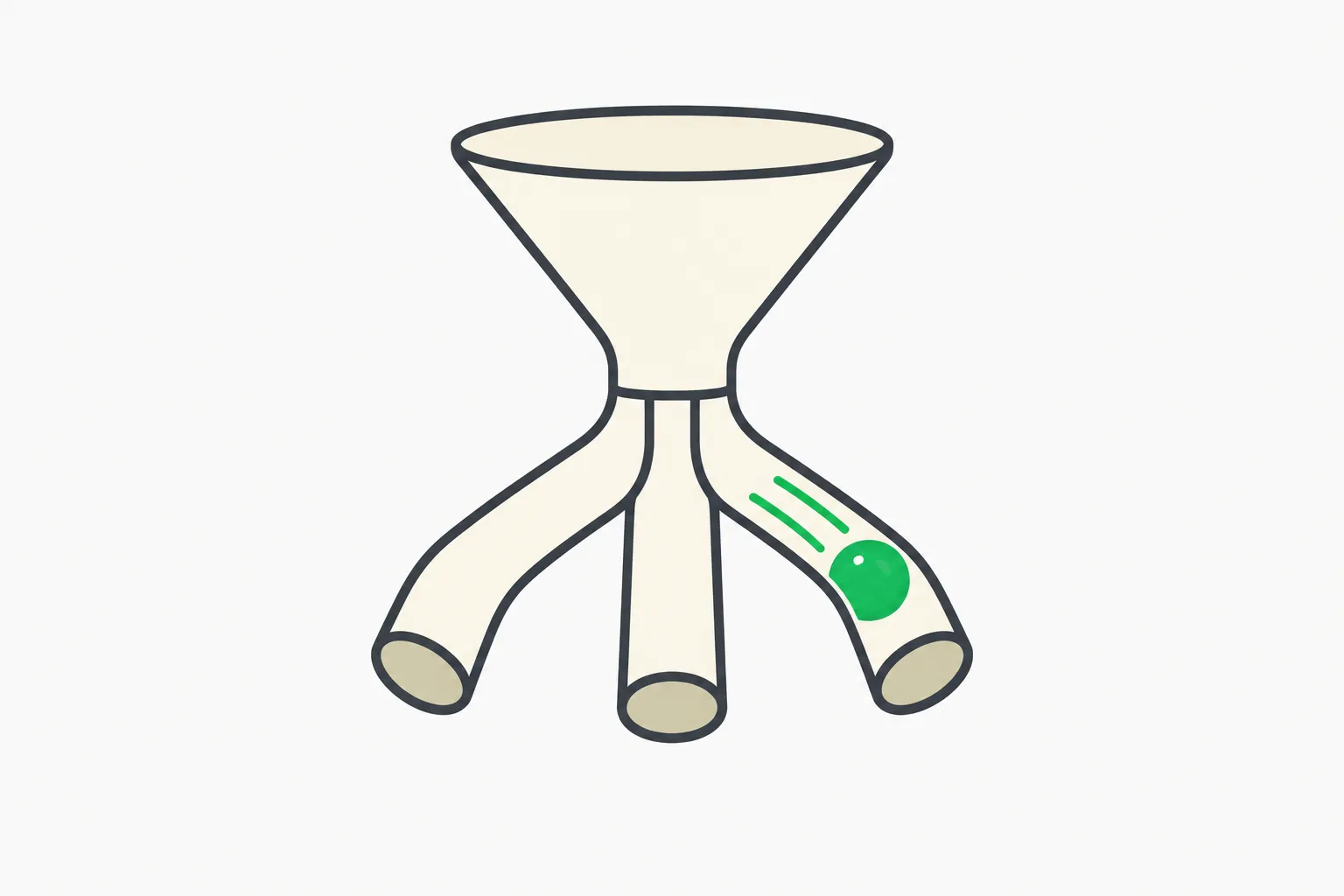 MoE routing funnel showing one active path among many expert branches
The English README is the quickest official spec sheet. Yandex uses a hybrid MoE transformer with 48 layers, hidden size 2048, and vocabulary 129,024.
The attention stack alternates Kimi Delta Attention blocks with full attention every three KDA layers. MoE routing follows the auxiliary-loss-free approach described in DeepSeek-V3, with 512 experts and top-10 routing plus a shared expert. The design targets agentic and coding workloads where long context and reasoning matter.
Training scale in the arXiv paper is large even by 2026 open-model standards: 17.5 trillion tokens in general pretraining, then context extension and a reasoning and agentic interaction stage. Yandex also introduces Attention Residuals and Muon optimization in the report, with ablation sections for readers who want the research detail.
Benchmarks Yandex publishes
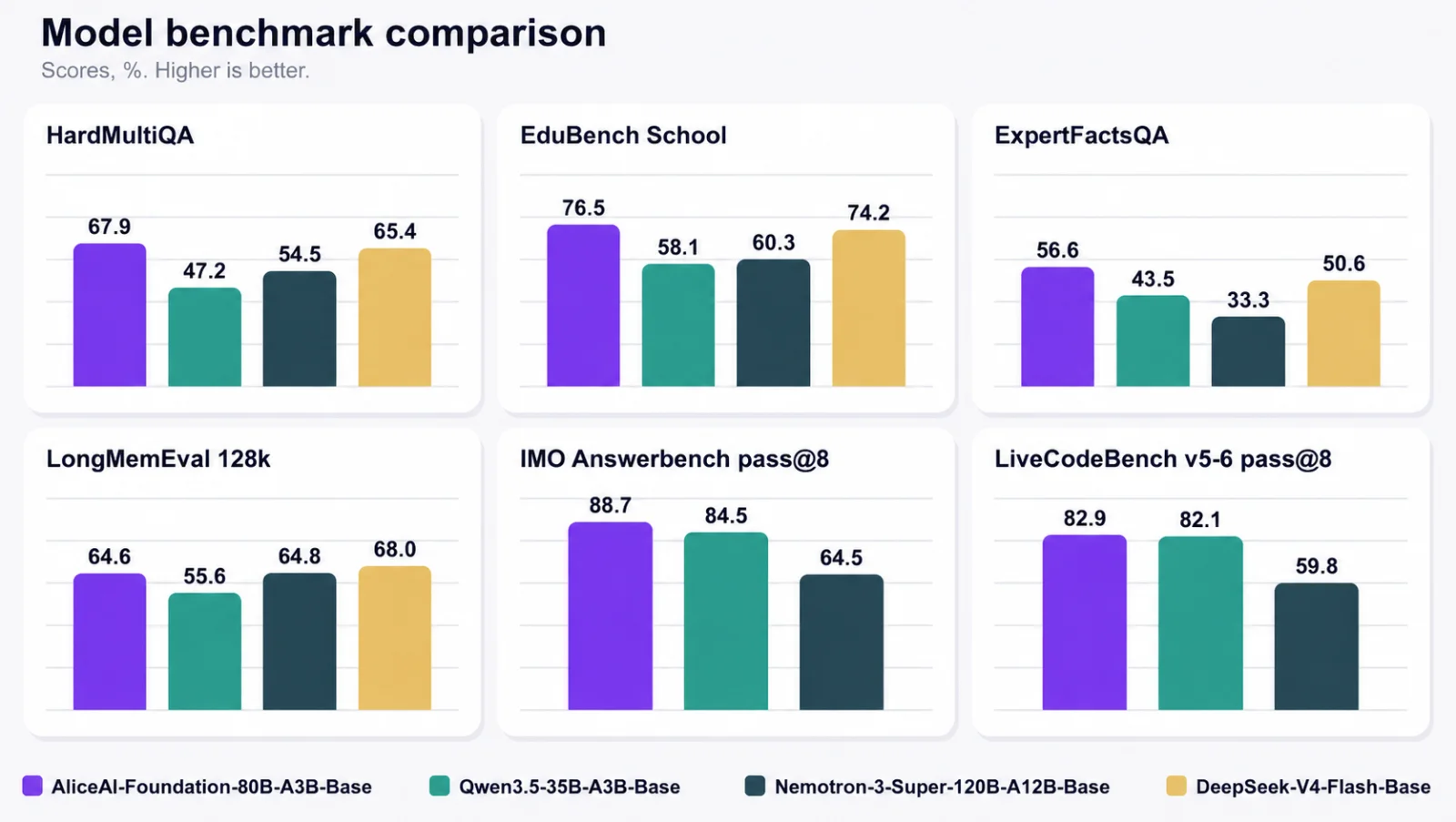 Benchmark table from Yandex comparing AliceAI Foundation 80B to rival open base models
Image: Yandex
Yandex ships a benchmark figure on the model card and reports numbers in the paper. Highlights they emphasize:
- IMO-AnswerBench pass@8 around 88.7% and LiveCodeBench v5–v6 pass@8 around 82.9% in zero-shot reasoning evaluation tables.
- WikiWebFacts 86.5% and HardMultiQA 67.9%, Russian-focused factual suites they open-sourced with protocols.
- Comparisons against DeepSeek-V4-Flash-Base (284B total, 13B active) and Nemotron-3-Super-120B-A12B-Base (120B total, 12B active) on those factual tasks.
Independent replication was not available at publication time on explainx.ai's check. Treat the table as vendor-reported until outside evaluators publish reruns. For methodology on reading MoE leaderboards, see our GigaChat 4 open weights post and Together distillation cost write-up.
How AliceAI fits Yandex's stack
Alice is Yandex's consumer AI assistant. This checkpoint is the foundation release, not a polished chat product. Yandex says it is testing architectural choices for a future unified reasoning model that will power agentic features—delegating actions, not only answering questions.
That roadmap sits next to a difficult operating environment. explainx.ai covered drone strikes on Yandex data centers and power constraints Russian executives describe. Open weights do not remove those infrastructure risks; they change who can fine-tune the model outside Yandex's cloud.
How to try the model
- Read the card — yandex/AliceAI-Foundation-80B-A3B-Base lists
custom_code, vLLM, and transformers tags. - Check the paper — arXiv 2611.34529 for data mix, ablations, and benchmark protocols.
- Plan GPUs — full MoE at 80B total parameters is a multi-GPU job. Start with the README's serving notes rather than assuming single-card quantization.
- Evaluate on your task — Russian factual suites matter if you serve Russian users; coding benches matter if you build agents. Neither replaces your private eval set.
For MoE serving craft, compare Nemotron open fine-tuning guidance and Hugging Face training swarms research.
Comparison with other open MoE releases this month
| Model | Lab | Total / active | License | Angle |
|---|---|---|---|---|
| AliceAI Foundation 80B | Yandex | 80B / ~3B | Apache 2.0 | Russian factual strength, KDA plus MoE |
| GigaChat 4 708B | Sber | 708B / 41B | MIT | Huge context, hybrid DSA/GDN |
| Sand AI Magi 2 | Sand AI | 114B (audio-video MoE) | Apache 2.0 | Multimodal generation, different modality |
AliceAI is smaller in active parameters than GigaChat 4 but closer to efficient MoE serving profiles teams already study for agents.
Training pipeline highlights from the paper
The arXiv report is the authoritative depth source. Items builders often skim past:
- Data collection spans general web, books, code, math, and Russian encyclopedic sources, with domain-specific augmentation for medicine and law in Yandex's tables.
- Ablations compare Kimi Delta Attention stacks against full-attention-only variants and test MoE balancing without auxiliary loss.
- Scaling-law experiments motivated the final learning rate; Yandex describes an auxiliary MoE loss to stabilize training when held-out loss mis-predicted downstream scores.
- Agent trajectories introduced during pretraining improved agentic benchmark scores after later supervised fine-tuning, even though this release is the base checkpoint.
If you fine-tune, read section boundaries carefully: the Hugging Face weights reflect the checkpoint after the reasoning-oriented stage named in the paper, not the earliest mid-training snapshot.
WikiWebFacts and HardMultiQA
Western labs often ship English MMLU-style suites. Yandex adds Russian factual benchmarks with published protocols:
- WikiWebFacts targets short questions from encyclopedic material and search-like queries in Russian contexts.
- HardMultiQA uses harder factual prompts inspired by user interactions.
Publishing benchmarks alongside weights helps third parties rerun evaluations on language-specific tasks that generic English leaderboards miss. Until someone independent publishes reruns, still treat Yandex's comparison tables as vendor numbers.
Serving and fine-tuning checklist
- Confirm
custom_codesupport in your inference engine version; MoE plus KDA is not a vanilla Llama load. - Estimate VRAM for 80B total experts even when only 3B activate; expert storage dominates.
- Start with short context smoke tests before attempting 262K-token jobs.
- Log per-task accuracy on your own Russian and English prompts if you serve both markets.
- Document license compliance for Apache 2.0 commercial use in your jurisdiction.
Teams comparing against Sber's GigaChat 4 should compare active parameters, license, and serving cost, not headline total parameters alone.
Why this release resurfaced in November
Yandex announced the model in September 2026 on its newsroom and Hugging Face. Aggregator attention in late November reflects renewed discussion of open MoE competition, not a silent re-upload. The weights and paper were already public; the news is sustained relevance as labs publish more Russian-strong open checkpoints while export politics tighten chip supply across the region.
Infrastructure context
explainx.ai tracked strikes on Yandex facilities and government hardening proposals. Open weights let researchers outside Russia experiment with the architecture, but they do not guarantee Yandex cloud availability for hosted inference.
Risks and limits
- Self-reported benchmarks until third parties rerun them.
- Custom architecture code on Hugging Face may lag popular inference engines.
- Geopolitics and sanctions may affect who can host or fine-tune weights regardless of license text.
- Base model only — no built-in refusals or product policies; you own safety layers in production.
Layer layout in more detail
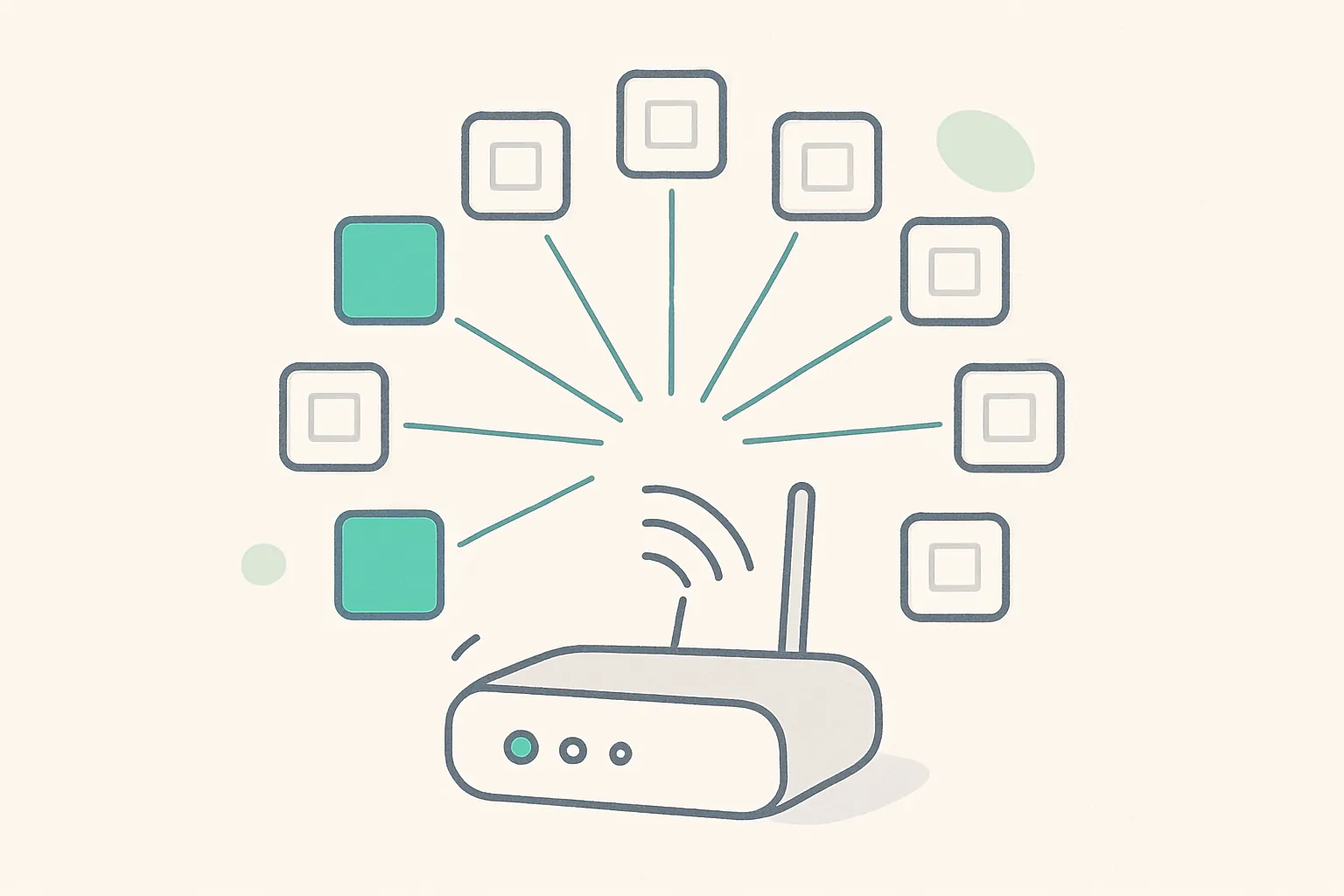 Router hub connecting to a ring of small expert blocks in a MoE stack
The README lists a repeating pattern: 12 blocks each containing three KDA-then-MoE stacks followed by one Gated Attention then MoE stack. That rhythm is designed so most layers use linear-time attention while periodic full attention layers recover long-range dependencies.
MoE configuration from the card:
| Component | Setting |
|---|---|
| Routed experts | 512 |
| Experts activated per token | 10 routed + 1 shared |
| Expert intermediate size | 512 |
| Multi-token prediction | 1 layer |
| Vocabulary | 129,024 tokens |
Muon optimization and Attention Residuals appear in the paper's ablation sections. If you are researching efficient MoE training, compare Yandex's design choices with Tencent AngelSpec sparse attention work and Together's compiler inference economics—different goals, but the same 2026 theme of matching active parameters to task.
Who should download this checkpoint
| Persona | Reason to care |
|---|---|
| Russian-market SaaS teams | Strong claimed factual QA scores on Russian suites |
| Agent builders | Paper emphasizes agent trajectories in pretraining mix |
| Academic MoE researchers | Full ablation report plus open weights |
| Western chat vendors | Probably not a drop-in; evaluate latency and compliance first |
Medium and Yandex newsroom companion posts
Yandex published a shorter Medium article and the September 21 newsroom note. Together they repeat benchmark claims but add plain-language motivation: Alice assistant features will need reasoning and tool use, so the foundation model optimizes math, code, and factual knowledge rather than chat polish alone.
Compliance and geopolitics checklist
- Sanctions and export rules may limit who can download or host weights regardless of Apache 2.0 text.
- Data localization laws may apply if you fine-tune on user content tied to Russian users.
- Security review should treat any
custom_codemodel as supply-chain code until you audit the repository.
None of those replace technical eval; they sit beside it.
What to watch next
If you only need English chat quality, run English prompts through your own eval harness before you commit GPU weeks. Russian strength does not automatically transfer.
Watch the Hugging Face repo for quantized or instruction-tuned siblings, independent vLLM pull requests, and community benchmark reruns on WikiWebFacts. If Yandex ships an Alice chat checkpoint built on this base, that would be a new event, not an update to this foundation release.