




Walmart and Meta said on November 24, 2026 that shoppers can hunt Black Friday deals inside Meta Muse instead of scrolling walmart.com. Walmart’s official announcement describes sign-in through Muse, product search, price comparison, and checkout over Walmart Agent Gateway — the same infrastructure Walmart opened in October 2026 for external agents. TechCrunch and other outlets reported the same flow the same day.
How the Muse flow works
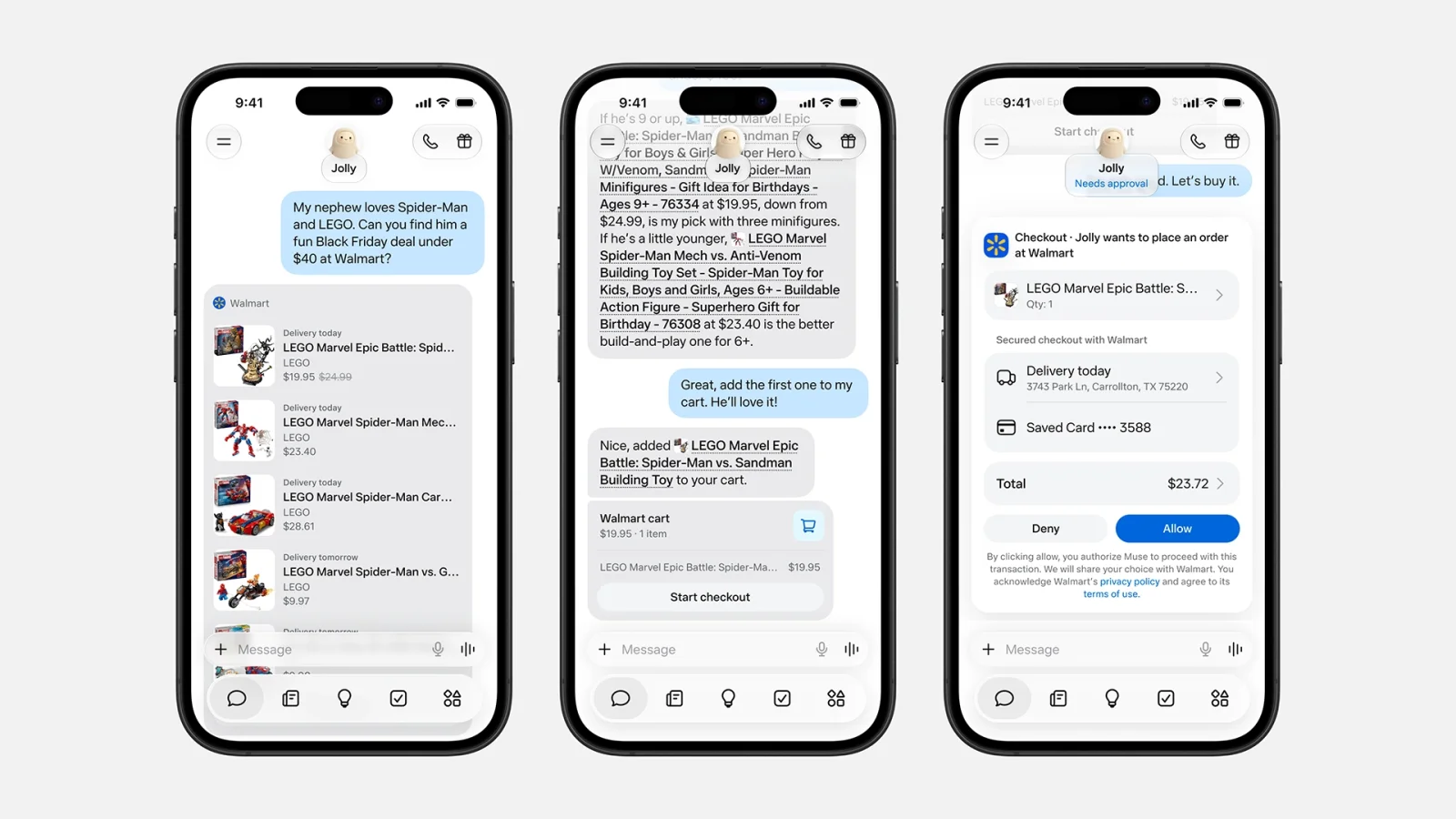 Three phone screens show signing into Walmart in Muse to shop Black Friday deals
Image: Walmart
- Open Muse.
- Sign in to Walmart through the integration.
- Return to Muse and ask for deals or products.
- Muse sends requests to Walmart; Walmart returns SKUs and cart lines.
- User reviews limits and approves checkout.
Walmart emphasizes privacy and spend controls:
- No Walmart purchase history shared with Muse, per Walmart statements relayed by TechCrunch.
- Spending limits and approval before purchase.
- Ability to delete the agent profile.
Why Walmart is leaning in while Amazon resists
The announcement frames a strategic split: Walmart invites agent traffic; Amazon has moved to block some third-party shopping agents, as we covered in Amazon vs Muse shopping.
For founders building checkout APIs, Walmart is signaling Muse first, open gateway later — TechCrunch quotes Walmart planning to open Agent Gateway to more developers and AI platforms.
Agent Gateway recap
Our October post on Walmart Agent Gateway explained MCP servers, agent profiles, and per-checkout limits. Black Friday is the first mass-market holiday test of that stack inside a consumer super-app with 10M+ Muse installs reported at Meta Connect.
Pair this with Personal Agent Protocol / Poppy and Sierra’s Shopify rollout: Walmart is both a protocol signer and a live merchant endpoint.
Meta Muse commerce context
Muse already connects to PayPal, Shopify, Expedia as a transaction layer. Instagram DM rollout puts shopping prompts beside social content — Black Friday in Muse is the retail-scale version of “share a post, ask for shoe deals.”
UK Muse launch shows regulators watching connector security; US holiday volume will stress approval UX and fraud review.
Sparky versus Muse: two Walmart AI surfaces
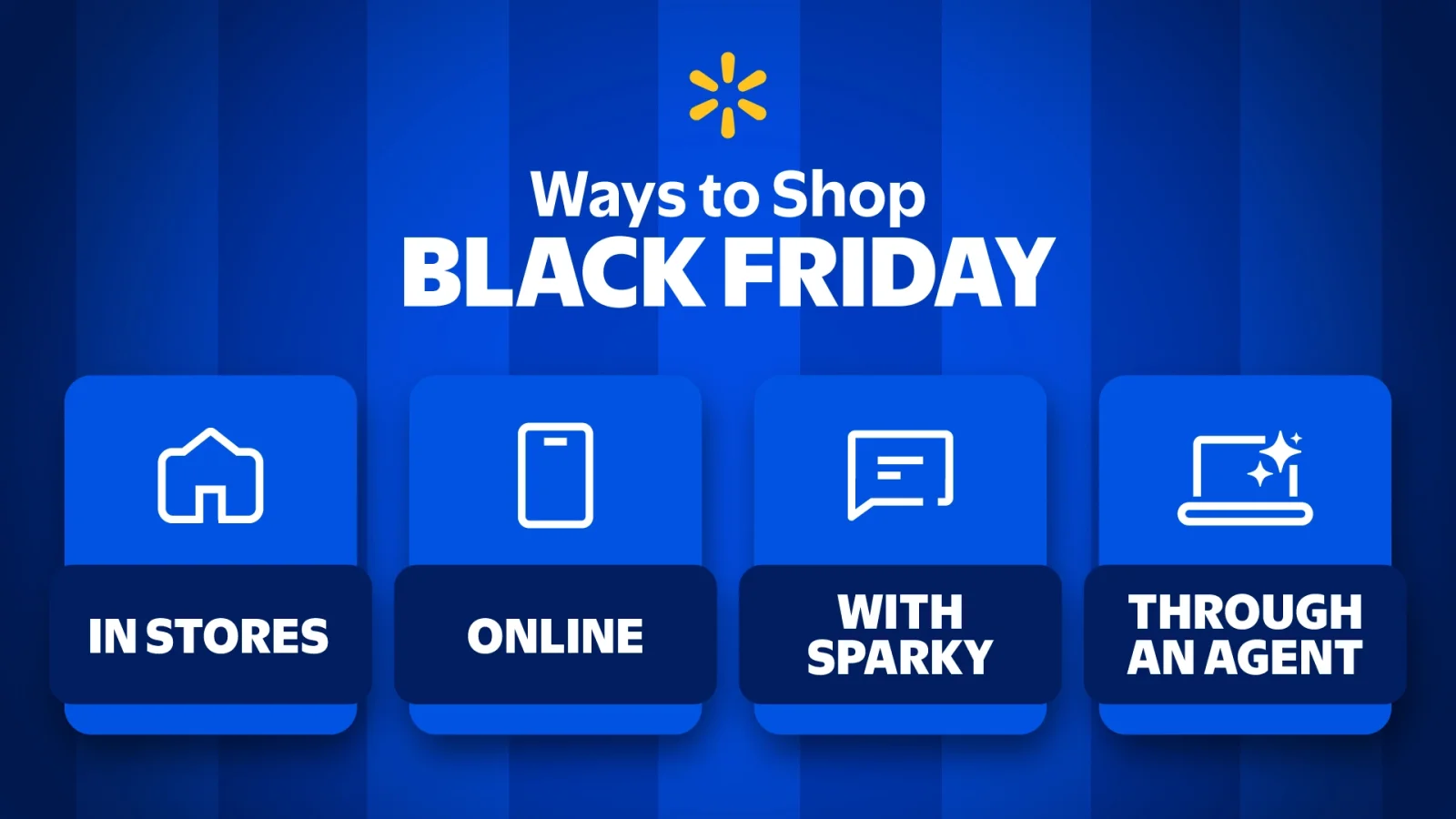 Walmart infographic on Black Friday shopping in stores online Sparky and AI agents
Image: Walmart
TechCrunch lists Sparky upgrades: handwritten list → cart, photo/voice search, in-store aisle pins, Flash Price Tag shelf lights. That is first-party app AI; Muse is third-party assistant AI hitting the same catalog through Agent Gateway.
Retailers evaluating both should ask which channel owns returns, chargebacks, and PCI scope.
Builder checklist if you integrate next
- Implement Agent Gateway or Poppy-compatible profiles with hard spend caps.
- Never request full order history unless the user opts in — Walmart’s Muse posture sets consumer expectations.
- Log every agent-originated cart for chargeback review; Uber’s agent commerce stats show volumes stay small until they suddenly do not.
- Plan for Amazon-style blocking on other merchants — diversify retail partners.
- Read ShellBench: agents still fail invoice and pickup rubrics often.
Privacy and trust questions shoppers will ask
| Question | Walmart’s stated answer (via TechCrunch) |
|---|---|
| Does Muse read my Walmart history? | No access to shopping history |
| Can it auto-buy? | Limits + approvals required |
| Can I disconnect? | Delete agent profile |
| What about Black Friday scams? | Users should still verify SKU and price in cart review |
Holiday timeline
Announcement: November 24, 2026 — aligned with Black Friday week. No public end date; seasonal campaigns may roll through Cyber Monday depending on Walmart merchandising.
Step-by-step for shoppers trying Muse + Walmart
TechCrunch’s flow implies these user-visible steps (wording may vary in-app):
- Launch Muse on phone or desktop.
- Navigate to Walmart connection or shopping connector settings.
- Authenticate Walmart — OAuth-style login separate from walmart.com cookies.
- Return to Muse chat and prompt for “Black Friday deal on [product]” or compare options.
- Muse queries Agent Gateway; Walmart returns product cards and cart entries.
- User sets or confirms spending cap and approval gate before place order.
- Optional: delete agent profile to revoke tokens.
If any step fails, fall back to walmart.com — agents still miss rubrics on ShellBench personal tasks.
Fraud, returns, and chargebacks
Agent commerce introduces new dispute lines:
- Wrong SKU selected when user approved too quickly.
- Duplicate orders when user retries a failed Muse session.
- Price mismatch between Muse quote and checkout total as promos expire.
Walmart’s approval requirement pushes liability toward users who tap confirm, but payment networks will still ask whether Muse or Walmart UI displayed the final price. Document screenshots inside Muse if you test purchases for reviews.
Technical architecture (inferred from prior Walmart posts)
Agent Gateway exposes an MCP server with agent profiles — scoped tokens, category allowlists, and per-checkout limits. Muse likely holds a profile id tied to your Walmart OAuth session.
Meta’s connector platform means this integration may share schema with Shopify and Expedia connectors — reducing one-off parsers, but increasing blast radius if a connector bug misprices items.
Competitive table: US retail agent posture
| Retailer | Agent stance (2026) | Consumer example |
|---|---|---|
| Walmart | Open — Agent Gateway, Muse Black Friday | This announcement |
| Amazon | Restrictive — blocks some third-party agents | Muse shopping blocks |
| Shopify merchants | Protocol-driven — Poppy / Sierra | Poppy 1.0 |
| Instacart | Muse grocery partner | TechCrunch same-day note |
Founders selling DTC should assume Walmart + Meta set default UX for holiday agent promos — optimize structured product feeds, not only SEO.
Black Friday merchandising implications
Black Friday is time-boxed and inventory volatile. Agents must handle:
- Lightning deals expiring mid-conversation.
- Out-of-stock substitutions without user consent.
- Store pickup vs ship eligibility by ZIP.
Walmart’s Sparky in-store features (aisle pins, shelf tags) do not automatically transfer to Muse online flows. Shoppers asking for “pickup today” may need explicit store context Muse lacks unless users grant location.
Regulators and UK parallels
Muse UK launch shows DRCF scrutiny on connector security. US FTC interest in dark patterns may ask whether one-tap agent checkout obscures final price. Walmart’s approval language is preemptive defense.
Marketing teams: what to claim safely
Approved:
- “Shop Walmart Black Friday inside Muse with limits and approvals.”
- “Walmart does not share order history with Muse per Walmart statements.”
Avoid until verified:
- “Cheapest price guaranteed” — agents can mis-read promos.
- “Fully autonomous shopping” — approvals still required.
Developer opportunities on Agent Gateway
Walmart told TechCrunch it will open Gateway to more AI platforms. Second movers (enterprise assistants, bank apps) should:
- Register agent profiles early — queues may mirror 1,500+ Muse connector applications at Connect.
- Implement Personal Agent Protocol identity hooks where possible.
- Run ShellBench-style invoice/payment tasks before marketing auto-buy.
Muse scale context
Meta reported 10M+ Muse setups in the U.S. and Canada early on, with DM embedding growing daily actives. Even low conversion to Walmart carts is massive GMV if approval friction stays low — watch trust incidents closely.
Sparky feature list (first-party comparison)
TechCrunch-listed Sparky capabilities for store mode:
- Handwritten list → cart
- Photo and voice product search
- Store map aisle pins
- Flash Price Tag shelf highlight
Muse lacks in-aisle lighting but wins cross-retailer narrative if Gateway adds partners. Walmart may be running two AI strategies: owned app depth + open agent reach.
Security: what Muse must not do
Walmart says Muse lacks history access — critical for competitive intelligence and stalking-adjacent prompts. Test whether Muse can still infer preferences from chat context outside Walmart; that is not answered in the press release.
Rotate OAuth tokens if users delete agent profile; stale tokens were a classic failure mode in early Plaid integrations.
Search queries this post answers
- “Shop Walmart with Meta Muse”
- “Walmart Black Friday AI agent”
- “Walmart Agent Gateway Muse how to”
- “Does Muse see Walmart orders” → No per Walmart
- “Walmart vs Amazon AI shopping”
Timeline after announcement
November 24, 2026 launch aligns with Black Friday week. No sunset date published. Cyber Monday and holiday returns season will stress agent-initiated orders — watch Walmart help forums and Meta’s status channels if checkout errors spike.
What enterprise procurement should ask Walmart and Meta
If you run employee perks or corporate gifting this holiday, treat Muse + Walmart like any new OAuth integration:
- Data processing agreement — who stores cart and payment tokens?
- SOC reports for Agent Gateway endpoints.
- Incident response if Muse misroutes a corporate card on file.
- Kill switch to revoke connectors company-wide.
None of that appears in the November 24 consumer press; enterprise buyers should open tickets before pilots.
Limits of this coverage
TechCrunch cites Walmart and Meta announcements; explainx.ai has not independently completed a Muse purchase. Verify fees, eligible items, and geographic availability inside Muse and Walmart help pages before publishing buyer guides. Meta and Walmart may update connector terms without a second press release—check in-app disclosures after upgrades.