



Tether AI Research, the group behind the QVAC local-AI stack, has released TranscribePsy, a 254M-parameter open-weight speech-to-text model that is built to run on a laptop or a phone with no network connection. According to the QVAC announcement on Hugging Face, the 25-language model beats every similar-sized model the team tested on three benchmark suites, and its Core ML build transcribes 10 minutes of audio in 1.65 seconds on an iPhone 17 Pro Max.
Those are the authors' numbers, not an independent evaluation. This post separates what the model cards say from what you should verify yourself, and shows how the family fits the growing field of small on-device speech models, including Cactus Whistle and the cloud-first Microsoft MAI-Transcribe-2.
Quick reference: TranscribePsy at a glance
| Question | Answer (per the model cards) |
|---|---|
| Who made it? | Tether AI Research (QVAC), published under the qvac organization on Hugging Face |
| Size | 254.45M parameters (253.95M base plus 0.50M CAFE adapters) |
| License | Apache 2.0 |
| Languages | 25 European (EU model); 8 for the sub variants |
| Architecture | FastConformer encoder (24 layers, 640-dim) with a transducer decoder |
| Teacher | NVIDIA Parakeet-TDT-0.6B-v3 (627M), pruned then distilled |
| Training data | 564,102 hours, 117M utterances |
| Streaming? | No, batch only |
| Headline speed | 10 minutes of audio in 1.65 s on iPhone 17 Pro Max (Core ML build) |
| Independent verification | None found at time of writing |
What exactly did Tether release?
TranscribePsy is not one checkpoint but four, each aimed at a different deployment target. The base model card lists them:
- TranscribePsy-250M-EU: the 25-language PyTorch (NeMo) checkpoint, for broad coverage.
- TranscribePsy-250M-EU-sub: the same architecture trained on the eight Multilingual LibriSpeech languages, with lower error on those languages.
- TranscribePsy-250M-EU-sub-gguf: an 8-bit GGUF build for phone CPUs, run through the team's
qvac-fabric-speech.cppengine. - TranscribePsy-250M-EU-sub-coreml: a Core ML build for the Apple Neural Engine.
The release also includes the evaluation scripts behind the benchmark numbers and an on-device engine repository, qvac-transcribepsy. A technical report and a paper on CAFE, the "novel design" the team says gives a better trade-off between English and the other 24 languages, are promised but not yet published. That matters: until the paper lands, CAFE is a name and a claim, not something you can inspect.
How was it built? Pruning plus distillation
The student model is not trained from scratch. According to the model card, it is obtained by structured pruning of NVIDIA's Parakeet-TDT-0.6B-v3 teacher, so it starts inside a representation space the teacher already organized, and is then trained by knowledge distillation from that teacher rather than from transcripts alone.
That recipe is familiar from text LLMs, where a large model is shrunk into a cheaper one that keeps most of the quality. It is the same reasoning behind the production pattern we covered in CoreWeave's model distillation preview. Here it is applied to speech: take a 627M-parameter recognizer, prune it to roughly 254M, and teach the smaller network to imitate the larger one on 564,102 hours of audio.
The practical consequence is lineage. TranscribePsy depends on a NVIDIA teacher, and its quality ceiling is bounded by that teacher. If you already run Parakeet, the question is whether you accept a quality trade for a roughly 2.5x smaller footprint.
What do the benchmarks say?
 TranscribePsy-250M word error rate chart against similar-size on-device speech recognition models
Image: QVAC (Tether AI Research)
TranscribePsy-250M word error rate chart against similar-size on-device speech recognition models
Image: QVAC (Tether AI Research)
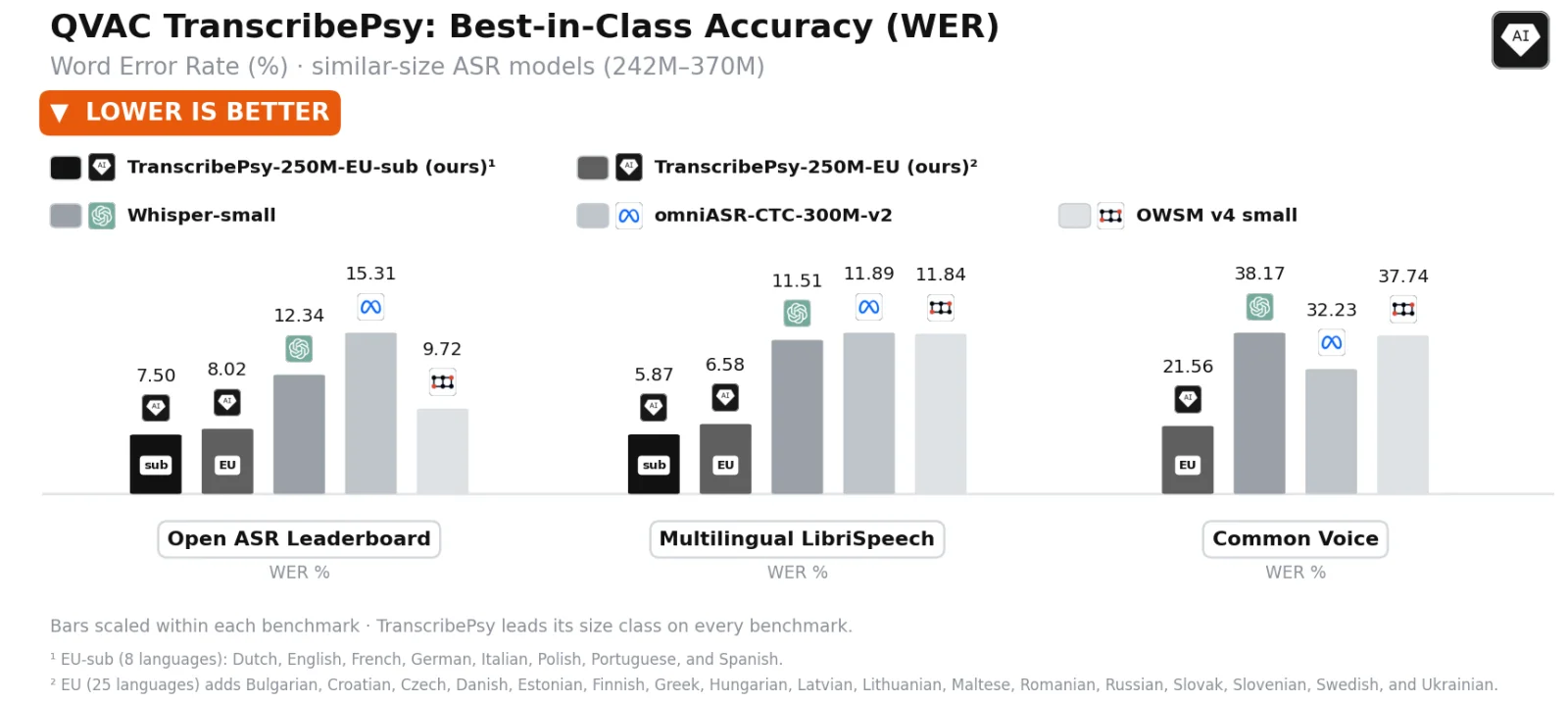
The team compares TranscribePsy-250M-EU with models in the 242M to 370M range. Word error rate, lower is better:
| Benchmark | TranscribePsy-250M-EU (254M) | Whisper-small (242M) | omniASR-CTC-300M-v2 (326M) | OWSM v4 small (370M) |
|---|---|---|---|---|
| Open ASR Leaderboard (mean) | 8.02 | 12.34 | 15.31 | 9.72 |
| Multilingual LibriSpeech (8-language mean) | 6.58 | 11.51 | 11.89 | 11.84 |
| Common Voice v25 (24-language mean) | 21.56 | 38.17 | 32.23 | 37.74 |
Against larger models, the picture is more mixed, and the card is honest about it:
| Benchmark | TranscribePsy (254M) | Qwen3-ASR-0.6B (782M) | omniASR-CTC-1B-v2 (976M) | Whisper-Medium (764M) | OWSM-CTC-v4 (1.01B) |
|---|---|---|---|---|---|
| Open ASR Leaderboard | 8.02 | 7.40 | 9.68 | 8.79 | 8.32 |
| Multilingual LibriSpeech | 6.58 | 12.60 | 7.71 | 7.76 | 10.65 |
| Common Voice v25 | 21.56 | N/A | 20.07 | 26.94 | 32.87 |
So the "beats models three to four times its size" claim holds on Multilingual LibriSpeech, where it wins outright, but on the Open ASR Leaderboard mean it trails Qwen3-ASR-0.6B (7.40 against 8.02), and on Common Voice it trails omniASR-CTC-1B-v2 (20.07 against 21.56). Qwen3-ASR was not scored on Common Voice because it does not support 8 of the 24 languages.
The per-dataset table on the card shows where the small model is weaker. For example, on SPGISpeech (financial earnings calls) it scores 7.98 against 3.24 for Whisper-small and 2.79 for OWSM v4 small, and on GigaSpeech and Earnings-22 it is roughly level with or slightly behind Whisper-small. If your audio is English business speech, do not assume the headline average applies.
How fast is it on a phone?
 Average efficiency of the TranscribePsy GGUF build across six phones, a Tether on-device speech model
Image: QVAC (Tether AI Research)
Average efficiency of the TranscribePsy GGUF build across six phones, a Tether on-device speech model
Image: QVAC (Tether AI Research)
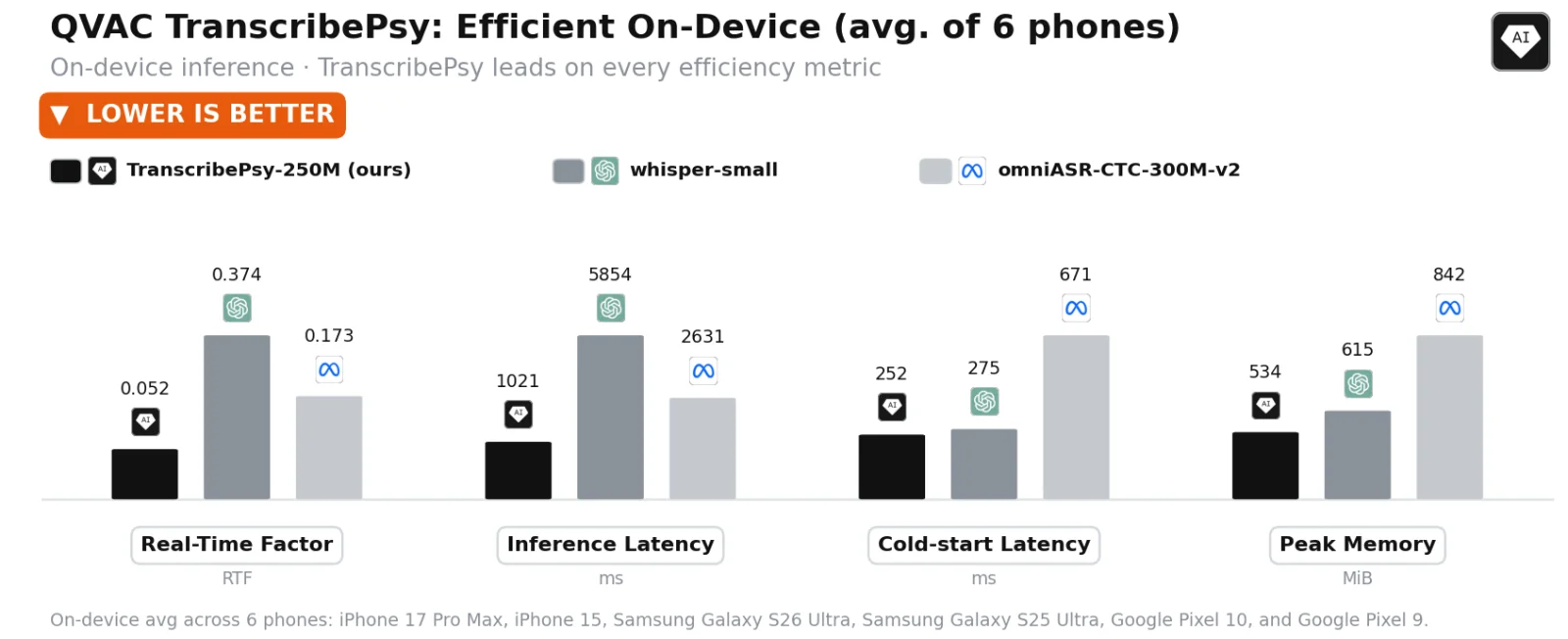
The speed claims use two builds. For the phone CPU, the GGUF build was measured on six phones: Samsung Galaxy S26 and S25 Ultra, Google Pixel 10 and 9, iPhone 17 Pro Max and iPhone 15. Averaged over the six, the team reports a real-time factor of 0.052, 534 MiB peak memory at 10 seconds of audio, and a 252 ms cold start. It says latency is 2.6x lower than the next-fastest model (omniASR-CTC-300M-v2), 5.7x lower than Whisper-small, and 7.5x to 15x lower than the three larger models. OWSM is omitted from the phone comparison because no mobile-compatible version exists.
For the Apple Neural Engine, the Core ML model card compares against another Core ML recognizer, desert-ant-labs/voz:
| Metric (iPhone 17 Pro Max) | TranscribePsy Core ML | voz |
|---|---|---|
| 40-minute test set (160 utterances, cold start excluded) | 32.8 s | 39.9 s |
| 10-minute single recording | 1.65 s | 2.34 s |
| Cold start | 12.4 s to 12.7 s | 18.4 s to 18.6 s |
| Peak memory (10-min recording) | 333.4 MiB | 570 MiB |
| Model size | 212.4 MB | 488.8 MB |
Two caveats the card itself states. First, the Neural Engine runs fixed input shapes, so short clips are padded to a full window and do not show its best speed; the 1.65-second figure is a sustained, long-recording number. Second, the 12-second cold start includes Apple's one-time Core ML compilation on first load. A 10-minute file in 1.65 seconds is roughly 360 times faster than real time, but plan for the first-launch delay in a real app.
How do you run it?
The Hugging Face route for the Core ML build is a one-liner, then the engine does the rest:
hf download qvac/TranscribePsy-250M-EU-sub-coreml --local-dir .
The Core ML models are not called directly. The patched parakeet.cpp engine in qvac-fabric-speech.cpp, built with -DPARAKEET_COREML=ON, computes the mel spectrogram, runs the encoder and the batched decoder on the Neural Engine, and returns text from a 16 kHz mono WAV. The upstream parakeet.cpp cannot load these files, and the team says it is submitting its patches upstream as a pull request. The three Core ML files must sit in one directory with the exact names the engine expects, 212.4 MB in total.
For Android and cross-platform use, pick the GGUF build. For desktop Python work, the PyTorch checkpoints load through NeMo. As a rule of thumb from the card:
| If you need | Use |
|---|---|
| 25 European languages on a laptop | TranscribePsy-250M-EU |
| Lowest error on the 8 MLS languages | TranscribePsy-250M-EU-sub |
| Android or phone CPU | TranscribePsy-250M-EU-sub-gguf |
| iPhone or Mac Neural Engine | TranscribePsy-250M-EU-sub-coreml |
The QVAC SDK documentation also lists Parakeet-based transcription as an add-on alongside whisper.cpp, so teams already on that stack have a path to the new weights.
What are the limits?
The model cards are direct about several, and they are the reason to test before adopting:
- Apple silicon only for the Core ML build, with iOS 18 or later.
- Eight languages only in the
subvariants; the 25-language model does not have the phone-optimized builds. - Batch, not streaming. You cannot use it for live captions the way you would use a streaming recognizer such as Meta Muse Voice Transcribe or Grok Voice Transcribe 2.
- Not for high-stakes use. The card says it is not intended for safety-critical or high-stakes automated decisions.
- No speaker labels. Diarization is a separate problem; see NVIDIA's Nemotron 3 diarization release.
- Benchmarks are first-party. The Open ASR Leaderboard mean, MLS and Common Voice numbers are Tether's own runs using its published evaluation configs; none has been reproduced by a third party yet.
Why does this matter for people building with speech?
 A chip inside a handheld device cutaway showing how on-device AI keeps audio local
Local transcription is the quiet enabler of a lot of products: meeting notes that never leave the laptop, voice notes in clinics and law firms, captions in apps with no connectivity. We saw the same logic in Google's local meeting-notes demo. The cost of a cloud transcription API disappears, and so does the compliance question of sending recordings to a third party.
For European developers there is a further angle. A model that covers Bulgarian, Croatian, Estonian, Maltese and Ukrainian in one 254M checkpoint, under Apache 2.0, is a useful building block for sovereign, locally run AI in smaller language markets that large providers cover unevenly.
This is also Tether's second QVAC language release in two months. In September the same team published offline translation models for African languages, which we covered in Tether's TranslatePsy release. Tether is best known as the issuer of the USDT stablecoin, so QVAC is a notable side bet: a company with a large balance sheet funding open, small, local models. Whether it keeps shipping at this pace, and whether the technical report supports the claims, is what to watch.
What should you do next?
- Test on your audio. Run the 25-language checkpoint and a Whisper baseline on 30 to 60 minutes of your real recordings, with your accents, noise and domain vocabulary. The benchmark sets are read speech and curated corpora.
- Check the English-heavy business case. The SPGISpeech and Earnings-22 rows suggest weaker results on financial and meeting audio.
- Budget for first launch. The Core ML compile step can take over 12 seconds once per device.
- Wait for the paper if CAFE matters to you. The architecture change is described only in a sentence for now.
- Treat the license as the strongest part. Apache 2.0 weights plus GGUF and Core ML builds are real and downloadable today.
Figures in this article come from the QVAC announcement and Hugging Face model cards as of October 14, 2026, and may change as the team publishes its technical report.
Related reading
- Apple's code-switching detector reads Whisper-small encoder dimensions
- Cactus Whistle: 16MB on-device speech-to-text
- Microsoft MAI-Transcribe-2: streaming and word error rate
- Meta Muse Voice Transcribe
- Grok Voice Transcribe 2 launch
- NVIDIA Nemotron 3 diarization
- Tether TranslatePsy offline African language models
- What is sovereign AI?
- Official: TranscribePsy-250M-EU model card and QVAC announcement