



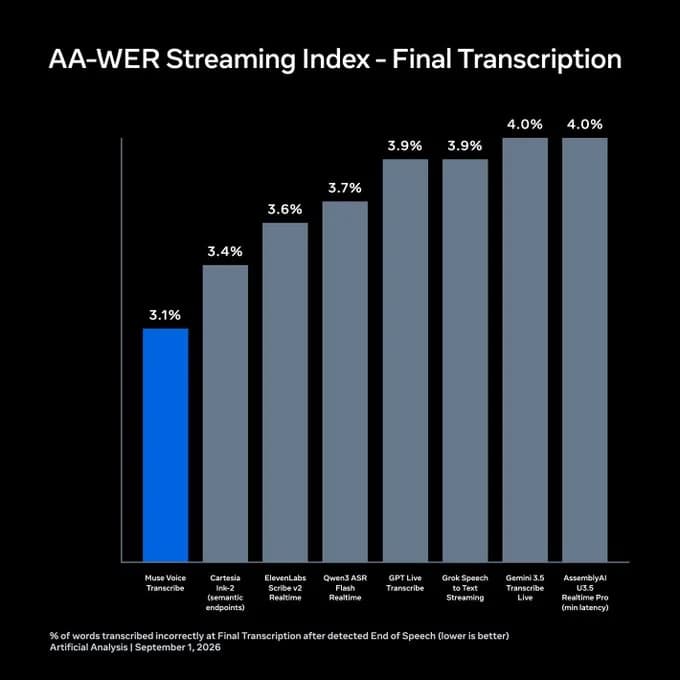
xAI launched Grok Voice Transcribe 2.0 on September 18, 2026, describing it as "the world's most accurate speech transcription model" — twice as accurate as its predecessor on customer-support calls, spoken credentials, and short voice commands, according to xAI's own announcement. Atlassian is already using it inside Loom, letting users dictate a change request while recording and export the transcription directly to Cursor to implement. It's available today via the Grok Voice API at $0.10/hour batch and $0.20/hour streaming.
TL;DR
| Question | Answer |
|---|---|
| What launched? | Grok Voice Transcribe 2.0, xAI's second-generation speech transcription model |
| Headline claim | 2x more accurate than its predecessor on support calls, spoken credentials, and voice commands |
| Independently verified? | No — xAI's own comparison against its own prior model, no disclosed third-party benchmark |
| Real-world use | Atlassian's Loom, for voice-dictated change requests exported to Cursor |
| Pricing | $0.10/hr batch, $0.20/hr streaming |
| Availability | Live today via the Grok Voice API |
The specific claim, and what it rests on
xAI's own framing across its announcement thread: "Grok Voice Transcribe 2.0 is twice as accurate as its predecessor in customer-support calls, spoken credentials, and short voice commands." Those three named categories are a sensible, practical set to optimize transcription accuracy for — customer-support calls involve background noise and varied accents, spoken credentials (account numbers, confirmation codes) demand near-perfect character-level accuracy since a single misheard digit breaks the downstream task, and short voice commands need to work reliably with minimal context to disambiguate similar-sounding phrases. That's a more concrete, testable claim than a vague "more accurate overall" statement — but the public announcement doesn't disclose the actual benchmark methodology, test sets, or comparison against any competing transcription service, which is the detail worth checking directly before adopting the model based on the headline number alone, the same caution explainx.ai applies to any single vendor's self-reported performance claim.
The real-world use case: voice-to-code-change via Loom and Cursor
The most concrete, verifiable detail in the launch is the Atlassian Loom integration, since it describes an actual deployed use case rather than just a benchmark number: "Atlassian used Transcribe 2.0 in Loom and found it more accurate at capturing user instructions. Dictate your change requests using Loom, then directly export to Cursor to code it up." That's a specific, plausible workflow worth understanding on its own terms — a reviewer or product manager records a Loom screen capture while talking through a requested change, Transcribe 2.0 turns that spoken description into text, and that text flows directly into Cursor as an instruction for an AI coding agent to implement. It's the same underlying pattern explainx.ai has covered with voice-driven coding workflows more broadly — using speech as the natural interface for describing a change, with transcription accuracy directly determining how much manual correction the resulting instruction needs before an agent can act on it reliably.
Pricing and availability
Transcribe 2.0 is available today through the Grok Voice API at $0.10 per hour for batch processing and $0.20 per hour for streaming use. That pricing structure — a meaningful discount for batch versus real-time streaming — is a standard and sensible split for transcription services generally: batch processing can be scheduled and optimized for throughput, while streaming has to maintain low latency continuously, which costs more per hour of audio processed. This launch follows closely on xAI's Grok Voice Think Fast 2.0, a speech-to-speech latency model explainx.ai covered separately, and the broader rollout of voice mode to the consumer-facing Grok Bot — Transcribe 2.0 is specifically the transcription layer in that same expanding voice product line, distinct from the conversational speech-to-speech models built for different use cases.
Why the three named categories are a smarter benchmark choice than "overall accuracy"
It's worth appreciating why xAI chose to frame its accuracy claim around three specific categories (customer-support calls, spoken credentials, short voice commands) rather than a single blanket "X% more accurate overall" number, because it's a more honest and more useful framing than the alternative. A single aggregate accuracy score across all possible speech types can hide meaningful variation — a model might be excellent on clean, scripted audio and mediocre on noisy phone calls, and an aggregate number would obscure exactly the cases a real deployment cares most about. By naming specific, practically important categories, xAI is implicitly admitting that transcription quality varies by context and giving potential customers a way to check whether the specific improvement actually matches their own use case, rather than asking them to trust one undifferentiated number. That's a more useful claim structure for evaluation purposes, even without the underlying benchmark methodology being disclosed — a developer building a support-call transcription pipeline specifically knows which of the three named categories to test against directly, rather than having to guess whether an aggregate improvement claim actually applies to their specific audio conditions.
Why the Loom integration is a more credible signal than a benchmark chart
It's worth being explicit about why the Atlassian/Loom deployment carries more evidentiary weight than a raw accuracy percentage would, even without independently verified numbers attached to it. A benchmark score can be optimized for, selectively reported, or run under favorable conditions that don't generalize to real usage — a familiar pattern with self-reported AI performance claims generally. A company the size of Atlassian actually integrating a transcription model into a shipping product used by a large existing customer base is a different, harder-to-fake kind of validation: it implies Atlassian's own team ran comparisons against whatever they used previously, found Transcribe 2.0 good enough to justify an engineering integration effort, and is willing to have that integration be publicly cited by name in xAI's own marketing materials. That's not the same as an independent audit, but it's a meaningfully stronger signal than an isolated accuracy claim with no real-world deployment attached to it.
Honest limitations
- The "2x accuracy" and "world's most accurate" claims are xAI's own self-reported comparisons, with no disclosed benchmark methodology, test set, or third-party comparison published alongside the announcement.
- The Atlassian/Loom endorsement is a positive customer mention in xAI's own launch materials, not an independently published case study with specific metrics from Atlassian's side.
- No language-coverage breakdown was published — whether the accuracy claims hold consistently across languages and accents, or specifically for the English-language use cases highlighted, isn't detailed.
- No comparison against other transcription providers (Whisper, Deepgram, AssemblyAI, or competing frontier-lab transcription models) is included in the launch materials.
How this fits xAI's broader voice strategy
Transcribe 2.0 landing alongside Think Fast 2.0's speech-to-speech latency gains and the recent rollout of voice mode to the consumer Grok Bot suggests xAI is building out a full-stack voice product line deliberately, rather than shipping isolated point features — transcription for turning speech into usable text, speech-to-speech for natural conversational latency, and a consumer-facing surface (Grok Bot voice mode) to put both in front of ordinary users rather than just developers calling an API. That's a meaningfully different strategic posture than treating voice as a single bolted-on feature, and worth watching for how xAI continues to build out the rest of that stack — translation, diarization for multi-speaker settings, and further latency improvements are the natural next pieces of that same product line, based on where competitors in this space have focused their own voice roadmaps.
What this means for builders
If you're building voice-to-text pipelines — dictated code changes, customer-support transcript analysis, or voice-command interfaces — Transcribe 2.0's pricing and the specific Loom/Cursor use case xAI highlights make it worth a direct trial against your own audio, particularly for the three named strength categories (support calls, spoken credentials, short commands). Given the lack of disclosed independent benchmarks, the right move before committing production traffic is running your own comparison against whatever transcription service you currently use on your actual audio data, rather than taking the "2x more accurate" and "world's most accurate" framing as settled without checking it against your specific use case. The batch-versus-streaming pricing split is also worth planning around deliberately rather than defaulting to streaming for everything: any workflow that doesn't need real-time results — bulk transcription of recorded support calls, overnight processing of a backlog of Loom recordings — should route through the cheaper batch tier, which is a straightforward cost optimization many teams miss when they reach for the same API tier across every use case regardless of actual latency requirements, effectively paying a real-time premium for work that never needed to happen in real time in the first place.
Related on explainx.ai
- Grok Voice Think Fast 2.0: speech-to-speech latency
- How to read AI benchmark claims critically
- AI benchmark claims: a fact-check framework
- Claude Code VS Code/IDE extension setup guide
- Top 10 things to build with GPT-6 Astra
- OpenAI GPT Live 1 API: voice agents
- Official source: x.ai — Grok Voice Transcribe 2.0
This post is sourced to xAI's own September 18, 2026 announcement on X and its accompanying blog post. Accuracy claims, the Atlassian/Loom use case, and pricing are xAI's own stated figures; no independent benchmark or third-party verification was available at time of writing.