




TailSteer is a last training stage that makes AI image editors keep an image stable across many edits in a row. Edit a picture ten times with most current editors and small unintended changes pile up: textures smear, colors shift, objects move. The paper, TailSteer: Trajectory-Tail Steering for Drift-Resistant Multi-turn Image Editing, reports substantially lower cumulative drift over 15 to 20 turns on FLUX, SenseNova and Qwen model families. The team has released code, checkpoints and datasets through its GitHub repository and project page.
The authors come from MMLab at CUHK, SenseTime Research and Shanghai AI Lab. The tagline in their README is "Preserve what the model knows. Steer the trajectory tail." This post explains the idea, the reported numbers, how to run the checkpoints, and what the results do not show.
TL;DR: TailSteer at a glance
| Question | Short answer |
|---|---|
| What problem does it solve? | Visual drift when an edited image is edited again and again |
| What is new? | A final training stage that keeps early denoising close to the base model and corrects drift near the end of the trajectory |
| Does it need new architecture? | No; the README says no adapters or new modules at inference |
| Which backbones? | FLUX.2 klein Base 9B, Qwen-Image-2.1, SenseNova-U1.5-8B-MoT (FLUX.1 Kontext dev as a training config only) |
| What is released? | Code (Apache 2.0), checkpoints on Hugging Face, a 11,947-image training set, an Add & Preserve evaluation set |
| Main cost | Small drops on some single-turn benchmarks, such as RISE |
| Weights license | Backbone terms still apply |
Why multi-turn editing drifts
Most image editors are trained and judged on a single instruction: take this photo, make the sky pink. Real use is a conversation. You ask for a change, look, then ask for another, using the previous output as the next input. The model never saw its own imperfect outputs during training in that way, so each turn adds a little error, and the next turn builds on it.
The paper's abstract puts it this way: "Strong single-turn editing performance does not guarantee reliable multi-turn interaction: as edited outputs are repeatedly reused, small unintended changes can accumulate into severe visual drift." Existing fixes either train on multi-turn data or cross-turn rollouts, which can disturb what the base model already learned, or add inference-time machinery that is hard to scale to large foundation models.
We covered a related attack on the same problem in MT Forcing, which trains a unified model on its own edit histories. TailSteer takes a different route: it leaves the base model's behavior mostly alone and adds a narrow correction at the end of generation.
The idea: steer the tail of the trajectory
Diffusion and flow models generate an image by denoising step by step. The early steps decide the layout and the big structure. The late steps, the "tail", fill in fine detail. The abstract states the principle directly: "keep early denoising dynamics close to those of the base model and concentrate preservation corrections near the trajectory tail, where fine-grained deviations can be suppressed."
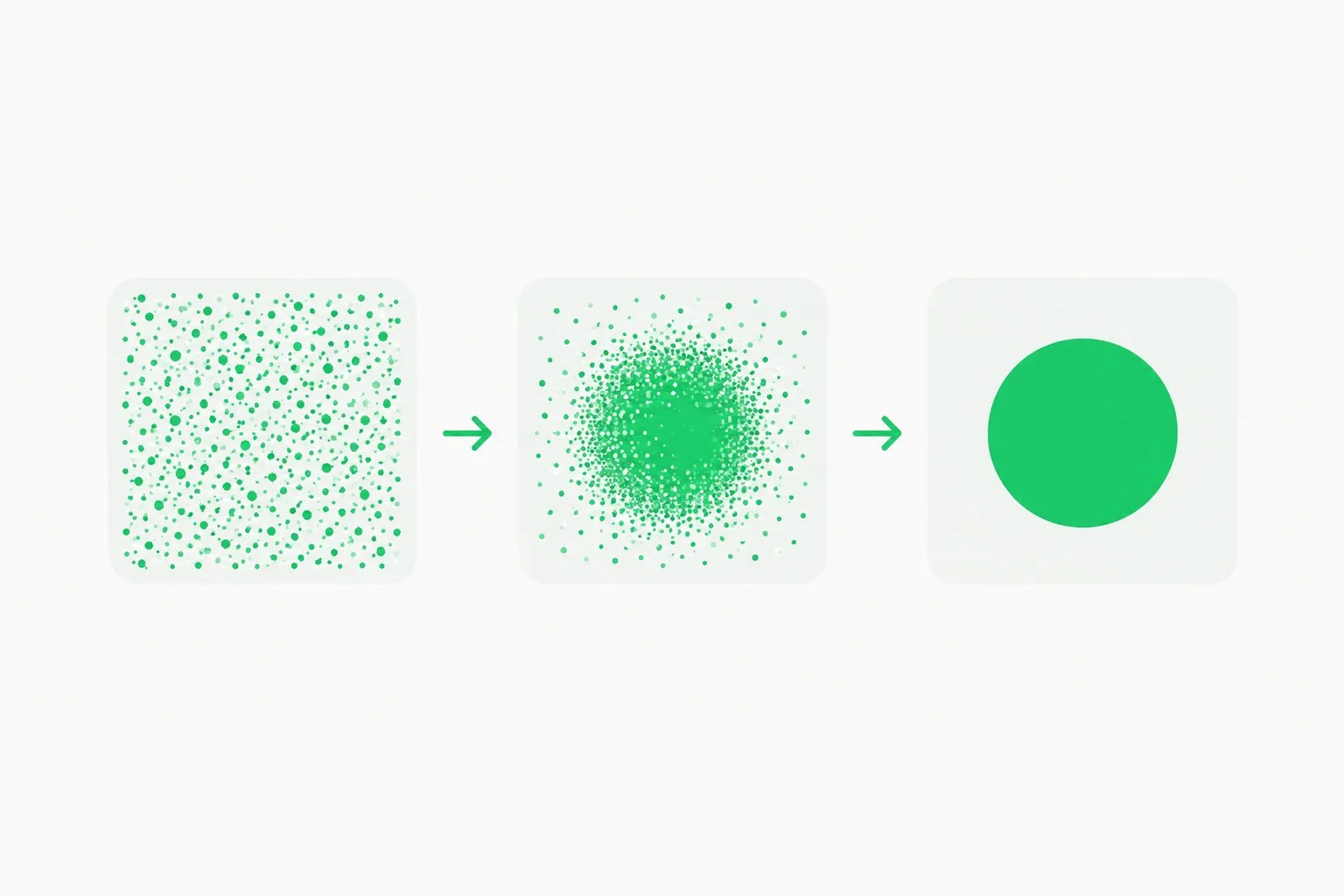 Noise resolving into a clean image across three panels, showing the denoising trajectory that TailSteer corrects near its end
Our explainer on how diffusion image generation works covers the basics of that process. The key point for TailSteer is where the fix goes. Early steps carry the model's creative ability, so the authors avoid changing them. Late steps carry the fine fidelity to the source image, which is exactly what drifts, so that is where the correction goes.
Three details make the approach practical:
- It is a final stage. It runs after supervised fine-tuning, reinforcement learning or on-policy distillation. You keep the work you already did.
- It learns from the editor's own rollouts. The corrections come from on-policy denoising rollouts, so the model trains on the kind of imperfect output it will really produce.
- It needs no curated ground-truth edit pairs. Unchanged source content serves as the preservation reference: if a region should not change, the target is the original pixels.
The authors summarize the result as long-horizon editing robustness unlocked in foundation models "rather than by relearning their existing capabilities."
What the numbers show
The README reports results on an Add & Preserve evaluation over ten turns. The table shows base model to TailSteer, with PSNR, SSIM and LPIPS measured at turn 10. Higher is better for PSNR and SSIM; lower is better for LPIPS.
| Backbone | COA (%) | PSNR | SSIM | LPIPS |
|---|---|---|---|---|
| FLUX.2 klein 9B | 31.02 to 31.84 | 13.85 to 19.96 | 0.289 to 0.621 | 0.524 to 0.290 |
| SenseNova-U1.5 | 94.93 to 94.78 | 11.23 to 18.22 | 0.166 to 0.489 | 0.607 to 0.417 |
| Qwen-Image-2.1 | 67.36 to 66.94 | 16.93 to 18.15 | 0.438 to 0.513 | 0.270 to 0.239 |
The gains are biggest on FLUX.2 klein, where PSNR rises by about six points and SSIM more than doubles. They are smaller on Qwen-Image-2.1, whose base model drifted less to begin with. The COA column, which the README does not expand in the material we read, stays roughly flat, which fits the authors' claim that the model keeps its editing ability. We did not rerun the evaluation, so these are the authors' reported figures.
The cost on single-turn tasks
The authors say TailSteer largely preserves base-model performance on text-to-image and single-image editing. The README is candid that it is not free:
| Benchmark | FLUX.2 klein | SenseNova-U1.5 | Qwen-Image-2.1 |
|---|---|---|---|
| GEdit EN | 7.47 to 7.52 | 8.33 to 8.27 | 8.11 to 8.04 |
| RISE accuracy | 14.17 to 13.61 | 31.39 to 29.44 | 20.56 to 18.06 |
RISE accuracy drops on all three, by about two points on Qwen. If your product is one-shot edits, you may not want this stage. If users iterate, the trade can be worth it.
The repository's banner image also says TailSteer's long-horizon preservation "rivals, or even surpasses" GPT-Image-2.5 Sunburst. The README tables include no GPT-Image-2.5 results, so we treat this as an unsupported claim. For context on that closed model, see our coverage of OpenAI's Images 2.5 launch.
How to try it
The README gives these setup steps for FLUX.2 klein:
python3.10 -m venv .venv
source .venv/bin/activate
pip install PyYAML
python scripts/setup.py flux2-klein-base-9b
hf auth login

tailsteer infer --backbone flux2-klein-base-9b \
  --checkpoint Lyricccco/FLUX.2-klein-base-9B-TailSteer \
  --policies tailsteer --inference-suite cafe-20turn --gpus 1
That runs a 20-turn suite on one GPU. If you already use an official pipeline for one of the backbones, the README says you can swap in the TailSteer model ID. Checkpoint access follows Hugging Face permissions and base-model terms, so you may need to accept the base model's license first.
To reproduce training, the README lists three commands: tailsteer prepare, tailsteer cache and tailsteer train. The default is the paper's 2,000-update schedule on 8 GPUs. The released TailSteer-Source dataset has 11,947 images and 47,788 trajectory requests.
Where it fits among open editing models
Open image editors have moved quickly this year. Qwen-Image-2.1 is one of the backbones, and our write-up covers its license. For a closed-model comparison, our post on Google's Nano Banana 2.5 shows what the large labs ship, and Krea 3's fast editor shows the speed and price end of the market. On the agent side, Adobe's EditAgent tackles reliable editing with specialized tools and verification instead of training.
TailSteer is a different kind of contribution from those products. It is a training recipe that anyone with the compute can apply to an open model. That makes it most useful to teams that fine-tune their own editors and to researchers studying long-horizon behavior.
 Photo-editing slider beside a landscape frame, representing repeated multi-turn image editing that TailSteer keeps stable
What to check before you rely on it
- Reproduce on your own edits. The Add & Preserve set measures adding objects while preserving the rest. Your edits may be color grading, text changes or style transfer. Test a 10-turn chain on your own images.
- Watch the single-turn cost. The small RISE drops are real in the authors' own table.
- Check the licenses. Code is Apache 2.0. Weights, datasets and example images keep original terms per the README.
- Treat comparisons to closed models as claims. The GPT-Image-2.5 comparison appears only as a banner slogan, with no data behind it in the README.
- Expect early-stage tooling. The repository was new when we read it, with a small number of stars, so expect rough edges and issues.
What is confirmed and what is not
| Item | Status |
|---|---|
| Paper, abstract and method description | Confirmed from the Hugging Face paper page |
| Code, checkpoints, datasets and commands | Confirmed from the repository README |
| Add & Preserve and single-turn numbers | Reported by the authors; not reproduced by us |
| Rivals or surpasses GPT-Image-2.5 | Banner slogan only; no supporting data found |
| Results on your own edit types | Not known |
Bottom line
TailSteer is a focused, open answer to a problem every image-editing user has met: edits that decay with each round. The method is simple to state, the code and weights are public, and the authors openly list a single-turn cost. If you build or fine-tune image editors, it is worth testing against your own chains of edits. If you only use hosted editors, it is a useful sign that drift is now a measured, fixable problem.
Repository details, license terms and reported numbers are accurate as of November 6, 2026, and may change as the authors update the project.