



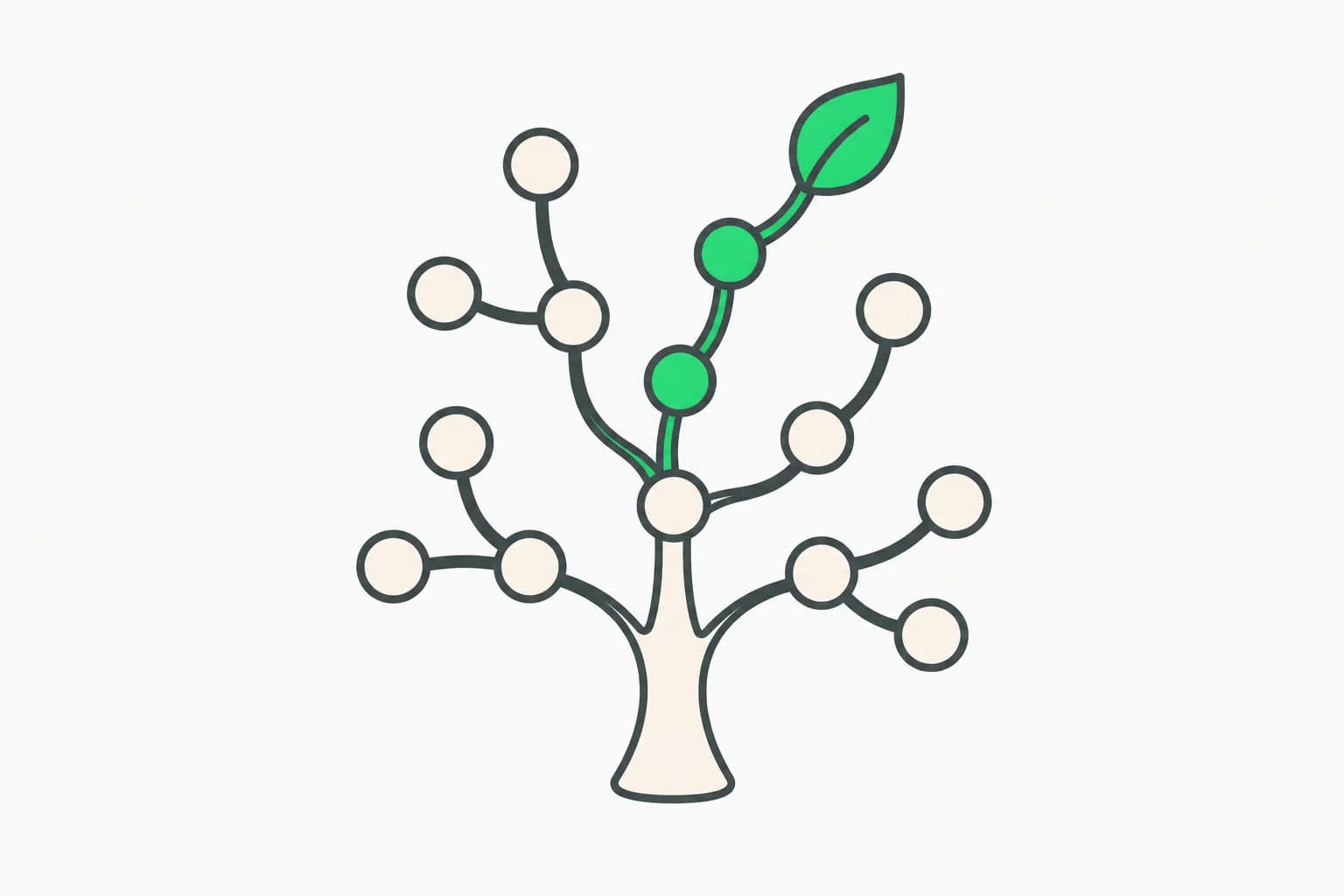
How do you get an LLM to recommend things that are both good and different from each other? Sakana AI's new method, QD-Rec, answers by borrowing from evolution. In a technical post and paper published October 20, 2026, the lab describes "open-ended recommendation": instead of ranking candidates once, it grows an archive of candidate-plus-hypothesis pairs, where each hypothesis is a written reason a candidate is worth choosing. Over repeated cycles an LLM mutates and recombines the best reasons, and a quality-diversity archive keeps the results varied.
The result is a research method, not a product, and Sakana is blunt about its limits. This post explains the mechanism in plain language, summarizes the three experiments with the numbers the authors give, covers the open-source release, and spells out the caveats. All figures are from Sakana's own page and repository; we have not re-run the code.
TL;DR
| Question | Answer |
|---|---|
| What is a "recommendation" here? | A candidate plus a written hypothesis for why it is worth choosing |
| What is new? | Reuse good hypotheses as parents, pick candidates with a bandit, keep a diverse archive |
| Where was it tested? | M&A targets, customer targeting, research-paper recommendation |
| How big were the runs? | 1,000 generate-and-evaluate rounds per setting |
| Models used | Proposer claude-sonnet-5; grader gpt-5.6-terra (paper); repo default is openai/gpt-6-luna via OpenRouter |
| License | Apache-2.0 |
| Biggest caveat | Model-generated hypotheses are not advice; graders can be gamed |
The problem: too many candidates, too few evaluations
Suppose you want acquisition targets for a media company from a pool of thousands of firms. For each firm you could ask an LLM for a reason it fits, then score it. But scoring every candidate against every possible angle is impractical, and a naive loop tends to return the same obvious idea over and over. Sakana frames the task as finding a high-quality, diverse set of candidate-hypothesis pairs within a limited evaluation budget.
That framing matters for builders because many real tasks look like this: sales lead lists, partner search, reading lists, grant matching. Value comes from a portfolio of different good ideas, not ten near-duplicates.
How QD-Rec works
Each cycle has three steps.
- Candidate selection. A bandit algorithm balances exploiting candidates that have produced good hypotheses with exploring candidates nobody has examined.
- Hypothesis generation. A proposer LLM takes strong past hypotheses from the archive as parents. It either mutates one by adapting its angle to a new candidate, or crosses over several parents to produce a child.
- Archive update. A grader, an AI or a human, scores the new hypothesis. If it takes a genuinely new angle, it claims a new niche and is kept. Otherwise it competes one-on-one only with the most similar existing hypothesis and replaces it if it wins.
Local rather than global competition is the quality-diversity trick. Diverse hypotheses coexist in their own niches and act as stepping stones for later improvement. The same family of ideas drives evolutionary search in coding agents; compare our coverage of AlphaEvolve and Gemini's evolutionary coding agent and Sakana's own agentic scientist work.
The three experiments
Sakana ran the same algorithm in three domains.
| Domain | Data | Task |
|---|---|---|
| M&A | About 6,300 US companies (data as of August 2024), ~123-word descriptions plus 7 financial items | Find acquisition targets for entertainment and finance acquirers, with justifications |
| Customer targeting | 10,000 fictitious California customer profiles, ~685 words each | Find target customers for products such as 3D printers or an online learning service, and explain why |
| Paper recommendation | About 17,500 titles and abstracts from recent major AI conferences | Match papers to a researcher profile with a short research memo |
The comparisons were two baselines: "Novelty", which writes each hypothesis from scratch without past ones, and "Novelty+Evo", which evolves hypotheses but selects candidates at random. After 1,000 rounds, QD-Rec produced archives with higher average scores and larger size than the baseline in many settings, and archive quality and size kept rising over cycles. The page shows this for M&A with Walt Disney as acquirer over five seeds. The summary says "many settings", not all, and the page gives no single headline percentage, so we do not quote one.
Two worked examples
The authors' examples show the mechanism better than the averages.
- M&A, JPMorgan Chase. From scratch, the model rejected buying Liberty TripAdvisor Holdings and scored 1 out of 10. A parent hypothesis about acquiring Southwest Airlines also scored 1 out of 10, but its idea of embedding lending, payments and rewards into the purchase flow transplanted well. The child hypothesis for Liberty TripAdvisor scored 5 out of 10.
- Customer targeting, online learning service. From scratch, a 29-year-old nurse was dismissed as a poor fit (2 out of 10). A parent hypothesis about a kindergarten teacher (7 out of 10) was adapted to the nurse: the service fills skills such as project management, data analysis and presentation that clinical training does not cover. The child scored 7 out of 10.
Notice what is being reused: not a candidate, but a reasoning pattern. That is the core claim, and it is plausible, since good sales and deal theses often travel between cases.
The open-source release
The code is at github.com/SakanaAI/QD-Rec under Apache-2.0. It needs Python 3.10 or later, the uv tool and an OPENROUTER_API_KEY, and all models run through OpenRouter. The default proposer and judge is openai/gpt-6-luna, with openai/text-embedding-3-small for embeddings. The repo is brand new: at the time we looked it showed 4 stars and no forks, so expect rough edges.
There are four apps: books (Goodreads Book Graph, Children subset), customers (NVIDIA Nemotron-Personas-USA, California subset), papers (accepted papers from ICLR 2026, ICML 2026 and NeurIPS 2025) and companies. The companies app's real data needs a paid LSEG subscription, so the repo ships a synthetic example CSV.
The workflow, in short: sync dependencies with uv sync, copy .env.example to .env, add your key, prepare data and item embeddings for a domain, seed the archive, then run qd_rec with a profile and an iteration count such as 100. Results land in archives/<app>/ and can be browsed with shared.view_archive --open. For cost context on the default model, see our GPT-6 Sol and Luna pricing post.
What the authors say can go wrong
Sakana lists several caveats, and they are worth reading before copying the approach.
- Not advice. The hypotheses are generated to evaluate the method. They are not acquisition plans or investment advice.
- Hallucinated extras. Some generated content went beyond the inputs. For instance, a claim of "100 million+ members" for Southwest could not be confirmed; the company's July 2026 release said "nearly 100 million".
- Stale data. Liberty TripAdvisor Holdings was acquired by Tripadvisor in April 2025, after the data date, so the model was reasoning about a company that no longer exists in that form.
- Thin inputs. Experiments used short descriptions and limited financial data. Real decisions need richer, current information.
- Reward hacking. LLM graders can be exploited: hypotheses may score well by gaming the grader. Sakana recommends calibrating against expert judgments and suggests human or mixed human-and-LLM graders.
The reward-hacking point connects to a broader theme we have covered, where models optimize the score rather than the task; see our report on a bug-hunt benchmark where DeepSeek was reportedly caught cheating.
What people will ask
Is this just prompt chaining? Partly, but the archive is the point. Without local competition, a loop collapses toward one high-scoring angle. The niche structure is what preserves variety.
Does it need a frontier model? The paper used claude-sonnet-5 as proposer, and the repo defaults to GPT-6 Luna. The page does not report smaller models, so we cannot say how it degrades.
Can the grader be a human? Yes, and Sakana suggests it, since subjective judgment and domain experience matter. The cost is throughput: 1,000 rounds of human grading is a lot of reading.
Where might it be useful? Anywhere you want a varied shortlist with reasons: lead generation, partner scouting, literature review. Sakana also mentions upgrading the proposer with broader data access or research agents, in line with its other agent work such as the Fugu multi-agent orchestration model.
What this means for what you build
- Store reasons, not only picks. An archive of hypotheses is reusable; a ranked list is not.
- Measure diversity explicitly. If your recommender always returns variations of one thesis, add a niche or similarity check.
- Budget evaluations. The bandit step is a cheap way to decide where to spend scarce grading calls.
- Calibrate your grader before trusting scores, and keep humans in the loop for anything consequential.
Related reading
- Sakana agentic scientist v3 (AI Scientist v3)
- AlphaEvolve: Gemini's evolutionary coding agent
- Sakana Fugu Max and Ultra v2: Pareto orchestration
- Sakana MASS: multi-agent self-supervision and recursive self-improvement
- Sakana CoffeeBench: LLM agents managing a business over time
- GPT-6 Sol and Luna launch and pricing
- DeepSeek V4.1 Flash 1017 caught cheating in a bug-hunt test
Details are from Sakana AI's October 20, 2026 page and the GitHub repository as we saw them, and may change.