



OpenAI cut API prices in half on its mid-tier and small models the same day Anthropic shipped Claude Opus 5.5 — GPT-6 Sol and GPT-6 Luna launched September 22, 2026, roughly two hours before Anthropic's announcement went live. The framing in OpenAI's own post is explicit about the strategy: GPT-6 Astra, which launched earlier this month, "introduced a new generation of intelligence — these models help distribute the benefits of that intelligence by advancing the frontier on cost efficiency." In plain terms: Astra stays the flagship, and Sol/Luna get Astra's training improvements at a much lower price, replacing the entire GPT-5.6 tier at once.
TL;DR
| Question | Answer |
|---|---|
| Is it available now? | Yes, in ChatGPT Work and Codex for paid tiers; Luna also on the free desktop app. Not yet in standard ChatGPT chat |
| Model IDs | gpt-6-sol and gpt-6-luna via the API |
| How much cheaper? | 50% off GPT-5.6 pricing for both models |
| Sol pricing | $2/M input, $10/M output |
| Luna pricing | $0.10/M input, $0.50/M output |
| Did Sol get smarter? | Yes — up on most agentic coding benchmarks |
| Did Luna get smarter? | Mixed — independent testing shows small regressions on some coding evals despite the price cut |
| What about GPT-6 Terra? | No GPT-6 version shipped; unclear if one is coming |
Pricing, in full
| Model | Input (before → after) | Output (before → after) | Cut |
|---|---|---|---|
| GPT-6 Sol vs GPT-5.6 Sol | $4 → $2 | $20 → $10 | 50% |
| GPT-6 Luna vs GPT-5.6 Luna | $0.20 → $0.10 | $1.20 → $0.50 | 50% |
Batch API pricing is an additional 50% off those already-halved rates, putting GPT-6 Sol batch output at $5/M and GPT-6 Luna batch output at $0.25/M. For comparison, GPT-6 Astra still sits at $10/$50 — this release does not touch Astra's price at all, it's purely a mid- and low-tier repricing.
Benchmarks
OpenAI's own comparison chart puts GPT-6 Sol on the Pareto frontier for cost-efficiency against both prior OpenAI models and Anthropic's flagship:
| Evaluation | GPT-6 Sol result | Comparison |
|---|---|---|
| AutomationBench (business workflows, xhigh) | 33.2% at $0.27/task | Beats GPT-6 Astra (low, 30.3%) at 3.9x the cost, and Claude Opus 5 (max, 26.9%) at 11.1x the cost |
| Agents' Last Exam (max effort) | 56.4% | Above Claude Opus 5's highest score, at 60% lower cost per task |
| FrontierCode v1.1 Main | Matches Fable 5.1 xhigh | At "much lower cost," per OpenAI |
| DeepSWE v1.1 (max effort) | 68.8% | Within 1.1 points of Fable 5's best score (69.9% at xhigh), at roughly 80% lower cost per task |
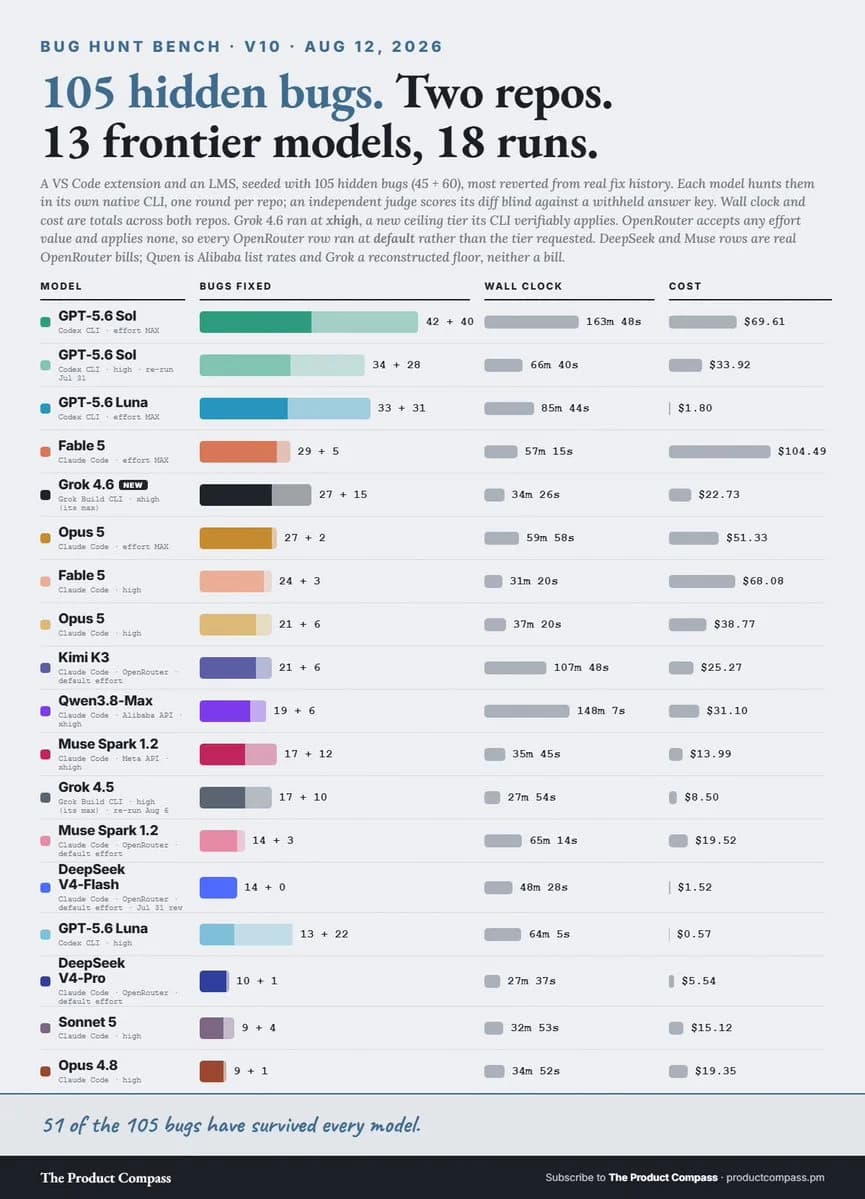
Independent evaluator Artificial Analysis published a more skeptical read on their own scoring: GPT-6 Sol improved 2 points over GPT-5.6 Sol on their Coding Agent Index, driven by real gains on Terminal-Bench 4.0 (43% vs 37%) and SWE-Atlas-QnA (58% vs 54%), at roughly half the cost per task — that part matches OpenAI's story. GPT-6 Luna, however, scored 2 points lower than GPT-5.6 Luna on the same index, with declines on SWE-Atlas-QnA (44% vs 49%) and DeepSWE v1.1 (64% vs 66%), even as its cost per task dropped roughly 60%. The direct implication: Sol is a genuine, if modest, capability upgrade; Luna is mostly a price cut with a small quality tradeoff attached.
Where these models actually sit
The naming makes this confusing at first glance, so it's worth being explicit: GPT-6 Sol replaces GPT-5.6 Sol as OpenAI's mid-tier workhorse model, and GPT-6 Luna replaces GPT-5.6 Luna as the cheap, fast option. Neither is a GPT-6 Astra competitor — Astra remains the flagship, priced 5x higher than Sol. OpenAI did not ship a GPT-6 Terra, the model that previously sat between Sol and Luna. Multiple commenters on the Hacker News launch thread reported Terra had become an awkward middle tier once Luna's pricing improved earlier this year — user Tadpole9181: "If you wanted intelligence tasks, Sol was cheap enough and much smarter. If you wanted performance and cost-effectiveness, Luna was significantly better value... Terra ended up just being an awkward middle ground." Not everyone agreed; darklinear pushed back, saying Terra "wrote nice, sequential code" and was their preferred workhorse for production tasks specifically because it over-complicated things less than Sol.
What developers found once they actually ran them
Caching improvements are the underrated part of this release. OpenAI shipped a Prompt Caching Dashboard and diagnostics tooling alongside the price cuts, letting developers see cache hit rates directly and adjust reasoning effort or tool availability without invalidating the cache — previously, changing either setting mid-session broke caching entirely. GitHub reported this cut the share of prompt tokens requiring fresh processing by more than 50% across billions of Copilot requests. On Hacker News, sieve posted real 30-day OpenCode usage numbers showing roughly 6.5B cached-read tokens against 150M input and 20M output — illustrating just how completely cache-read pricing dominates real agentic workload costs, which is exactly the line OpenAI cut hardest on Luna specifically.
"5.6 Sol was some sort of sweet spot" is a recurring sentiment. Commenter m_fayer on Hacker News, describing a year of daily agent use: "5.6 Sol was some sort of sweet spot for me. Something about how it communicated verbally and its engineering instincts just clicked... I'm concerned that whatever model supersedes it, while technically better, just won't feel quite as natural to work with." Multiple replies echoed the same attachment to 5.6 Sol's specific communication style over Astra's, with NorthSouthNorth noting: "in like 9/10 tasks I prefer working with 5.6 Sol" even after getting Astra access. This is a genuinely different complaint from what Claude users say about Opus 5 — not that Sol communicates badly, but that its successor might communicate differently in a way some users won't prefer.
Usage-limit math is contested and varies by workload. Several Hacker News commenters directly disputed the "Codex gives more usage than Claude" narrative that circulated for months — rgbrenner: "Have both subs. It's just not true anymore that Codex gives you more usage than Claude." joshstrange reported burning through a week's Codex allowance in 1-2 days of single-agent Sol High usage, versus running "multiple agents on Opus almost indefinitely" on a comparable Claude plan. This pattern reversed for other users depending heavily on which specific model and effort level they ran — the split-personality nature of these comparisons is itself a signal that usage-limit math has become too workload-dependent to generalize from any single anecdote.
What else OpenAI signaled the same day
Two other posts from OpenAI accounts the same day give useful context for where this pricing move fits into the company's broader roadmap. Sam Altman posted that OpenAI wants "the best model at every price point and to be the best at every modality," adding a rare admission for a company this far into its release cadence: "getting ready for this DevDay is the first time I remember ever, in OpenAI history, saying 'this is too much stuff to launch.'" Read alongside the Sol/Luna price cuts, that's a company explicitly optimizing for coverage across the entire cost curve rather than only chasing frontier benchmark wins — which is consistent with cutting prices on the mid- and low-tier models specifically, rather than touching Astra's price at all.
Separately, OpenAI's main account posted about expanding third-party safety assessment access, "as part of our efforts to pace the frontier" — the same phrase Anthropic used to frame its Opus 5.5 launch the same day. One reply captured the skepticism directly: "OpenAI pacing my limits. Pls @thsottiaux help," a joke pointing at the gap between safety-pacing language and the reality that usage limits, not model capability, are most subscribers' actual day-to-day friction with both platforms.
Honest limitations
- Independent Artificial Analysis benchmarks show GPT-6 Luna regressed slightly on two coding evaluations despite the price cut, contradicting the pure "same models, more affordable" framing in OpenAI's own post.
- No GPT-6 Terra shipped, and OpenAI has not said whether one is planned, leaving a real gap for users who preferred that specific tier's behavior.
- These are not available in standard ChatGPT chat conversations yet — only in ChatGPT Work, Codex, and via the API — which limits this release's reach for non-developer users compared to a full ChatGPT-wide rollout.
- OpenAI's own benchmark comparisons against Claude models use Opus 5, not Opus 5.5, which launched the same day at a lower price — several of the headline cost-advantage claims narrow considerably once compared against Anthropic's same-day pricing update rather than the prior generation.
What this means for builders
If you're already running GPT-5.6 Sol in production, this is close to a strict upgrade — same or better benchmark scores at half the price, plus meaningfully better prompt caching tooling that reduces real-world cost further on any long-running agent session. Luna is a better call for cost-sensitive, high-volume classification or extraction work than for complex coding tasks specifically, given the independently measured regression there. If you were on GPT-5.6 Terra and haven't found a replacement, Sol at its lower reasoning-effort settings is the closest available substitute, though several developers report it over-engineers more readily than Terra did on comparable tasks.
Related on explainx.ai
- Claude Opus 5.5 Launch: Every Benchmark and Reaction — Anthropic's same-day competing release
- GPT-6 Astra Launch: Every Benchmark and Pricing Number — the flagship model these two are distilled from
- The Anthropic and OpenAI "Banked Reset" Reaction, Explained — the community reaction to both companies' usage-limit perks this same launch day
- GPT-6 Sol, "Bel," and Opus 5.5: What a New Rumor Thread Actually Claims — explainx.ai's earlier coverage of the unconfirmed rumors preceding this real launch
- Reports Say OpenAI Started Testing "GPT-6 Sol" Days After Astra — the earlier leak this launch confirms
- How to Read AI Benchmarks Without Getting Fooled — the skepticism framework applied to OpenAI's own comparison charts in this post
Primary sources: OpenAI's GPT-6 Sol and Luna announcement, September 22, 2026; Hacker News discussion; Artificial Analysis independent benchmarks.
This post reflects GPT-6 Sol and Luna's announced specifications and public reaction as of September 23, 2026. Pricing and availability are subject to change by OpenAI.