



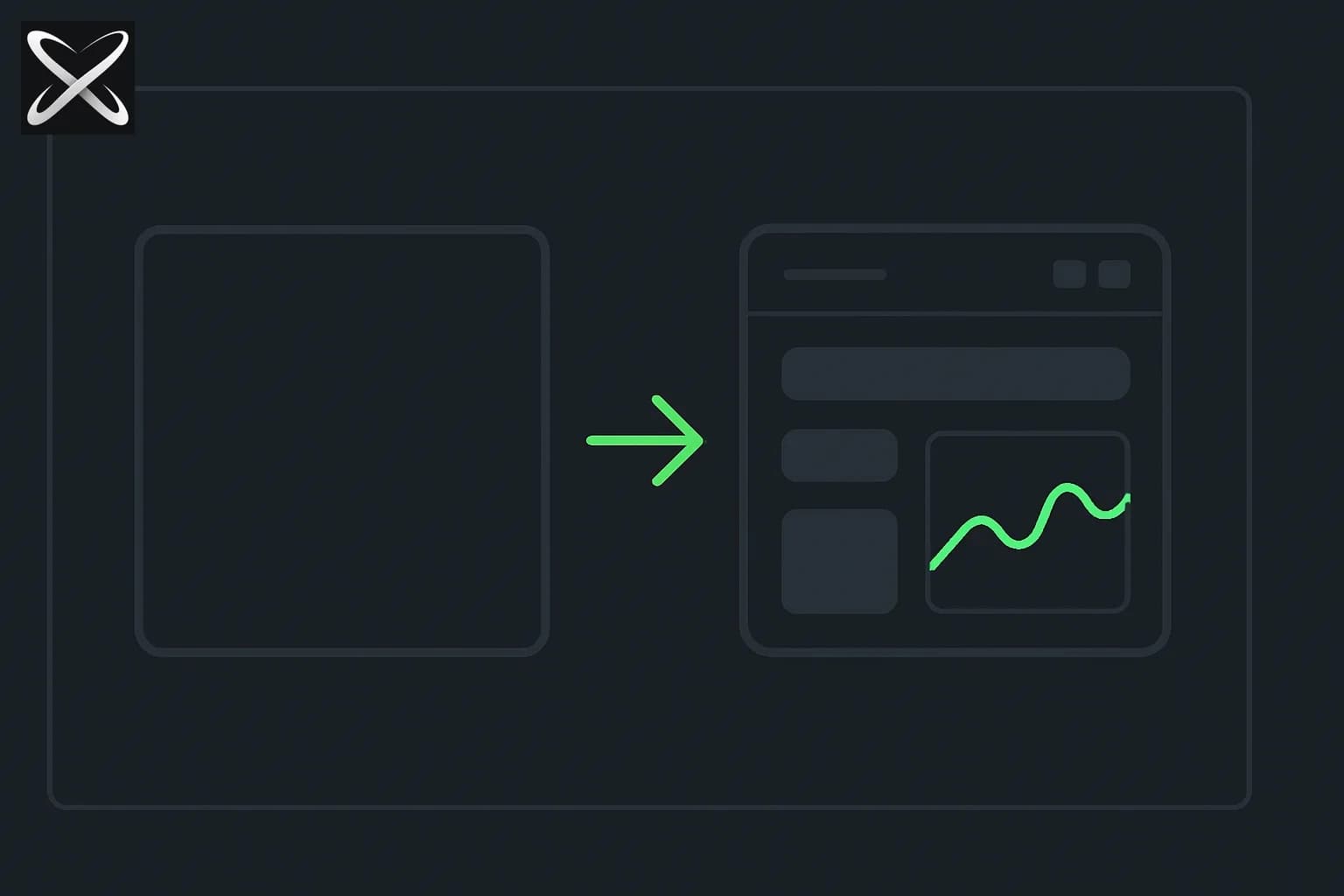
Runway spent 2025 and 2026 building world models for video and real-time avatars. On August 31, 2026, it pointed that same machinery at something nobody had shipped this way before: the interface itself. Solaris is Runway's first Interface World Model — it doesn't write code that a browser renders. It renders the app, frame by frame, as you click, drag, and type into it.
That's a genuinely different architecture from the current wave of AI UI builders, and it's worth being precise about what changes and what doesn't. This post covers what Solaris actually is, how "world model" translates into "no code" in practice, whether the "first" claim in Runway's framing holds up against explainx.ai's existing world models coverage, and how it stacks up against code-based generators like v0, Lovable, and Bolt.
TL;DR
| Question | Answer |
|---|---|
| What is Solaris? | Runway's first "Interface World Model" — generates OS-style interfaces frame by frame in real time, built on Gen-4.5 |
| Does it write code? | No. There's no HTML/CSS/JS at any point — each frame is generated directly as a response to the previous frame plus your input |
| Is it really "first"? | First one branded for general UI. Not the first world model to generate interactive, screen-like content — see Genie 2, Starchild-1, and Runway's own GWM-1 below |
| How does it compare to v0/Lovable/Bolt? | Those tools output inspectable source code a browser executes. Solaris outputs pixels directly — nothing to read, edit, or diff |
| Can I use it today? | No. Early access only, via a request form. No pricing disclosed |
| What's the resolution/speed? | 720p, targeting sub-500ms per-frame latency for interactive responsiveness |
| Are the benchmark claims independently verified? | No — Runway's own user study (250 participants, 7,500 judgments) and LLM-reconstruction comparison are self-reported |
| Biggest limitations? | Legible text rendering, trust in "convincing wrong" output, long-session coherence, and accessibility integration — all flagged by Runway itself |
What is an "Interface World Model," concretely?
explainx.ai's world models guide defines a world model as a neural network that learns the dynamics of an environment — not by memorizing pixels, but by learning to predict what happens next given the current state and an action. Odyssey's Starchild-1 does this for synchronized audio-video. Google's Genie 2 does it for playable 3D-feeling worlds from a single image. NVIDIA Cosmos does it for physical robotics scenes.
Solaris applies the same prediction loop to a screen. Runway's own framing: the model "observes clicks, drags and other interactions as it generates, using them as signals for what comes next." Instead of predicting how a thrown ball falls, it predicts how a button press should change the next frame of a dashboard, a form, or a game.
The technical foundation: Gen-4.5, adapted
Solaris is not a from-scratch architecture. Runway built it on top of Gen-4.5, its existing video generation model, adapted in three specific ways:
- Autoregressive generation — each frame depends only on the frames before it, which is what makes real-time, open-ended interaction possible instead of generating a fixed-length clip
- Compressed denoising — diffusion models normally need many denoising steps per frame; Runway says Solaris collapses this to "just a few steps" to hit interactive latency
- A hybrid reasoning split — a language model handles interpretation and behavioral logic (what should happen when you click "submit"), while the world model itself handles the actual visual rendering of the next frame
Runway is targeting 720p output with sub-500ms per-frame latency — fast enough that the interface feels responsive rather than laggy, though notably lower resolution than a typical desktop app renders at.
What "no code" actually means
This is the part worth being precise about, because "generates UI without code" is doing a lot of work in the headline.
A code-based UI generator — Antigravity's Interactive Generative UI Artifacts, v0, Lovable, Bolt — takes a prompt and produces HTML, CSS, and JavaScript. That code is an intermediate representation: a browser then parses, lays out, and executes it to produce the pixels you see. The code is the artifact. You can read it, edit a line, check it into git, or hand it to another developer.
Solaris removes that intermediate step. The model predicts the pixels themselves, frame by frame, directly from your interaction — there is no markup being generated in between, and nothing a browser is executing. As Runway puts it, the goal is a system where "any visual concept can become an interactive interface" without first being translated into a UI framework's components. The entire frame is the interface; there's no lossy conversion between "what I imagined" and "what got coded."
That distinction has a real trade-off, not just a novelty angle:
| Code-based (v0, Lovable, Bolt, Antigravity) | Interface World Model (Solaris) | |
|---|---|---|
| Output | HTML/CSS/JS files | Live video frames |
| Inspectable source | Yes — readable, diffable | No — nothing to read or diff |
| Version control | Standard git workflow | Not applicable in the traditional sense |
| Editability | Edit the code directly | Re-prompt or re-interact; no line-level edit |
| Runtime | Browser parses and executes | The model is the runtime |
| Accessibility (screen readers, APIs) | Inherits from real DOM elements | Needs separate integration — Runway flags this as unsolved |
| Deployability | Standard web hosting | Requires the model running live, per session |
Is the "first" claim actually true?
Partly. Solaris is the first system explicitly branded an "Interface World Model" aimed at general operating-system-style apps, and Runway's benchmark framing treats it as a new category. But the underlying technique — a world model generating interactive, screen-like visual state frame by frame in response to user input — has prior art already covered on this site:
- Google DeepMind's Genie 2 generates playable, responsive environments from a single image, predicting the next visual state from an action, the same core loop Solaris uses for app screens instead of game worlds.
- Odyssey's Starchild-1, covered in the world models guide, generates synchronized audio-video in real time while responding to continuous input — architecturally the closest sibling to what Solaris is doing, just aimed at a different output domain.
- Runway's own GWM-1, which powers Runway Characters, already demonstrated real-time autoregressive frame generation responding to live input months before Solaris — GWM-1 is explicitly the groundwork Solaris builds on, not a separate lineage.
So the honest read: Solaris is a new application of an established world-model technique to a new domain (general UI), not a new kind of model. That's still a meaningful step — nobody had pointed this specific machinery at "operating system that generates apps as you use them" before — but "first Interface World Model" is a category Runway is naming for itself, not a claim that no prior system generated interactive, frame-by-frame visual state.
How does it compare to v0, Lovable, and Bolt?
The comparison Runway itself draws, and the one worth taking seriously: companies like Vercel (v0), Lovable, and Bolt have spent the last two years racing to make natural-language-to-app generation faster and cleaner — but every one of those tools still produces code as an intermediate step. Solaris's pitch is that the intermediate step is exactly where fidelity gets lost.
Runway's own comparison data (self-reported, not independently verified) claims:
- In a 250-participant, 7,500-judgment user study, Solaris was preferred over coded interfaces 61% of the time for following instructions, and 71% of the time for feeling natural to interact with.
- When multimodal LLMs (Runway names Claude, GPT-4o, and Gemini 2.5 Pro-class models) were asked to reconstruct an interface by describing it in language first, information loss increased with visual complexity across every model tested — the argument being that going through language as an intermediate representation, the same way code is an intermediate representation, loses fidelity that direct frame generation doesn't.
Take both claims as Runway's framing until an outside lab replicates them — that's the same posture explainx.ai took with Google's Antigravity generative UI claims and with the Gemini 3.7 Flash showcase: a vendor's own benchmark is a claim, not a verdict.
The trade-off practitioners should actually weigh: if you need a shippable, maintainable, version-controlled codebase — the workflow DESIGN.md is built around — a code generator still wins, because the code is the product you deploy. If you want to prototype a feel, test an interaction pattern, or spin up a throwaway interface faster than code-then-render allows, an Interface World Model is aimed at a different job entirely: the interface as ephemeral experience, not durable artifact.
What Runway itself says is still broken
To Runway's credit, the announcement doesn't oversell readiness. Four limitations are named directly:
- Text rendering. "Stable, legible text remains one of the hardest problems in video generation" — and interfaces are unusually text-dependent, unlike the scenic video content Gen-4.5 was originally built for.
- Trust and hallucination. A convincing but wrong screen is worse than an error, especially for anything commercial. Runway says this is currently only anchored through the starting frames of a session — there's no deeper verification layer yet.
- Long-session coherence. Keeping an extended, open-ended interaction visually and logically consistent over time is unsolved.
- Accessibility. Generated interfaces still need to be wired into screen readers and accessibility APIs — something a real DOM element gets much closer to for free, and a rendered video frame does not.
Access and pricing
Solaris is in early access as of the August 31, 2026 announcement. Runway is collecting requests through a form and says it is "working with key partners to launch Solaris publicly" — no public launch date or pricing has been disclosed. Given Runway's existing Gen-4.5 pricing model runs on compute-metered credits, expect Solaris access, whenever it's public, to be metered similarly rather than a flat subscription.
The bottom line
Solaris is a real, technically coherent extension of world-model research into a domain — general app interfaces — that hadn't been targeted this directly before. The "no code" framing is accurate in a narrow, important sense: there genuinely is no HTML/CSS/JS being generated or executed anywhere in the pipeline. But "first" oversells the underlying technique, which Genie 2, Starchild-1, and Runway's own GWM-1 already demonstrated in adjacent forms. And the trade-off is real, not just a limitation to patch later: an interface with no inspectable source can't be version-controlled, code-reviewed, or handed to another engineer the way a v0 or Lovable output can. For prototyping feel and interaction fluidity, that trade might be worth it. For anything you intend to actually ship and maintain, code-based generation isn't going anywhere yet.
Specs, benchmark figures, and access details reflect Runway's August 31, 2026 announcement and are accurate as of publication; Runway has not independently verified third-party benchmarks, and early-access terms may change before public launch.
Related reading
- World Labs Atlas: another "world model," a completely different meaning — camera-controlled 3D generation
- Micro-gesture AI writing UX: gesture-scoped edits vs chat prompting
- Vercel DESIGN.md: spec-driven code UI vs frame-generated interfaces
- OpenDesign Harness beta: eval layer for polished design
- What are world models? Starchild-1, Genie 2, and the complete guide
- Runway Characters: real-time conversational video agents from one image (GWM-1)
- Antigravity's Interactive Generative UI Artifacts vs Claude Artifacts
- Gemini 3.7 Flash showcase: what Googlers are one-shotting
- DESIGN.md templates: the professional UI blueprint for AI agents
- Induction Labs' intrinsic discovery for terminal world models
- Runway's official Solaris announcement