



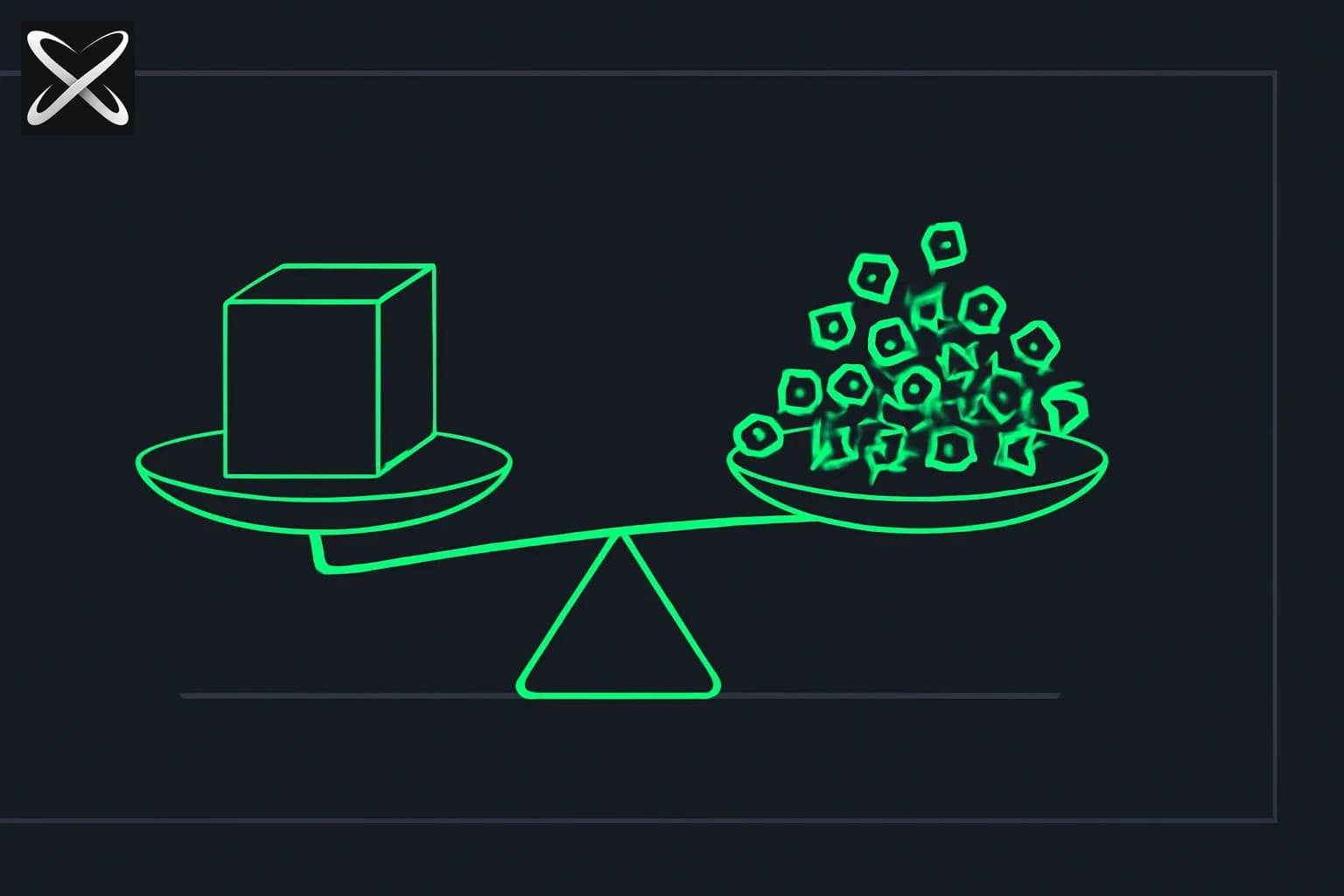
Update — October 5, 2026: A new engine, Strata, runs this model on a 12 GB GPU at 44-124 tokens per second. See the speed table and quality caveats.
A ModelScope page for Qwen3.8-Flash-Next went live and disappeared on August 25, 2026 — and it may answer the single most repeated request in the Qwen3.8-27B Hacker News thread: a mixture-of-experts (MoE) sibling to Alibaba's dense 27B launch. The listing described 125 billion total parameters, 6 billion active (125B-A6B), built on what Alibaba called "next-generation Qwen4 architecture", with expected repos Qwen/Qwen3.8-Flash-Next and an FP8 variant on ModelScope and Hugging Face around August 26, 2026 ~20:30 UTC+5:30.
That timing is crowd-sourced from the leak discussion, not a confirmed Alibaba calendar invite. But the specs — if they hold — reshape the local-AI math for anyone who already runs Qwen3.8-27B on a Mac Studio or RTX 5090, and anyone waiting for a MoE that closes the gap to closed frontier models on agentic coding without a GB300 rack.
Update — August 28, 2026: Qwen3.8-Flash-Next shipped as forecast on August 26, and the confirmed specs are in — though note this is still a Qwen3.x-generation release, not a model actually branded "Qwen4" (some aggregators mislabeled it that way; Alibaba's own framing is that it previews the architecture Qwen4 will build on, not that this model is Qwen4). Confirmed architecture: 125B total params with a 51B N-gram embedding table and a 4B multi-token-prediction module, 6B active per token across a 48-layer hybrid stack — 36 Gated DeltaNet (linear-attention) layers plus 12 full-attention layers using Qwen Sparse Attention (QSA) — trained with the Muon optimizer. Native context is 262,144 tokens, extensible to 1M. Reported benchmarks: 62.5 on SWE-bench Pro and 91.7 on GPQA Diamond. It ships under a custom qwen-community license, with weights (plus an FP8 variant) live on Hugging Face as Qwen/Qwen3.8-Flash-Next and on ModelScope.
TL;DR — what people are asking
| Question | Direct answer |
|---|---|
| What leaked? | ModelScope listing: Qwen3.8-Flash-Next, 125B total / 6B active MoE, "Qwen4 architecture" |
| When? | Aug 26, 2026 ~20:30 IST on ModelScope + Hugging Face — community expectation, not official |
| Expected repos? | Qwen/Qwen3.8-Flash-Next and an FP8 checkpoint |
| Who is it for? | 128GB Mac Studio/MBP, Strix Halo, RTX 5090 + heavy quant — not 32GB-only boxes |
| Who is disappointed? | Builders who wanted Qwen3.8-35B-A3B — a smaller MoE like Qwen3.6-35B-A3B |
| Performance claim? | Eric Boehs on HN: 125B-A6B may perform like ~27B dense, rival Sonnet/Opus on agentic coding — unverified until weights drop |
| How to run oversized MoE? | FreeToken-style CPU/GPU expert splitting came up immediately in the thread |
| Dense vs MoE recap? | Qwen3.8-27B is dense; Flash-Next is the speed-optimized branch |
What the leaked ModelScope page said
The listing appeared on ModelScope, was scraped and discussed on Hacker News, then removed — a pattern Alibaba has used before with embargoed Qwen drops. What survived in screenshots and thread summaries:
| Field | Leaked value | What it implies |
|---|---|---|
| Name | Qwen3.8-Flash-Next | "Flash" = efficiency tier; "Next" = forward-looking Qwen4 bridge |
| Total params | 125B | Large expert pool — bigger than Nemotron-scale 30B MoEs, smaller than Qwen3.8-Max's 2.4T |
| Active params | ~6B per token | Roughly 2× Qwen3.6-35B-A3B's ~3B active — more compute per forward pass |
| Architecture label | "Next-generation Qwen4 architecture" | Teaser for the Qwen4 family; no public layer diagram yet |
| Expected weights | Qwen/Qwen3.8-Flash-Next, FP8 variant | Same dual-repo pattern as Qwen3.8-27B-FP8 |
| Release window | Aug 26, 2026 ~20:30 UTC+5:30 | Evening India Standard Time — aligns with prior Alibaba drop cadence |
Alibaba has not republished the page as of this writing. Every number above comes from the leak thread and mirrored screenshots, not an official model card — the correction-if-wrong posture explainx.ai uses for every pre-release Qwen story.
Why HN wanted this — and why some people still do not
When Qwen3.8-27B hit #1 on Hacker News with 893 points, the praise was real — a dense model whose vendor benchmarks put it near Claude Opus on SWE-bench Pro. The complaint was equally real: every parameter activates on every token, so it is slower and hungrier than an MoE of similar quality.
Our Qwen 3.6 27B hands-on guide documented the same tradeoff a generation earlier: dense Qwen3.6-27B beat the sparser Qwen3.6-35B-A3B on agent output, but the MoE ran roughly 3× faster on Apple Silicon. Commenters explicitly asked Alibaba for Qwen3.8-35B-A3B — a direct successor to that shape.
Flash-Next is not that model. At 125B-A6B it is:
- More capable on paper — larger total expert pool, double the active parameters vs 35B-A3B
- Heavier to serve — checkpoint size and memory tiers closer to frontier MoE than to "single 4090 comfort zone"
- A different buyer — people with 128GB unified memory (Mac Studio tier), Strix Halo integrated setups, or RTX 5090 + substantial host RAM — not the "32GB VRAM and done" crowd
That split showed up immediately: excitement from Mac Studio owners who felt Flash-Next was sized for their machines; frustration from RTX 5090 owners who wanted a 35B-A3B-class drop they could quant to fit 32GB without FreeToken-grade orchestration.
Eric Boehs: "perform like 27B dense, rival Sonnet/Opus on agentic coding"
Eric Boehs — known in local-AI circles for hardware-forward MoE commentary — argued on Hacker News that Qwen3.8-Flash-Next 125B-A6B could land near ~27B dense effective quality while keeping MoE throughput advantages. Translated into builder terms:
| Claim | Honest read |
|---|---|
| ~27B dense equivalent | Plausible for a well-trained 125B-A6B — active 6B is in the same ballpark as dense width, expert pool adds capacity MoE routing can exploit |
| Sonnet/Opus on agentic coding | Aspirational until SWE-bench / Terminal-Bench numbers ship — Qwen3.8-27B already edges Opus on one vendor metric and trails on four others |
| Faster than dense 27B locally | Likely on tok/s if quant and routing are tuned — MoE's whole point |
| Better than dense 27B on every task | Not guaranteed — dense still wins quality-per-parameter on some agent loops in prior Qwen generations |
Treat Boehs's framing as the upper bound of community hope, not a benchmark table. The useful part: Flash-Next is positioned as the agentic-coding MoE in the Qwen3.8 lineup, not a speech or vision sidecar.
Hardware: who Flash-Next actually fits
Until GGUF tables arrive, map the leak to tiers explainx.ai already tests:
| Hardware tier | Realistic expectation for 125B-A6B | Notes |
|---|---|---|
| 128GB Mac Studio / MBP | Likely with Q4–Q8 MLX or llama.cpp + expert offload | Same class that runs Kimi K3 1-bit builds — unified memory is the asset |
| M6 Mac mini (32GB max) | No for full model | Apple's August 25 M6 mini tops out at 32GB — fine for 7B–14B, not 125B MoE |
| RTX 5090 (32GB VRAM) | Partial GPU + host RAM | Needs aggressive NVFP4/FP8 and CPU-resident experts — the FreeToken thread on HN |
| Strix Halo APU | Possible with unified memory configs | Same "slow GPU, big RAM" profile as MacBook vs dedicated GPU |
| Single RTX 4090 (24GB) | Unlikely without heroic offload | This is why commenters wanted 35B-A3B instead |
FreeToken and MoE split across CPU/GPU
The Hacker News thread connected Flash-Next immediately to FreeToken's MoE serving approach — measuring PCIe and host-memory bandwidth, caching hot experts on GPU, running cold experts on CPU. FreeToken's published 753B demo used a 96GB GPU plus 512GB host RAM, not "VRAM only."
For Flash-Next, the practical lesson from that coverage applies at smaller scale: a 125B MoE is a whole-machine problem. Budget checkpoint size, expert pool residency, and agent harness context — not just "does it fit on my 5090."
Qwen4 architecture: teaser, not spec sheet
The leaked copy's "next-generation Qwen4 architecture" line is the second story underneath the release timing. Alibaba is signaling that Flash-Next previews design choices — routing, attention variants, training stack — that will define the Qwen4 family proper.
What we do not have yet:
- Layer counts, expert counts, or attention/Mamba hybrid details
- Context window confirmation (Qwen3.8-27B ships 262K native / 1M YaRN)
- License terms (Qwen3.8-Max's open-weight drop had relicensing caveats)
Read Flash-Next as Qwen3.8 branding on Qwen4 internals — similar to how vendors ship "preview architecture" models before a numbered generation launch. When Alibaba publishes a card, update this section; until then, do not treat "Qwen4" as a searchable spec.
How to prepare before weights drop
You do not need the checkpoint to get the stack ready:
# 1. Inference server — llama.cpp or vLLM once HF repos go live
# Pattern from Qwen3.8-27B; swap model id when published
llama-server -hf Qwen/Qwen3.8-Flash-Next-GGUF:Q4_K_M \
  --spec-type draft-mtp \
  -ngl 999 \
  -fa on \
  -c 65536 \
  --port 8080

# 2. Wire into OpenCode (any OpenAI-compatible local endpoint)
# See opencode.jsonc provider block in the local models guide
Full provider wiring lives in how to run open-source models locally with OpenCode. For Apple Silicon, watch for MLX ports the way OrcaRouter shipped for Qwen3.8-27B — third parties often beat official quants by hours.
Day-one checklist:
| Step | Why |
|---|---|
| Confirm repo names on Hugging Face / ModelScope | Leak said Qwen/Qwen3.8-Flash-Next — verify before pulling |
| Pick quant from total RAM + VRAM, not VRAM alone | MoE checkpoints punish VRAM-only math |
| Enable MTP / speculative decoding if available | Same lever that separated 10 vs 160 tok/s on Qwen3.8-27B |
| Test on low/medium reasoning effort first | Dense 27B's xhigh default burned 20+ minutes on simple prompts — do not repeat blindly |
| Compare against dense 27B on your agent harness | Vendor SWE-bench rows ≠ your repo's edit loop |
Flash-Next vs the rest of the August Qwen stack
| Model | Type | Total / active | Local fit | Role |
|---|---|---|---|---|
| Qwen3.8-Max | MoE | ~2.4T / sparse | GB300-class cluster | Frontier open-weight flagship |
| Qwen3.8-27B | Dense | 27B / 27B | Single 4090, Mac Studio | Quality-per-parameter local default |
| Qwen3.8-Flash-Next (expected) | MoE | 125B / ~6B | 128GB Mac, 5090 + offload | Speed + agentic coding MoE tier |
| Wanted, not confirmed | MoE | ~35B / ~3B | RTX 4090/5090 native | The ask HN repeated after 27B |
Against Kimi K3, Flash-Next is orders of magnitude smaller — a local-workstation story, not a datacenter-scale 1-bit GGUF saga. Against NVIDIA Nemotron 3.5 Lightning (30B / 3B active), Flash-Next brings 2× active compute and a much larger expert pool, at the cost of a heavier checkpoint.
What to watch at release
- Official model card — context length, reasoning_effort defaults, vision/multimodal support
- License — whether open weights match Qwen3.8-27B or repeat Max's restrictions
- Unsloth / community GGUFs — Dynamic v3.0 for 27B landed within days; expect the same
- Independent agentic benchmarks — Terminal-Bench, SWE-bench Pro, real OpenCode loops
- Smaller MoE follow-up — whether Alibaba ships the 35B-A3B shape as Flash-Lite or similar
Bottom line
Qwen3.8-Flash-Next is the MoE answer to a question Qwen3.8-27B explicitly raised — if the leaked 125B-A6B specs and Aug 26 timing hold. It targets builders with 128GB-class unified memory or multi-tier MoE runtimes, promises Sonnet/Opus-class agentic coding in community estimates, and teases Qwen4 architecture ahead of a numbered generation launch. It is not the smaller 35B-A3B many RTX 5090 owners asked for. We will update this post when Qwen/Qwen3.8-Flash-Next goes live on Hugging Face.
Update — August 29, 2026: Qwen3.8-Flash 125B is now selectable in OpenCode Go as a preview, which also serves as the first hands-on look at Qwen4 architecture — see OpenCode adds Qwen3.8-Flash 125B.
Update — September 2, 2026: Alibaba confirmed the production, hosted version of this model — dropping the "-Next" research-preview label — with QwenCloud pricing at $0.16/1M input and $0.47/1M output tokens, 1M context by default, and official built-in tools. Same architecture as this post documents; see Qwen3.8-Flash goes live on QwenCloud for the pricing breakdown and cost comparison against GLM-5.3-Flash and DeepSeek V4 Flash.
Related on explainx.ai
- OpenCode adds Qwen3.8-Flash 125B — a preview of Qwen4 architecture
- Qwen3.8-27B — dense, #1 on HN, locally runnable
- Qwen 3.6 27B local dev — dense vs MoE tradeoffs, OpenCode wiring
- Unsloth Dynamic v3.0 GGUFs for Qwen3.8-27B
- FreeToken — MoE expert splitting across GPU, CPU, and host RAM
- MacBook vs dedicated GPU — unified memory vs VRAM for local LLMs
- M6 Mac mini — 32GB ceiling and what it actually runs
- Run open-source models locally with OpenCode
- Kimi K3 1-bit GGUF on Mac Studio
- Qwen3.8-Max open weights — the 2.4T flagship half of August
Primary sources: Hacker News leak discussion (August 25, 2026) · ModelScope listing screenshots (removed) · Eric Boehs commentary on Hacker News
Status as of August 25, 2026. Qwen3.8-Flash-Next weights were not yet public; specs and timing come from a removed ModelScope page and community discussion, not an official Alibaba model card. Follow @explainx_ai for same-day updates when repos go live.