



Nvidia has published the software list that goes with RTX Spark laptops, which go on sale Friday, October 16. The headline items are an open-weight Nemotron 3.5 Bolt 74B model that Nvidia says fits in 24GB, NVIDIA PAIR leaving beta, a Llama Windows app for llama.cpp, and a security layer for local agents. This is Nvidia's own announcement, so every performance figure below is a vendor claim until reviewers get hardware.
TL;DR: what ships and when
| Item | What it is | Date (per Nvidia) |
|---|---|---|
| RTX Spark laptops | Up to 128GB unified memory, 1 petaflop AI compute | Fri, Oct 16 |
| Nemotron 3.5 Bolt 74B-A9B | 74B MoE, 9B active, 24GB at 2-bit, open weights, data and recipes | Thu, Oct 15 |
| NVIDIA PAIR | Personal AI router, free and open source, out of beta | Oct 13 |
| Llama Windows | Windows system-tray app for llama.cpp | Oct 13 |
| Broadcast 2.3 | Video super resolution, frame generation, MCP server for agents | Available now |
| Nemotron 3.5 Bolt E4B 4GB | Small model for in-game AI characters (ACE) | Fri, Oct 23 |
| AI playbooks | Guided setups: first agent, "chief of staff", dev config | Fri, Oct 16 |
Source: Nvidia's announcement. Hardware background is in our earlier posts on RTX Spark power envelopes and the Surface RTX Spark dev box.
What is Nemotron 3.5 Bolt 74B?
Nvidia calls it a model "purpose-built for running local agents on RTX Spark." The details it gives:
- 74 billion parameters in a mixture-of-experts design, with 9 billion active per token
- Packed into 24GB using 2-bit quantization with quantization-aware training "to retain quality"
- Positioned as faster than most popular dense models and smarter than most MoE models with a similar memory footprint
- Fully open: weights, training data and recipes, so developers can fine-tune
- Run at launch through llama.cpp, vLLM, Ollama, Unsloth and LM Studio, and reachable from agents like Hermes and OpenClaw
The arithmetic is plausible: 74B parameters at 2 bits is roughly 18.5GB for weights before overhead, so 24GB leaves room for cache. The question no one can answer yet is how much accuracy the 2-bit compression costs on real agent tasks. Nvidia gives no benchmark numbers in this post, so wait for independent tests after the October 15 release. Our piece on streaming MoE experts from SSD explains why active-parameter count, not total size, drives speed on local hardware.
How do local agents get set up and sandboxed?
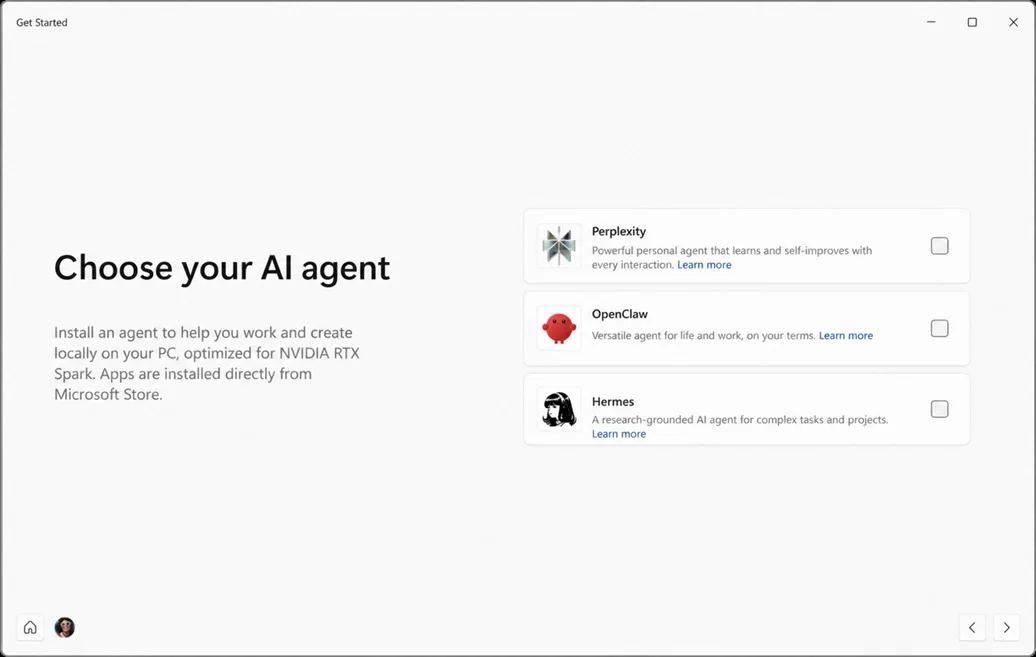 RTX Spark Getting Started screen where users pick a local AI agent app on first boot
Image: NVIDIA
RTX Spark Getting Started screen where users pick a local AI agent app on first boot
Image: NVIDIA
From first boot, Nvidia says RTX Spark shows a "Getting Started" screen to pick and install an agent app. GitHub Copilot, Hermes Agent, OpenClaw, Perplexity, Pi and WorkBuddy will recommend an optimized local model and settings and configure them in a few clicks.
Security is handled by two layers. MXC (Microsoft Execution Containers) provides operating-system-level isolation, covered in our post on Windows hybrid intelligence and MXC. OpenShell makes it easier for agents to adopt MXC and adds credential protection and security monitoring. Per Nvidia, OpenClaw and GitHub Copilot already support MXC, and Hermes Agent will integrate granular OpenShell controls by the end of October.
For routing, NVIDIA Switchyard is an open source model router library that sends queries between local and cloud models, so users minimize cloud usage while getting similar results. Hermes will add it later in October; Perplexity Computer and GitHub Copilot use their own routers (Copilot's is called HydraFusion and now supports local models).
Agents also get hooks into apps: Nvidia is releasing MCP servers for NVIDIA App, Broadcast, PAIR, Omniverse and RTX Remix, plus a library of CUDA-X Skills. If MCP is new to you, start with our explainer on what MCP is.
PAIR leaves beta; Llama Windows arrives
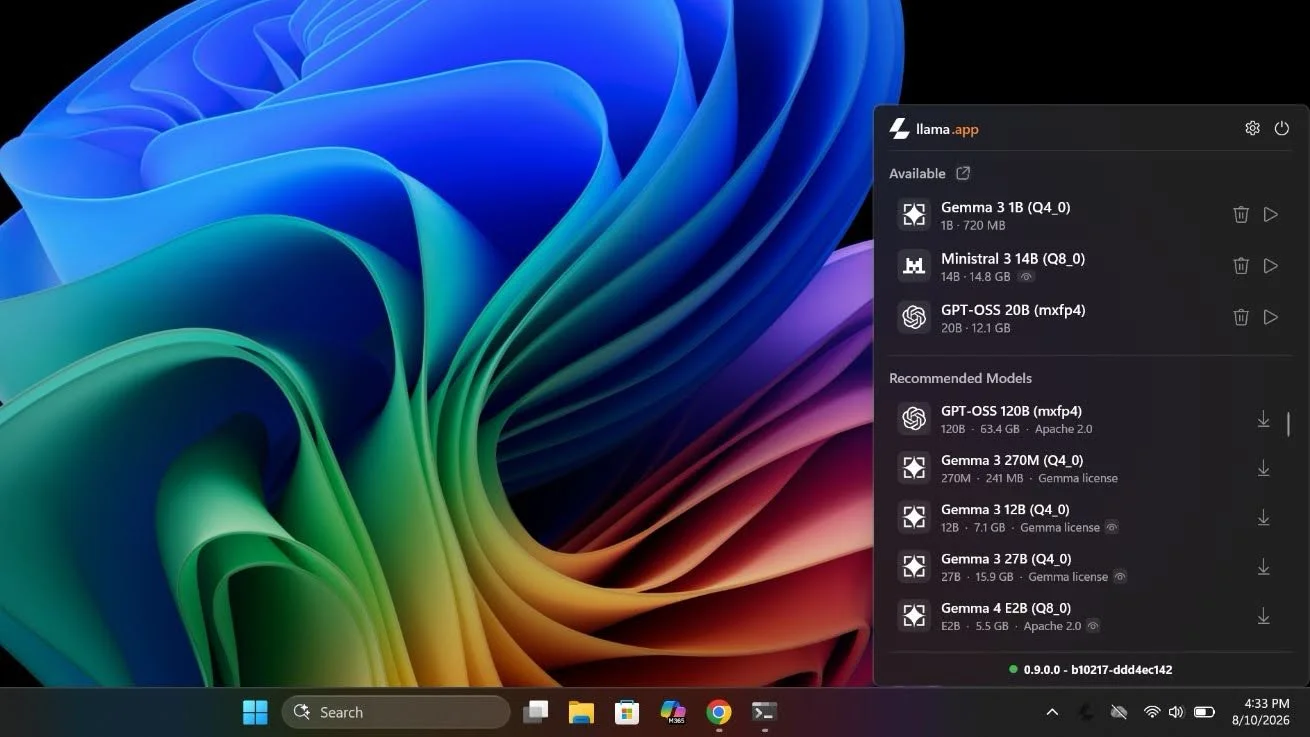 Llama Windows system tray app for running local models on RTX Spark
Image: NVIDIA
Llama Windows system tray app for running local models on RTX Spark
Image: NVIDIA
PAIR automatically discovers compatible PCs on your network, installs models and inference engines, and spreads AI workloads across them. The 1.0 release adds llama.cpp support, direct Hugging Face downloads and customizable engine settings. Nvidia says the community contributed over 10 features and fixes in the first month. We covered its debut in PAIR's first real partner, Hermes Desktop and in the original distributed home AI post.
Llama Windows is a Windows 11 system-tray app for llama.cpp with one-click access to recommended Hugging Face Hub models. Nvidia's blog points to the Hugging Face blog for details, which we did not review for this post. It matters because the command line has been the main barrier to running llama.cpp on Windows.
What are decision models?
Nvidia describes decision models as giving agents "a near-instant way to make decisions, without lengthy reasoning loops," choosing the next action or classifying a request "up to 200x faster than traditional agents." llama.cpp and Unsloth now support them on RTX Spark and GeForce RTX GPUs. The 200x number is Nvidia's and has no stated benchmark, so treat it as a best-case figure for routing-style tasks, not general agent speedup.
Developer tooling on Windows on Arm
RTX Spark is an Arm machine running Windows, so tooling gaps were a risk. Nvidia lists, with Microsoft and the community:
- The first PyTorch-CUDA build for Windows on Arm
- The first Python build native by default on Windows on Arm, with Python 3.15
- The first native Conda installer for Windows on Arm with over 2,000 packages
- 97% of the top 15,000 Python wheels ready, with the rest in progress
- Microsoft making coding models such as MAI 1.1 Coding Flash available locally and adding llama.cpp as a Windows ML backend; see our post on MAI-Code-1.1 Flash local on Windows
A 97% wheel coverage claim still means roughly 450 of the top 15,000 packages may need workarounds, so check your own dependency list before relying on it.
Creative and gaming claims
Nvidia says Adobe will deliver up to 2x faster AI, editing, color and effects in Photoshop, Premiere and Substance 3D, with Photoshop and Premiere AI optimizations in beta now. Broadcast 2.3 adds Video Super Resolution, Frame Generation, an offline file processor and an MCP server. ComfyUI gains RTX Video Frame Generation and HDR nodes. Blender 5.3 beta supports RTX Spark, with DLSS Ray Reconstruction coming in November.
On gaming, Nvidia lists hundreds of titles at launch, DLSS 5 with a 2x faster model debuting in NBA 2K27 on October 16 (up to 1.4x frame rates), and Nemotron 3.5 Bolt E4B 4GB for AI characters on October 23, demoed in the SkyrimNET mod. All are Nvidia-reported figures.
Why local agents are the pitch
Nvidia's framing is that local models have crossed a threshold. The post says agent projects such as OpenClaw and Hermes topped GitHub popularity charts this year, that models like Qwen 3.8-Flash-Next are "catching up to frontier cloud models released just a few months ago," and that local LLM downloads are already 5x higher than all of last year. Those are Nvidia's statements, not audited numbers, but they match the direction we have seen in the Verge's long-term local-agent experiment.
The practical trade-offs are worth spelling out. Local models cost nothing per token and keep files on the machine, which is why sandboxing and credential protection are part of the launch. Cloud models still lead on the hardest tasks, which is why Switchyard-style routing is the other half of the pitch: iterate locally, escalate when a task needs it. The open question is where the line sits for your workload, and only your own tests answer it.
The runtime layer is also open. llama.cpp is the engine underneath Llama Windows, LM Studio-style tools and several of the model launches Nvidia lists, so improvements such as decision-model support land for anyone with a supported GPU, not only RTX Spark buyers. If you already run a GeForce RTX desktop, Nvidia says decision-model support applies there too.
What to do before October 16
| If you are... | Do this |
|---|---|
| A local-LLM tinkerer | Plan to test Nemotron 3.5 Bolt 74B on Oct 15 in llama.cpp or LM Studio and compare it against your current model |
| Running agents | Check whether your agent supports MXC/OpenShell sandboxing before giving it file access |
| A Python developer | Audit wheels for Windows on Arm before buying |
| Waiting on reviews | Treat the 2x, 200x and 1.4x figures as marketing until independent benchmarks land |
For a grounded view of what living with local agents is like, read the Verge's local AI diary.
Our read
The notable shift is that Nvidia is selling a software stack, not just a chip: model, router, sandbox, installer and MCP hooks arrive together. That is smart, because local AI has been held back more by setup and trust than by raw speed. The unknowns are real: how a 2-bit 74B model performs, how well Windows on Arm holds up, and what the laptops cost. We will update this post after the October 15 model release.
Related reading
- RTX Spark N1X power envelopes
- Surface RTX Spark dev box
- PAIR and Hermes Desktop
- PAIR: open source distributed home AI
- Windows hybrid intelligence and MXC
- MAI-Code-1.1 Flash running locally
- The Verge's local AI diary
Specs, dates and figures come from Nvidia's October 13, 2026 post and may change; check Nvidia and Microsoft pages before buying.