



Nvidia is reportedly close to acquiring Inception, a two-year-old startup that builds diffusion-based language models, for at least $500 million. The claim comes from The Information, which cites three people familiar with the talks, as relayed by The Decoder on November 20, 2026. Neither company had commented at the time of writing. The deal is therefore reported, not confirmed.
TL;DR: what is reported and what is confirmed
| Question | Reported | Confirmed? |
|---|---|---|
| Is a deal near? | Nvidia is "nearing a deal" to acquire Inception | No. Neither company has commented |
| Price | At least $500 million, plus performance bonuses | No. Anonymous sources only |
| Team | More than 30 employees; co-founders Ermon, Grover and Kuleshov expected to join full time | No |
| Purpose | Strengthen Nemotron open models and robot models | No official statement |
| Past Nvidia link | NVentures joined Inception's $50M seed round in 2025 | Yes, per TechCrunch |
| Product | Mercury family of diffusion LLMs, latest is Mercury 3 | Yes, per Inception and our earlier coverage |
What did the report actually say?
The Decoder summarizes The Information's story in a few points. Nvidia is nearing a deal to buy Inception for at least $500 million. The package also includes performance bonuses for the more than 30 employees. The startup builds language models with the diffusion process known from image generation. It most recently released Mercury 3.
The Decoder adds that the purchase aims to bolster Nvidia's open-source Nemotron models and its physical models for robots, helping it compete with OpenAI and Anthropic as both build their own inference chips. It also reports that Palantir and US government agencies already use Nemotron as an alternative to Chinese models, that talks began before Jensen Huang's resignation, and that Microsoft expressed interest.
All of this is relayed secondhand, from a paywalled original. We could not find a statement from Nvidia or Inception, a regulatory filing or a second independent report confirming the terms. Any of the details, including the price, can still change.
What does Inception build, and why is it different?
Most chat models, such as the ones behind ChatGPT and Claude, are autoregressive. They write a response one token at a time, each token depending on the previous ones. Diffusion models work another way. They start from a rough full draft and refine all of it in several steps, the same process that powers image generators like Stable Diffusion.
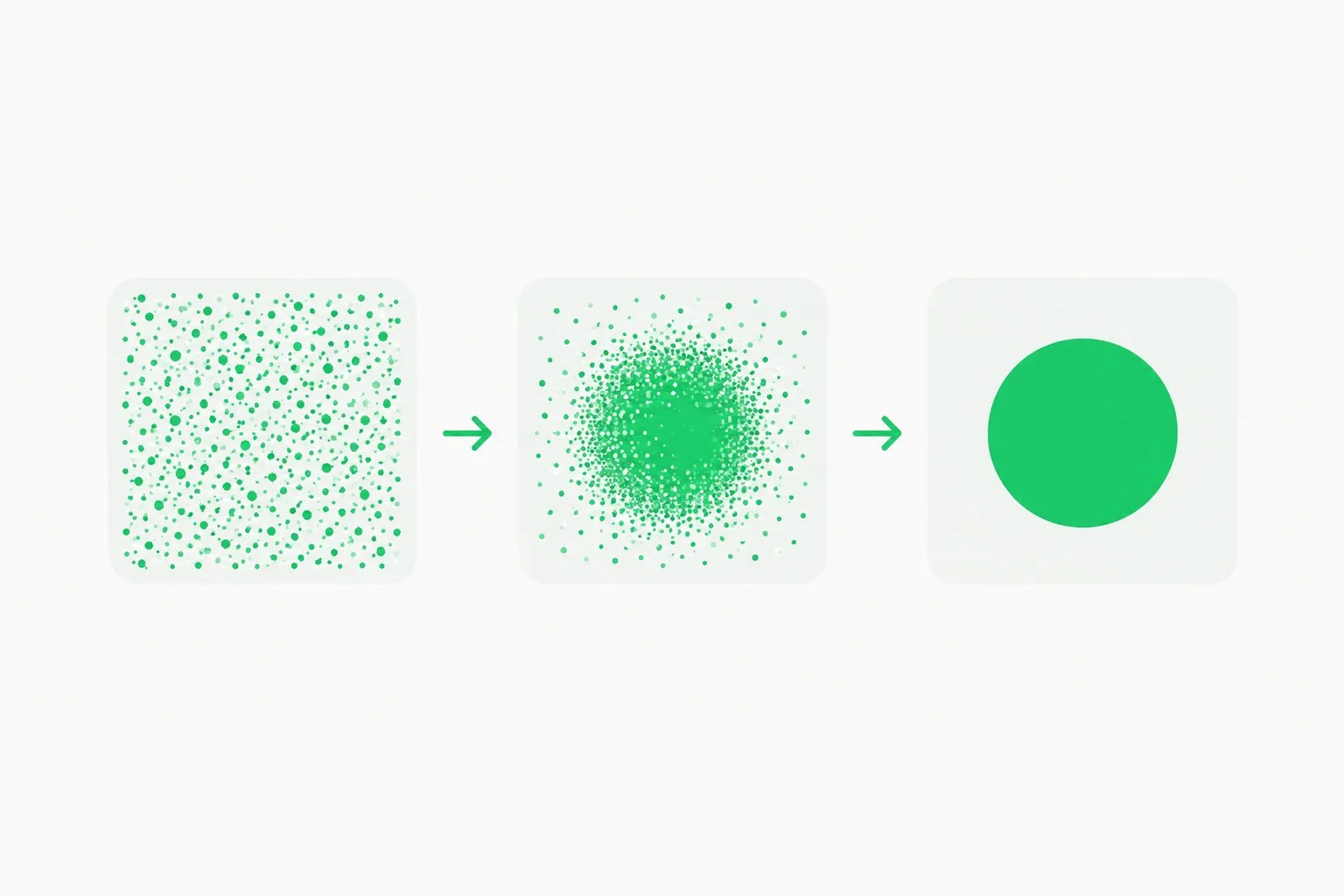 Noise resolving into a clean shape across three panels, showing how a diffusion LLM refines a whole answer in steps
When Inception raised a $50 million seed round in November 2025, TechCrunch reported that the round was led by Menlo Ventures, with Mayfield, Innovation Endeavors, Microsoft's M12, Snowflake Ventures, Databricks Investment and Nvidia's NVentures taking part. Stanford professor Stefano Ermon leads the company. He told TechCrunch the diffusion approach is "much faster and much more efficient" than what others build, and the pitch is lower latency and compute cost, especially across large codebases.
We have covered the product line as it grew:
- Mercury 2 and 1,009 tokens per second, June 2026.
- Mercury 3 with a 1M context and a claimed 1,068 tokens per second, October 2026, where we separated vendor claims from measured results.
The speed numbers are Inception's own claims. Read our Mercury 3 post for what was and was not independently measured.
Why would Nvidia want this?
Three reasons fit the reporting. None is confirmed by Nvidia.
1. Nemotron needs a differentiator. Nvidia's open Nemotron models compete with a crowded field of open-weight models. A diffusion approach would give Nemotron something rivals do not ship at scale. For recent Nemotron news, see our post on Nvidia at Microsoft Ignite with Nemotron 3.5 and Vera Rubin.
2. Speed sells hardware. Diffusion decoding can use parallel compute more fully than token-by-token generation. That is an argument that is plausible but not proven here. Nvidia sells the GPUs that would run it. We have no benchmark from Nvidia on this.
3. Robotics. The report says the team could help Nvidia's physical models for robots. Diffusion methods are already common in robot control research. That makes the link technically sensible, though again it comes from the report, not from a company plan.
Diffusion versus autoregressive: what changes for a user?
The practical difference shows up in three places, based on how the two methods work and on what Inception and TechCrunch have said about its own models.
Latency. An autoregressive model must finish token 50 before it starts token 51. A diffusion model updates many positions at once, so the number of steps does not have to grow with the length of the answer. That is the basis for Inception's speed claims, which we have not seen independently reproduced across workloads.
Editing and infilling. Because the whole draft exists from the first step, diffusion models can revise earlier parts of a response while later parts are still rough. This suits code edits and structured output, where the end of a function can inform its start.
Maturity. Autoregressive models have years of tooling: serving stacks, quantization, fine-tuning recipes and evaluation habits. Diffusion LLMs have far less. A buyer with Nvidia's software team could narrow that gap, which is one more plausible reason for the reported interest. It is our reading, not a statement from the companies.
None of this says diffusion beats autoregressive models on quality. Inception's own materials emphasize speed and cost, and our earlier posts treat the quality numbers as vendor claims.
 Two shapes joining into one with a seam, representing a reported Nvidia acquisition of Inception
Where does this sit in Nvidia's recent run of deals and investments?
Nvidia has been putting money into AI labs and model makers across the year. Our earlier coverage includes Nvidia's Korea startup investments and the Nvidia Inception program for startup credits. Note the naming clash: the Nvidia Inception program is Nvidia's own startup program and is unrelated to the startup Inception Labs discussed here.
The timing also matters. The report says talks started before Huang's resignation. For the leadership context, see Nvidia's town hall where Kress told staff to move on and Chinese labs renting overseas Nvidia capacity after the Huang scandal. A new CEO-era deal would be a signal about direction, but we have no source that says so.
What are the open questions?
- Is it an acquisition or an acqui-hire? With about 30 staff and bonuses tied to performance, it may be mostly a talent deal. The report does not say what happens to Mercury as a product or to existing customers.
- Will Mercury stay available? Customers reported on November 12 an Inception email saying the Mercury API shuts down after December 28, 2026. See our Mercury API shutdown post. Inception had not published a matching notice then, and the acquisition report does not say how the two connect.
- Would Nemotron get diffusion variants? The report implies so. No release plan has been published.
- Does regulation matter? A deal of this size by Nvidia could draw scrutiny. We found no filing or comment on that.
- Did Microsoft really bid? The Decoder says Microsoft expressed interest, and Microsoft's M12 fund did invest in the seed round. Whether Microsoft made an offer is unconfirmed.
What should builders and founders do?
If you use Mercury through an API, plan for the reported December 28, 2026 shutdown regardless of this deal. Export your data and line up an alternative, as our shutdown post explains. A deal could change that plan, but no source says it will.
If you are evaluating diffusion LLMs for latency-sensitive work such as code completion, test them yourself. Inception's claims, like those of any vendor, are best checked on your own prompts and hardware. Our Mercury 3 claimed-vs-measured post lists what to measure.
If you are a founder, notice the shape of the report: a team of about 30 people with a distinct technical approach, a prior investment from the buyer's venture arm, and a reported price above half a billion dollars. Whether or not it closes, it shows how strategic investors value model-architecture bets. See also our earlier look at US rules on disclosing Chinese AI models, which is part of why open American models such as Nemotron are in demand with government users.
Why a "reported" deal still deserves caution
Deal reports based on anonymous sources often get the direction right and the details wrong. Prices move between a first report and signing. Structures change, for example from a full purchase to a licence plus hiring. Some talks simply end. That is why we repeat the attribution throughout this post, and why the table above marks each claim as unconfirmed. When the companies speak, the numbers in this post should be replaced by theirs.
How to follow the story
Watch for a statement from Nvidia or Inception, an announcement on Inception's site, and follow-up reports from major outlets. A real acquisition would normally appear in a press release or a blog post from one of the two companies. Until then, quote the figure as "reportedly at least $500 million, according to The Information."
We will add a dated update if either company confirms or denies the report.
Related reading
- Mercury 2: diffusion LLM at 1,009 tokens per second
- Mercury 3: claimed vs measured
- Inception Mercury API shutdown on December 28
- Nvidia at Microsoft Ignite: Nemotron 3.5 and Vera Rubin
- Nvidia's Korea startup investments
- Nvidia Inception program: free AI startup credits
- Nvidia town hall: Kress tells staff to move on
Details are accurate as of November 20, 2026. The deal is reported and unconfirmed; facts may change.