



NVIDIA says cities and local partners across Europe are using its Cosmos, Nemotron and Omniverse tools to build AI agents and digital twins that help run urban operations. The NVIDIA blog post, published October 13, 2026 ahead of the GTC Berlin keynote on October 21, covers projects in Belgium, Finland, France, Italy, the Netherlands, Poland, Sweden and the UK.
It is a vendor showcase, so the useful work is sorting it. Of the projects named, one reports measured results: the French Department of Côte-d'Or says its agents cut total operating costs by 10 percent across more than 500 public buildings. The rest are pilots, tests or plans. This post separates the two and explains the technology so you can judge the next city-AI announcement yourself.
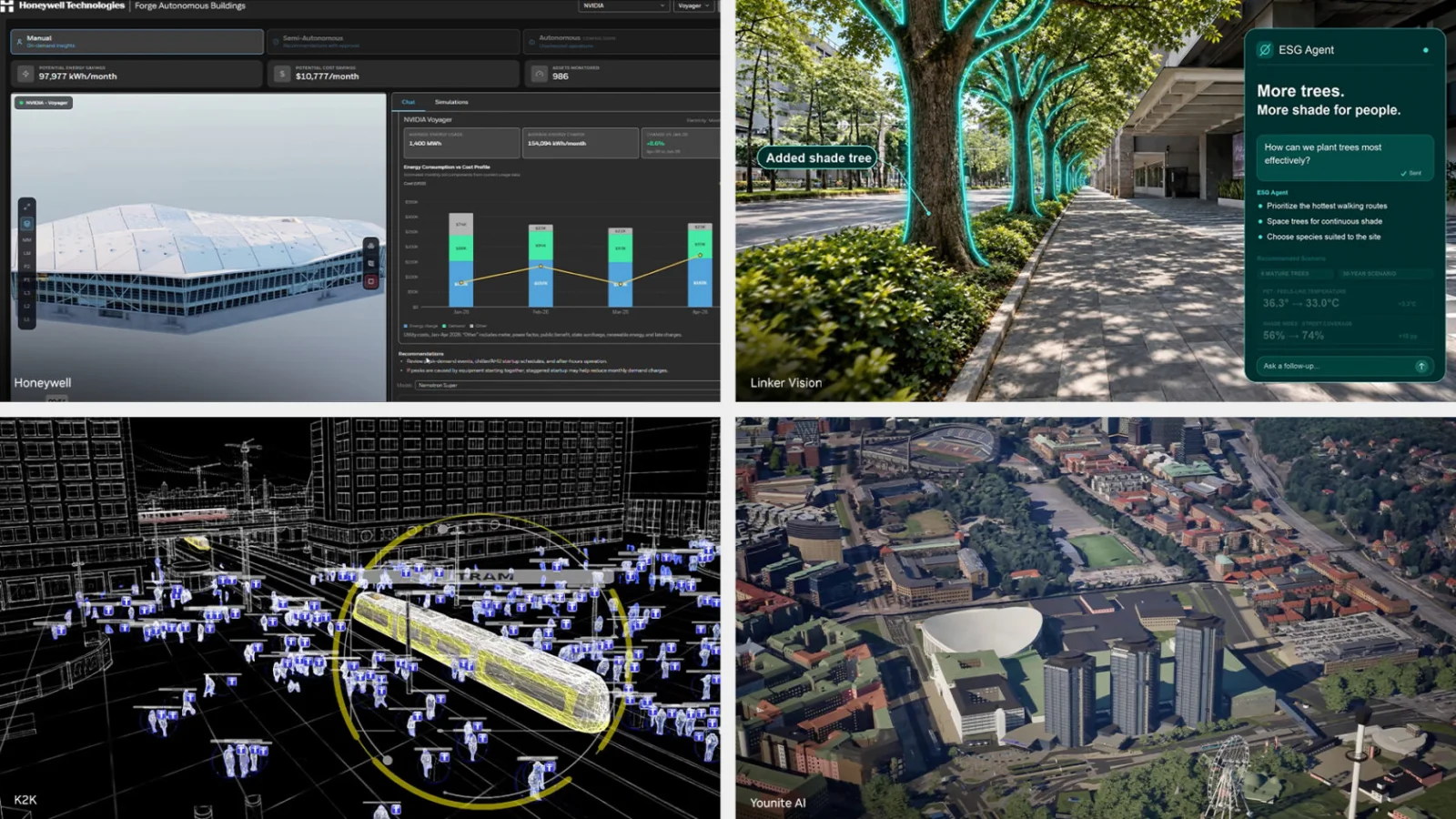 NVIDIA AI agents for European city operations, with partner demos from Honeywell, Linker Vision, K2K and Younite AI
Image: NVIDIA
NVIDIA AI agents for European city operations, with partner demos from Honeywell, Linker Vision, K2K and Younite AI
Image: NVIDIA
Quick reference: the projects NVIDIA lists
| Place | Partners | What it does | Stage per NVIDIA |
|---|---|---|---|
| Côte-d'Or, France | Akila, ThinkDeep | Operations agents on a sovereign digital twin across 500+ public buildings | Built; reports 10% lower operating costs, 30% targeted at scale |
| Port Sud de France, Sète | ThinkDeep | Agents analyzing cargo and safety data, guiding handling of hazardous materials | Working with the platform |
| Milan region, Italy | Galene.AI, Dell, TD Synnex | Locally operated AI factory: translation, citizen chatbots, procurement and funding help | Deploying in Cinisello Balsamo, four more municipalities planned |
| Port of Antwerp-Bruges, Belgium | Milestone, Dell | Vision agents for incidents such as oil-spill warnings, trained on synthetic data | Testing |
| Liverpool City Region, UK | K2K | AI factories for mobility and safety applications | Exploring |
| Jersey and Belfast | K2K | Decision-making, mobility, planning, clean energy; smart mobility pilot | Exploring and pilot |
| Gothenburg, Sweden | Younite | Digital twin for simulating changes and event previews, part of the EU Citiverse initiative | Developing |
| Dubai Fairmont Hotel | Honeywell Technologies | Forge Cognition connecting agents with building systems | Deploying |
What the technology stack actually is
NVIDIA describes three layers, and knowing them helps you read any similar announcement.
Cosmos and the VSS blueprint: agents that read video
NVIDIA Cosmos open models and the NVIDIA Metropolis Blueprint for video search and summarization (VSS) help agents interpret video and identify conditions such as traffic congestion, equipment condition, underused spaces and safety hazards. We covered the developer side in our guide to building a vision agent with NVIDIA VSS 3.3. The idea is that a camera feed becomes searchable, summarizable text an agent can reason over.
Nemotron: agents that reason and answer
NVIDIA Nemotron open models let developers build agents that reason over information, respond in natural language and run alongside digital twins built with Omniverse libraries. Nemotron is also the model family behind NVIDIA's local push; see our RTX Spark and Nemotron 3.5 ecosystem coverage.
Omniverse digital twins: the shared model of the city
A digital twin is a simulation of a building, port or district fed with sensor and historical data. Agents query it, run what-if changes, and propose actions. Gothenburg's Younite project, for example, is meant to let a city simulate changes and improve accessibility by previewing event entrances, seating and crowd conditions.
The one measured result: Côte-d'Or
The Côte-d'Or project is the most concrete in the post. NVIDIA says the Department, with Akila and ThinkDeep, built operations agents that combine sensor, infrastructure and historical data in a sovereign digital twin using Nemotron, Omniverse and accelerated computing, with Cosmos adoption planned for video data. Across more than 500 public buildings, the agents support energy, compliance, safety and climate resilience. NVIDIA reports two results: document search time cut from weeks to minutes, and total operating costs reduced by 10 percent, with 30 percent targeted at scale.
Two cautions. These are the vendor's and partners' figures, and the post does not say how the baseline was measured, over what period, or whether the 10 percent comes from the agents alone or from other changes. And "weeks to minutes" for document search is a believable gain for retrieval over scattered building files, but it is a different kind of result from an operating-cost reduction. Treat the first as plausible and the second as unaudited until the Department or a partner publishes methodology.
What is still exploratory
Most of the other projects use the verbs "exploring" and "testing," and the difference matters.
- Liverpool, Jersey and Belfast. K2K is "exploring" AI factories for urban planning and public services, with Jersey working to strengthen decision-making and Belfast "exploring a pilot" on smart mobility, transport, citizen safety and event response.
- Antwerp-Bruges. Milestone and Dell are "testing how" agentic vision AI could support use cases like oil-spill warnings, training models with synthetic data because real incident footage is scarce. Synthetic data is a sensible answer to rare events, but the quality of the simulation limits what the model learns.
- Milan region. The locally operated AI factory is the nearest to everyday service: translation, citizen chatbots, procurement and funding assistance, aiming to give people access to municipal data in seconds instead of hours while keeping local governance of data. It starts in Cinisello Balsamo and plans four more municipalities.
Pilots are normal in public-sector technology. The trap is reading a pilot list as adoption. Procurement, privacy review and integration with legacy systems are where city projects usually slow down.
Why "locally operated AI factories" is the real pitch
The infrastructure section is arguably the main commercial message. NVIDIA says system builders and infrastructure partners including Cisco, Dell Technologies, HPE, Lenovo and Supermicro are packaging NVIDIA computing, networking and storage into locally operated AI factories, so cities can customize and run applications locally while retaining control of data, models and operations. Nebius and Net Zero Compute are named as part of the wider ecosystem, with EY and Accenture providing integration to connect applications with city systems and build repeatable deployment blueprints.
That is the sovereign AI argument applied to municipalities: keep sensitive public data on hardware the city controls. Our explainer on what sovereign AI is and its six layers breaks down where that control does and does not extend, since running open models locally still depends on NVIDIA hardware and software. For the national-scale version of the same story, see our companion piece on NVIDIA's UK ecosystem roundup and $250M safety compute pledge. The infrastructure that would sit under these deployments is the same rack-scale design we covered in NVIDIA's open Vera Rubin designs at OCP.
For context on earlier NVIDIA Europe moves, its September 2025 UK announcement put up to 11 billion pounds behind UK AI factories, and the same pattern, sovereign infrastructure first and applications second, is visible here.
What the post does not say
A city-operations agent that watches video and acts on conclusions raises questions the announcement does not address.
- Privacy and retention. Agents that interpret camera feeds see people. The post emphasizes local control of data but does not describe retention periods, anonymization, consent or oversight.
- Error handling. What happens when an agent misreads a hazard or flags the wrong equipment? Human review requirements are not described.
- Procurement and lock-in. The stack spans NVIDIA models, software and hardware plus partner software. Switching costs are not discussed.
- Independent evaluation. None of the results has an outside audit in the post.
- Cost. There is no price for the AI factories or the partner software.
The same concerns apply wherever AI is added to public infrastructure. Our coverage of Flock Safety's staff cuts and surveillance backlash shows how quickly public trust becomes the limiting factor for camera-based AI.
What this means if you build or buy city AI
- Ask for the baseline. Any "10 percent" claim needs the measurement method, period and what else changed.
- Separate retrieval from action. Search and summarization agents (documents, chat, translation) are lower risk than agents that trigger operational decisions. Start there.
- Plan data governance first. Decide retention, access and audit before connecting cameras and sensors.
- Use synthetic data carefully. It helps for rare events like spills, but validate against any real incidents you have.
- Put guardrails between agents and systems. If agents can act on building or port systems, AgentBeam, the agent security platform from the explainx.ai team, is built to stop AI agents before they take dangerous actions.
Limits of this coverage
We read NVIDIA's post in full and checked its earlier UK release. We did not find independent reporting or municipal statements on these specific projects, so every result above is as stated by NVIDIA and its partners. The post's videos from Linker Vision, K2K, Akila and Honeywell are promotional demos, not evaluations. We will update this article if cities publish their own figures.
Related reading
- Building a vision agent with NVIDIA VSS 3.3
- NVIDIA's UK ecosystem roundup and $250M safety compute pledge
- What is sovereign AI? The six layers
- NVIDIA RTX Spark launch ecosystem and Nemotron 3.5
- NVIDIA open Vera Rubin designs at OCP
- Flock Safety cuts staff amid surveillance backlash
Details are as stated in NVIDIA's October 13, 2026 post and may change.