




Sellers in Shenzhen's Huaqiangbei electronics market still pitch Nvidia Blackwell B300 servers for multimillion-dollar prices even though U.S. export rules treat those chips as off-limits for China, the Washington Post reported November 25, 2026. Reporter Joshua Yang writes that vendors who first denied stocking cutting-edge Nvidia silicon later offered eight-GPU B300 systems at about $3 million to $3.4 million, up from near $2 million two months earlier in the same bazaar narrative relayed by trade press.
| Question | Answer |
|---|---|
| Where? | Huaqiangbei, Shenzhen — kilometers from Trump–Xi meetings last week per the Post |
| What chip class? | Blackwell B300 servers (restricted tier) |
| Quoted price | ~$3M–$3.4M per 8-GPU box (Post reporting) |
| Verified hardware? | Not fully — PANews and other relays note authenticity gaps |
What the Washington Post says on the ground
 Export-controlled AI chips at a closed compliance gate
The Post opening sets scene-level facts readers can cite: smartwatches, drones, motherboards, and barred AI silicon share the same stalls. Yang describes a vendor who denied knowing where to find high-end chips, then relented and discussed B300 availability — a pattern consistent with Reuters reporting on Hong Kong stockpiles and Taipei Times filings on state-linked leasing of restricted servers.
The piece ties timing to Jensen Huang's reinstatement drama and export-control politics, not a Commerce rule change. For builders, that means headline risk can move street premiums even when official license pipelines freeze.
How this fits the license and smuggling map
explainx.ai has tracked three parallel lanes:
- Licensed legacy-tier shipments — House Foreign Affairs data on 879,000+ approved H200 / MI325X class exports through May 2026, with Nvidia saying it stopped H200 shipments afterward.
- Paused federal probes — Wyden–Neal letters alleging BIS slowed smuggling inquiries after industry outreach.
- Gray-market fulfillment — Taiwan indictments over alleged illegal server exports, Megaspeed routing reporting, and now open-air bazaar quotes for Blackwell.
The Post story does not prove every quoted server contains genuine B300 silicon. It does show that asking prices for the most restricted tier remain visible inside China while White House statements in November 2025 told reporters Blackwell is not for China sale.
What changed on November 25 vs. earlier coverage
| Thread | Earlier explainx.ai coverage | Nov 25 WaPo add |
|---|---|---|
| Blackwell in China | Regulatory filings and Beijing withholding H200 import approval | On-the-ground asks for B300 with $3M+ tags |
| Price pressure | Eight-card H200 near 6M yuan (~3× year-ago) | B300 eight-GPU quotes ~$3–3.4M (~2× vs two months prior in Post narrative) |
| Politics | Huang lobbying timeline | Same reporter's world desk tie-in near Shenzhen diplomacy |
The Washington Post does not report Commerce issuing new Blackwell licenses in this story. The gap remains: policy says no, bazaars say maybe, for a price.
Practical guidance for builders and compliance teams
If you run U.S.-linked AI training:
- Document provenance for every GPU purchase — serials, OEM invoices, and BIS classifications.
- Treat Hong Kong and ASEAN routing as high scrutiny after Commerce remote-use rules and Singapore cases.
- Separate "approved license" from "delivered chip" — Nvidia told CNBC many licenses never became large shipments; Beijing gatekeeping still matters.
If you benchmark models in China-facing regions, assume latency and driver stacks on gray-market boxes may not match official CUDA support paths — a reliability issue separate from law.
What to watch next
- Commerce and BIS statements on Blackwell diversion after synchronous Post and Reuters Taiwan indictment news cycles.
- Nvidia OEM responses — prior statements promise investigations when journalists surface restricted server purchases.
- Congressional interviews with Huang on December 1–3 schedules described in reinstatement coverage — street photos become hearing exhibits.
Related reading
- House Foreign Affairs 879,000 chip license dump
- Wyden–Neal export investigation
- Nvidia H200 Hong Kong stockpile reporting
- Bessent on H200 orders and Nvidia halt
- Huang Washington lobbying timeline
- Singapore Megaspeed routing case
A compliance checklist for teams auditing GPU provenance
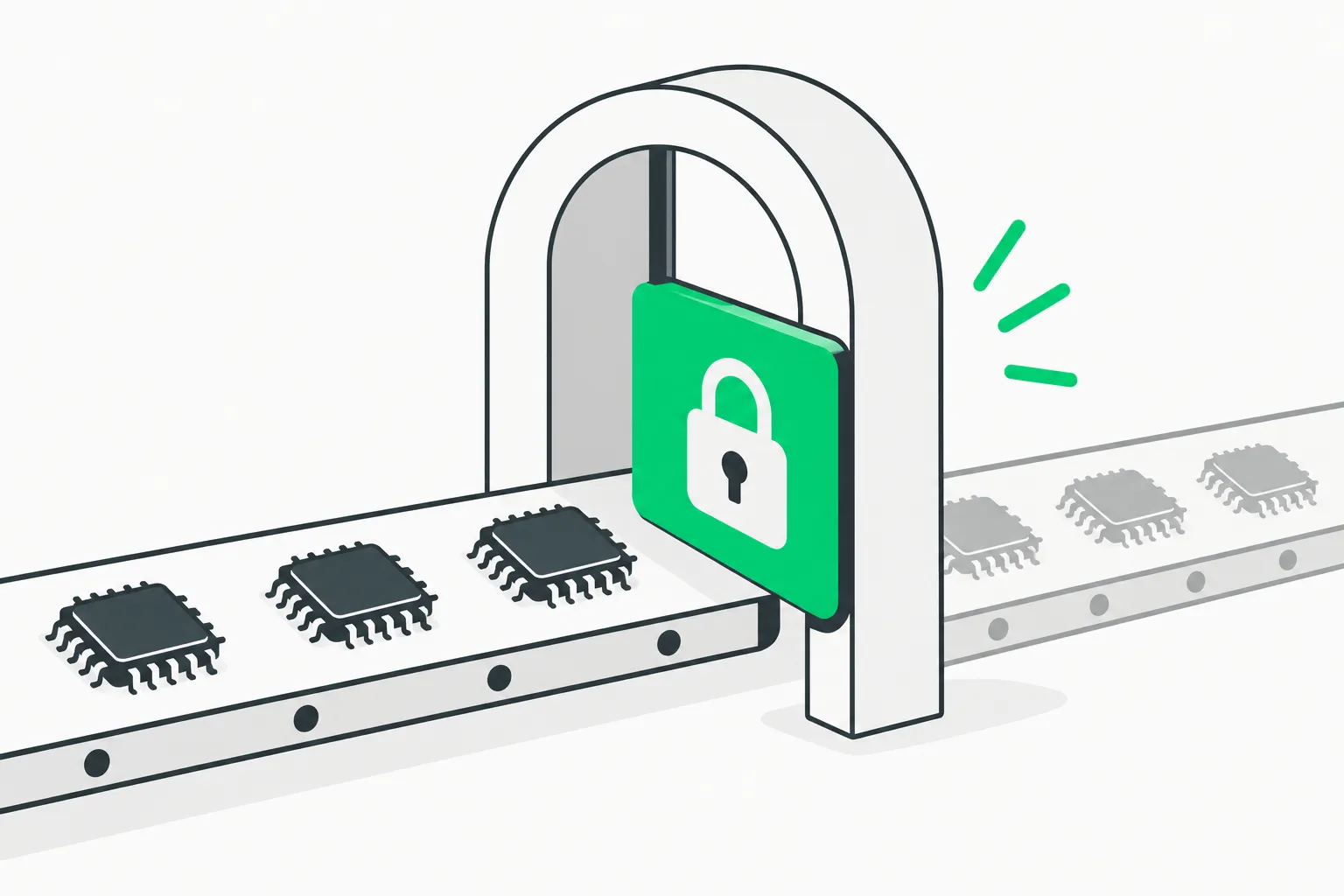 Export controls as a gate on semiconductor shipments
Use this table when a vendor quotes China-accessible Blackwell or Hopper capacity:
| Step | What to request | Why it matters |
|---|---|---|
| 1. Classification | ECCN or vendor SKU sheet | Confirms whether the part is license-controlled |
| 2. License ID | BIS approval number and date | Separates legal Channel from gray market |
| 3. Chain of custody | OEM → integrator → end user invoices | Taiwan indictments allege broker falsification |
| 4. Import approval | Chinese customs release if claimed delivered | Reuters has reported licensed H200 units stuck awaiting Beijing |
| 5. Physical audit | Serial photos and NVLink topology | Post reporting says vendors could not always prove B300 authenticity |
Skipping step five is how teams end up paying moon prices for relabeled H100s or empty chassis — a recurring scam pattern in Hong Kong stockpile reporting.
Timeline: from export liberalization to bazaar quotes
Understanding the November 25 story requires the December 2025 policy pivot when Trump said H200-class sales could restart for approved Chinese customers with a U.S. revenue share, per CNBC's December 8 coverage. That opened a licensed lane distinct from Blackwell, which White House spokeswoman Karoline Leavitt said remained off the table.
By May 2026, House Foreign Affairs released data showing 879,000 license approvals versus 3.4 million requests — explainx.ai mapped the figures in Mast's license post. Nvidia told CNBC it stopped H200 shipments even after approvals, citing Beijing friction.
The Post piece adds November 2026 color: open negotiation for B300 boxes near diplomatic venues, implying enforcement lag rather than a single policy dial.
Regional enforcement threads readers confuse
Malaysia, Singapore, and Taiwan appear repeatedly in smuggling coverage — including Malaysia Megaspeed entity-list action and Singapore routing investigations. None of those replace Shenzhen street reporting, but together they show multi-hop paths traders use after direct U.S.–China lanes tighten.
California's attorney general also opened Nvidia investor and China disclosure probes, meaning public companies face state pressure even when federal licenses exist.
What buyers outside China should infer
Street $3M B300 quotes do not mean U.S. list prices collapsed. They signal risk-adjusted scarcity inside a market that still builds TSMC-backed domestic alternatives and Huawei custom HBM roadmaps.
For ML engineers, the operational lesson is simpler: never benchmark on mystery silicon. Mismatched firmware, thermal throttling, or counterfeit boards can invalidate weeks of training comparisons — even when the purchase cleared internal finance.
Why street prices moved faster than policy
Export controls update on quarterly political clocks; bazaar prices update when headlines scare supply. The Post narrative places Huang's personal scandal and Trump–Xi optics beside vendor quotes, suggesting risk premia — not new fabs — drive the $3M+ tags.
Builders outside China should not infer global GPU deflation from those numbers. U.S. buyers still face B300 lead-time claims and Asia neocloud remarketing in legitimate channels.
Questions security and finance teams should ask leadership
CSOs hearing about Huaqiangbei B300 offers should schedule a 30-minute drill:
- List every GPU cluster whose ownership chain includes Hong Kong, Shenzhen, or Singapore brokers.
- Compare serial numbers against OEM shipment disclosures when available.
- Review employee travel policy — some firms ban carrying evaluation boards through CN hubs.
CFOs should separate CapEx for legitimate U.S. purchases from anecdotal CN pricing used in investor slide decks. The Post story is qualitative evidence of parallel markets, not a price index.
Policy staff can map the article to Wyden–Neal investigation timelines and Speaker Johnson statements to see whether bipartisan pressure accelerates after photo-driven reporting.
Ding Huang-era optics without mixing unrelated scandals
Yang's Post piece situates vendors near diplomatic meetings while Huang's reinstatement dominates U.S. headlines. Readers should not infer causation — no vendor quoted a direct link — but media coupling can still move short-term ask prices when buyers speculate about policy relief.
Separate threads — Alice Huang collateral reporting and Megaspeed probes — belong in compliance training, not hardware RFPs.
If you are documenting GPUs already deployed in Asia
Teams running inference at the edge in APAC should log:
- Firmware hashes and driver versions monthly.
- Egress paths for model weights and telemetry.
- Contracts governing re-export if U.S. parent owns the silicon.
When Waymo-scale regulation shows governments impose kill switches, chip provenance audits become the infrastructure equivalent for cloud regions.
Reporting tips for journalists and researchers
If you are verifying the Post narrative independently:
- Photograph SKU labels and packaging vendors show, but do not purchase illegal shipments.
- Cross-check Alibaba and Tencent capex disclosures against claimed installed Blackwell counts.
- FOIA or committee requests for BIS enforcement actions since November 19 license dumps may lag street reporting by quarters — absence of public fines does not prove absence of diversion.
explainx.ai will amend this post when Commerce, Nvidia, or PRC regulators publish direct responses to Yang's November 25 story. Until then, treat Huaqiangbei quotes as signals to audit, not pricing inputs for legitimate procurement teams. Update internal vendor questionnaires to ask about Blackwell-class silicon explicitly.
Last updated: November 25, 2026