



About 600,000 of Nvidia's H200 AI chips are stored in Hong Kong awaiting shipment to mainland China, according to a Reuters exclusive published November 5, 2026. Two people familiar with the matter told Reuters that Beijing is withholding approval for large-scale imports even though Chinese technology firms want the chips. The size of the stockpile had not been reported before, Reuters said in the syndicated text.
This post lays out what Reuters reports, how it fits with earlier accounts, what the price numbers mean, and what no one has confirmed. It is a story about compute supply being squeezed between two governments, which shapes which models China can train and what they cost.
TL;DR: the story in one table
| Question | Answer | Source |
|---|---|---|
| How many H200 chips are in Hong Kong? | About 600,000 | Reuters, two people familiar |
| Has China approved bulk imports? | No, not large-volume imports into the mainland | Reuters |
| Has any H200 reached China? | Yes, some. Several major internet firms each got about 10,000 in recent months | Reuters, one person |
| Other routes? | Small quantities via intermediaries and indirect routes | Reuters, three people |
| What does a server cost? | More than 6 million yuan (about $900,000) for eight cards by end of October | Reuters, one person |
| Did officials or companies comment? | MIIT and NDRC did not respond. Nvidia, Alibaba, ByteDance, DeepSeek and Tencent did not respond | Reuters |
What does Reuters report?
The central claim is the stockpile: about 600,000 H200 chips stored in Hong Kong, waiting for a decision from Beijing. Reuters says the number reflects Beijing's reluctance to increase reliance on US technology, at the same time as Chinese companies need advanced Nvidia compute to meet surging AI demand.
Reuters also reports that China has let some chips through. Three people said so. One of them said several major Chinese internet companies have each obtained about 10,000 H200 chips over the past few months. Three people said small quantities arrived through intermediaries and indirect routes, without giving numbers.
The H200 is not Nvidia's newest processor. Reuters notes it has capabilities Chinese alternatives have yet to match, which makes it useful for training AI models, especially with Nvidia's software stack.
How does this fit the earlier timeline?
The H200 has swung between allowed and blocked more than once in 2026.
- Before 2026: US export controls since 2022 have tried to limit China's access to advanced Nvidia chips and chipmaking equipment. Reuters says the US barred H200 exports to China, then the Trump administration gave Nvidia permission last year to sell to approved Chinese customers after trade negotiations.
- January 2026: Press reports said Chinese customs agents were told not to let H200 imports through, which amounted to a de facto block at the time. We could not cite a clean primary copy of that report, so treat the January detail as secondhand.
- July 2026: Reuters cites The Information reporting that Chinese officials told companies including Alibaba, ByteDance and DeepSeek they could receive permission to buy limited quantities for training. Total approvals could be under 200,000 chips, and Beijing wanted firms to prioritize Chinese processors for inference, the task of running models.
- August 2026: Investing.com's live desk summarized an FT report that ByteDance and Tencent each got roughly 10,000 chips, that Beijing told firms to keep most holdings in Hong Kong, that the total was estimated around 500,000, and that Hong Kong lacks data center capacity to deploy them fully.
- November 5, 2026: Reuters puts the Hong Kong stock at about 600,000 and says bulk mainland imports remain unapproved.
The two figures, 500,000 in August and 600,000 now, come from different outlets and different anonymous sources. They are consistent in direction, but they are not the same measurement.
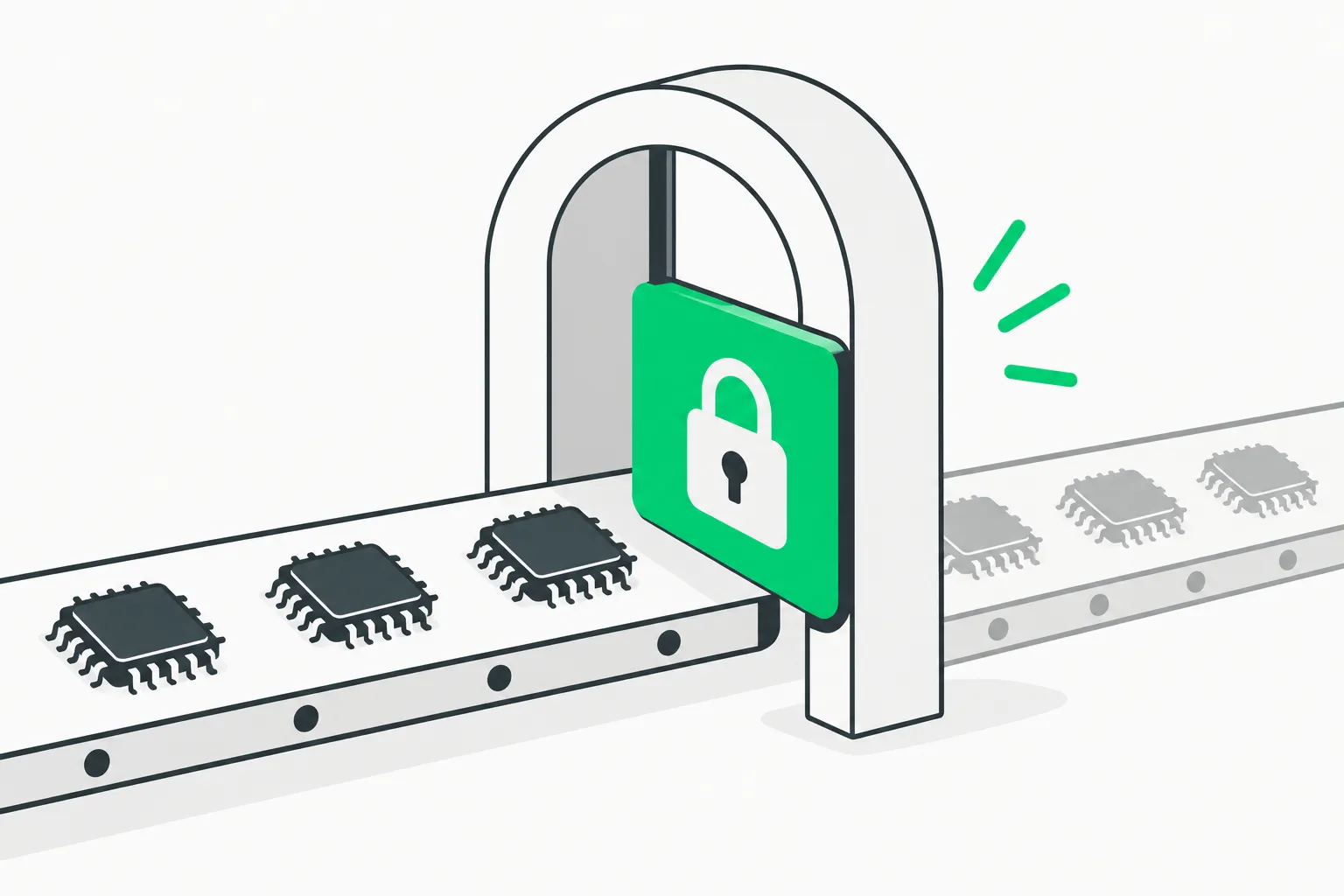 Export controls gate letting only a limited stream of chips through, as in the Nvidia H200 China import dispute
What do the prices tell us?
Reuters gives the sharpest numbers on the unofficial market. An eight-card H200 server was offered in mainland China for more than 6 million yuan ($900,000) by the end of October. One person said that is about three times its price a year earlier. Servers using Nvidia's newer Blackwell chips, which fall under US export controls, were offered for more than 20 million yuan each.
Read these as a single source's report of offers, not official list prices. They show strong scarcity at the margin. When authorized supply is capped, buyers pay for intermediaries, and the premium rises.
How does this connect to other chip stories we followed?
Several recent stories point the same way.
Reuters reported last month that ByteDance, Alibaba and Tencent ordered more than 3 million Nvidia RTX Pro 5500 graphics cards, a less powerful export-compliant product, with a combined sticker price above $35 billion. We covered it in our post on the RTX Pro 5500 orders. If Chinese firms can only get limited H200 volume, volume purchases of lower-tier cards are a rational fallback.
Domestic alternatives are another path. We checked Iluvatar's claim that its Tiangai 300 matches the H200, and looked at DeepSeek and Huawei chip co-design. On market share, see our analysis of the IDC Nvidia vs Huawei split.
On the US side, we covered remote access rules and chip export controls and a B300 smuggling case in Taiwan, which show the pressure on gray-market routes.
Why would Beijing hold chips in Hong Kong?
Reuters offers one explanation: reluctance to increase reliance on US technology. The earlier reporting adds a second angle. If Beijing wants companies to use Chinese processors for inference, it can allow H200s only for training and cap the volume.
Neither explanation has been confirmed by the ministries involved. MIIT and NDRC did not respond to Reuters, and we found no official statement. Any account of Beijing's intent is the sources' reading, not policy text.
Hong Kong storage itself is also not proof of intent. The FT account in August said the city lacks data center capacity to run the chips, so physical limits and policy may both play a role. We cannot separate them from the public record.
Training versus inference: why the split matters
The reporting keeps returning to a distinction between two jobs. Training builds a model from data and needs large, tightly connected clusters. Inference runs a finished model for users and can be spread over many smaller machines.
Reuters says the H200 is useful for training in particular, because Chinese alternatives have yet to match its capabilities, especially when paired with Nvidia's software. The earlier report Reuters cites from The Information says Beijing wanted firms to prioritize Chinese processors for inference. Put together, the likely shape of any approval is narrow: some H200s for training runs, domestic chips for serving.
That shape would fit the facts reported so far. Limited inflows of about 10,000 chips per large firm are enough for a serious training job but small next to the 600,000 in storage. A bulk approval would change the balance. It would let Chinese labs build clusters in the hundreds of thousands of accelerators, which is the scale where frontier training becomes feasible.
It would also change the market for the domestic suppliers we have covered. If H200s flow freely, buyers have less reason to take a risk on newer Chinese accelerators. If they do not, the pressure to make domestic chips work grows. This is why the stockpile figure matters beyond Nvidia's sales: it is a measure of how much compute Chinese labs could add the day a decision comes.
Two cautions apply. First, none of this is confirmed policy; it is how sources describe Beijing's thinking. Second, the capacity limit reported in August still applies. Moving chips out of storage is only useful if there is power, cooling and floor space to run them, and Hong Kong's data center capacity was described as limited.
What does this mean for AI builders?
For people comparing Chinese models: Training compute inside China is capped by both US licensing and Beijing's approvals. Claims about cluster sizes should be read against that. A lab saying it has a large H200 cluster may be counting chips that sit outside the mainland.
For people buying or renting GPUs: The unofficial price is a signal that demand is outrunning permitted supply. It is not a price you can buy at, and buying through intermediaries carries legal and supply-chain risk.
For people tracking chips and policy: Two governments now gate the same chip. A US license does not mean delivery. A Chinese customs rule can wipe out a US approval.
For model watchers: If H200 volume stays limited, expect more reporting on Chinese labs training on domestic accelerators and on cost-saving model designs. We will cover those as they appear.
What is confirmed and what is not
| Item | Status |
|---|---|
| About 600,000 H200 chips in Hong Kong | Reuters, two anonymous sources; not confirmed by Nvidia, Beijing or Chinese firms |
| Several firms each got about 10,000 | One anonymous source in Reuters; consistent with the earlier FT account |
| Beijing has not approved bulk mainland imports | Three-plus anonymous sources; no official statement found |
| Eight-card server over 6 million yuan | One person's report of offers |
| Beijing's reasons | Interpretation by sources; no official statement |
| Exact date chips arrived in Hong Kong | Not reported |
How to check this yourself
- Read the Reuters text and note which claims carry one source and which carry several.
- Look for statements from China's Ministry of Industry and Information Technology and the National Development and Reform Commission. None had appeared in the sources we reviewed.
- Watch Nvidia's next earnings call for any mention of China H200 revenue.
We will update this post when an official statement, a company comment, or a new count appears.
Related reading
- ByteDance, Alibaba and Tencent order 3 million RTX Pro 5500 cards
- Iluvatar Tiangai 300 vs Nvidia H200: claimed vs verified
- DeepSeek and Huawei chip co-design
- Nvidia vs Huawei China AI chip share
- Chip export controls and remote access
- Taiwan B300 smuggling and export controls
Details are accurate as of November 5, 2026. Figures come from anonymous sources and may change.