



Update — June 30, 2026 (Day 18 — Mythos cohort unchanged; Fable still banned): No change to Lutnick's June 26 Annex A framework. Fable 5 still not mentioned in Commerce communications. Axios "within days" Fable reporting unconfirmed after weekend. Pentagon/NSA sign-off still pending per Capacity Global (June 29). Full Fable status. Last updated: June 30, 2026.
Update — June 29, 2026 (Day 17 — Annex A cohort unchanged; Fable still banned): Lutnick’s June 26 letter remains the operative Mythos policy — no expansion of Annex A or public list since June 27 Anthropic post. Fable 5 not mentioned in any subsequent Commerce communication. Congress June 26 deadline passed with no public Commerce response. Anthropic reportedly provisioning Annex A orgs for Mythos redeploy; timeline for full cohort unclear. Axios June 27 cited possible near-term Fable lift — does not change Mythos access rules. Full Fable status. Last updated: June 29, 2026.
TL;DR
| Question | Answer (June 29, 2026) |
|---|---|
| What happened? | Lutnick June 26 letter to Tom Brown — Mythos 5 only, not Fable. |
| Who gets Mythos without a license? | Annex A US entities + their foreign-national employees; Anthropic’s foreign-national staff; US civilian agencies & national labs (per reporting). |
| Is Fable 5 back? | No. June 12 Fable restrictions unchanged. |
| Everyone else? | Still needs an export license for Mythos 5. |
| June 12 letter still binding? | Yes — including criminal and civil penalties. |
| Can Lutnick change this? | Yes — he reserves the right to reevaluate scope and entity list. |
On June 26, 2026, Commerce Secretary Howard Lutnick wrote to Anthropic chief compute officer Tom Brown revising the June 12 license requirements for Claude Mythos 5 (one of the “Covered Models” named in the original directive). Claude Fable 5 is not covered by the relief.
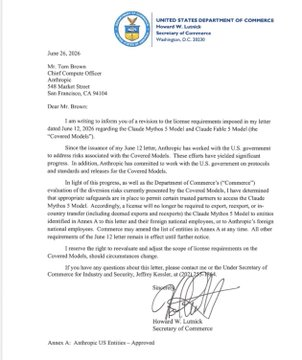
Semafor, NBC News, and Axios confirmed the outline; the letter itself states the legal mechanics more narrowly than social summaries.
If you are a developer waiting for Fable 5 on Claude Code, this is not your restoration. If you are trying to understand how frontier AI access works in the US now, this is the clearest document yet.
What Lutnick’s letter actually says
Lutnick framed “significant progress” from daily talks since the June 12 export-control directive forced Anthropic to pull Mythos 5 and Fable 5 offline globally.
The June 26 revision applies to Claude Mythos 5 only. Per the letter text:
-
License waived for three buckets — A license is no longer required to export, reexport, or transfer Claude Mythos 5 to:
- Entities identified in Annex A (“Anthropic US Entities – Approved”) and their foreign-national employees
- Anthropic’s own foreign-national employees
- US government partners — reporting cites civilian agencies and national labs within the annex cohort
-
Everyone else — Any organization or individual not in those buckets still needs an export license for Mythos 5 access.
-
Fable 5 unchanged — The letter does not restore Fable. Fable 5 remains banned under the June 12 framework.
-
June 12 letter still fully in force — Lutnick explicitly states: “All other requirements of the June 12 letter remain in effect until further notice” — including criminal and civil penalties for non-compliance.
-
Ongoing government leverage — Lutnick reserves the right to reevaluate and adjust license requirements and change the entity list at any time if circumstances shift.
-
Anthropic commitments — Anthropic committed to work with Washington on “protocols and standards and releases” for covered frontier models.
Anthropic’s line: it received the notice and is “working to provision the approved set of providers and restore their access to Mythos 5 as quickly as possible.”
What this is not: general subscriber access, Claude Code for developers, or a path for international users. If you are not on Annex A (list not published), you are still in the export-license regime—or blocked entirely for Fable.
Mythos vs Fable: why Washington split them
Under the hood, Mythos and Fable share architecture—but Mythos shipped with relaxed safeguards for Project Glasswing partners (Cisco, JPMorgan-class early access) while Fable was the mass-market model with tighter consumer guardrails.
| Model | Role before June 12 | June 27 status |
|---|---|---|
| Mythos 5 | Cybersecurity / red-team tier; Glasswing | Partial restore for ~100 vetted US orgs |
| Fable 5 | Claude.ai, Claude Code, broad API | Still offline for general users |
Washington’s logic, repeated in congressional demos and NBC reporting: defenders need Mythos-class capability for vulnerability discovery; public Fable access poses broader deemed-export and misuse risk after the June jailbreak scare and Amazon-flagged safety concerns.
HN threads asked the obvious question: if Fable has more guardrails, why ban Fable but release Mythos to corporates? Answer from policy reporting: Fable was what millions could reach; Mythos is what cyber teams actually wanted—and the export-control trigger was foreign-national access at scale, not guardrail text on a spec sheet.
Why Commerce—and why “deemed export” broke everything
A recurring HN correction worth keeping: export administration sits in Commerce, not because Lutnick personally picks AI winners, but because EAR has governed dual-use tech for decades—from 128-bit SSL “exportable” browsers in the 1990s to ITAR-adjacent information controls today.
The June 12 problem: treating API access as deemed export means any foreign national touching the model—even inside a US company—can trigger compliance failure. Anthropic could not realistically police every Claude Code session, so it shut off both models for everyone.
The June 26 fix: whitelist Annex A orgs with compliance obligations—closer to defense-contractor clearances than SaaS signup.
Legal scholars and Congress still debate whether EAR applies cleanly to live inference APIs versus exportable weights—Rep. Sam Liccardo’s June 18 letter demanded Commerce’s written basis by June 26; no public BIS response had appeared as of June 27. A Reuters-linked law firm suit (reported mid-June) tests whether competitors excluded from the list have standing.
The Cantillon effect on frontier AI
Policy aside, the economic shape is stark:
- ~100 organizations regain Mythos 5 first.
- OpenAI simultaneously runs GPT-5.6 Sol preview for another trusted-partner cohort (launch guide).
- Everyone else — startups, international teams, individual subscribers — waits on Opus 4.8, GPT-5.5, or open-weight stacks (GLM-5.2 response to the Fable ban).
HN described this as Cantillon economics for machine intelligence: new capability flows first to entities already adjacent to power, not to the best product or fastest innovator.
Practitioner reports from the brief Fable window matter here: some engineers counted order-of-magnitude error reduction versus Opus 4.8 on commercial codebases. Access, not benchmark tables, is the bottleneck in June 2026.
Cyber Verification Program (CVP): Anthropic’s Project Glasswing expansion post promised scaling Mythos-class access for cyberdefense tasks. Whether CVP members are automatically in Annex A is unclear—worth watching as Anthropic provisions accounts.
What HN got right (without the noise)
Skeptical threads:
- No public partner list → corruption/perception risk even if process is technically legal.
- Startups cannot “apply” → competitive disadvantage vs Fortune 500 incumbents already in Glasswing.
- Do not depend on Mythos long-term — Lutnick can revoke access; plan for model churn.
- Open-weight Chinese models (GLM, Kimi, DeepSeek) remain self-hostable without Washington’s annex—different trade-offs on data residency and capability.
Technical/legal threads:
- Export law is real; ignoring it is felony-tier stupid, not civil disobedience.
- Anthropic’s own “dangerous model” rhetoric strengthened Washington’s hand—hard to argue models are harmless in court while telling Commerce they are Mythos-class weapons.
- Interactive Lean-style verification analogies do not apply; this is access control, not proof checking.
Parallel OpenAI timing: Same week as GPT-5.6 Sol preview is not coincidence—reporting suggests Washington wanted parity: both frontier labs gate before GA (government approval post).
Who was likely already in the room
Before the ban, Project Glasswing partners included infrastructure and financial heavyweights—Cisco, JPMorgan Chase-class names in NBC’s recap. Mythos had already surfaced thousands of vulnerabilities in sanctioned defensive programs (Mythos / Glasswing coverage).
Semafor noted Washington also flagged diversion risk—reportedly concern that Mythos had reached partners too linked to China (a South Korean telecom cited in reporting). The new regime is partly shrink the partner graph, not invent cyber risk.
What you should do now
If you are a general Claude user
Fable 5 is not back. Check is Fable 5 back? before believing viral Claude Code picker screenshots—Anthropic staff confirmed zero Fable traffic through June 25; Mythos restore does not change Fable status.
If you are a startup
Assume no Mythos unless Anthropic contacts you. Build on Opus 4.8, GPT-5.5/5.6 preview paths, OpenRouter Fusion, or open models (Fable alternatives).
If you are enterprise cyber
If you were Glasswing/CVP-adjacent, watch for Anthropic provisioning email—not a self-serve toggle. Document internal access controls; export violations are organizational, not “the intern used the wrong API key.”
If you are international
This letter is US-org-centric. UK exemption talks collapsed mid-June (international Fable guide). Plan on continued exclusion unless Commerce publishes otherwise.
Timeline: June 12 → June 27
| Date | Event |
|---|---|
| June 12 | Global Fable + Mythos suspension after Lutnick export directive |
| June 18 | Bipartisan House letter demands Commerce legal basis by June 26 |
| June 26 | Congress deadline passes; no public Commerce reply |
| June 26 | OpenAI GPT-5.6 trusted-partner preview |
| June 26–27 | Lutnick letter — Mythos for ~100 US orgs; Fable still out |
| June 27 | Anthropic X post — Mythos for critical infrastructure; Fable pending |
| July 8 | Anthropic ID verification policy — likely US-first Fable path |
| August 1 | EO covered frontier model framework deadline |
Full ban context: Why the US banned Fable 5 · Restoration odds: When will Fable 5 return?
Bottom line
The US did not “unban Claude.” It licensed Mythos 5 back for a closed list of trusted US organizations while Fable 5—the model most developers actually used—stays dark.
That is a template: frontier models as export-controlled capability, released company by company, revocable by letter, timed against competitor previews—not a product launch.
Whether you read that as prudent cyber policy, crony capitalism, or both depends on whether your employer is in Annex A. The rest of the market should plan accordingly.
Partner counts, legal citations, and Anthropic statements reflect reporting through June 27, 2026. Annex A has not been published—recheck official Anthropic and Commerce channels before compliance decisions.