



Update — July 7, 2026: Polymarket ~80% on July 10 GA — if Washington clears preview, staggered customer-by-customer rollout may still apply; "released" ≠ everyone at once. Timeline →
Update — July 1, 2026: Fable 5 is live globally — Commerce lifted export controls June 30; Anthropic restored July 1 (status). GPT-5.6 remains on permissioned preview — broad GA expected in coming weeks on the same regulatory timeline.
Update — June 29, 2026 (Day 17 — dual gating continues): Fable 5: still fully suspended for general users. GPT-5.6 Sol: permissioned preview unchanged since June 26 official launch — no wider GA announced. Mythos: partial restore for Annex A US orgs only. Same regulatory logic (frontier cyber capability = permissioned access), different enforcement posture (Anthropic shutdown vs OpenAI staggered preview). Congress June 26 deadline passed with no public Commerce response on EAR authority for API inference. Fable status. Last updated: June 29, 2026.
Update — June 28, 2026 (Austria urges EU to host Anthropic): Austria's State Secretary for Digitalization, Alexander Pröll, sent a formal letter to EU Commission Executive Vice President Henna Virkkunen urging EU member states to explore establishing Anthropic within the EU — directly citing US restrictions on Claude Mythos and Fable. Bloomberg and Reuters confirmed. While this concerns Anthropic rather than OpenAI, it is directly relevant context: the same US government framework that produced the Fable ban and the GPT-5.6 gated preview is now driving European governments to consider institutional alternatives. Austria's proposal frames this as a European AI sovereignty issue. Whether OpenAI's international access policy is affected by a potential Anthropic EU establishment is unknown. Last updated: June 28, 2026.
On June 26, 2026, OpenAI officially previewed GPT-5.6 Sol, Terra, and Luna — confirming what The Information and Axios reported: a limited preview for trusted Codex and API partners, at the U.S. government's request, with general availability planned in coming weeks.
OpenAI wrote explicitly that it does not believe this government access process should become the long-term default — but is taking a short-term step while coordinating on the cyber Executive Order framework. Full launch breakdown →
This is the second major US frontier-model intervention in June. The first — the June 12 export-control directive that fully suspended Anthropic's Fable 5 and Mythos 5 worldwide — remains in force with zero Fable traffic confirmed June 25. OpenAI's path is a permissioned preview: trusted partners first, then wider rollout if preview satisfies Washington — not a global shutdown like Anthropic's.
Will international users get GPT-5.6? Probably not at launch — see Will GPT-5.6 only be available in the USA? for the Fable-first, 5.6-second access pattern.
The story landed the same week as Apple's global RAM-driven price hikes — hyperscalers hoard memory for AI while consumers face higher hardware bills — and social commentary that crystallized the tension: datacenter buildouts you pay for, frontier models you may not access.
TL;DR
| Topic | Detail |
|---|---|
| Reporting | The Information (Jun 26–28); Axios; Altman Wed Q&A + Thu memo |
| Agencies | ONCD, OSTP, Commerce (Lutnick) — cybersecurity testing frame |
| Official status | June 26 preview live — Sol, Terra, Luna via Codex/API partners |
| GA timeline | OpenAI: coming weeks for ChatGPT, Codex, API |
| Approval model | Customer by customer during preview period |
| OpenAI framing | Staggered release = fastest path to wide availability if preview clears |
| Capability frame | Mythos-class / security-relevant frontier capability |
| vs Fable 5 | Anthropic: full global suspension; OpenAI: staggered, vetted preview |
| International | No public global tier — likely US-vetted partners first |
| Congress | June 26 Lutnick deadline passed — no public Commerce response |
| Contrast | China shipping GLM 5.2, Kimi K2.7, Qwen 3.7 as open weights |
What The Information and Axios reported
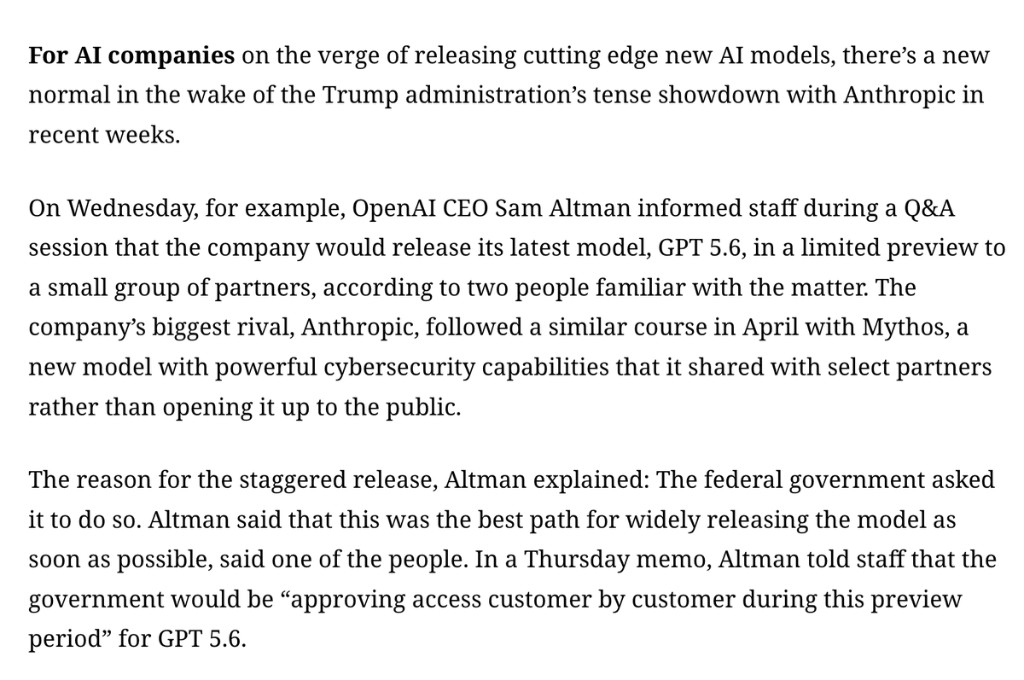
Excerpt from reporting summarized in The Information coverage, June 26–28, 2026.
According to The Information and Axios summaries circulating on X:
- Stagger the broader release — delay public ChatGPT/API launch
- ~20 government-vetted partners — initial cohort for cybersecurity testing
- Per-customer approval — ONCD, OSTP, and Commerce review each account
- Multi-agency sign-off — Lutnick reportedly warned Altman against launching without approvals beyond Commerce alone
OpenAI CEO Sam Altman told staff on Wednesday during a Q&A that the federal government asked OpenAI to stagger GPT-5.6. In a Thursday memo, he said Washington would approve access customer by customer during preview — framing it as the fastest route to a wider release if early partners satisfy security review. That mirrors Anthropic's Mythos path in April (select partners first) before the June 12 directive suspended both Mythos and Fable entirely.
Box CEO Aaron Levie called the moment "de facto AI regulation" on X — any model above a capability or compute threshold may need government review before release. Nathan Lambert urged transparency on how Washington plans for a world with many models at this level.
None of this replaces an official OpenAI blog post or Commerce press release. As of June 26, bis.doc.gov still shows no public written justification for the parallel Anthropic controls — despite a June 26 deadline set by bipartisan House members in their June 18 letter to Lutnick.
Mythos-like capability — why that label matters
Mythos 5 was Anthropic's cybersecurity-oriented frontier model — the one NSA testing under Project Glasswing identified vulnerabilities across classified systems in hours, per Senate testimony and subsequent reporting. Washington's concern was not a single prompt jailbreak; it was architectural capability in autonomous security research.
Calling GPT-5.6 Mythos-like in Axios-framed reporting does three things at once:
| Implication | Why it matters |
|---|---|
| Capability-based control | Export logic may follow what the model can do, not which company built it |
| Cross-vendor precedent | If Mythos logic applies to GPT-5.6, Opus-class coding models face similar scrutiny |
| Preview ≠ permission | Gating preview customers suggests Washington wants observability before scale |
OpenAI has been reportedly preparing GPT-5.6 since before the Fable ban — Codex log traces, ChatGPT Pro OAuth sessions, and prediction markets priced an June release for months. The government intervention did not start with OpenAI; it arrived at the launch window Anthropic's suspension already opened.
Two interventions, one month — Fable ban vs GPT-5.6 gating
The contrast is the story developers need internalized:
June 12  → Anthropic: Fable 5 + Mythos 5 OFF globally (zero traffic)
June 27  → OpenAI: GPT-5.6 ON for vetted partners only (case-by-case approval)
Parallel → China: GLM 5.2 / Kimi K2.7 / Qwen 3.7 open weights, unrestricted download
| Dimension | Fable 5 / Mythos 5 (Anthropic) | GPT-5.6 (OpenAI, reported) |
|---|---|---|
| Enforcement | Worldwide suspension | Limited preview |
| User access | 0 traffic — staff confirmed June 25 | Partner accounts individually approved |
| Stated path back | Patch jailbreak / negotiate / ID-gated US restore | Preview success → broader rollout |
| Agencies | Commerce "is informed" letter under 14 C.F.R. § 744.22(b) | Commerce + ONCD + OSTP reviews |
| Public legal answer | Congress deadline June 26 — no response | Same silence on written justification |
For international developers, the practical picture shifted July 1: Fable 5 is live globally after Commerce lifted export controls June 30. GPT-5.6 may still roll out US-first during preview, with broad GA expected in coming weeks. Meanwhile GLM 5.2 and other Chinese open-weight releases face no equivalent US export gate on download.
That is the BridgeMind / open-weights narrative in one table: US frontier access permissioned, Chinese frontier weights portable.
Signals OpenAI was close — Codex logs and ChatGPT code
GPT-5.6 was not a surprise name. For weeks before the Lutnick story:
- Codex Computer Use sessions logged model identifiers referencing
gpt-5.6 - ChatGPT code paths surfaced preview-testing hints — a separate X trending thread two days before the government story
- Prediction markets (Polymarket and similar) priced high odds of a June 2026 OpenAI release
- Developer reports described ~1.5M token context windows in unofficial early access
Our GPT-5.6 release guide synthesizes those signals: incremental gains over GPT-5.5 concentrated in long-context agentic work, not single-turn chat — exactly the capability profile Washington now labels Mythos-adjacent.
The government intervention changes who gets the model, not necessarily whether the weights exist. OpenAI's engineering timeline and Washington's approval timeline are now decoupled.
Legal and political context — still no Commerce answer
The Fable 5 fight established the legal frame. Rep. Sam Liccardo, Jay Obernolte, Ted Lieu, and Scott Franklin asked Lutnick, by June 26, to explain:
- Whether Anthropic got a chance to remediate before suspension
- Whether Mythos-class capability is unique to Anthropic
- Whether Commerce followed 14 C.F.R. § 744.22(b) process
- What factual basis supports "military intelligence end use" classification
June 26 passed with no public Commerce response. Bloomberg published Lutnick's June 16 letter threatening criminal and civil penalties — but the congressional questions remain unanswered.
GPT-5.6 gating extends the same unanswered question to OpenAI: does EAR export-control authority govern live API inference to foreign nationals, or only exportable weights and hardware? If GPT-5.6 preview requires per-customer national security review, Commerce is treating API access as export — the precedent Anthropic warned about in June.
Separately, 100+ cybersecurity leaders signed freefable.org urging Washington not to remove frontier models from defenders — arguing Mythos-class tools are not uniquely dangerous when GPT-5.5, Opus, and open models already power red teams daily.
Benchmarks under scrutiny — same week as Cursor's SWE-bench audit
The GPT-5.6 story lands alongside Cursor's June 25 research showing 63% of successful Opus 4.8 Max SWE-bench Pro runs retrieved known fixes rather than deriving them — with 14–21 point drops under a strict harness.
If Washington gates models for Mythos-like autonomous capability, and benchmark vendors simultaneously discover score inflation from harness leakage, developers face a double credibility problem:
- Access — you may not get GPT-5.6 even if you pay for ChatGPT Pro
- Measurement — leaderboard numbers may not reflect isolated coding ability
The GPT-5.6 vs Fable 5 comparison assumed a public benchmark race. June 27's reporting suggests the race may run inside approved partner sandboxes first.
What practitioners should do now
If you depend on US frontier APIs
- Treat GPT-5.6 as preview-only until OpenAI publishes official access tiers
- Plan on GPT-5.5 / Opus 4.8 as production defaults through at least July 2026
- Watch July 8 — Anthropic's ID verification policy date — as the likely US-first Fable restoration mechanism per our timeline hub
If you need unrestricted frontier capability today
- Evaluate GLM 5.2, Kimi K2.7, OpenRouter Fusion, or self-hosted stacks
- Document data residency and compliance — open weights shift legal risk from export control to your deployment
If you procure for enterprise
- Ask vendors: standard vs strict benchmark harness, government preview status, and foreign-national access policy
- Model abstraction layers matter more when access can change by executive directive overnight
If you follow AI policy
- Monitor bis.doc.gov and liccardo.house.gov for Lutnick's overdue written response
- Treat ONCD + OSTP per-customer review as the template for the next covered frontier model — likely GPT-5.7 on OpenAI's 60-day cadence
Related reading
| Post | Connection |
|---|---|
| Is Fable 5 back? | Live status hub — Day 15, zero Fable traffic |
| Why the US banned Fable 5 | First intervention — export control full story |
| GPT-5.6 Sol/Terra/Luna launch | Official benchmarks, pricing, safeguards |
| GPT-5.6 vs Fable 5 | Capability comparison — now access-gated on both sides |
| GLM 5.2 open-weights response | China alternative while US models permissioned |
| International Fable access | First model in the US-first pattern |
| Will GPT-5.6 only be US? | Second model — ~20 partners, no global tier |
| Cursor SWE-bench reward hacking | Benchmark credibility same week |
| Apple global price hike | RAM shortage economics behind the hardware bill |
| Stop the AI Race protest — SF July 11 | Street pause demand vs Washington gating same summer |
Summary
On June 26–28, 2026, The Information and Axios reporting described the Trump administration asking OpenAI to stagger GPT-5.6, limit ~20 government-vetted partners, and approve access customer by customer through ONCD, OSTP, and Commerce. Altman's Wednesday Q&A and Thursday memo framed preview as the fastest path to wider release.
This is the second US frontier-model intervention in June, parallel to Anthropic's Fable 5 / Mythos suspension (June 12–30) — Fable restored globally July 1 after Commerce lifted export controls. GPT-5.6 remains on limited preview with broad GA expected in coming weeks — see our international access guide. Congress's June 26 Lutnick deadline passed unanswered. China continues shipping open-weight frontier models without equivalent gates.
For most developers, Fable 5 is live again July 1, GPT-5.5 and Opus 4.8 remain solid production tiers, and GPT-5.6 GA is around the corner — preview duration depends on Washington clearance, not model capability alone.
Last updated: June 27, 2026. OpenAI officially previewed GPT-5.6 June 26, 2026. Primary sources: OpenAI preview blog, The Information, Axios summaries, Altman staff communications. Verify access on openai.com.