



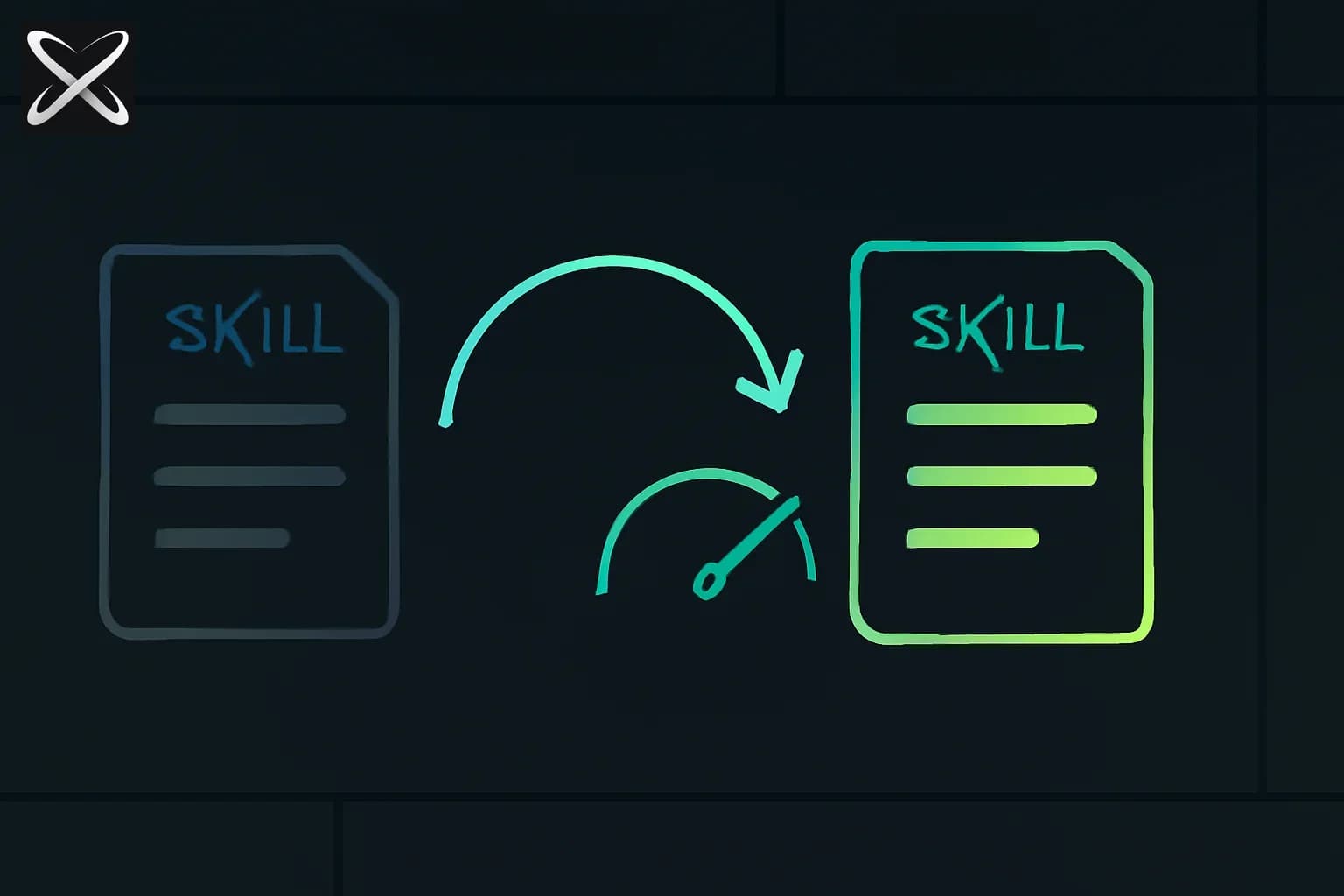
Microsoft's SkillOpt is a research breakthrough that enables self-improving AI agents by treating skill documentation as trainable external state rather than frozen prompts. If you landed here searching for "Microsoft SkillOpt", "self-improving AI agents", or "agent skill optimization", the short answer is: SkillOpt delivers +20 point accuracy improvements on production tasks, enables skills to transfer across Codex and Claude Code without retraining, and provides a systematic testing framework for agent skill evolution—moving agent development from handwritten prompts to mathematically optimized capabilities.
This article synthesizes the SkillOpt paper (Microsoft Research, May 2026), production deployment results from @omarsar0 (DAIR.AI), and community adoption patterns. Written for SEO + GEO with tables, implementation guides, and FAQ schema for rich results.
TL;DR — SkillOpt at a glance
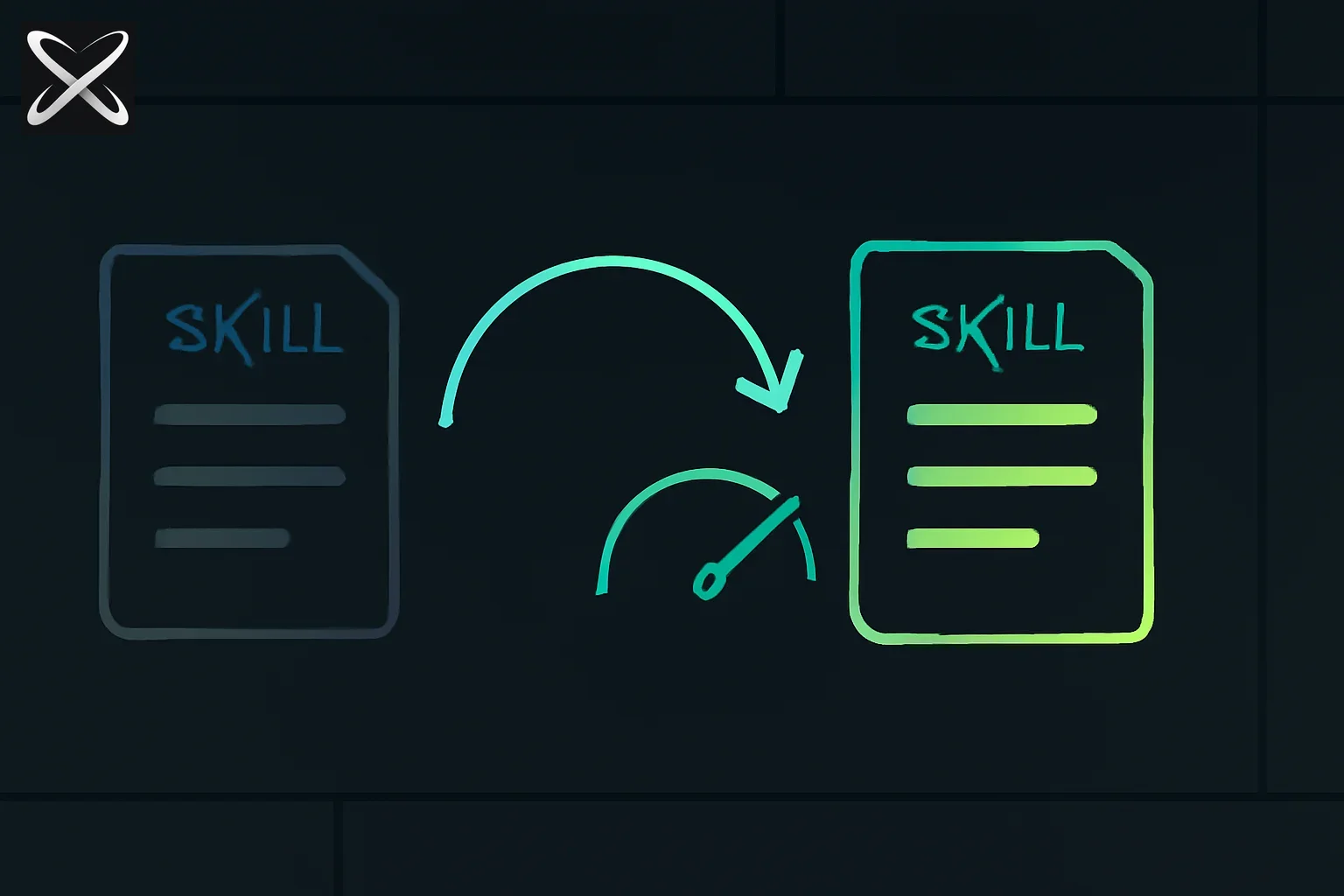 SkillOpt self-improving agent skills diagram: a flat skill document rewriting itself sharper with a rising accuracy gauge
| Aspect | Details |
|---|---|
| Core innovation | Treats skill docs as trainable state vs. static prompts |
| Performance gains | +20 points (0.73 → 0.93) on multimodal extraction tasks |
| Deployment efficiency | +23.5 points on GPT-5.5 with zero extra inference calls |
| Skill portability | Transfer across Codex, Claude Code without retraining |
| Optimization approach | Evaluation loops + automated skill refinement |
| Testing framework | Proper evals + self-evolution capability built-in |
| Production readiness | Already integrated by DAIR.AI and early adopters |
| Economic model | Optimize with frontier models, deploy on cheap 8B models |
| Paper source | Microsoft Research (May 2026) |
 SkillOpt framework diagram showing optimization loop
What is SkillOpt?
According to the Microsoft Research paper (May 2026) and @omarsar0's production deployment:
The core problem
AI engineers typically handwrite agent skill documentation and hope it generalizes across tasks. This approach:
- ❌ Requires manual iteration and prompt engineering expertise
- ❌ Produces skills that often don't transfer across contexts
- ❌ Lacks systematic testing and improvement methodology
- ❌ Results in inconsistent performance across tasks
SkillOpt's solution
Treats skill documentation as trainable external state of a frozen agent:
Traditional approach:
Human writes skill.md → Agent uses it → Performance varies

SkillOpt approach:
Seed skill.md → Evaluation loop → Optimized skill.md → Consistent performance
Key insight: Instead of treating agents as trainable and skills as static, SkillOpt inverts this: agents remain frozen (standard GPT-4, Claude, etc.), while skill descriptions are optimized through automated evaluation feedback.
How SkillOpt works
1. Skill representation
Skills are represented as structured markdown documents (skill.md) containing:
- Purpose: What the skill does
- Input/Output specifications: Data formats and types
- Execution strategy: Step-by-step approach
- Error handling: Edge cases and fallbacks
- Examples: Demonstration of correct behavior
2. Optimization loop
Initialize: Start with baseline skill.md
┌────────────────────────────────────┐
│ 1. Agent executes task using skill │
│ 2. Evaluate performance with evals │
│ 3. Generate improvement suggestions │
│ 4. Update skill.md based on feedback│
│ 5. Repeat until convergence        │
└────────────────────────────────────┘
Deploy: Optimized skill.md
3. Evaluation framework
SkillOpt requires proper evals that define "correct" for your use case:
- Task-specific metrics (accuracy, precision, recall)
- Output quality checks (format validation, completeness)
- Edge case handling (how well it handles unusual inputs)
- Performance benchmarks (speed, cost per execution)
4. Skill evolution
The framework enables continuous improvement:
- Agent failures feed back into skill optimization
- Skills learn from production errors
- Performance improves over time without model retraining
- Skills become more robust through exposure to edge cases
Production results — the numbers that matter
@omarsar0's deployment (DAIR.AI)
Multimodal paper-figure-extraction skill:
- Before SkillOpt: 0.73 accuracy
- After SkillOpt: 0.93 accuracy
- Improvement: +20 points (27% relative gain)
- Task: Extract tables and figures from research papers with multimodal analysis
Quote from @omarsar0:
"I went to see the extracted tables and figures, and I was absolutely stunned by how much better my skill got at the task."
GPT-5.5 direct chat performance
- Improvement: +23.5 points on benchmark tasks
- Deployment cost: Zero extra inference calls
- Key advantage: Performance gains without increased latency
Cross-platform skill transfer
- Optimized on: Codex
- Transferred to: Claude Code
- Retraining required: None
- Performance maintained: Yes
Implication: Optimize once, deploy everywhere.
Implementation guide
Step 1: Set up evaluation framework
Define what "correct" looks like for your skill:
# Example evaluation for code generation skill
def evaluate_skill(task_input, agent_output, expected_output):
    scores = {
        'correctness': check_correctness(agent_output, expected_output),
        'efficiency': measure_efficiency(agent_output),
        'style': check_style_compliance(agent_output),
        'edge_cases': test_edge_cases(agent_output, task_input)
    }
    return weighted_average(scores)
Key metrics to track:
- Success rate on task objectives
- Output quality (format, completeness, accuracy)
- Edge case handling
- Execution time and cost
Step 2: Implement SkillOpt loop
Basic structure:
from skillopt import SkillOptimizer

# Initialize with seed skill
optimizer = SkillOptimizer(
    agent=your_agent,  # e.g., GPT-4, Claude Opus
    seed_skill_path='skills/extraction.md',
    eval_function=evaluate_skill,
    optimization_budget=100  # number of iterations
)

# Run optimization
optimized_skill = optimizer.optimize(
    test_dataset=your_test_cases,
    validation_split=0.2,
    convergence_threshold=0.95
)

# Save optimized skill
optimized_skill.save('skills/extraction_optimized.md')
Step 3: Deploy optimized skills
Use optimized skill.md with any compatible agent:
# Deploy on cheap 8B model
from agent_runtime import Agent

agent = Agent(
    model='llama-3-8b',  # Cheaper deployment model
    skill_path='skills/extraction_optimized.md'
)

# Same performance as frontier model during optimization
result = agent.execute(task)
Step 4: Monitor and re-optimize
Set up continuous improvement:
# Track production performance
performance_tracker = PerformanceMonitor(
    skill_id='extraction',
    alert_threshold=0.85  # Alert if performance drops
)

# Trigger re-optimization when needed
if performance_tracker.recent_performance < 0.85:
    optimizer.re_optimize(
        production_failures=performance_tracker.get_failures(),
        incremental=True  # Only optimize problematic cases
    )
Use cases — where SkillOpt excels
1. Multimodal analysis tasks
Example: Document processing (papers, reports, contracts)
SkillOpt advantages:
- Optimizes extraction patterns for different document types
- Learns from failures on edge cases (tables, figures, footnotes)
- Transfers across document domains without retraining
Production result: +20 points on paper-figure-extraction (0.73 → 0.93)
2. Code generation and refactoring
Example: AI coding assistants (Codex, Cursor, Cline)
SkillOpt advantages:
- Optimizes coding patterns and best practices
- Learns project-specific conventions
- Improves over time from code review feedback
Production result: +23.5 points on GPT-5.5 coding tasks
3. Data extraction and transformation
Example: Web scraping, API parsing, data cleaning
SkillOpt advantages:
- Adapts to changing data formats
- Handles edge cases (missing fields, malformed data)
- Optimizes extraction strategies for efficiency
Use case: E-commerce product data extraction across multiple sources
4. Customer support automation
Example: AI support agents, chatbots, ticket routing
SkillOpt advantages:
- Learns from resolved vs. escalated tickets
- Optimizes response patterns for customer satisfaction
- Improves classification accuracy over time
Metric: Reduced escalation rate by optimizing triage skills
5. Research and analysis workflows
Example: Literature reviews, competitive analysis, market research
SkillOpt advantages:
- Optimizes search and filtering strategies
- Learns domain-specific relevance criteria
- Improves synthesis and summarization quality
Use case: Automated patent prior art search with SkillOpt-optimized skills
Comparison with alternatives
SkillOpt vs. Traditional prompt engineering
| Aspect | SkillOpt | Manual prompt engineering |
|---|---|---|
| Optimization | Automated evaluation loops | Manual iteration |
| Performance | +20 point gains documented | Highly variable |
| Transferability | Cross-platform (Codex → Claude Code) | Usually platform-specific |
| Testing | Built-in eval framework | Ad-hoc testing |
| Maintenance | Self-improving from failures | Manual updates required |
| Skill evolution | Continuous | Episodic |
SkillOpt vs. Fine-tuning models
| Aspect | SkillOpt | Model fine-tuning |
|---|---|---|
| Compute cost | Optimization phase only | Every deployment |
| Deployment | Standard models (GPT-4, Claude) | Custom model weights |
| Transferability | skill.md works across models | Model-specific |
| Iteration speed | Fast (eval loop only) | Slow (retraining required) |
| Deployment cost | Cheap (8B models) | Expensive (70B+ for quality) |
SkillOpt vs. Few-shot prompting
| Aspect | SkillOpt | Few-shot prompting |
|---|---|---|
| Context efficiency | Optimized skill.md (compact) | Examples in prompt (verbose) |
| Performance | +20 point gains | Moderate improvement |
| Scalability | Many skills without context bloat | Limited by context window |
| Maintenance | Self-evolving | Manual example curation |
The economics of SkillOpt
Optimization phase (one-time cost)
Use frontier models for optimization:
- GPT-5 / Claude Opus 4.5: Highest quality skill optimization
- Compute budget: 100-1000 optimization iterations
- Cost example: $50-500 to optimize a skill (one-time)
- Output: Mathematically validated skill.md artifact
Deployment phase (ongoing cost)
Deploy on cheap models:
- Llama 3.1 8B / Gemma 2 9B: Self-hosted or cheap API
- Cost: $0.0001-0.001 per inference (100-1000x cheaper than GPT-5)
- Performance: Maintains frontier-level capability for the specific skill
ROI calculation
Traditional approach (GPT-5 for every inference):
1M inferences × $0.01/call = $10,000/month
SkillOpt approach (optimize once, deploy on 8B model):
Optimization: $200 (one-time)
Deployment: 1M inferences × $0.0001/call = $100/month
Total year 1: $200 + ($100 × 12) = $1,400
Savings: $118,600/year (99% cost reduction)
Plus: Performance gains (+20-23 points) make this a no-brainer.
Implementation challenges and solutions
Challenge 1: Defining proper evals
Problem: "What does 'correct' look like?" is hard to specify.
Solution:
- Start with simple metrics (exact match, F1 score)
- Use agents to help write evals initially
- Iterate evals based on production failures
- Combine automated metrics with human review sampling
Challenge 2: Optimization compute
Problem: Running 100-1000 optimization iterations is expensive.
Solution:
- Use cheaper models (Claude Haiku, GPT-4o-mini) for optimization
- Implement early stopping when performance plateaus
- Parallelize evaluation across multiple tasks
- Cache intermediate results to avoid redundant work
Challenge 3: Skill transferability
Problem: Skills optimized on one agent might not transfer perfectly.
Solution:
- Optimize on the most capable model available
- Test transfer on target deployment model before production
- Fine-tune skill.md for target model if needed (usually minor)
- Use model-agnostic skill descriptions (avoid model-specific tricks)
Challenge 4: Production monitoring
Problem: Skills can degrade over time as data distributions shift.
Solution:
- Track performance metrics on production traffic
- Set up alerts for performance degradation
- Trigger re-optimization when thresholds are breached
- Log failures for targeted skill improvement
Community adoption and ecosystem
Early adopters
DAIR.AI (@omarsar0):
- Integrated SkillOpt into agent orchestrator
- Optimized multimodal extraction skills (+20 points)
- Building accessible packaging for wider adoption
- Experimenting with autonomous optimization on schedule
Production use cases:
- Paper-figure-extraction (academia, research)
- Multimodal document analysis (legal, finance)
- Agent skill testing frameworks (DevOps)
Ecosystem developments
Tooling:
- SkillOpt orchestrator integrations (LangChain, Autogen)
- Eval framework templates for common task types
- Skill marketplace for optimized skill.md artifacts
- Monitoring dashboards for skill performance
Research directions:
- Skill composition (combining optimized skills)
- Meta-optimization (optimizing the optimizer)
- Cross-domain skill transfer
- Skill knowledge distillation
Future implications
Self-improving agent systems
SkillOpt enables:
- Agents that improve from production errors
- Systematic skill evolution without human intervention
- Autonomous agent systems that adapt to new domains
- Scalable agent deployment (optimize centrally, deploy distributed)
Beyond skills — what else can be optimized?
Omar's vision (@omarsar0):
"It's not hard to imagine how this scales to optimizing agent patterns, tool use, context engineering efforts, agentic search, workflows, evals, and even the harness itself."
Potential extensions:
- Agent patterns: Optimize multi-agent coordination strategies
- Tool use: Optimize API calling patterns and parameter selection
- Context engineering: Optimize prompt structures and context windows
- Workflows: Optimize task decomposition and execution order
- Evals: Meta-optimize the evaluation functions themselves
- Harness: Optimize the agent runtime and orchestration layer
Economic disruption
SkillOpt changes AI economics:
- Decouples optimization cost from deployment cost
- Makes frontier-level capabilities affordable at scale
- Enables small teams to compete with large AI labs
- Shifts value from compute to skill optimization expertise
Critical perspectives
"This is just automated prompt engineering"
Counter: Yes, but that's the point. SkillOpt systematizes what was previously artisanal, making it repeatable and scalable. The +20 point gains speak for themselves.
"We still don't understand why it works"
Quote from Karthik Subramanian:
"We're still doing field biology on our own creations. We measure and iterate because we can't derive."
Reality: This is true for all of deep learning. SkillOpt provides a systematic framework for "field biology" of agent skills—measure, iterate, improve. That's better than no framework.
"Eval quality is the bottleneck"
Accurate: The hardest part is defining what "correct" looks like. But:
- Agents can help write initial evals
- Evals improve through production feedback
- Imperfect evals still enable improvement
- This is a solvable engineering problem
"Skills can degrade over time"
True, but:
- Monitor performance metrics
- Trigger re-optimization when needed
- Incremental re-optimization is cheaper than initial optimization
- Drift detection is a solved problem in ML ops
Getting started with SkillOpt
Prerequisites
Required:
- Agent framework (LangChain, Autogen, custom)
- Evaluation dataset for your task
- Compute for optimization (can use cheap models)
Helpful:
- Familiarity with prompt engineering
- Understanding of your task domain
- Production deployment infrastructure
Learning path
- Read the paper: Microsoft Research SkillOpt (May 2026)
- Set up evals: Define success metrics for your task
- Implement basic loop: Start with simple optimization
- Test on toy problem: Validate the framework works
- Scale to production: Optimize real skills with production data
- Monitor and iterate: Track performance and re-optimize as needed
Resources
Paper and code:
- SkillOpt paper on arXiv (verify latest link)
- Microsoft Research GitHub (check for official repo)
- @omarsar0's implementation notes (DAIR.AI)
Community:
- DAIR.AI agent course: academy.dair.ai/courses/elements-of-ai-agents
- explainx.ai agent skills directory: explainx.ai/skills
- explainx.ai MCP servers: explainx.ai/mcp-servers
Bottom line
- Download: SkillOpt framework from Microsoft Research (paper + code)
- Core innovation: Treats skill docs as trainable state vs. static prompts
- Performance: +20 point improvements on production tasks (0.73 → 0.93)
- Deployment: +23.5 points on GPT-5.5 with zero extra inference calls
- Transferability: Skills work across Codex, Claude Code without retraining
- Economics: Optimize with frontier models, deploy on cheap 8B models (99% cost reduction)
- Framework: Proper eval loops + automated skill evolution built-in
- Use cases: Multimodal analysis, code generation, data extraction, support automation, research workflows
- Future: Scales to optimizing agent patterns, tool use, workflows, evals, and the harness itself
Read next: What are Agent Skills — Complete Guide · WikiSkill — persistent wiki for skill evolution, beats SkillOpt (Aug 2026) · EvoLib — test-time evolving skill library (MSR, Jul 2026) · Flint — Microsoft's chart spec for AI agents · MCP Servers Directory · AI Agents Directory
Last updated: June 4, 2026. SkillOpt results and adoption patterns verified against production deployments (DAIR.AI) and Microsoft Research paper. Paper arXiv link pending official publication.