



Meta is taking its Instagram AI age-estimation system global, automatically placing teens who misstated their age into Teen Account protections instead of trusting the birthday they typed at signup. In Meta's November 9, 2026 announcement, the company says millions more teens worldwide will receive default limits on contact, content, and time on Instagram, building on earlier deployments in the United States, European Union, and Brazil.
For families and builders, the move matters because age gating is moving from honor system to machine inference. Meta frames that as safety; privacy advocates and regulators will ask how often the model misfires and what recourse users have when an adult account is downgraded.
TL;DR
| Topic | What Meta says |
|---|---|
| Scope | Global Instagram expansion now; Facebook and Threads later |
| Target users | Teens 13–17 who may have used an adult birthday |
| Signals | Profile context, social graph, text cues, and selective visual analysis |
| Australia | Adds Apple App Store age-range signal when available |
| Parents | US parents get in-app notifications explaining the process |
| Legal backdrop | Builds on agreement with 52 bipartisan state attorneys general |
What Teen Accounts already do
Teen Accounts bundle private-by-default profiles, DM restrictions, sensitive-content filters, and time limits. Meta says hundreds of millions of teens already sit in that bucket when birthdays are honest. The hard case is teens who pick an adult birth year to avoid limits.
Meta's response is a second layer: models estimate whether the account behaves like a minor. When confidence crosses an internal threshold, Instagram moves the account into Teen protections without waiting for an ID upload.
How Meta describes the AI signals
Meta's May 2026 age-assurance post explains the stack in more detail than the November global note:
- Text and context: birthday posts, grade-level mentions, bios, comments, Reels captions, and group activity.
- Visual analysis (select regions): scans photos and videos for patterns associated with youth, explicitly not facial recognition or identity matching.
- Under-13 enforcement: suspected children under 13 face deactivation and must pass document or vendor checks to return.
The November global post does not restate every technical limit, but it reinforces that estimation is probabilistic. False positives and false negatives are inevitable at scale, which is why Meta couples automation with parental supervision tools and appeals via ID verification for age changes.
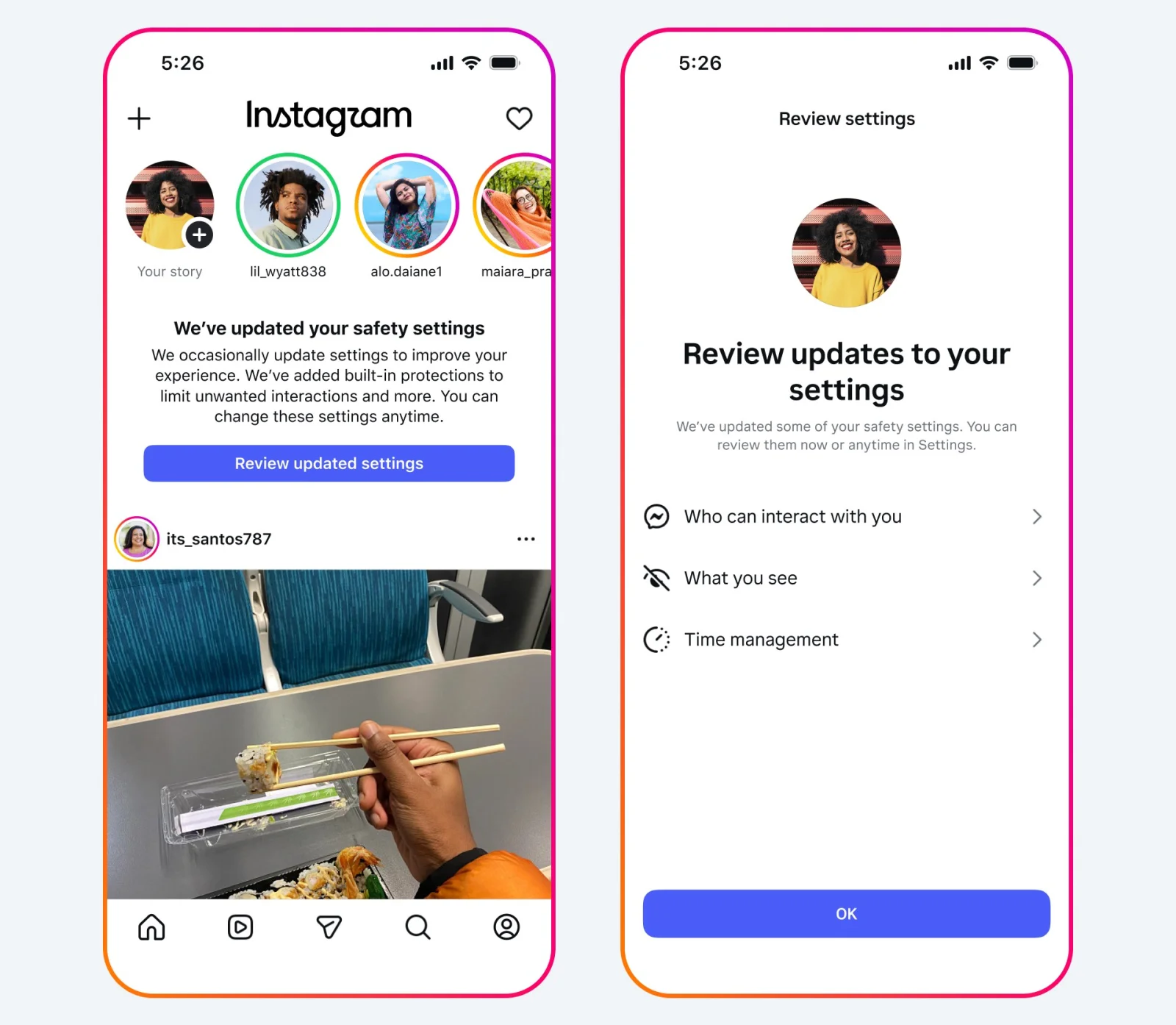 Instagram Teen Account protections UI after Meta global AI age estimation rollout
Image: Meta
Apple age-range signal in Australia
Meta's Australia pilot uses Apple's optional age-range attestation when parents configure a child's device. If the App Store shares a range, Meta can treat it as another age hint.
Meta argues the industry should standardize one device-level signal instead of every app running its own biometric pipeline. That aligns with France and UK age-verification laws pushing verification upstream, and with Apple's App Store 18+ dating rules tightening storefront metadata.
Builders shipping to minors should assume Meta, Apple, and regulators will trade signals, not compete on isolated checkbox flows.
Policy and business context
Meta ties the expansion to its attorneys general agreement after state investigations into youth safety. The company also faces civil suits from families over harms linked to social feeds and chatbots; see eight states suing OpenAI over child safety for how states are parallel-litigating AI products.
Instagram chief Adam Mosseri has publicly warned that AI-generated negativity will get worse before platforms catch up, a theme in our Mosseri interview recap. Age estimation is one defensive layer; feed ranking and synthetic media labels are others.
On deepfakes, Meta has rolled out likeness tools after celebrity cases we covered in Instagram deepfake enforcement. Age assurance and synthetic-media detection now sit in the same trust-and-safety budget.
What parents and teens can do
 Parental supervision and in-app guidance for Teen Account settings
Meta says US parents will soon see in-app notifications explaining when a teen is placed in protections and how to correct an inaccurate age. Teens 16 and under still need guardian approval to loosen restrictions.
Practical steps:
- Use accurate birthdates at signup; appeals are slower than getting it right first.
- Turn on parental supervision if you want time limits and DM visibility.
- If an adult account is misclassified, use Meta's documented ID verification path rather than creating a duplicate account.
Implications for AI builders
If you ship consumer social or companion products:
- Plan for probabilistic age classifiers, not binary signup gates.
- Document whether your models use biometrics; regulators distinguish pattern classifiers from facial recognition.
- Watch App Store and Play age APIs; Meta's Australia pilot is a template other apps may copy.
For feed-ranking teams, Mosseri's point still applies: models that boost engagement can undermine teen protections if slop or predatory content slips through classifiers.
What Meta did not publish
The November post does not list per-country effective dates, error rates, or appeal volumes. It does not say when Facebook's US age-assurance pilot goes global. Threads timing is "later this year" without a month.
Treat performance claims as internal success stories until Meta or auditors publish third-party evaluations.
Teen Account settings in practice
Meta's public Teen Account documentation bundles controls parents care about into a short list worth memorizing before a teen argues they "suddenly" lost features:
| Control | Default for teens | Parent override |
|---|---|---|
| Account privacy | Private account | Can approve public switch for 16+ with supervision |
| Direct messages | Limited to follows | Supervision can widen for 16+ |
| Sensitive content | Filtered | Tightened by default in Teen mode |
| Time limits | Enabled with nudges | Supervision can set stricter caps |
| Advertising | Restricted categories | Follows global ad policies |
When estimation misclassifies a 19-year-old as a minor, the user experience feels like an unrequested downgrade. Meta's ID verification path is the intended appeal valve. Document that for support teams if you run communities that integrate Instagram login.
Comparison with government-led age gates
Meta's voluntary expansion sits between hard law and self-reported birthdays. France and the UK are moving toward nationwide social bans with third-party age checks, described in our France and UK ban overview. Meta's global rollout is the platform trying to get ahead of regulators by showing proactive enforcement.
Apple's App Store age-range signal, used in Australia, previews the device-rooted trust anchor model regulators want: one attestation at OS setup, many apps consuming the same range. Meta explicitly calls for legislation mandating that pattern so teens do not face inconsistent rules app by app.
For AI companion and dating apps, Apple now forces explicit 18+ metadata on storefront listings, a separate lever from Instagram's in-app estimation, covered in our App Store 18+ policy post.
Privacy and accuracy questions regulators will ask
 Policy guardrails when platforms infer age instead of trusting birthdays
Civil society groups will press Meta on false positive rates, especially for young-looking adults and marginalized communities where visual classifiers historically skew. Meta's May clarification that the system is not facial recognition is a legal distinction, not a guarantee of fairness.
Builders who replicate Meta's approach should publish:
- Data retention windows for age-estimation features
- Human review thresholds
- Appeals SLAs
- Geographic variance in model deployment
Without transparency, governments default to blunt bans instead of nuanced Teen Account defaults.
Settlement and litigation backdrop
Meta's 2026 legal calendar includes multistate attorney general agreements, EU DMA obligations, and family suits over youth harm. Age estimation is both a compliance deliverable and a litigation exhibit: states will ask whether Meta knew minors were on the platform despite stated birthdays.
That pressure parallels AI chatbot child-safety suits against OpenAI and Character.AI bankruptcy scrutiny we summarized in state AG actions on chatbots. Social feeds and conversational AI are merging in regulation even when products stay separate.
What developers integrating Meta login should do
If your SaaS offers "Sign in with Instagram" or imports Meta social graph data:
- Do not assume
birthdayfields from OAuth are reliable youth signals. - Mirror Meta's age-appropriate API restrictions for teen accounts when Meta exposes account type flags.
- Store minimum necessary profile data; teen estimation increases sensitivity of entire profiles.
If you run moderation tooling, coordinate with Meta's Teen Account transitions so your automations do not treat a downgrade as a ban evasion attempt.
Threads and Facebook timelines
Meta says Facebook continues rolling age estimation beyond US pilots and that Threads will get a global launch later in 2026. Developers building cross-post tools should expect account-type flags to diverge per surface for months.
Plan feature detection rather than assuming Instagram settings propagate instantly to Threads APIs. Meta's Your Algorithm feed controls already showed how ranking differs per app even inside one company.
Document your app's assumptions about account_type or age bucket fields if Meta exposes them in future API changelog entries.
Reporting and transparency requests
Journalists and researchers should file Meta transparency reporting requests with specific questions: weekly teen reclamation counts, appeal turnaround times, and breakdown of estimation signals by country. Without those numbers, policymakers only see marketing statements.
Parents can document cases where teens lose access incorrectly and push support tickets early; aggregated complaints often precede regulator questions.