



Update — July 27, 2026: Open weights are live. Moonshot published free public Kimi K3 weights on July 26, 2026, ~7:30 PM EDT — a day ahead of the July 27 target mentioned below — with Together AI and Modal both confirming day-0 hosted access. Full breakdown: what's confirmed vs claimed →
Update — July 22, 2026: White House OSTP Director @mkratsios47 accused Moonshot of running an internal distillation platform against Claude Fable 5 using restricted Nvidia chips acquired via Thailand. Treasury Secretary Scott Bessent warned sanctions and Entity List designations are possible. Skeptics note K3 testing reportedly predated Fable 5's release. Full breakdown →
Update — July 21, 2026: Reporting attributed to The Information says Microsoft is evaluating Kimi K3 for possible Copilot features and preparing Azure availability. No Microsoft deployment announcement or validated $600M savings forecast exists; Foundry's public Kimi price list does not yet show K3. Evidence and cost analysis →
Update — July 21, 2026: Moonshot shipped Kimi Work — desktop agent with WebBridge (real Chrome/Edge via CDP), K3 Agent Swarm to PowerPoint/Excel, Cron scheduling, and native A/HK/US finance data. Free download; paid tiers gate swarm volume. Apple silicon Mac + Windows only — tasks stop when the machine sleeps unless you use Kimi Claw (cloud).
Update — July 20, 2026: @Kimi_Moonshot paused new K3 subscriptions — GPU capacity near limit after 48h demand (7.2M+ views). Same weekend: viral thread claimed Claude Fable ~10T vs K3's official ~2.8T — UNVERIFIED Anthropic sizing. Parameter count debate →. Cyber guardrails thread praised K3 for security fixes Codex/Fable refused. Subscription pause deep dive →
Update — July 17, 2026: Moonshot published the official Kimi K3 tech blog — positioning K3 as the world's first open 3T-class model (2.8T params) with Stable LatentMoE (16 of 896 experts active), ~2.5× scaling efficiency vs K2, and MXFP4/MXFP8 quantization-aware training. Moonshot acknowledges K3 trails Claude Fable 5 and GPT 5.6 Sol overall but claims frontier-level results on BrowseComp (91.2), GDPval-AA v2 (1668 Elo, #3), Terminal Bench 2.1 (88.3), and GPQA-Diamond (93.5). Independent signals same day: #1 on nextjs.org/evals (Rauch) and #1 Arena Frontend Code at 1679 Elo. Weights + technical report promised July 27, 2026. Companion coverage: Next.js evals deep dive · mobile app guide · local desktop prep.
Update — July 16, 2026: Moonshot AI launched Kimi K3 — platform.kimi.ai documents 2.8 trillion parameters, 1M-token context, native vision, and kimi-k3 at https://api.moonshot.ai/v1. This guide covers official API specs, pricing, and production limits.
TL;DR — official specs and quick answers
| Question | Answer (official platform docs, Jul 16, 2026) |
|---|---|
| What model ID? | kimi-k3 |
| How big is it? | 2.8T parameters — Kimi's most capable model to date |
| Context window? | 1,048,576 tokens (1M) — flat pricing, no length tiers |
| Architecture? | KDA + AttnRes · Stable LatentMoE (16/896 experts) · ~2.5× K2 scaling efficiency |
| Quantization? | MXFP4 weights, MXFP8 activations (quantization-aware from SFT) |
| Local inference prep? | vLLM KDA prefill cache contribution ships with weights |
| Vision? | Native visual understanding — base64 or ms://<file-id> only; no public URLs |
| Thinking mode? | Always on — reasoning_effort: "max" only at launch; low/high coming |
| Where to use K3? | Kimi app (iOS/Android/HarmonyOS) · Kimi Work 3.1.0+ · Kimi Code /model · API · Enterprise |
| API base URL? | https://api.moonshot.ai/v1 · env: MOONSHOT_API_KEY |
| Input pricing? | $0.30/M cache hit · $3.00/M cache miss |
| Output pricing? | $15.00/M tokens |
| Best for? | Software engineering, knowledge work, deep reasoning |
| Playground? | platform.kimi.ai/playground |
| Spec | Official value |
|---|---|
| Release | July 16, 2026 |
| Vendor | Moonshot AI (Beijing) |
| Parameters | 2.8 trillion |
| Context | 1,048,576 tokens |
| Vision | Native — array content, base64 or ms:// file refs |
| Thinking | Always enabled · reasoning_effort (not K2.x thinking) |
| Default max output | 131,072 tokens (max 1,048,576) |
| Caching | Automatic on regular requests |
| Web search tool | Being updated — not recommended for production near term |
What Moonshot shipped — and what the platform docs confirm
K3 is Moonshot's most capable model to date, positioned for frontier workloads: software engineering, knowledge work, and deep reasoning. The pre-launch leak window (July 14–16) correctly flagged scale and architecture direction; official platform documentation now pins the numbers:
- 2.8 trillion parameters — world's first open 3T-class model per Moonshot's July 17 tech blog
- Kimi Delta Attention (KDA) + Attention Residuals (AttnRes)
- Stable LatentMoE — 16 of 896 experts activated per token
- ~2.5× scaling efficiency vs Kimi K2 from structural + training recipe changes
- Quantization-aware training from SFT — MXFP4 weights, MXFP8 activations
- vLLM KDA prefill cache contribution coming with open weights release
- 1M-token context (1,048,576 tokens exactly)
- Native visual understanding for multimodal agent loops
Official architecture write-up: kimi.com/blog/kimi-k3. Launch-night reporting from Financial Times and X still describes K3 as open-weight, rolling out on kimi.com and the Kimi app — continuing Moonshot's pattern from Kimi K2.7 Code.
Docs index: platform.kimi.ai/docs/llms.txt
Open frontier model size — K3 jumps from 1T to 2.8T
Community tracker charts circulating July 17, 2026 place K3 in context against other open flagship releases over the past year. The jump from Kimi K2 (~1T) to Kimi K3 (2.8T) is the steepest single-generation climb on the timeline — and the first to cross the 3T-class line Moonshot claims in its official blog.
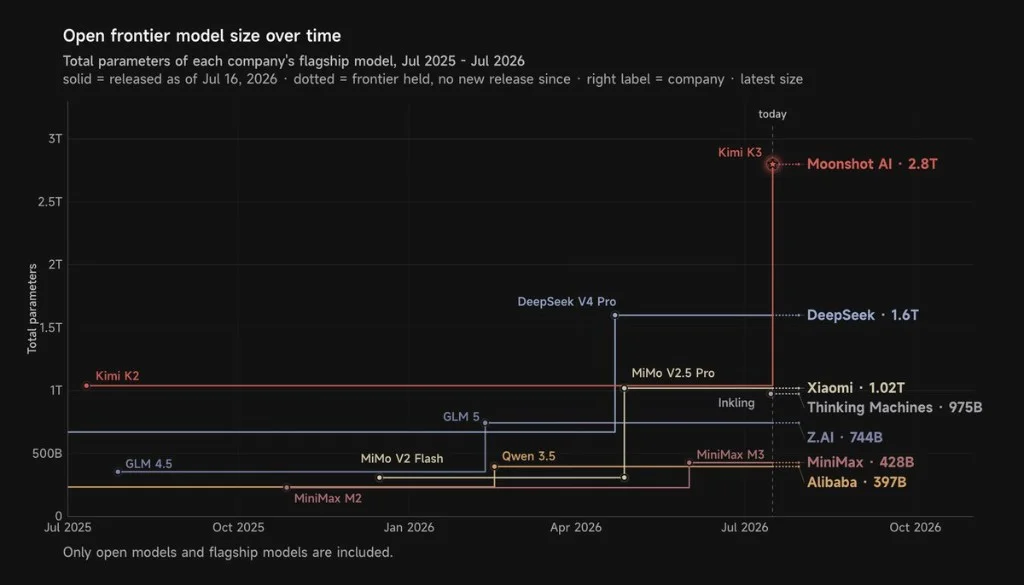 Open frontier model size over time — Kimi K3 at 2.8T leads DeepSeek V4 Pro 1.6T, MiMo V2.5 Pro 1.02T, Inkling 975B, GLM 5 744B, MiniMax M3 428B, Qwen 3.5 397B as of July 2026
Chart: open flagship model total parameters, July 2025 – July 2026. Solid lines = released by mid-July 2026; dotted extensions = current frontier size with no newer release scheduled. "Only open models and flagship models are included."
| Model (company) | Total params | Approx. release |
|---|---|---|
| Kimi K3 (Moonshot) | 2.8T | July 2026 |
| DeepSeek V4 Pro | 1.6T | May 2026 — see DeepSeek V4 Pro pricing |
| MiMo V2.5 Pro (Xiaomi) | 1.02T | May 2026 |
| Inkling (Thinking Machines) | 975B | June/July 2026 — Inkling open weights |
| GLM 5 (Z.AI) | 744B | March 2026 |
| MiniMax M3 | 428B | June 2026 |
| Qwen 3.5 (Alibaba) | 397B | March 2026 |
How to read this: Total parameter count is not quality — MoE models like K3 activate 16 of 896 experts per token, so inference cost tracks active params, not 2.8T. The chart matters for open-weight landscape positioning: K3 is the largest announced open flagship by raw scale, ahead of DeepSeek V4 Pro's 1.6T, while closed models (Fable 5, GPT 5.6 Sol) sit off this axis entirely. Weights drop July 27, 2026 for independent verification of whether the scale jump matches architecture claims — especially amid unofficial distillation chatter.
For local inference planning, see Kimi K3 desktop prep — full 2.8T MoE is not a single-GPU workload regardless of where it sits on this chart.
July 17 — benchmarks, Arena, macOS 27, and open weights timeline
The API went live July 16; July 17 is when independent evaluators and demo builders started publishing numbers that change how teams should read K3.
Official benchmark table — Moonshot positioning vs Fable/Sol
Moonshot's July 17 tech blog is candid: K3 trails Claude Fable 5 and GPT 5.6 Sol overall but claims frontier-level performance across its suite. Harness differences matter — Kimi K3 often uses KimiCode; Fable may use Claude Code with Opus fallback; GPT 5.6 Sol uses Codex. Read footnotes before procurement.
| Benchmark | Kimi K3 (max) | Notes |
|---|---|---|
| BrowseComp | 91.2 | Moonshot table max; 90.4 at 1M without compaction |
| GDPval-AA v2 (Elo) | 1668 | #3 behind Fable 5 (1760) and GPT 5.6 Sol (1748) |
| Terminal Bench 2.1 | 88.3 | Near Sol (88.8), ahead of Fable (84.6) on Moonshot table |
| DeepSWE | 67.5 | Behind Fable (70.0) and Sol (73.0) |
| FrontierSWE | 81.2 | Behind Fable (86.6) |
| GPQA-Diamond | 93.5 | Tied with GPT 5.5; near Sol (94.1) |
Moonshot also highlights kernel optimization case study: an early K3 version optimized AttnRes from 283.6ms → 114.4ms on NVIDIA H200, and built MiniTriton — a from-scratch Triton-like compiler with MLIR tile IR — rivaling Triton on roofline benchmarks.
Independent July 17 signals complement (not replace) Moonshot's table:
Next.js evals — first open model above all proprietary entries
Vercel CEO Guillermo Rauch posted that Kimi K3 is the best-performing model on nextjs.org/evals — ahead of Claude Fable 5, with a comparable success rate in less time. This is the first time an open model tops a comprehensive web engineering benchmark that includes real Next.js App Router tasks, not just isolated code completion.
Rauch's caveats matter for production planning:
- Benchmarks don't tell the full story — eval suites miss org-specific constraints, design systems, and legacy code paths.
- No model reaches 100% — top scores peak around 92% and 96% "with help" (human steering or iterative correction).
- Cost column coming — Rauch replied to community requests that he will add cost per eval run to the table.
For a full breakdown of what "with help" means and how Arena.ai Frontend Code compares, see our Next.js evals + Frontend Code Arena guide.
Arena.ai Frontend Code — #1 at 1679 Elo
Arena.ai updated its Frontend Code leaderboard July 17: Kimi-K3 at 1679 Elo, surpassing Claude Fable 5. Kimi-k2.6 sat at #18 before launch — a 17-place jump in one generation.
K3 leads 6 of 7 Frontend domains on the Arena board, including:
| Domain | Kimi K3 placement |
|---|---|
| Brand & Marketing | #1 |
| Reference-Based Design | #1 |
| Data & Analytics dashboards | #1 |
| Component libraries | #1 |
| Landing pages | #1 |
| Interactive UI | #1 |
Arena Elo is crowd-voted pairwise comparison — not a vendor card. It correlates with how developers feel about frontend output quality, which is why the jump from k2.6 (#18) to K3 (#1) is the headline metric for UI-heavy teams.
Architecture highlights from official blog + launch summary
| Feature | Claimed benefit |
|---|---|
| 2.8T params, 1M context, native multimodal | World's first open 3T-class model |
| Stable LatentMoE (16/896 experts) | High sparsity with quantile balancing + Per-Head Muon |
| Kimi Delta Attention + AttnRes | Efficient long-context attention; AttnRes kernel 283.6→114.4ms on H200 |
| ~2.5× scaling efficiency vs K2 | Structural + data recipe improvements |
| MXFP4/MXFP8 quantization-aware SFT | Broad hardware compatibility at inference |
| vLLM KDA prefill cache | Community contribution ships with weights |
API pricing remains $0.30/$3.00/M input (cache hit/miss) and $15/M output — see pricing section below. That positions K3 closer to Sonnet-tier spend than Fable-tier for many agent loops, which matters when Rauch adds cost columns to nextjs.org/evals.
macOS 27 browser demo — agent swarm in ~3 hours
Creative Strategies analyst Max Weinbach used Kimi K3 Max agent swarm to recreate macOS 27 in the browser: macos27.kimi.page. The demo includes Liquid Glass chrome, a working dock, playable 3D Chess, Maps, widgets, and webcam FaceTime — built in roughly 3 hours and consuming about 60% of his monthly Kimi usage allowance.
Honest limitations from Weinbach's thread:
- The browser shell works, but embedded pages are blocked (no proxy) — external sites won't load inside the faux Safari frame.
- Community comparisons noted an MIUI-adjacent aesthetic — useful context if you're evaluating design taste, not just capability.
This is evidence for long-horizon agent swarms on K3, not a substitute for your own eval on production repos. Pair with loop engineering patterns when reproducing multi-agent builds.
BrowseComp and frontier positioning
Benchmark chatter from independent evaluators placed K3 in Fable/Sol class — "strictly better than Opus 4.8 across the board at Sonnet pricing." On BrowseComp, community numbers cite Sol 90.4 (single agent) and 92.2 (multi-agent) as reference points; K3 is being described as an undisputed frontier model in threads comparing open vs closed.
Treat these as directional until you run your workload. For closed-vs-open landscape context, see GPT-5.6 vs Fable 5 and closed source vs local alternatives.
Open weights — July 27, 2026 + technical report
Moonshot promised full open-source weights by July 27, 2026, with a technical report covering architecture, training, and evaluations. A vLLM KDA prefill cache implementation will release alongside weights.
| Access path | Available today? |
|---|---|
| Kimi app | Yes — iOS, Android, HarmonyOS |
| Kimi Work desktop 3.1.0+ | Yes — Windows, Apple Silicon Mac |
| Kimi Code terminal | Yes — select K3 via /model command |
| platform.kimi.ai API | Yes — kimi-k3 model ID |
| Kimi Enterprise | Yes — separate org accounts; visit pricing page |
| Self-hosted vLLM / llama.cpp | No — prep only; see local desktop guide |
| K2.7 Code weights (1T MoE) | Yes — K2.7 guide |
At launch, K3 uses reasoning_effort: max only. Moonshot says low- and high-effort modes arrive in subsequent updates.
Limitations — what Moonshot acknowledges
Moonshot's official blog lists three production caveats builders should plan for:
1. Sensitivity to thinking history
K3 was trained in preserved thinking history mode. If your agent harness fails to pass back all historical thinking content, or if you switch from another model mid-session, generation quality may become highly unstable. Moonshot recommends Kimi Code or other verified-compatible harnesses — and avoid switching to K3 mid-conversation.
This aligns with API docs requiring the complete assistant message unchanged in multi-turn loops.
2. Excessive proactiveness
K3's training emphasizes long-horizon, challenging tasks. On minor issues or ambiguous intent, it may make unexpected decisions on the user's behalf. For bounded agent workflows, impose explicit constraints in system prompts or AGENTS.md.
3. UX gap vs Fable 5 and GPT 5.6 Sol
Moonshot states K3 is highly competitive overall but exhibits a noticeable UX gap compared to Fable 5 and GPT 5.6 Sol — despite strong benchmark numbers. Treat independent eval wins (nextjs.org/evals, Arena) as task-specific, not blanket UX superiority.
Hacker News and builder chatter (July 17)
Brief signals from launch-day threads worth tracking:
| Topic | Detail |
|---|---|
| Simon Willison pelican test | ~$0.25 API cost, ~16k reasoning tokens for a classic agent eval prompt |
| Subscription quota | macOS 27 swarm demo consumed ~60% of monthly allowance on a $100 plan (Weinbach) |
| Training on API data | Community concern — Kimi Enterprise offers separate org accounts with enterprise-grade privacy; verify opt-out paths for production data |
| Distillation from Claude? | Unofficial speculation — see section below; not confirmed by Moonshot |
These are directional, not vendor policy documents. Enterprise buyers should read Moonshot's enterprise privacy terms before routing sensitive repos through K3.
Distillation claims — unofficial chatter, not Moonshot confirmation
K3's July 16–17 launch landed days after Claude Fable 5 and GPT 5.6 Sol went wide. That timing — plus #1 nextjs.org/evals and 1679 Elo on Arena Frontend Code, surpassing Fable 5 — triggered unofficial Hacker News debate: did Moonshot close the gap by distilling frontier teacher models, especially Claude, rather than purely independent scaling?
What we know from vendors (not K3-specific):
- In February 2026, Anthropic publicly accused Moonshot AI (Kimi), DeepSeek, and MiniMax of coordinated distillation campaigns — auto-generated queries harvesting chain-of-thought reasoning, agentic tool use, and coding workflows from Claude via fraudulent accounts. Coverage of that report cited 3.4 million+ queries attributed to Moonshot alone, targeting agentic reasoning, tool use, coding, and vision — overlapping K3's marketed strengths.
- In June 2026, Anthropic escalated a separate Alibaba / Qwen letter to the Senate Banking Committee (~25,000 accounts, 28.8M exchanges) — a different operator, but part of the same industrial extraction narrative US labs use to justify export controls and API hardening.
Moonshot has not publicly confirmed or denied Claude-specific distillation for K3. The official Kimi K3 tech blog credits KDA + AttnRes, Stable LatentMoE (16/896), MXFP4/MXFP8 training, and ~2.5× K2 scaling efficiency — standard architecture storytelling, not a response to distillation allegations.
What HN builders are arguing
| Claim (speculation) | Counterargument (also on HN) |
|---|---|
| Benchmark parity with Fable/Sol so soon after their launch implies teacher-model distillation | Post-training on synthetic teacher outputs is routine industry practice — Anthropic, OpenAI, and Google all use similar pipelines on their own and third-party data |
| Some users report K3 (and earlier Kimi models) identifying as "Claude" in bare API harnesses with no Claude in the prompt — circumstantial | Could be training-data artifact or overfit system-prompt leakage, not proof of weight-level cloning; HN compares it to older models defaulting to ChatGPT-style phrasing |
| 2.8T open MoE at Sonnet-tier API pricing feels "too good" vs closed frontier APIs | Moonshot's MoE sparsity (16/896) and quantization-aware training materially cut inference cost; open weights July 27 enable third-party architecture and data-mix audits |
| Anthropic's "distillation attack" framing is self-serving | True that labs disagree on definitions — HN distinguishes logit distillation (needs teacher weights) from output-only imitation (API chat logs), and notes Anthropic trained on copyrighted web corpora without permission |
Security angle builders cite: If frontier models hide reasoning traces from API consumers (as Claude does for reasoning_content in many tiers), industrial harvesters may still reconstruct agentic behavior from final outputs and tool loops — the concern behind Anthropic's detection and prevention blog post and the broader export-control / distillation war context.
What July 27 open weights could settle (and what they won't)
Moonshot promised full weights + technical report by July 27, 2026. Independent researchers can then inspect:
- Architecture lineage — MoE routing, attention patterns, tokenizer and vocabulary overlap vs K2/K2.6 and public Western baselines
- Training stack claims — whether the report documents synthetic-data mixes vs purely in-house corpora
Open weights cannot prove negative on API-harvested post-training data. They can show whether K3 is a credible independent 2.8T MoE build or something that only makes sense as a compressed imitation of a closed teacher.
Practical takeaway for teams: Treat distillation chatter as risk disclosure, not a reason to ignore K3 eval numbers. If data provenance or ToS compliance matters for your procurement policy — especially US enterprises post-Fable export controls — factor Anthropic's prior Moonshot allegations into vendor review. If task performance and cost matter most, run nextjs.org/evals-style suites on your repo and decide on measured output, not forum theory.
Kimi K3 API pricing
Flat pay-as-you-go — no tiering by context length. Context caching is automatic for regular requests.
| Token type | Price (per 1M tokens) |
|---|---|
| Input — cache hit | $0.30 |
| Input — cache miss | $3.00 |
| Output | $15.00 |
Cache strategy: With a 1M-token window, keep long system prompts, tool definitions, and document prefixes unchanged across requests. Moonshot's automatic caching rewards stable prefixes — the same pattern that made DeepSeek V4 Pro's permanent API discount interesting for agent loops, but at frontier reasoning depth.
Compare against K2.7 Code's published rates ($0.95/M input cache miss, $4/M output) in our K2.7 guide when choosing a Kimi model for cost-sensitive coding vs K3 frontier reasoning.
Quick start — Python (OpenAI SDK compatible)
Get an API key at platform.kimi.ai/console/api-keys.
Basic chat with thinking mode
K3 always runs in thinking mode. Use reasoning_effort — not the K2.x thinking parameter.
import os
from openai import OpenAI

client = OpenAI(
    api_key=os.environ["MOONSHOT_API_KEY"],
    base_url="https://api.moonshot.ai/v1",
)

response = client.chat.completions.create(
    model="kimi-k3",
    reasoning_effort="max",  # only supported level today; default if omitted
    messages=[
        {"role": "system", "content": "You are a senior software engineer."},
        {"role": "user", "content": "Refactor this handler to use async/await."},
    ],
    max_completion_tokens=8192,
)

message = response.choices[0].message
# Parse final answer from content — not reasoning_content
print(message.content)
Streaming reasoning and content separately
Streaming emits reasoning_content deltas (chain-of-thought) and final content deltas in separate streams:
stream = client.chat.completions.create(
    model="kimi-k3",
    reasoning_effort="max",
    messages=[{"role": "user", "content": "Prove this invariant holds."}],
    stream=True,
)

for chunk in stream:
    delta = chunk.choices[0].delta
    if getattr(delta, "reasoning_content", None):
        print(delta.reasoning_content, end="", flush=True)
    if getattr(delta, "content", None):
        print(delta.content, end="", flush=True)
For structured output, parse message.content only — ignore reasoning_content.
Structured output (JSON schema)
response = client.chat.completions.create(
    model="kimi-k3",
    reasoning_effort="max",
    messages=[
        {"role": "user", "content": "Extract entities from: Acme Corp raised $50M."}
    ],
    response_format={
        "type": "json_schema",
        "json_schema": {
            "name": "extraction",
            "strict": True,
            "schema": {
                "type": "object",
                "properties": {
                    "company": {"type": "string"},
                    "amount_usd": {"type": "number"},
                },
                "required": ["company", "amount_usd"],
                "additionalProperties": False,
            },
        },
    },
)
import json
result = json.loads(response.choices[0].message.content)
Set strict: true on the schema. Do not parse reasoning_content for the JSON payload.
Vision — base64 only (no public URLs)
Vision content must be an array of objects. Use local base64 encoding or upload files and reference via ms://<file-id>. Public image URLs are not supported.
import base64

with open("screenshot.png", "rb") as f:
    b64 = base64.standard_b64encode(f.read()).decode()

response = client.chat.completions.create(
    model="kimi-k3",
    reasoning_effort="max",
    messages=[
        {
            "role": "user",
            "content": [
                {"type": "text", "text": "What UI bug do you see?"},
                {
                    "type": "image_url",
                    "image_url": {"url": f"data:image/png;base64,{b64}"},
                },
            ],
        }
    ],
)
print(response.choices[0].message.content)
For video, use ms://<file-id> after uploading through Moonshot's file API — same constraint as MCP tool-use workflows where agents pipe local artifacts rather than hotlinked URLs.
Key API capabilities builders should know
Thinking mode (reasoning_effort)
| K2.x pattern | K3 pattern |
|---|---|
thinking: { "type": "enabled" } | reasoning_effort: "max" (top-level field) |
| Optional disable | Always enabled — cannot turn off |
| — | Only max supported today; more levels coming |
Partial mode — continue from a prefix
Send an assistant message with partial=True to continue generation from a prefix — useful for autocomplete-style agent harnesses and loop engineering patterns where you steer mid-generation.
Tool choice and multi-turn
- Set
tool_choice="required"(or other OpenAI-compatible values) when tools must fire - In multi-turn tool loops, return the complete assistant message unchanged — do not strip tool calls or reasoning fields Moonshot expects round-tripped
Dynamic tool loading
Put tool definitions in a system message without a content field — Moonshot supports loading tools dynamically without bloating the visible system prompt.
Official tools via Formula API
Moonshot exposes first-party tools through the Formula API (/tools, /fibers). Web search is being updated — platform docs do not recommend it for production near term. Prefer your own retrieval or MCP servers until the search tool stabilizes.
Fixed parameters and limits — do not send these
Moonshot fixes several sampling parameters on K3. Omit them from requests — the server applies defaults:
| Parameter | Fixed value |
|---|---|
temperature | 1.0 |
top_p | 0.95 |
n | 1 |
presence_penalty | 0 |
frequency_penalty | 0 |
| Limit | Value |
|---|---|
reasoning_effort | max only (for now) |
max_completion_tokens default | 131,072 |
max_completion_tokens maximum | 1,048,576 |
| Vision URLs | No public URLs — base64 or ms:// only |
| Multi-turn | Return full assistant message unchanged |
| Web search (Formula) | Not production-ready — being updated |
How the leak window mapped to official specs
Before platform docs went live, K3 spent July 14–16 leaking across Moonshot's billing pages and X — and several predictions held:
| Leaked (Jul 14–16) | Official / launch (Jul 16) |
|---|---|
| "~2.5T MoE parameters" | 2.8T per platform docs |
| "New architecture, not scaled K2.6" | Kimi Delta Attention + Attention Residuals |
| "~1M token context" | 1,048,576 tokens confirmed |
| "Community hopes for open-source Kimi 3.0" | Launch reporting: open-weight release |
| "~Fable tier, slightly worse" (tester chatter) | #1 nextjs.org/evals and #1 Arena Frontend Code (1679 Elo) — surpasses Fable 5 (Jul 17) |
The recharge campaign page that briefly appeared July 14 on Moonshot's billing domain — pointing to a July 15 China-time start — was the strongest pre-launch artifact. The launch landed evening July 16, a short slip from the leaked date.
Treat benchmark placement as directional until Moonshot publishes an official card and independent evaluators run Senior SWE-bench-class suites. Launch-night X threads are not vendor benchmark cards.
What people are asking — builder decisions today
K3 API vs K2.7 Code weights
| Need | Use today |
|---|---|
| Frontier reasoning + 1M context via API | Kimi K3 — platform.kimi.ai |
| Self-hosted coding MoE, weights public now | Kimi K2.7 Code — 1T MoE, Modified MIT |
| Copilot integration | K2.7 on GitHub Copilot |
| Fable-class tasks (US) | Fable 5 use cases |
| Open vs closed landscape | Closed source vs local open alternatives |
K3's $15/M output pricing reflects frontier reasoning depth — budget agent loops that fire hundreds of tool calls may still favor K2.7 or local open models via OpenCode until you measure quality delta on your workload.
Safety and agent deployment
K3's launch lands the same week as Anthropic's agentic misalignment report, which tested Kimi K2.6 in simulated fraud scenarios. A larger model with 1M context, always-on reasoning, and tool APIs raises the same permission and audit questions — especially if open weights follow the K2 release pattern. The deployer owns safety configuration, not the vendor. Same lesson as Claude Memory Heist: long-context agents with web fetch need explicit guardrails.
Why "beats Opus 4.8" still matters for open-weight
If independent benchmarks confirm launch-night placement, K3 becomes evidence that open-weight frontier models can compete with closed APIs at the top of the scale — not just in the budget tier where DeepSeek and earlier Kimi releases competed. It ships alongside Inkling's 975B open MoE and Gemma 4 updates — but 2.8T is a different magnitude than any of them.
Summary
Kimi K3 launched July 16–17, 2026 as Moonshot's most capable model and the world's first open 3T-class model: 2.8T parameters, KDA + AttnRes, Stable LatentMoE (16/896), MXFP4/MXFP8 quantization, 1M context, native vision. Moonshot acknowledges K3 trails Fable 5 and GPT 5.6 Sol overall but hits frontier-level on BrowseComp (91.2), GDPval-AA v2 (1668 Elo), and Terminal Bench 2.1 (88.3). July 17 independent signals: #1 nextjs.org/evals, #1 Arena Frontend at 1679 Elo. A July 20 developer case study framed K3 vs Fable on a WebGL stadium as verification-heavy "vibe engineering" versus fast single-file "vibe coding" — useful harness anecdote, not a substitute for the tables above. Unofficial HN distillation-from-Claude chatter is unverified — Anthropic accused Moonshot of prior extraction campaigns; Moonshot has not confirmed K3-specific distillation; open weights July 27 may clarify architecture lineage. API pricing $0.30/$3/$15 per MTok unchanged. Use reasoning_effort: max (low/high coming), verified harnesses for thinking history, and explicit behavioral constraints for proactiveness.
Related on explainx.ai
- MiniMax-H3: An Open Video Model Ranked #1 on Video Editing With Audio — same pre-release teaser pattern, different lab
- Kimi K3 open weights are live — 2.8T params, Together/Modal day-0
- Are AI labs "pelicanmaxxing"? A 1,008-SVG statistical study
- Kimi K3 vs Fable 5 — vibe engineering stadium case study — one developer's E2E vs one-shot HTML anecdote (July 20)
- Kimi K3 beta leaks — Moonshot agent flagship
- Asia AI models 60% OpenRouter tokens — Jul 2026
- Kimi K3 Next.js evals + Frontend Code Arena deep dive (Jul 17)
- Kimi K3 mobile app and API guide
- Kimi K3 local desktop prep — open weights July 27
- Kimi K2.7 Code — open 1T MoE coding model
- Kimi K2.7 on GitHub Copilot
- Anthropic vs Alibaba — Claude distillation letter (June 2026)
- US Fable/Mythos export controls and distillation context
- GPT-5.6 vs Claude Fable 5 comparison
- Fable 5 top 35 use cases
- Closed source vs local open alternatives
- How to run open-source models locally in OpenCode
- Loop engineering for coding agents
Official sources: Kimi K3 tech blog · Kimi Platform · Next.js evals · Arena.ai Frontend Code · API keys · Playground · Docs index · kimi.com · macOS 27 demo
API specs, pricing, and limits accurate as of July 17, 2026, per Moonshot Kimi platform documentation and independent eval posts from Vercel and Arena.ai. Verify current rates, eval standings, and model availability on platform.kimi.ai and nextjs.org/evals before planning production workloads — open weights are promised by July 27, 2026.