



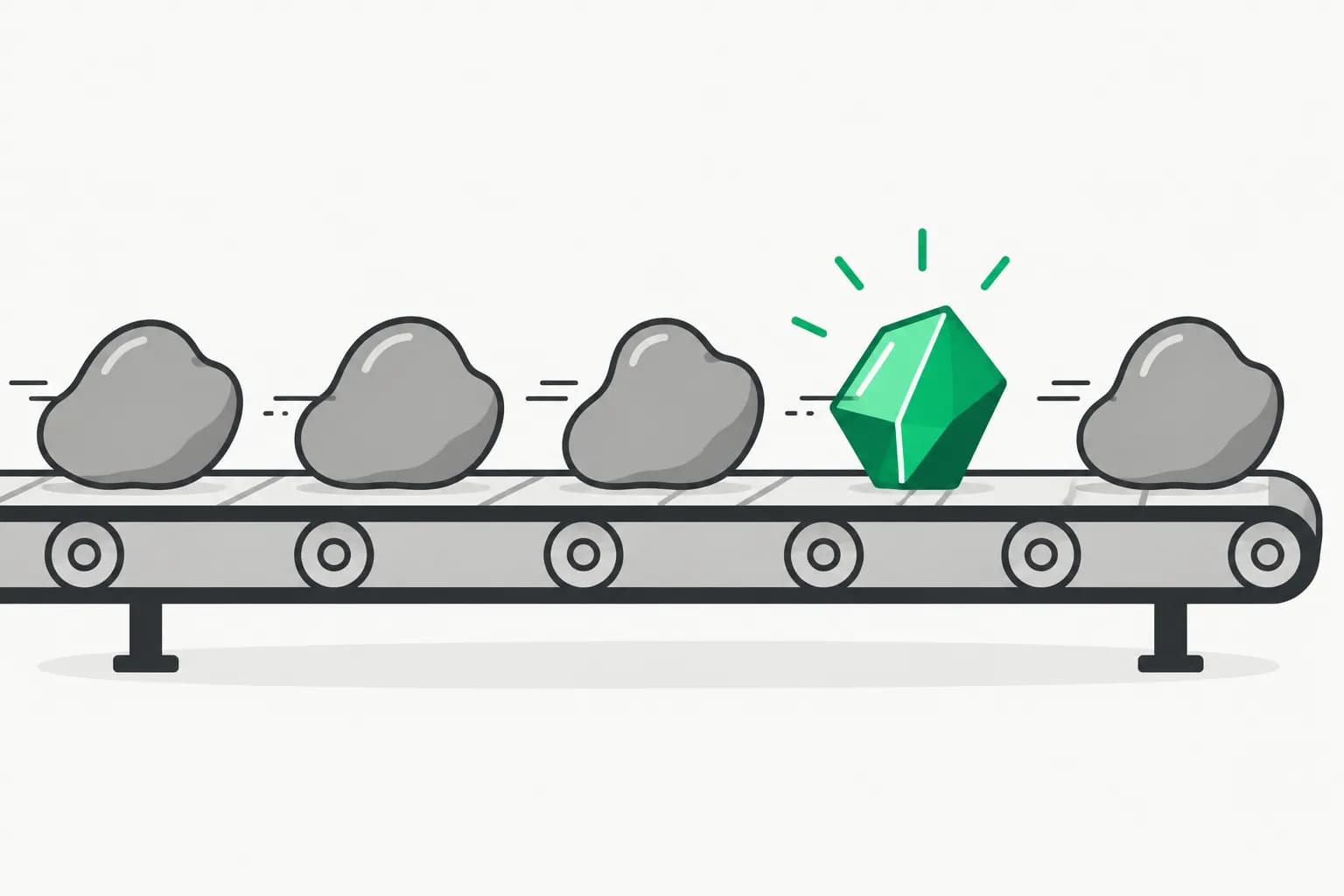
Engineer Kevin Boone published an essay titled "Why I don't really care if web content is AI-generated" on kevinboone.me in June 2026. It trended on Hacker News on November 7, 2026 with a modest but thoughtful thread. Boone is not cheerleading model spam. He argues that authorship is the wrong filter for the vast sea of unknown pages, and that builders already living in skepticism-first mode should double down on verification—not boycott every page a model might have touched.
TL;DR: Boone versus the slop panic
| Boone's claim | What he does not mean |
|---|---|
| Unknown web content gets the same scrutiny whether human or AI | He is not saying slop is good |
| He keeps a tiny trust list of people and orgs | He is not saying provenance never matters |
| We are exiting the Gutenberg parenthesis | He is not saying books were always true either |
| Labeling AI use is courteous | He is not saying labels replace fact-checking |
What Boone actually wrote
Boone opens with the small web movement: readers flee mainstream sites drowning in low-effort LLM pages. He shares a visceral dislike of AI-generated content, then tackles three common complaints.
Accuracy. Models hallucinate, but so do humans—especially on social feeds. Boone notes models cannot yet act in bad faith the way people can, but they amplify sloppy training data. His fix is critical reading, not assuming human text is safer by default.
Authenticity. His emotional example is a widow's cancer story that may have been synthetic. Boone distinguishes fiction that asks for empathy from fiction dressed as fact. The waste is emotional labor on a stranger who may not exist—a theme our slopocalypse explainer tracks when cheap generation floods feeds.
Disclosure. Many readers want to boycott AI on principle, including labor or ethics grounds. Boone cites Oracle laying off 10% of staff citing AI uptake as a reason someone might refuse AI summaries entirely. He still concludes that, for him, courtesy labels help but personal vetting matters more.
His constructive frame is the Gutenberg parenthesis (a historical model that treats the print era as a temporary detour between oral and digital culture): for a few centuries, print made institutional publishers look trustworthy. The web exported that habit to pages that never earned it. Boone says we are back to communal, skeptical reading—with or without models in the loop.
How this connects to explainx.ai's slop coverage
Boone's essay is not a policy document. It is a practitioner stance on information diet. It rhymes with several threads we have covered:
- What AI slop is — generation is cheap; distribution and trust are expensive.
- Google's OSS bug-bounty freeze — maintainers drowned in AI-written junk reports.
- Cosmic Desktop banning AI-generated code — communities raise the cost of entry when verification cannot keep pace.
- Spotify removing tens of millions of slop tracks — platforms admitting detectors are imperfect.
- The AI verification tax at work — redoing model output costs more than producing it.
Boone's 1:1000 trusted-to-unknown ratio is hyperbolic but useful. Security engineers already live there: you do not run a curl bash from a random blog; you read the script. The essay asks whether blog readers should adopt the same discipline for facts.
What developers are saying on Hacker News
 Rounded speech bubbles clustered around one green bubble, for the modest HN thread on Boone's essay
The HN thread (13 points, seven comments at crawl time) is small but substantive.
User benrutter pushed back on Boone's cancer-story logic: if a story is invented but "the kind of thing that happens," that is not true in the journalistic sense (comment 50404917). Avicebron agreed that trusted versus untrusted buckets are healthy, but warned that saying "I do not trust anything anyway" is the defeatism people fear online (50404962). guitarlimeo wanted spaces without AI, niche but real (50405081). positron26 argued the mainstream web has been low-trust for years; HN readers are late to the mourning (50405128).
None of these comments verify Boone's claims about Oracle layoffs; treat that line as his anecdote unless you find a primary filing. They do show the gap between Boone's personal workflow and community norms that still value provenance.
Where Boone is right for builders
If you ship software or write docs, Boone's essay reinforces habits that survive model-written text:
- Primary sources first. Link specs, release notes, and repos—not another blog summarizing them. Our Addy Osman cognitive surrender piece makes the same point for agents: the model is not the spec.
- Separate empathy media from engineering media. Heartfelt posts can be synthetic; CVE write-ups need CVE IDs.
- Build trust lists, not platform trust. Follow maintainers whose track record you have tested, similar to Boone's short trusted roster.
- Use disclosure when you publish. Readers asked for labels in Boone's essay; SKILL.md and README honesty help even if skeptics still verify.
- Assume slop in search results feeding your agent. Washington Post reporting on AI-built voter sites shows how synthetic pages can pollute RAG corpora.
Boone's closing line—that skepticism about all online information is justified—is the bridge to security culture. It matches what Alex Stamos told The Verge the same day about paranoia on AI-driven scams while rebuilding real defenses.
Where the essay is weak
Boone underplays scale effects. One bad human blog post does not flood Google; a million model pages do. Communities cannot manually verify everything. That is why r/OpenSource bans and platform removals exist.
He also treats fiction and fraud lightly compared with SEO fraud and affiliate slop, which are economic attacks, not taste questions. For builders, the actionable slice is verification discipline—not indifference to whether a dependency README was ghostwritten.
Practical checklist for reading AI-era web content
| Step | Action |
|---|---|
| 1 | Identify the claim, not the author |
| 2 | Find a primary doc, commit hash, or dataset |
| 3 | Reproduce or test if the claim affects your build |
| 4 | Down-rank pages with no accountable entity |
| 5 | Prefer maintainers with merged PR history |
That checklist is compatible with wanting human-only art spaces or non-AI school policies—topics in our Google schools AI controls coverage—without pretending labels solve spam.
Platforms, search, and why authorship still matters at scale
Boone writes as an individual reader. Platform operators cannot. When 52% of new pages may be model-assisted but search shows a far smaller share ranking, as our slopocalypse piece explains, the fight is not one essay at a time. It is index hygiene, reputation systems, and costly human review on channels that matter.
That is why Boone's courtesy-about-labels point lands differently depending on where you stand:
- Readers can ignore unknown authors and spot-check claims.
- Maintainers need submission filters because volume overwhelms merit review, as seen when Google paused OSS VRP triage.
- Educators need product policies, not trust lists, when millions of students share one login—see our running Google K-12 AI controls thread.
Boone's Gutenberg metaphor still helps engineers. Print centralized trust in institutions; the web decentralized publishing faster than we rebuilt institutions. Models accelerate publishing again. Verification skills—the kind we outlined in ASD-STE100 simplified English for AI docs—are how teams keep internal docs honest when agents draft them.
For open-source contributors, the middle path is neither boycott nor blind acceptance:
| Situation | Reasonable stance |
|---|---|
| Personal blog comment | Judge on merit if stakes are low |
| Medical or financial advice | Require accountable author and citations |
| Dependency README install steps | Reproduce in a sandbox |
| CVE write-up | Demand advisory ID and vendor link |
| Hugging Face model card | Read eval tables; rerun a sample |
That table is compatible with Boone's trust list. It also explains why HN commenters still want spaces without AI: sometimes the stake is community identity, not factual accuracy alone.
How teams can operationalize Boone's stance
Documentation repos. Require human sign-off on security sections even when agents draft prose. Track who merged the change, not who prompted.
RAG corpora. Version snapshots; exclude domains with no accountable entity; log retrieval citations in user-facing answers when possible.
Hiring and learning. Teach juniors to trace claims the way Boone describes, but add platform literacy: how slop spam hurts maintainers, how fake case studies pollute training data, and why Spotify-style removals happen at scale.
Personal reading. Keep a trust list, but refresh it when someone errs twice on facts you checked. Boone implies that discipline; the HN thread reminds us not to freeze the list into ideology.
Bottom line
Kevin Boone's essay is a calm provocation in a loud slop panic. He does not prove AI pages are fine; he argues unknown pages were never fine, and that the web is forcing us back to habits older than printing. Developers should read it as a reminder to verify like operators, not as permission to skip attribution fights on platforms where scale matters.
Based on Boone's essay on kevinboone.me and the Hacker News thread of November 7, 2026.