



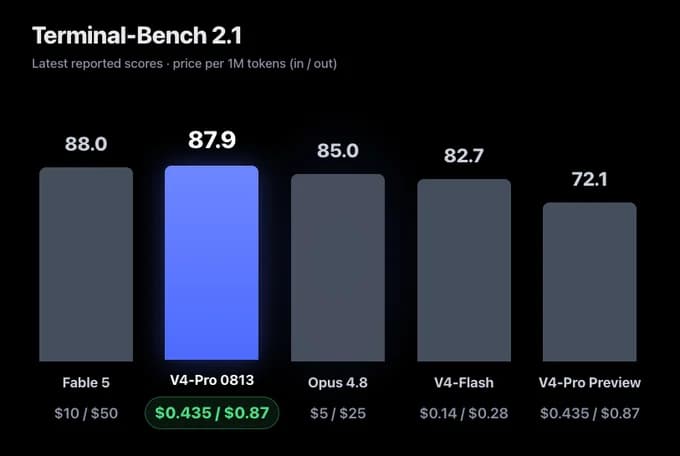
A community project is claiming it can make DeepSeek V4-Pro-0813 beat Fable 5 on several benchmarks — without touching a single model weight. The claim is spreading fast on X. It is also, as of this post, entirely self-reported by the project that built it. Nobody outside that project has confirmed the numbers.
The project is called J-Space Cognition Suite, also referenced in related posts as "Operation Cheepseek." It is an inference-time harness — code that wraps around DeepSeek V4-Pro-0813 at runtime, not a fine-tune or a new checkpoint. The pitch: two runtime bugs, "representation drift" and "premature stopping," were quietly capping the model's real benchmark ceiling, and fixing them at the harness layer unlocks scores the raw weights were already capable of.
That is a genuinely interesting claim about how agent harnesses work, independent of whether the specific numbers hold up. It is also, right now, unverified. Treat everything below accordingly — we say so more than once on purpose.
TL;DR: what is actually confirmed here?
| Question | Direct answer |
|---|---|
| What is J-Space Cognition Suite? | A community/open-source inference-time harness for DeepSeek V4-Pro-0813, posted to GitHub |
| Does it change model weights? | No — its entire claim is that it works without any weight changes |
| What does it claim to fix? | Runtime "representation drift" and "premature stopping" during agent tasks |
| What numbers are people citing? | Terminal-Bench 2.1: 87.9 → 90.1. NL2Repo: 61.5 → 73.4. Toolathlon-Verified: up to 79.5 |
| Who ran these benchmarks? | The project itself — this is not an independent third-party evaluation |
| Does DeepSeek V4-Pro now beat Fable 5? | That is the project's claim, not a confirmed, reproduced result |
| Is this an official DeepSeek or Anthropic release? | No. It is a community project, unaffiliated with either |
| What should builders actually do? | Pull the code, run it against your own tasks, and compare against a plain baseline yourself |
Who is saying what
The claim is moving through X via a small set of posts. Jun Song (@jun_song) framed it as: "Someone figured out how to unlock the true power of Deepseek-V4-Pro-0813. They fixed the thinking process errors with just a simple harness, and it completely outperforms Fable across every task." Md Ismail Šojal (@0x0SojalSec) echoed the same shape: "A simple harness J-Space fixed the capability-realization loss and it suddenly outperforms Fable across the board. without weight changes, Just fixed the thinking."
Both posts point at the project's GitHub repo. Community testers are now pulling the code to run it themselves — which is exactly the right next step, and exactly the step that has not finished yet. Nothing here has been independently reproduced by a third party as of this post.
The numbers being claimed — and why they need a "self-reported" label
Here is what is circulating, alongside DeepSeek's own official baseline for the same model from its August 13 launch (covered in our DeepSeek V4-Pro-0813 launch analysis):
| Benchmark | DeepSeek's official baseline | J-Space Cognition Suite claim | Change |
|---|---|---|---|
| Terminal-Bench 2.1 | 87.9 | 90.1 | +2.2 points |
| NL2Repo | 61.5 | 73.4 | +11.9 points |
| Toolathlon-Verified | 74.1 (official) | up to 79.5 | +5.4 points |
Two things are worth noticing. First, the "before" numbers in the community claim line up closely with DeepSeek's own published baseline — which is a small point in favor of the claim being run against the real model rather than a fabricated starting point. Second, none of the "after" numbers have been reproduced by anyone besides the project itself. That is the entire gap between "interesting community result" and "verified benchmark improvement," and it has not been closed yet.
Our AI benchmarks guide covers this exact pattern in more depth: a benchmark table is only as trustworthy as who ran it, on what hardware, with what harness, and whether anyone outside the publishing party has reproduced it. A vendor's self-reported number already needs that scrutiny. A community harness's self-reported number against its own benchmark runs needs at least as much — arguably more, since there is no reputational or regulatory downside for an anonymous GitHub project the way there is for a public company.
Say it plainly: "DeepSeek V4-Pro now outperforms Fable 5" is not a verified fact. It is one community harness's claim about its own test runs, not an independent third-party evaluation. Nothing in this post should be read as confirming that outcome.
What "representation drift" and "premature stopping" plausibly mean
The project describes its fixes only at a high level in the posts driving this story, so treat the following as informed context, not a technical specification pulled from the repo's internals.
Representation drift generally describes a model's internal state gradually degrading or wandering off-target across a long multi-step task — the kind of thing that shows up as an agent losing track of earlier context, repeating work, or drifting away from the original instruction as a session runs long. Premature stopping describes an agent halting a task before it is actually complete — declaring success, returning control, or giving up when more steps were needed.
Both are runtime, harness-layer problems, not weight problems. That distinction is the whole thesis of this story: if a model's benchmark ceiling is partly gated by how badly the surrounding scaffolding mishandles long sessions, then fixing the scaffolding — without touching the weights at all — can move the number. Our agent harness guide and the DAG-planner-worker-critic harness breakdown both cover this same underlying idea from the builder's side: benchmark gains increasingly come from harness engineering — retries, verification, memory, stopping conditions — rather than from a new model checkpoint. The J-Space Cognition Suite claim, whether or not its specific numbers hold up, is a real-world test case of that thesis playing out on an open-weight model in public.
It also lines up with the broader shift toward loop engineering: the discipline of designing the loop an agent runs inside — when it stops, what it verifies, how it recovers — rather than just prompting harder. Premature stopping specifically is a loop-design failure, not a model-capability failure, which is exactly the category loop engineering exists to fix.
A naming coincidence worth flagging: this is not Anthropic's "J-space"
If you search "J-space" you may land on Anthropic's own research instead. In July 2026, Anthropic published findings about an internal "J-space" inside Claude models — a privileged set of neural patterns tied to global workspace theory, the cognitive-science framework about how information becomes globally available inside a system. That is unrelated interpretability research from Anthropic, about Claude's internals, published a month before this story.
J-Space Cognition Suite is a different, unrelated community project, built for DeepSeek, not Claude, and not affiliated with Anthropic. It borrows the same global-workspace-theory language to describe its own inference-time technique — which may be a deliberate naming choice riffing on the concept, or coincidence. Either way, do not conflate the two: one is peer-reviewable interpretability research from a frontier lab about a closed model's internals, the other is an unverified community harness claim about an open-weight model's benchmark scores.
The OpenCode side of this story
A separate but related thread was moving through the same timeline. OpenCode (@opencode) posted about "Operation Cheepseek: Phase 1 Complete" — OpenCode Go subscribers reportedly now get $30 of usage for $10 — and separately confirmed that DeepSeek V4 Flash rate limits on OpenCode Go were cut roughly 88%, from 31,650 down to 3,800 requests per 5 hours. One reply, from Noctus (@noctus91), called the rate-limit cut "a betrayal." Our DeepSeek Flash 8 trillion tokens/day coverage has more on the token-volume pressure that likely drove that rate-limit change.
Separately, a screenshot referencing a third-party site offering "free" DeepSeek V4 Pro/Flash access circulated alongside this story. That service is unverified and not something to route through for anything you care about — explainx.ai is not linking to it, and you shouldn't hand it credentials or workloads without doing your own due diligence first.
None of this is confirmed to be the same effort as J-Space Cognition Suite. They are adjacent stories from the same few days of DeepSeek-and-harness chatter, not one coordinated announcement.
What builders should actually do with this claim
- Pull the code and read it before running it. A harness that wraps model calls has the same blast radius as any other third-party dependency — inspect what it sends, logs, and stores before pointing it at real credentials or data.
- Don't take the "beats Fable 5" framing at face value. Run your own comparison on tasks that matter to you, not the project's own benchmark suite, before drawing a conclusion.
- Isolate the harness variable. Run the same tasks against DeepSeek V4-Pro-0813 with and without the harness, holding everything else constant — same prompts, same tool access, same effort level — so you can actually attribute any change to the harness rather than noise.
- Watch for independent reproduction. The signal that would actually confirm this claim is a third party — not the project, not an X thread — reproducing the gains on a standard benchmark harness. That has not happened yet.
- If it holds up even partially, it is still a useful lesson. Even a smaller, independently confirmed gain from fixing stopping conditions and drift would support the harness-matters thesis this blog has covered repeatedly — it just isn't confirmed at the claimed magnitude yet.
Honest limitations
- Every benchmark number in this post attributed to J-Space Cognition Suite is self-reported by the project, not independently verified by explainx.ai or any third party we can identify.
- "Outperforms Fable 5 across every task" is a promotional claim from X posts amplifying the project, not a documented head-to-head result we can cite directly.
- The technical description of "representation drift" and "premature stopping" is inferred from the promotional language surrounding the project, not a published technical spec.
- The OpenCode "Operation Cheepseek" pricing/rate-limit story and the J-Space Cognition Suite harness claim are related in timing and community chatter, but not confirmed to be the same coordinated effort.
- This post will not be updated with a verified verdict unless and until independent reproduction actually happens — until then, the claim stands as claimed, not confirmed.
Related on explainx.ai
- DeepSeek V4 Pro 0813 launch: benchmarks, Codex, and pricing
- What is an agent harness? The scaffolding layer that makes AI agents reliable
- From ReAct loop to production harness: DAG planning, budget pressure
- Loop engineering: designing coding agent loops
- AI benchmarks in 2026: the complete guide
- Anthropic's J-space: a global workspace inside Claude
- DeepSeek Flash hit 8T tokens/day — what OpenCode measured
- Top 10 open and closed source agent harnesses
This post covers claims circulating on X as of August 18, 2026. The benchmark numbers attributed to J-Space Cognition Suite are self-reported by the project and have not been independently verified by explainx.ai. Treat them as an unconfirmed community claim, not an established result, and verify against your own tasks before relying on them. Follow @explainx_ai for updates if independent reproduction emerges.