



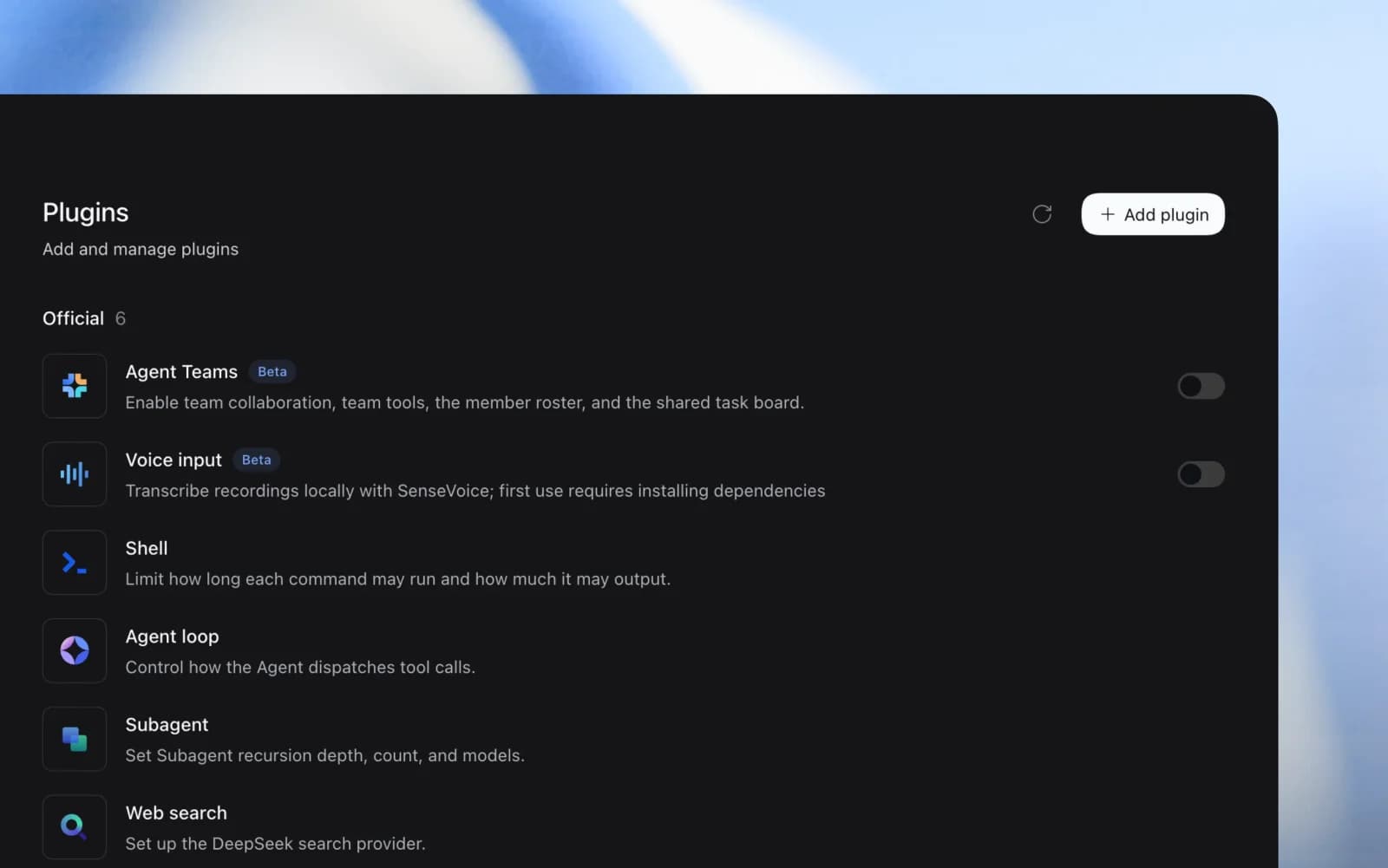
DeepSeek Harness reached 1.54 million daily active users on the official API as of November 4, 2026, according to TechNode's November 6 summary of figures the team released via IT Home. At the same time, Creator Mode on DeepSeek's Harness product page lets users turn plain-language requests into installable plugins, and DeepSeek is preparing an official marketplace with creator incentives. For builders, the story is not the headline number alone: it is whether an open, plugin-first harness can scale past power users without turning third-party extensions into a supply-chain risk.
TL;DR: what changed in November 2026
| Metric or feature | What DeepSeek reported | Caveat |
|---|---|---|
| Daily active users | 1.54M as of Nov 4 | Official API users only, per TechNode |
| Plugin count | ~35,000 third-party plugins | Not independently audited here |
| Plugin adoption | ~60% of those DAU created or installed ≥1 plugin | Same source chain |
| Creator Mode | Chat-driven plugin build, install, verify | Shown on DeepSeek's English product page |
| Marketplace | Official store + token incentives planned | Rules not published yet |
| Growth | ~271k seven-day DAU on Sep 30 → 1.54M on Nov 4, per aggregators citing the team | Compare like-for-like scopes |
Why 1.54M DAU matters for harness choice
 A market stall with one green jar highlighted, illustrating a growing plugin marketplace around DeepSeek Harness
Agent harnesses are the scaffolding around a model: tools, permissions, compaction, UI, and scheduling. Joel Niklaus's Harness Leaderboard showed the same open weights can swing double-digit benchmark points depending on the wrapper alone. DeepSeek's bet is that customization at scale beats a single locked-in UX, and the November user figures are the first time the lab attached a million-plus DAU label to that bet, albeit on a narrow denominator.
Three implications land immediately:
-
Plugin gravity. If six in ten official-API users touch plugins, the product is not "chat with DeepSeek models." It is a platform where behavior lives in extensions. That aligns with the Super-agent architecture post the team published days earlier, where Router and Worker plugins coordinate long-running tasks.
-
Competitive pressure on US harnesses. OpenRouter traffic already lists Harness beside Hermes Agent and Claude Code. A seven-figure DAU base, even API-scoped, gives DeepSeek leverage in the developer-agent fight where Anthropic and OpenAI earn most of their coding revenue.
-
Security surface expands with every plugin. Community growth is not free. The same week, our Microsoft Cambodia Artex incident post underlined how fast agent tooling becomes an attack path when installers trust unvetted bundles. Treat third-party Harness plugins like unreviewed dependencies.
Creator Mode: what DeepSeek actually ships
DeepSeek documents Creator mode on its official Harness page as part of the "Everything is a plugin" story built on Cordis. You can install curated plugins from a manager, or create them through chat in Creator mode to extend tools, skills, and interface chrome.
Creator Mode on the official product page
The English marketing site walks through a Pomodoro timer example:
- You ask Harness to write a Pomodoro plugin.
- The agent loads the cordis-plugin-development skill, writes bundle files, calls plugin_manager.install_bundle, and verifies live state.
- DeepSeek's demo shows the run completing in about five minutes.
That is materially different from "prompt the model to output code you paste elsewhere." Creator Mode closes the loop: generate → install → test inside the same runtime you use for coding and office work. It also matches how DeepSeek pitched the feature on social in early November: users showcased 3D renderers and video-editing workbenches built from English instructions, per secondary coverage that tracked the team's posts.
For readers who already run Harness, Creator Mode is the on-ramp to the 35,000 community plugins TechNode cites without forcing everyone to read Cordis docs first. For newcomers, start with our v0.1 plugin-first stack guide and the desktop public-preview explainer before you install random bundles.
The numbers behind the headline
TechNode attributes the following to IT Home and the Harness team's November 5 release:
- 1.54M DAU on November 4, counting users on the official API route.
- ~35,000 third-party plugins in the ecosystem.
- ~60% of active users created or installed at least one plugin.
Aggregators such as ChainCatcher's November 6 piece add a growth curve: a 271,000 seven-day average on September 30, 429,000 on October 7, then 1.54M on November 4, implying more than a million-user climb in roughly a month on the same official-API definition.
Token volume claims also circulated: some outlets reported on the order of 92 trillion tokens per day processed through Harness on the official API. We did not find that figure on DeepSeek's English site or GitHub README on November 8, so treat it as press-reported until the team publishes it on a primary page.
What is excluded: self-hosted npx @deepseek-ai/dsh web installs, unofficial repackaged sites, and desktop users who never touch the official API. The GitHub repository shows 276k+ stars as social proof of interest, but stars are not DAU.
Planned marketplace and creator program
According to TechNode, DeepSeek will ship:
- An official plugin marketplace for discovery and distribution.
- A creator support program with token incentives, technical exchanges, and recommendation slots.
- Engineering focus on API stability, compatibility, and security for third-party plugins.
DeepSeek has not posted incentive terms in English as of November 8. Until rules exist, assume the marketplace will face the same questions every agent store faces: malware disguised as productivity plugins, abandoned extensions after API breaks, and copycat skills that exfiltrate workspace files.
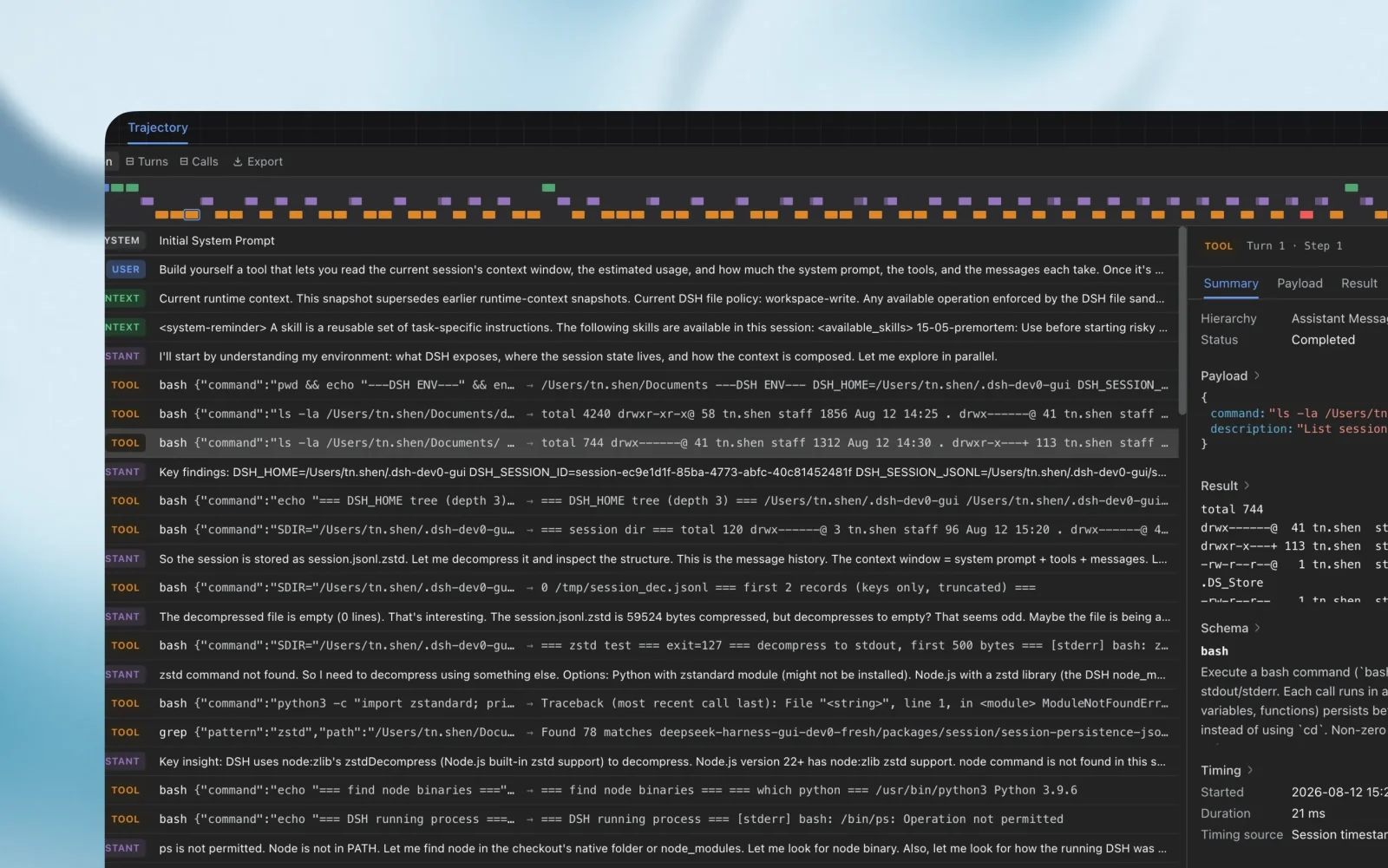 DeepSeek Harness execution trace view for developers tracking agent tool calls after scaling usage
Image: DeepSeek
The execution-trace UI on DeepSeek's site is the practical counterweight: when Creator Mode installs a new bundle, inspect tool calls and timing before you grant network or filesystem reach. That discipline matters more at million-user scale than in a weekend hackathon.
How to try Creator Mode without betting the farm
-
Use the official distribution paths. Run
npx @deepseek-ai/dsh webfrom the GitHub README or install the desktop preview from DeepSeek's domain. Third-party repackagers have already SEO'd confusing clones, as HN commenters noted on the desktop launch thread. -
Sandbox new plugins. Start Creator Mode requests in a disposable workspace. Do not point them at production repos or customer data on day one.
-
Compare harnesses on your model. If you run open weights, cross-check Harness Leaderboard numbers for your stack before you migrate from Hermes Agent or OpenClaw.
-
Watch API scope. Official-API DAU growth may track DeepSeek's hosted inference push more than local Cordis hackers. If you care about offline use, validate MLX or llama.cpp paths separately.
What developers are saying
The Hacker News thread on Harness Desktop is the richest recent discussion, even though it predates the DAU release:
- ssivark argued Cordis is the real story, not "yet another harness," and linked the Cordis composability paper as potentially "the emacs of harnesses" for long-running agents (comment).
- wg0 reported DeepSeek Harness feels lighter and faster than OpenCode in web/desktop use and praised two-way parent–subagent messaging mid-run (comment).
- redox99 echoed a common worry: third-party plugins may be malware, abandonware, or low quality, and they prefer curated defaults unless they author plugins themselves (comment).
- accountrequired warned that binary provenance and auto-updating plugins deserve scrutiny before granting full disk access (comment).
None of those comments verify the 1.54M figure; treat them as implementation feedback, not adoption statistics.
Cordis context: why plugins are the product
DeepSeek Harness is not a thin chat skin. The MIT-licensed repo implements model adapters, tools, sessions, sandboxes, loops, and UI as composable plugins under Cordis. That is why Creator Mode targets package.json, client bundles, and plugin_manager calls instead of dumping a single Python file.
Our Super-agent design explainer walks through how the same substrate supports always-on agents with Router and Worker presets. The DAU spike suggests more people are living in that substrate daily, not merely starring the repo.
 A green baton directing cream gears along a shaft, illustrating coordinated agent harness components
Security: treat Creator Mode like CI for untrusted code
Creator Mode is effectively LLM-authored package installation inside your agent runtime. Before you promote a plugin to a shared team workspace:
- Read generated client.js and manifest permissions.
- Deny network egress until you understand what the bundle calls.
- Rotate API keys if a plugin had access during testing.
- For production agent fleets, pair Harness with controls that stop dangerous tool chains. Teams running autonomous coding agents often layer AgentBeam or similar guardrails on top of permissive harnesses.
DeepSeek's own SAFETY.md in the repository stresses preview-stage breakage; it does not replace your org's software review.
Comparison: where Harness fits in late 2026
| Harness | License / model | Customization | Best for |
|---|---|---|---|
| DeepSeek Harness | MIT, Cordis plugins | Extreme (Creator Mode) | Builders who want to own UI, tools, and scheduling |
| Claude Code | Anthropic proprietary | Low | Teams standardized on Claude with enterprise support |
| OpenCode 2.x | Open, narrower surface | Medium | Terminal-first coding with fewer moving parts |
| Hermes Agent | Open, Nous stack | Medium–high | Open-model shops optimizing Terminal-Bench scores |
| Pi | Open, minimal | Low–medium | Durable sessions without plugin marketplace noise |
None of these rows prove which harness is "fastest" on your repo; run your own tasks. The DAU news mainly tells you DeepSeek's open stack is picking up hosted users, not that you must switch.
What to watch next
- Marketplace rules — token incentives, review gates, and rev-share math.
- Official token and retention stats on deepseek.com or the GitHub org, not only Chinese tech press.
- Breakage notices in the repo as Cordis APIs evolve; the README still warns of compatibility-breaking changes.
- US harness responses — whether Anthropic, OpenAI, or Cursor ship comparable in-harness plugin authoring without closed stores.
Bottom line
DeepSeek Harness is behaving like a platform: more than a million official-API daily users, tens of thousands of plugins, and Creator Mode that ships extensions from chat. The opportunity for builders is real composability; the risk is unreviewed plugins at scale. Use official installers, trace tool calls, and compare harnesses on your models before you migrate production workflows.
For Google's competing agent-builder surface, see Maps Platform in AI Studio (November 9, 2026).
Related reading
- DeepSeek Harness v0.1: plugin-first stack
- DeepSeek Harness desktop public preview
- Exploring Super-agent design
- Harness Leaderboard reliability bars
- What is an agent harness?
- Cordis spatiotemporal composability explainer
- Loop engineering for coding agents
- DeepSeek V4.1 Flash on OpenCode free tier
Figures on DAU, plugins, and growth are as reported by TechNode and secondary aggregators on November 6, 2026, unless otherwise linked to DeepSeek's own site.