




Thinking Machines Lab released Inkling 2 Mini on November 20, 2026 as an Apache 2.0 open-weight model you can run on a laptop or DGX Spark, not only on a multi-GPU cluster. The same day Vals AI reported that Mini ties Claude Opus 5.5 (CVP) on CyberBench v1.1 at 74.58% with a much lower cost per test on Vals harnesses.
Quick answer
| Question | Answer |
|---|---|
| Release date | November 20, 2026 |
| License | Apache 2.0 (per announcement and model card) |
| Architecture | Looped transformer: middle layers run 3× per token |
| Vals CyberBench v1.1 | 74.58%, #10 of 49, tied with Opus 5.5 (CVP) per Vals |
| Vals cost per CyberBench test | ~$0.93 vs ~$4.17 for Opus 5.5 (CVP) on the same page |
| Lab headline evals | DeepSWE v1.1 48.2%, Vals Index v2.2 46.5% per announcement |
What Thinking Machines announced
The Introducing Inkling 2 Mini post frames three ideas builders care about:
- Looped depth instead of more tokens. Mini reuses the middle stack three times per token so the model can spend more compute on reasoning without blowing up sequence length. That design targets agentic coding where quality per step matters.
- Local-first footprint. The lab says Mini is fast enough for a Mac laptop and NVIDIA DGX Spark, a shift from Inkling 2 Small, which needs hundreds of gigabytes of VRAM for NVFP4 checkpoints.
- Open weights day one. Unlike Small’s staged open release, Mini ships with Hugging Face and Ollama paths in the launch post.
The model card adds safety and capability slices: the lab compares CBRN, cyber, and agentic risk against public frontier models and documents refusal behavior on self-harm and harmful requests.
CyberBench tie: what Vals measured
CyberBench asks whether agents can find and patch realistic open-source security bugs. On November 19–20, 2026, the leaderboard shows Inkling 2 Mini at 74.58%, equal to Claude Opus 5.5 (CVP) in the accuracy column, while Wonder still leads at 80.36%.
Vals’ model page for Inkling 2 Mini adds cross-benchmark context:
- Vals Index: 46.46% (#38 of 43 on that composite).
- Vibe Code Bench: 77.92%, up sharply from the original Inkling generation on Vals.
- Finance Agent v2.1: 56.54% at roughly five minutes per task on Vals.
- SWE-bench Multimodal: 37.92%.
Vals also notes Mini reaches about 96% of Inkling 2 Small’s Vibe Code Bench score and 97% of Small’s SAGE score on shared tasks. That is useful if you choose between local Mini and datacenter Small.
What developers should not over-read
CyberBench scores depend on harness version, tool access, and duration per test. Vals lists ~33 minutes median duration and ~29M tokens per test for Mini on CyberBench, far heavier than top closed models on latency. A tie on accuracy does not mean Mini is faster or cheaper in production without your own load test.
For background on how CyberBench fits the wider eval push, see our Vals CyberOffense leaderboard post and Inkling 2 Small profanity-in-thinking-log analysis.
Architecture: looped transformer in plain language
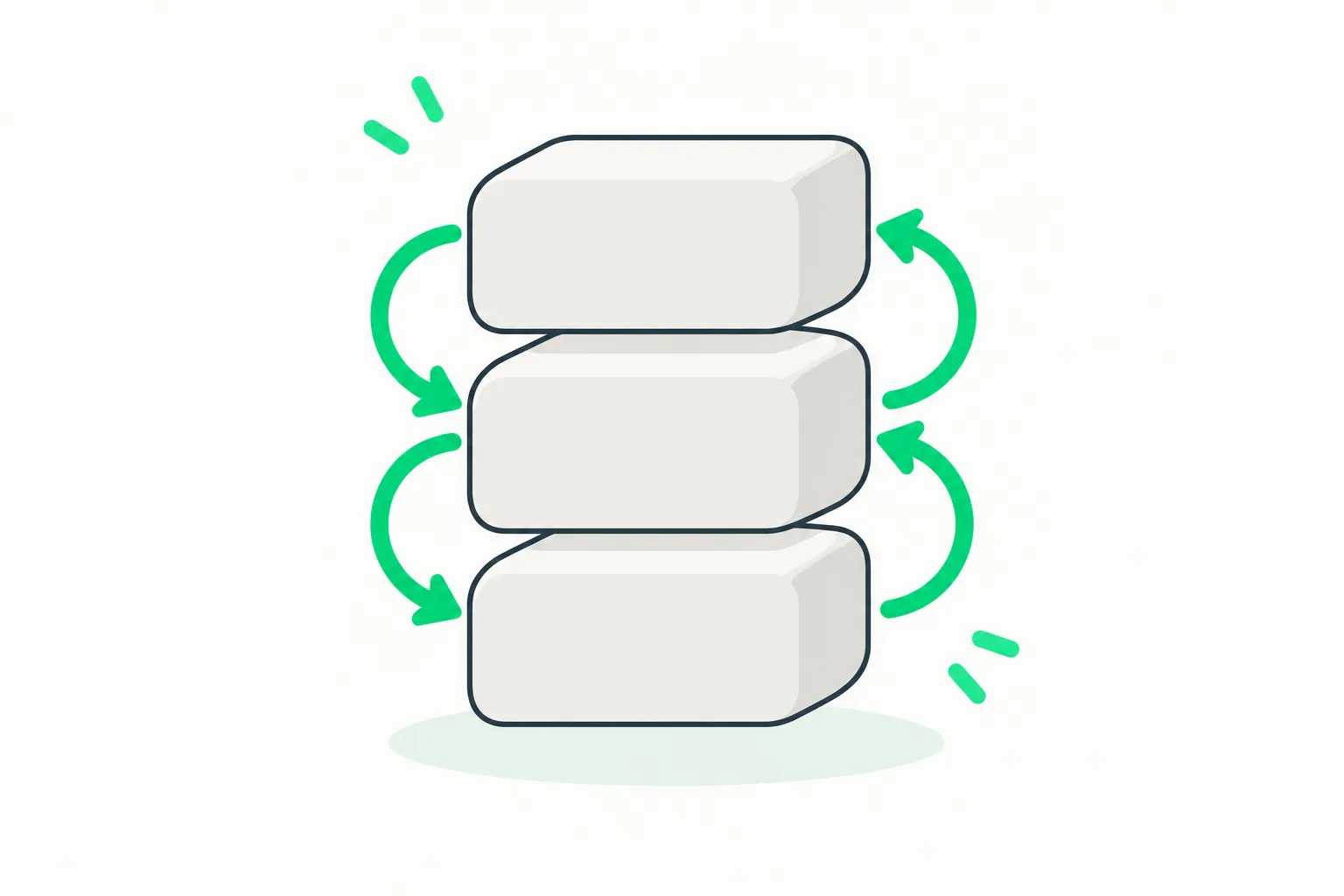 Looped transformer blocks reusing middle layers three times per token
A standard transformer runs each layer once per token. Inkling 2 Mini’s loop runs selected layers three times before moving on. The lab argues that extra depth improves agentic coding and reasoning without forcing the model to generate longer chains in the visible output.
Compared with MoE giants in the Inkling family:
| Model | Scale shape | Typical deploy |
|---|---|---|
| Inkling 2 Small | 594B total, 17B active MoE | Multi-GPU datacenter |
| Inkling 2 Mini | 26B looped (5.4B active per token on Vals) | Laptop, Spark, single-GPU rigs |
| Inkling-Small (July) | Earlier generation | Historical baseline |
If you serve with SGLang or vLLM, check the model card for supported runtimes before you commit hardware.
Benchmarks on the model card vs Vals
Thinking Machines publishes its own tables on the model card, including agent and knowledge-work slices. The announcement highlights:
- DeepSWE v1.1: 48.2%
- Vals Index v2.2: 46.5%
- Leadership claim among open models under 100B total parameters on those slices.
Always label numbers by source:
- Lab table = what Thinking Machines measured on its harness.
- Vals leaderboard = third-party harness with public methodology.
When you pitch security automation to customers, cite your rerun, not a headline tie alone.
How to try Inkling 2 Mini
- Read the model card for license, modalities, and safety tiers.
- Pull weights from the Hugging Face repo linked on the announcement (verify the org is
thinkingmachines). - Local inference: follow Hugging Face’s Inkling 2 Mini blog for Ollama and consumer-GPU guidance.
- Cyber eval: if you run offensive security agents, reproduce a subset of CyberBench tasks in a sandbox before you replace closed APIs.
- Serving at scale: compare Together and other hosts only after latency tests; Mini’s Vals token count per CyberBench test is high.
Cyber capability in context
Open models near Opus-class CyberBench scores change how teams staff appsec agent pilots. Closed APIs still dominate when you need vendor indemnity or enterprise DPA terms, but open weights let you air-gap inference.
Pair this launch with:
- Terminal-Bench cheating audit lessons when you trust agent benchmarks.
- Dragos canary prompt study when you send exploits or credentials through third-party routers.
- Open-source coalition without Jensen Huang for geopolitical framing on Western open weights.
What this does not solve
Mini does not fix export control, customer data residency, or alignment guarantees. The model card’s safety section describes internal evals; it is not a certification. CyberBench measures OSS-Fuzz-style crashes, not phishing, identity attacks, or living-off-the-land tactics.
If your workflow needs multimodal long documents, compare Mini’s image support against Gemini 4 Neon on your own docs.
Thinking Machines lineup after Mini
Mini sits between Inkling-Small history and Inkling 2 Small datacenter scale. The lab’s ladder strategy means more sizes may follow; Mini is the local cyber-curious rung released the same week Hugging Face amplified distribution.
For Tinker fine-tuning on larger Inkling variants, see the Inkling 2 Small weights post.
FAQ tie-in: is Inkling 2 Mini safe for production cyber agents?
The lab documents refusal and uplift tests, but production requires your policy layer, sandbox, and human approval on destructive tools. Vals’ tie with Opus on CyberBench is an eval signal, not a green light to run unsupervised exploits on production repos.
Hardware and consumer deploy paths
 Laptop-class local deploy for a 26B open-weight agent model
Thinking Machines markets Mini for Mac laptops and DGX Spark because the total parameter count fits a different envelope than Inkling 2 Small. You are not loading a 594B MoE; you are loading a dense-style 26B looped stack with 5.4B active per token on the Vals profile.
Practical checklist before you download weights:
- Confirm unified memory or GPU RAM against the checkpoint precision you pick (FP16, quantized GGUF, or vendor formats on Hugging Face).
- Pick a runtime the model card lists; do not assume every Inkling 2 Small server recipe ports downward without changes.
- Budget cooling and power on laptops; sustained agent loops peg GPUs for tens of minutes on CyberBench-class tasks per Vals durations.
- Isolate networks if you run exploit-finding agents; local weights do not remove legal or contractual duties on target repos.
Hugging Face’s companion Inkling 2 Mini blog walks through consumer paths; treat it as distribution guidance, not a warranty you hit Opus parity on your data.
Training and safety transparency
The announcement ties Mini to the same safe path to open weights narrative as larger Inkling releases: external testing before broad files ship. The model card still documents refusal behavior, sycophancy checks, and CBRN or cyber uplift comparisons against frontier baselines.
None of that replaces your red team on the workflows you automate. If you pipe customer credentials into CyberBench-style agents, read token fraud and trial abuse patterns and Signal screenshot blocking for adjacent operational security habits.
Cost modeling on Vals versus self-host
Vals lists $0.15 / $0.50 per million input and output tokens on its model page alongside per-benchmark dollars per test. CyberBench at ~$0.93 per test is cheap versus Opus CVP at ~$4.17 on the same harness, but 33-minute medians mean worker occupancy costs dominate if you serialize jobs.
Self-hosting trades token rent for amortized hardware and engineer time. A break-even calc needs your queries per day, quantization choice, and electricity. Mini’s story is strongest when data cannot leave the device or when you already own a Spark or Apple Silicon lab machine.
When not to choose Inkling 2 Mini
Skip Mini as your only model if you need:
- State-of-the-art multimodal reasoning on every benchmark slice (lab tables still show gaps on some finance and science indexes).
- Vendor-backed indemnity for cyber actions (open weights put liability on you).
- Sub-second routing at huge QPS (looped depth adds compute per token).
- Guaranteed parity with Opus on non-CyberBench tasks without testing.
Keep Inkling 2 Small or a frontier API in the loop for tasks where Mini’s Vals Index 46.46% composite is below your bar.
What developers are saying
Hacker News threads on Thinking Machines releases often debate eval harness honesty and VRAM marketing. We have no dedicated Mini thread with hands-on numbers in this run; treat social claims as unverified until you see reproducible logs.
When a thread appears, compare commenter commit hashes and GPU models to your stack before you trust a single accuracy screenshot.