




Huawei's Horinger AI campus in Inner Mongolia runs on domestic Ascend chips, yet Epoch AI estimates it holds only about 7% of the AI compute at SpaceX's Colossus 2 in Tennessee — roughly 81,000 versus 1.1 million H100-equivalents in late 2026. The gap is not mainly electricity. Epoch's November 6, 2026 report argues China can site hundreds of megawatts, while chip volume and per-watt efficiency still favor U.S. Blackwell stacks and export-controlled Nvidia supply.
For builders comparing where frontier training runs, which cloud regions matter, and how open-weight Chinese labs stretch domestic silicon, Horinger is the clearest public sizing exercise we have this week. It sits beside our Colossus 2 capacity thread, Anthropic's Colossus partnership, and Southeast Asia routing fights over who actually gets H100-class throughput.
TL;DR
| Metric | Huawei Horinger (Epoch point estimate) | Colossus 2 (Epoch directory) |
|---|---|---|
| AI compute | ~81k H100e (90% CI 36k–141k) | ~1,112k H100e |
| IT power | ~170 MW current | ~946 MW current |
| Chips cited | ~105k Ascend 910C, 8k 910B | Blackwell B200/B300 class |
| 2028 projection | ~141k H100e | ≥1.8M H100e |
| Share vs Colossus 2 | ~7% today; similar or smaller share in 2028 | Baseline |
What Epoch AI measured at Horinger
Epoch AI treats Horinger as a case study in China's East Data West Computing push. The campus sits in Horinger New Area, Inner Mongolia, split into West, South, and North zones marketed as Huawei Cloud availability regions. Epoch bought high-resolution satellite imagery and counted rooftop cooling towers and chillers to infer IT power. Four dense AI-style buildings in South and West zones sum to about 286 MW of IT capacity in the cooling model, aligned with substation and generator cross-checks near 304 MW and 230 MW.
How the three zones differ
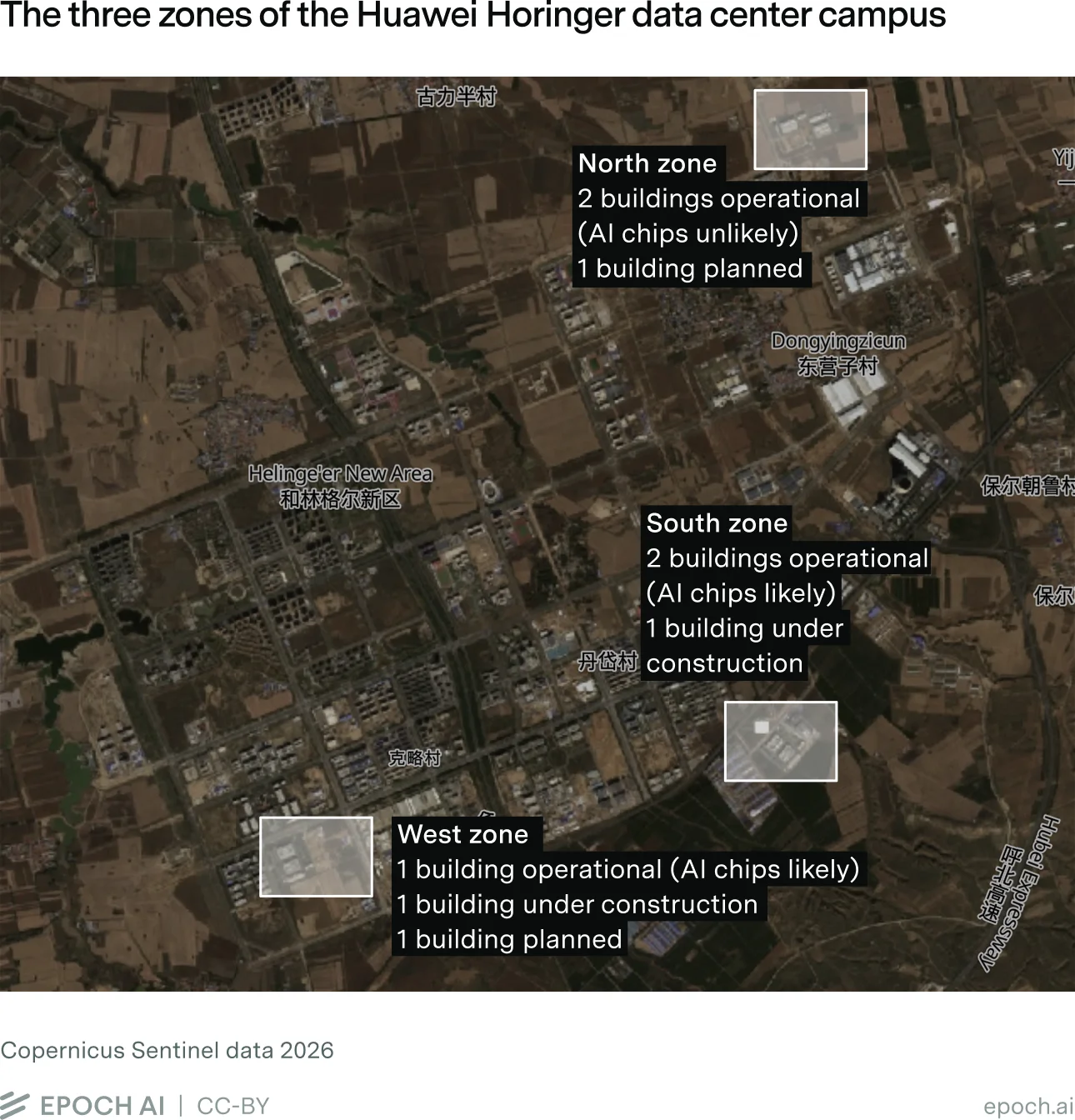 Satellite map of Huawei Horinger data center zones in Inner Mongolia for China AI infrastructure analysis
Image: Epoch AI
Epoch notes the North zone shows far fewer cooling towers than South and West, so those buildings likely host lower-density workloads. South and West match published renderings of hypernode halls aimed at large-model training. By August 2026 imagery, three of four AI-focused buildings looked operational; one West building remained idle with a December 2026 start assumption. Vapor plumes and moving fan "ghosts" in satellite frames support active cooling on running halls.
Occupancy matters. Epoch assumes 76% rack fill, matching a reported rate for the wider Horinger area in September 2026, then maps Ascend sales with a four-month deployment lag. That yields ~105,000 Ascend 910C and 8,000 Ascend 910B chips on site, or 81,000 H100e central estimate.
Ascend 910C vs Nvidia: why power is not enough
Epoch cites CloudMatrix-Infer evidence for ~1.504×10¹⁵ INT8 OP/s per 910C package (two dies), about 0.76 H100e versus an H100 peak near 1.979×10¹⁵ OP/s. Blackwell B200/B300 classes sit near 2.5 H100e with ~2.5× better energy efficiency in Epoch's framing.
The report's punch line for infrastructure planners: Chinese megawatts do not equal U.S. megawatts in useful FLOPs. Epoch writes U.S. AI data centers can support 2.5× more AI compute per unit of power than China's best domestic halls at current chip mixes. That connects to DeepSeek Ascend pretraining rumors and entity-list procurement workarounds — labs chase both domestic Ascend and diverted Nvidia.
The Colossus 2 comparison
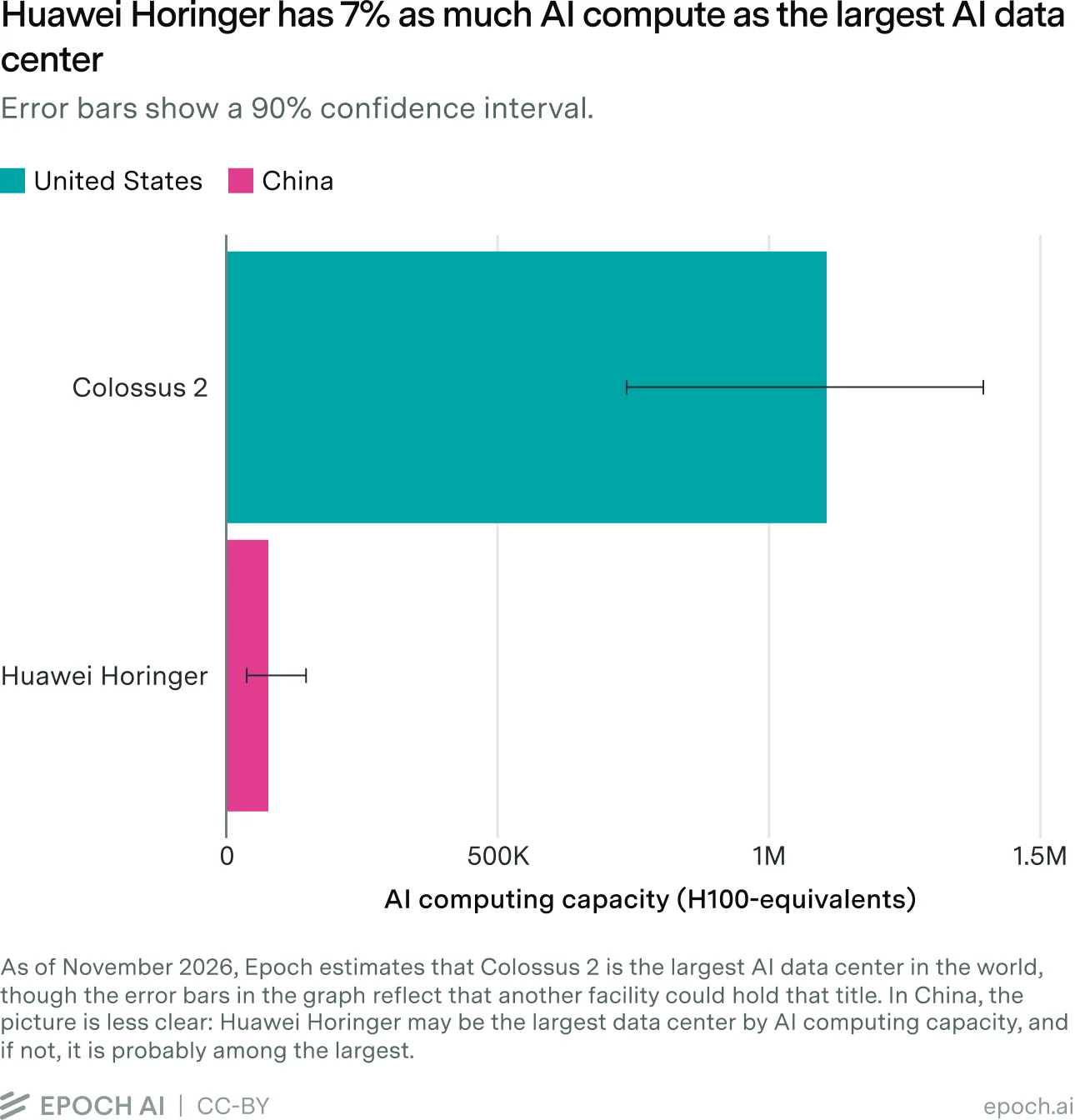 Bar chart comparing Huawei Horinger AI compute at 81,000 H100-equivalents versus SpaceX Colossus 2 at about 1.1 million
Image: Epoch AI
Epoch's Colossus 2 directory page lists roughly 1.112 million H100e today, tied to SpaceXAI ownership with customers including Anthropic and Cursor, plus 946 MW IT power and ~$35.8B capital cost in their model. Horinger at 81k H100e is still large by global standards — Epoch says only VNET Bayin Ulanqab and Huawei Wuhu likely match or slightly exceed it among Chinese sites they depth-reviewed.
Caveats Epoch flags:
- Campuses often split into multiple clusters that cannot merge into one training job without special networking.
- 10% of Horinger (~8,100 H100e) could still train a DeepSeek-V4-Pro scale model in one month in their scenario.
- An optimistic unified run might need ~one year for GPT-6 Astra scale — a thought experiment, not a product roadmap.
Build-out through 2028
Construction imagery shows another South-zone building on track for February 2028. A public line mentions 100,000 accelerator cards and Ascend 950 silicon; Epoch assumes ~76,000 950DT chips in that hall with 135 MW IT power. Grid plans suggest substation expansion could eventually support ~3.5× current campus power.
Even then, Epoch projects Horinger at ~141k H100e (90% CI 65k–227k) by early 2028 while Colossus 2 could pass 1.8 million H100e. Huawei Wuhu may grow faster, reaching ~151k H100e by December 2027 — so China's frontier is multi-campus, not a single Inner Mongolia site.
Who might use the capacity
Epoch lists plausible tenants without confirming contracts:
- Huawei Cloud itself, including driver-assistant workloads (~60k H100e cited elsewhere for April 2026).
- Fintech and data aggregation lines from a local announcement on a West-zone building.
- Zhipu (Z.AI) and iFlytek as companies tied to large domestic stacks and Horinger New Area offices — placement unverified.
That diversity matters for builders: not every Ascend rack trains a chat model. Much capacity likely serves inference, cloud SKUs, and vertical AI, similar to how U.S. hyperscalers mix training halls with general regions.
What this means if you build on AI compute
If you procure GPUs or rent clusters, treat Epoch's H100e numbers as capacity planning anchors, not lease pricing. China's power advantage shows up in land and cooling; frontier scale still tracks Nvidia export dynamics and Ascend ramp curves.
If you benchmark open models, a capable GLM or DeepSeek release on Ascend does not disprove the gap — it shows algorithmic efficiency under tighter FLOPs. Compare against Artificial Analysis-style cost posts only when the same chip class is named.
If you follow policy, Horinger supports Pax Silica allied supply-chain lists and Commerce remote-access rules narratives: Washington worries about rented compute, Beijing invests in domestic halls, and both sides argue with megawatt headlines while FLOPs per watt decide practical frontier access.
Sister campuses and CloudMatrix384 rollouts
Epoch lists eight reported CloudMatrix384 supernode sites from April–December 2025, mixing Huawei-owned halls and China Telecom, China Mobile, China Unicom, and Shenzhen Longgang facilities. Horinger is one node in that mesh; Wuhu may outgrow it by December 2027 in Epoch's projections. Treat national Chinese frontier capacity as the sum of many campuses, not Horinger alone — the same way U.S. readers should add Starbase notices to Colossus 2 rather than conflating them.
The report also estimates 907,000 Ascend 910C chips sold by end-March 2026, with Horinger consuming ~11% of that stock by August deployment assumptions. That ratio matters for supply-chain analysts: a flagship hall can be large without exhausting domestic inventory, leaving chips for telecom edge sites and supernodes listed in Epoch's table.
Satellite methodology in plain language
Epoch's workflow for readers who will cite the report in briefings:
- Buy commercial satellite passes over Inner Mongolia and sister sites.
- Outline cooling hardware on rooftops — towers, chillers, ghosted fan motion — to infer heat rejection and IT megawatts.
- Cross-check substation transformer counts and backup diesel banks against cooling totals.
- Apply rack occupancy and chip-deployment lag from sales databases.
- Convert installed Ascend counts to H100e using documented INT8 peaks, with confidence intervals.
The org withholds some vendor sources to protect continued access — contact info@epoch.ai per the article footer if you need the withheld annex for research. explainx.ai did not receive a private annex; our numbers come from the public page and Huawei Horinger directory entry.
Efficiency gap table for procurement teams
| Factor | U.S. frontier (Colossus-class) | Huawei Horinger (Epoch estimate) |
|---|---|---|
| Dominant silicon | Nvidia Blackwell B200/B300 | Ascend 910C / 910B mix |
| H100e per MW (qualitative) | Higher FLOPs per watt | ~40% of leading U.S. halls per Epoch |
| PUE context (2025 averages) | U.S. ~1.49 in Uptime survey | China ~1.40 — power not the bottleneck |
| Networking caveat | Multi-building NVLink domains | Clusters may not merge for one run |
If your compliance team blocks China-region training, these numbers still inform red-team benchmarking: adversaries with ~81k H100e can host credible mid-scale experiments even when they cannot match million-GPU campuses.
How Epoch AI fits other trackers
Epoch is a nonprofit research org publishing AI data center directories and compute-gap analyses. Searchers often ask what Epoch AI does — here, it fuses satellite evidence, chip sales estimates, and normalized H100e math so policymakers and ML engineers share one vocabulary. Our prior Epoch trajectory coverage shows the same team sizing agent risk; this report sizes physical AI capacity.
Related reading
- SpaceX Colossus 2: 1.2M Blackwell GPUs, claimed vs verified
- Anthropic secures SpaceX Colossus 1 supercomputer
- Chinese AI labs rush overseas Nvidia capacity after Huang scandal
- Congress bipartisan Nvidia China chip curbs in NDAA
- DeepSeek static browser client on GitHub
- Singapore Nvidia chip routing and Megaspeed probes