



Grep AI, an agent platform aimed at compliance and due diligence work, is running a launch week with one new feature a day. Two have shipped with official write-ups: a Skills Library on October 13, 2026 and Decision Outputs, powered by TypeSafe AI's Jev model, as day two. A third, 1,000+ SaaS integrations plus authenticated browser access, appears so far only in a social post.
This post sorts the three: what Grep itself documents, what is claimed, and what it means if you build or buy agents for regulated work. Sources are Grep's own posts on the Skills Library and Decision Outputs, and its changelog.
Claimed versus verified
| Item | Source | Status |
|---|---|---|
| Launch week, one feature a day | Grep blog | Confirmed by Grep |
| Skills Library (custom, reusable skills) | Grep blog, Oct 13 | Confirmed, with a 33-second demo |
| Decision Outputs powered by Jev | Grep blog, Oct 13 | Confirmed, with a 67-second demo |
| Probabilities for choice questions and review thresholds | Grep blog | Described by Grep; calibration is its claim |
| 1,000+ integrations via Composio (Gmail, Calendar, Outlook, Notion, Salesforce) | A post on X by Grep's AJ Asver | Not on Grep's blog or changelog when we checked |
| Authenticated browser access with an encrypted credential vault | Coverage of the same announcement | Not documented on Grep's site that we could find |
| Custom APIs and MCP connections | Coverage of the announcement | Plausible: Grep's changelog shows a public MCP server since v2.1 in May; the new connector support is unconfirmed |
The integrations count is the part to be careful with. Grep's own product pages and earlier materials cite far smaller numbers of built-in data sources, and its changelog lists nothing for this week yet. A partnership that exposes a third-party catalog is a different thing from 1,000 hand-built integrations. When Grep publishes its day-three post or changelog entry, we will update this post.
Day one: the Skills Library
Grep's description: a place to create custom skills for procedures used across multiple agents. You describe a procedure, attach your documents, and Grep uses deep research to draft the skill prompts and supporting context files. The skill can then be used in chat or attached to agents.
The example in the demo is merchant classification. A single skill is used in chat and in two agents, one for enterprise onboarding and one for small-business onboarding. When the procedure changes, you update the skill once and every agent that uses it follows the new process.
This is the same idea behind portable agent skills elsewhere; our complete guide to agent skills explains the pattern. What is different here is that the skill is authored through research plus your documents, rather than written by hand as a file. Grep's changelog also shows per-expert SKILL.md support since v2.3 in May, so this builds on an existing foundation.
Day two: Decision Outputs powered by Jev
Decision Outputs connects research to a judgment. In the agent builder you choose Decision as the output type, then write the questions, define the answer options and add a rubric for each. For a business-onboarding workflow the options might be approve, review or decline, and the research covers the company, its ownership, sanctions and adverse media.
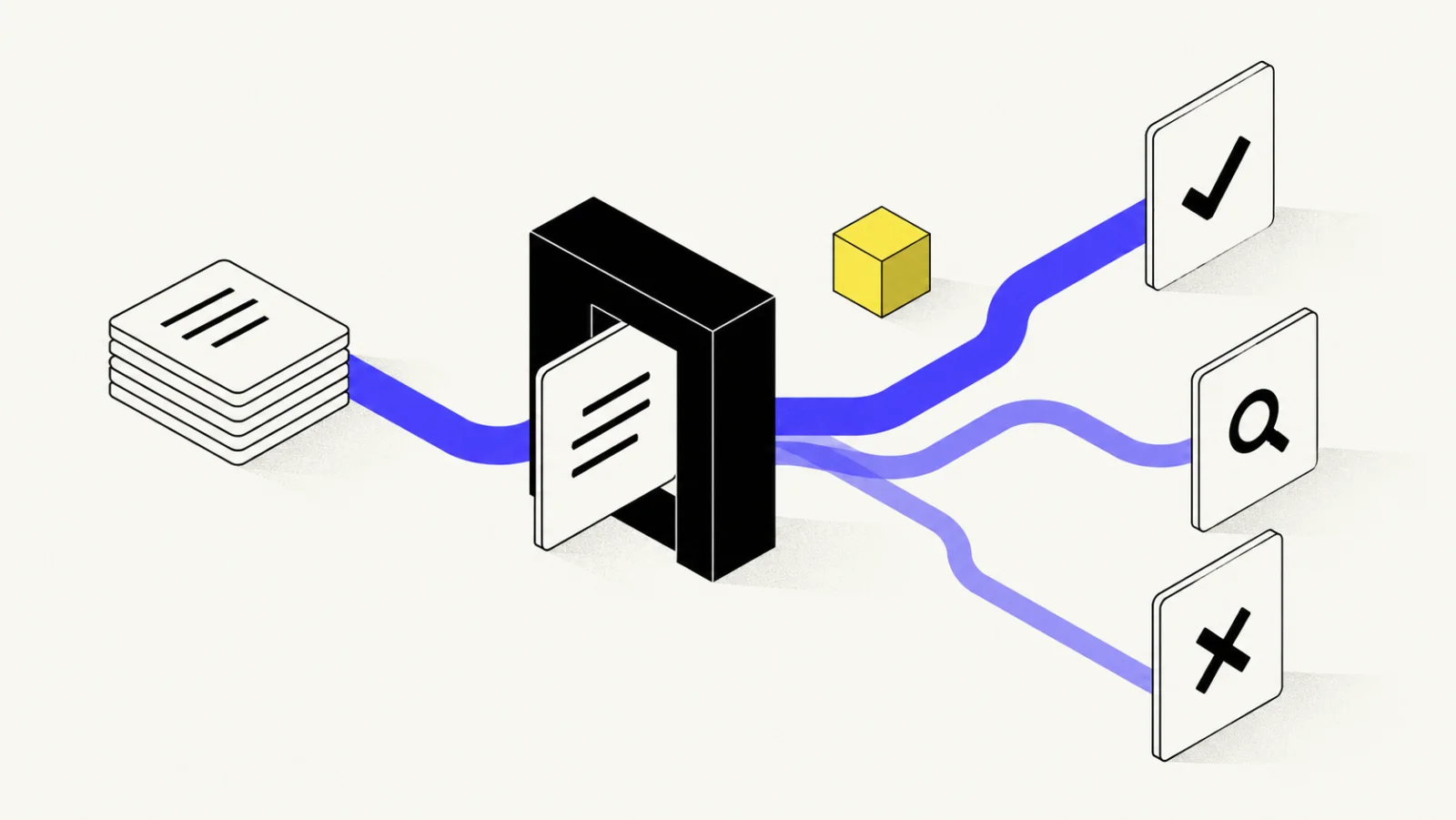 Grep AI Decision Outputs illustration: research documents passing a decision gate into approve, review and decline
Image: Grep
Grep AI Decision Outputs illustration: research documents passing a decision gate into approve, review and decline
Image: Grep
The architecture is two-stage. Frontier models do the research. TypeSafe AI's Jev model then evaluates the report and makes the final call against your criteria. For choice questions, Jev returns a probability for each option, and you set a threshold: above it the agent acts, below it a person reviews. Results show above the supporting research report with citations, and you can copy or download decisions as JSON.
Why the probability is the point
Grep's argument is that asking a general-purpose LLM how confident it feels yields a self-reported number, while Jev is trained to produce calibrated probabilities. If that holds, the threshold has real meaning: you can decide that cases under 85% go to a person and measure how many that is. If it does not, the threshold is decoration.
We have covered Jev from several angles, and this is the first product use we have seen that wires it into a human-review flow: how Jev works, Jev against XGBoost and BERT classifiers, scoring production traces in LangSmith, and Grep's AgentRun workflows. The practical test is the one in those posts: compare the model's stated probabilities with your own labeled outcomes before you trust a threshold.
Day three (unconfirmed): integrations and a browser that logs in
The reported announcement has two parts. First, Grep agents get access to 1,000+ integrations for SaaS products through Composio, with support for custom APIs and Model Context Protocol connections. Second, an authenticated browser lets agents navigate and automate websites, including government databases, that have no official API, by using credentials kept in an encrypted vault. A fintech example given is processing compliance alerts that normally require manual logins to legacy software.
If accurate, this matters because much compliance work lives in portals without APIs. It is also the riskiest of the three launches.
Risks to weigh
- Credential exposure. An agent holding logins is a high-value target. Use dedicated, least-privilege accounts, not personal ones.
- Terms of service. Many sites forbid automated logins. Check before automating a portal.
- Audit trail. For regulated work, you need to log which actions an agent took and under whose authority.
- Prompt injection. A page an agent visits can try to steer it. Our MCP guide covers the trust boundaries of tool connections.
- Runtime controls. Tools like AgentBeam, the agent security platform from the explainx.ai team, are built to stop agents before they take dangerous actions; whatever you use, put a control between the agent and irreversible steps.
Where launch week fits in Grep's 2026 release history
Grep's public changelog shows a steady build-out through the year, which helps judge how much of this week is new and how much is extension:
- Grep 2.0 (May 2, 2026): a public API with structured outputs, skills-first experts, scoped API keys and spend controls.
- v2.1 (May 7): a public MCP server and A2A discovery, so other agents can call Grep's research agents.
- v2.2 (May 8): API research paid through x402 and MPP payments with automatic failure refunds.
- v2.3 (May 22): per-expert SKILL.md instructions in research and chat runs.
- v2.5 and v2.7 (July): confidence-aware reports with verdict stamps, section-level confidence, source checking and screenshot-backed URL verification.
- v3.0 (July 24): Agent Builder, a redesigned editor with output templates, per-session chats and an activity inspector.
Seen this way, the Skills Library is the next step on the skills line begun in May, and Decision Outputs is a new output type in the Agent Builder introduced in July, building on the confidence work in the reports. The integrations item, if confirmed, would be the broadest change because it widens what agents can touch rather than what they produce.
A simple test plan before you buy
If you are evaluating this for compliance or onboarding work, a short pilot says more than any demo:
- Pick one procedure with a known right answer, such as classifying merchants or screening a set of companies you have already reviewed by hand.
- Build it as a skill and confirm two agents produce the same result from it, and that editing the skill changes both.
- Run Decision Outputs on 100 past cases with your rubric. Record the probability for each option and the human-verified outcome.
- Plot reliability. Group cases by stated probability and check how often each group was right. If 90% cases are right 90% of the time, a threshold at 90% is defensible.
- Set the review threshold from data, not intuition, and count how many cases a person would still see.
- Only then connect live systems, starting read-only.
This test also tells you whether the extra model stage is worth its cost compared with simply asking the research model for a verdict.
What it means for teams evaluating Grep
- Skills and decisions are shipped and documented. You can test them now against your own procedures.
- Ask for evidence on calibration. Request reliability data for Jev on tasks like yours, not just a demo.
- Hold off on integration-count claims. Wait for Grep's documentation, then check which apps, which scopes and what permissions.
- Scope browser automation narrowly. Start with read-only workflows.
- Keep a person in the loop for declines and edge cases, which is what the threshold design is for.
Open questions
- Which integrations are native and which come through Composio, and what do they cost?
- How is the credential vault encrypted, and who can access it?
- What are the published calibration results for Jev in Decision Outputs?
- What are the remaining launches this week?
Related reading
- AgentRun: how Grep.ai turns agents into cheap, auditable workflows
- How does Jev work? RLCD and System One models explained
- Jev vs XGBoost and BERT classifiers
- LangSmith and Jev: scoring production traces
- What are agent skills? Complete guide
- What is MCP? Model Context Protocol guide
- Sources: Grep: Skills Library, Grep: Decision Outputs, Grep changelog
Details are accurate as of October 14, 2026; Grep's launch week is ongoing and features may change.