




Google DeepMind used a new agent stack called AlphaProof Code to machine-check selected security properties of the Signal protocol against the cryptography code that actually runs on devices, completing the work in about four weeks, according to the lab's November 10 announcement. That is a different milestone from a pen-test or a design review: every proof step is checked by the Lean proof assistant, so errors in reasoning show up as compile failures rather than slide decks.
For builders, the story matters on two tracks. Signal, Google Messages, and other apps inherit Signal-derived cryptography, so independent assurance on core properties reduces the class of implementation bugs that no amount of unit testing fully covers. Separately, the project is evidence that agentic formal methods can shrink calendar time on problems security teams have treated as too expensive to finish. It does not mean every app is proved safe, and it does not replace threat modeling for clients, servers, and operational controls. For earlier math-oriented work in the same family, see our coverage of AlphaProof Nexus in Science; for complementary open verification efforts, the Signal Shot initiative on GitHub is worth watching alongside this release.
TL;DR: what was verified and what was not
| Question | Answer | Source |
|---|---|---|
| What framework? | AlphaProof Code, multi-LLM agents plus human experts | Google DeepMind |
| Proof language | Lean, with automatic checking of agent-written steps | Google DeepMind |
| Models cited for proof work | Gemini Carbon agents | Google DeepMind |
| Lines of Lean generated | Over six million | Google DeepMind |
| Human review focus | About one percent of codebase flagged for expert review | Google DeepMind |
| Calendar time | About four weeks for this proof of concept | Google DeepMind |
| New Signal bugs found? | None reported in examined portions | Google DeepMind, WIRED |
| Scope | Core cryptographic guarantees on production code, not full mobile clients | WIRED paraphrase of researchers |
| Artifacts | DeepMind says specs and proofs are being open-sourced | Google DeepMind |
| Relation to WhatsApp or other apps | Protocol family overlap; this work is on Signal stack as modeled | Industry practice |
Agents that act on your behalf need rules. See how explainx helps secure your agents →
Why implementation-level verification is the hard part
Cryptographers have formally analyzed the Signal protocol design for years. Production risk often lives one layer down: compilers, constant-time details, memory layouts, and the gap between a paper model and the code on a phone. DeepMind's post stresses that most prior protocol verification stopped at design level, while their agents aimed to show the compiled code meets specified properties, including forward secrecy style guarantees around temporary device compromise.
That gap is where real-world vulnerabilities hide. It is also why the project is expensive in human time without automation. Lean gives a mechanical gatekeeper: agents can draft verbose proofs, but only checked theorems count. The announcement ties this work to future targets like medical firmware and grid software, and to pairing with automated defense agents such as CodeMender mentioned on DeepMind's security roadmap.
 A sealed envelope with a padlock illustrating end-to-end encryption guarantees in the Signal protocol verification story
How AlphaProof Code is structured
DeepMind describes a split workflow that mirrors a verification lab rather than a single chat session. Humans and models collaborate to write formal specifications in Lean. Proof agents, powered by Gemini Carbon, attempt to close obligations. Lean rejects any invalid step. Agents also audit their own proof output and surface roughly one percent of the corpus for human judgment, while the checker handles the rest.
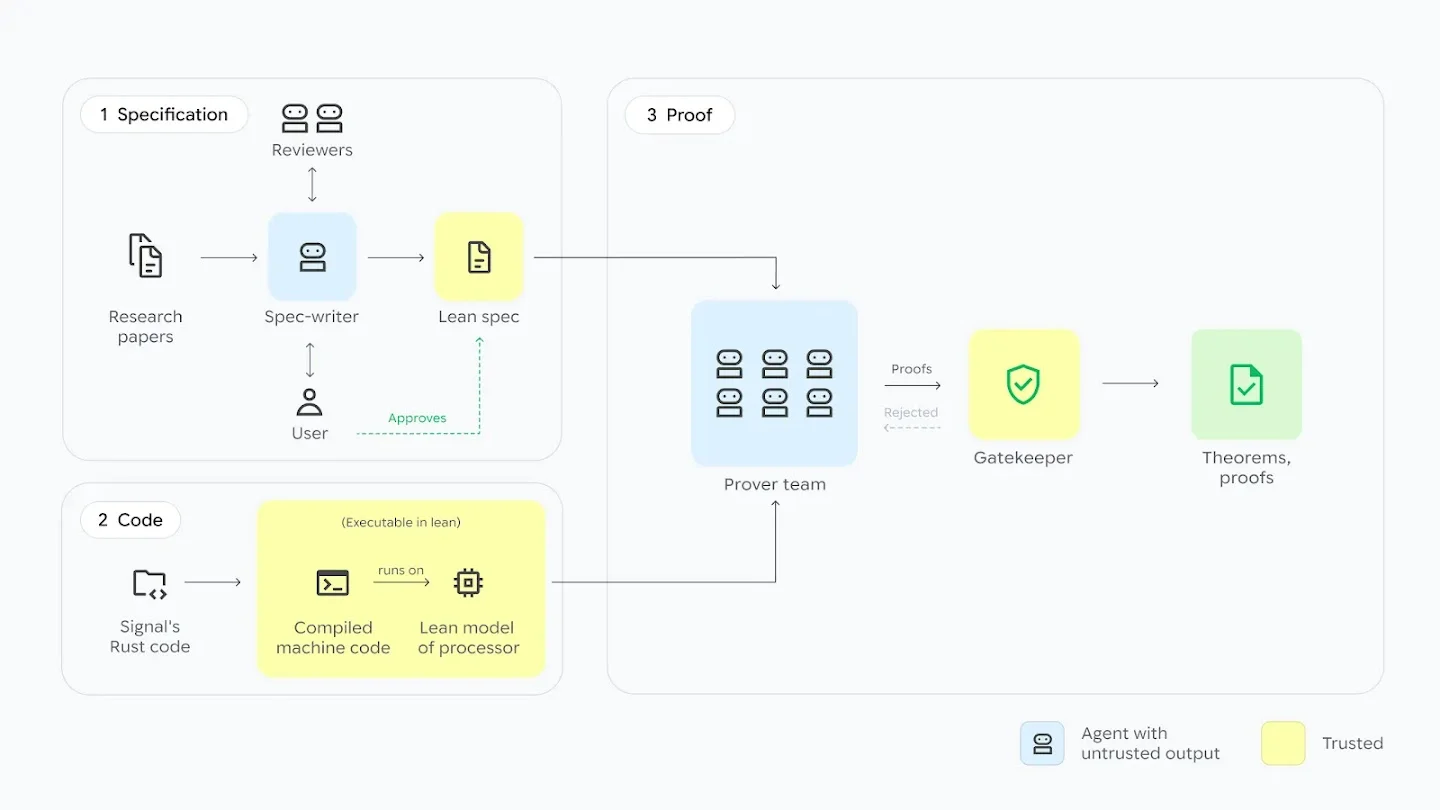 AlphaProof Code formal verification workflow diagram for Signal protocol Lean proofs
Image: Google DeepMind
WIRED's reporting on the same release notes that researchers reintroduced two historically fixed bugs into an isolated Signal codebase. AlphaProof Code then derived machine-checked proofs that those variants were insecure, which tests whether the pipeline can fail loudly when code is wrong, not only succeed when code is right.
If you are comparing frontier models for security tasks, our cyber model roundup covers a different slice, offensive and defensive copilots rather than theorem proving. Formal verification sits adjacent to agent security: both ask what an autonomous system did when nobody was watching every line.
What Signal said
Signal CTO Ehren Kret is quoted on DeepMind's post saying AI agents that translate live code into valid Lean theorems are a breakthrough, and that rigorous verification of the core protocol implementation increases confidence in privacy guarantees as AI-driven threats grow. That is an endorsement of methodology and scoped results, not a claim that every future Signal release is automatically proved.
Parallel community work continues under Signal Shot, which aims at Rust implementations via tools like Aeneas. DeepMind's four-week result does not subsume that roadmap; it shows one fast path through a slice of the cryptography stack using a new agent framework.
What builders should take away
Do not paste "Signal is mathematically proved secure" into threat models. Proofs are conditional on specs, attacker models, and the exact code paths included. DeepMind and WIRED both frame the run as a proof of concept with bounded scope.
Do treat open artifacts as a teaching resource if you run Lean or work on high-assurance crypto. When DeepMind publishes specs and proofs, they become worked examples of how to state properties precisely enough for agents to grind on them.
Do expect more agent plus prover loops in vendor roadmaps. The same week brought Opus 5.5-assisted CPython Lean formalization and continuing Raindrop-style agent memory research. Verification agents are becoming a product category, not a seminar topic.
For messaging apps you ship yourself, the practical checklist is unchanged: pin library versions, monitor CVEs, and run independent crypto reviews. Machine proofs raise the ceiling on assurance; they do not remove dependency supply-chain risk or server-side metadata handling.
Lean, agents, and why six million lines is not the headline
Lean is a proof assistant with a small trusted kernel. Agents can spew millions of lines of tactic scripts, but the artifact that matters is whether the kernel accepts the final theorem statements. That architecture is why DeepMind could let Gemini Carbon agents iterate aggressively while still treating Lean as the gatekeeper. It is also why comparing this project to LLM codegen volume metrics misses the point: verified theorems are binary, token counts are not.
The six-million-line figure describes generated proof material, not new application code shipped to phones. Maintainers will care about spec stability and proof maintenance cost when Signal's ratchet evolves. Early Signal Shot documentation already warns that formal artifacts must stay modular as Rust code changes. AlphaProof Code is a speed run on one snapshot; production assurance still needs continuous integration with prover farms.
Human reviewers focused on the one percent of obligations agents flagged as needing judgment. That ratio is the economic story. If it holds on other codebases, formal verification stops being a multi-year grant proposal and starts looking like a staffed security program with agents doing brute-force proof search.
How this fits next to other Google DeepMind security work
DeepMind's post explicitly names CodeMender, its code-security agent line, as a complement: verification proves properties under a model, while repair agents patch concrete defects found in the wild. Neither replaces the other. For encrypted inference research, our Google HEIR compiler explainer covers a different privacy axis, math on ciphertexts rather than proofs about cleartext protocol code.
Gemini Carbon appears here as the prover-facing model tier. Carbon routing and enterprise access remain a separate product question from theorem proving; see our Vertex access notes if you are trying models for your own specs.
What security teams should do this quarter
If you ship cryptography, treat the release as a benchmark, not a checklist item. Ask vendors which properties they can machine-check, which tools they use, and how they re-run proofs on every release branch. If answers are hand-wavy, your assurance is still review-based.
If you build agents that touch secrets, pair prover output with runtime controls. Our Notion AI transcript exposure incident is a reminder that proved protocols do not fix misconfigured SaaS integrations. Agent policy tooling matters at the orchestration layer.
If you train engineers, assign reading the open artifacts when they land rather than summarizing blog posts. Proof engineering is a skill; watching agents close obligations is one of the fastest ways to learn what good specs look like.
Limits and open questions
DeepMind's announcement does not, in the text we could read, attach a public arXiv identifier in the HTML body. It points readers to a technical paper via the blog's "Read the technical paper" control. Until that paper and artifact URLs are stable, cite the official post plus independent reporting such as WIRED for scope statements.
Open questions worth tracking include which exact protocol properties appear in the spec corpus, how updates to Signal's post-quantum ratchet will be re-verified, and whether AlphaProof Code generalizes to proprietary codebases without leaking training data. None of those are answered in the launch post; they are the next engineering milestones.
WIRED quotes researchers framing a stretch goal of verifying "all the software of the world." That is marketing altitude, not a roadmap date. The credible near-term claim is narrower: agentic provers plus Lean can shrink time on implementation-level crypto that previously stalled at design-only models.
Related on explainx.ai
- AlphaProof Nexus peer-reviewed results
- Opus 5.5 and CPython Lean formalization
- Cyber-oriented frontier models compared
- Gemini 4 Carbon access and routing
- November 2026 cyber incident tracker
- Google HEIR homomorphic encryption compiler
Specifications, model names, and artifact availability are accurate as of November 10, 2026.