



On November 11, 2026, Google DeepMind released AlphaGenome 2, a conditional DNA model that predicts how sequence variants change molecular activity in specific human cell types and states — not just tissue-wide averages. The launch post and companion paper frame it as a bridge between single-cell atlases like the Human Cell Atlas and human genetics: the same genome reads differently in a heart muscle cell versus a gut macrophage, and variant effect prediction has to respect that split.
For builders outside wet labs, the practical hook is API access. Non-commercial researchers can call AlphaGenome 2 today (the AlphaGenome GitHub repo documents the API as free for non-commercial use); commercial research sits in private preview. DeepMind also teased AlphaGenome 2 Skills in Google Antigravity, extending the agent pattern we covered when Atlas shipped as an Antigravity skill.
TL;DR
| Item | DeepMind (Nov 11, 2026) |
|---|---|
| Model | AlphaGenome 2 — conditional cell-type DNA model |
| Input | ~1M-letter DNA window plus target cell type/state |
| Training | 100M+ single-cell profiles, 68 tissues |
| Readouts | Expression, chromatin, histones, DNA methylation |
| Variant recall (TenK10K immune benchmark) | ~2× causal variants vs fine-tuned AG1 (30% vs 16% cited) |
| Access | AlphaGenome API — non-commercial now; commercial preview |
| Clinical use | Research only — not validated for diagnosis |
| Agents | Antigravity skills — announced as coming soon |
Why tissue averages miss disease-relevant variants
Every nucleated cell carries the same DNA, but gene regulation is cell-type specific. Genome-wide association studies (GWAS) flag intervals linked to traits; the hard step is naming the causal variant, target gene, and cell type where the mechanism acts. Bulk-tissue models smooth away the macrophage-specific switch that drives inflammatory bowel disease (IBD), which DeepMind revisits in its ETS2 / gut macrophage example on launch day.
That gap is why explainx.ai has tracked both long-read clinical genomics (Radboud-style rare disease workflows) and lab research credits (Anthropic rare-disease grants): sequencing got cheaper faster than interpretation at single-cell resolution. AlphaGenome 2 is DeepMind's bet that a conditional sequence model can compress atlas-scale single-cell data into predictions you can query per variant and per context.
Architecture shift: from parallel tissues to one condition at a time
AlphaGenome 1 emitted fixed parallel predictions across many tissue experiments from one sequence — efficient, but DeepMind says capacity was spread thin across unrelated outputs. AlphaGenome 2 is conditional: alongside the million-letter window, the model ingests a biological condition (tissue, cell type, or state) at each stage, learning how the same DNA is read differently.
 AlphaGenome 2 conditional cell-type DNA model architecture compared with AlphaGenome 1
Image: Google DeepMind
Two builder-relevant consequences follow from DeepMind's description:
- Cross-modality imputation — input only single-cell gene activity and the model can predict unmeasured properties such as chromatin accessibility, prioritizing the next wet-lab experiment.
- On-the-fly conditioning — pick a catalog cell type or generate a state embedding from a few dozen cells in a new experiment without full retraining.
Professor Sarah Teichmann, Human Cell Atlas co-founder, is quoted in the announcement emphasizing adaptation to new single-cell data without retraining — the feature that separates this from a static lookup table.
Benchmarks DeepMind highlights
On TenK10K, a single-cell map of 28 primary immune types, DeepMind reports AlphaGenome 2 identifies nearly twice as many causal variants changing expression (30% versus 16%) and directional gene effects (43% versus 23%) compared with AlphaGenome fine-tuned on single-cell data and specialized tools. Treat those figures as the lab's benchmark claims until independent reproduction lands; they still signal the design goal: recover variants bulk models miss.
For hematopoiesis, DeepMind publishes heatmaps comparing observed maturation trajectories with AG2 and AG1 predictions — visual evidence that conditional training tracks continuous differentiation better outside strict training regions.
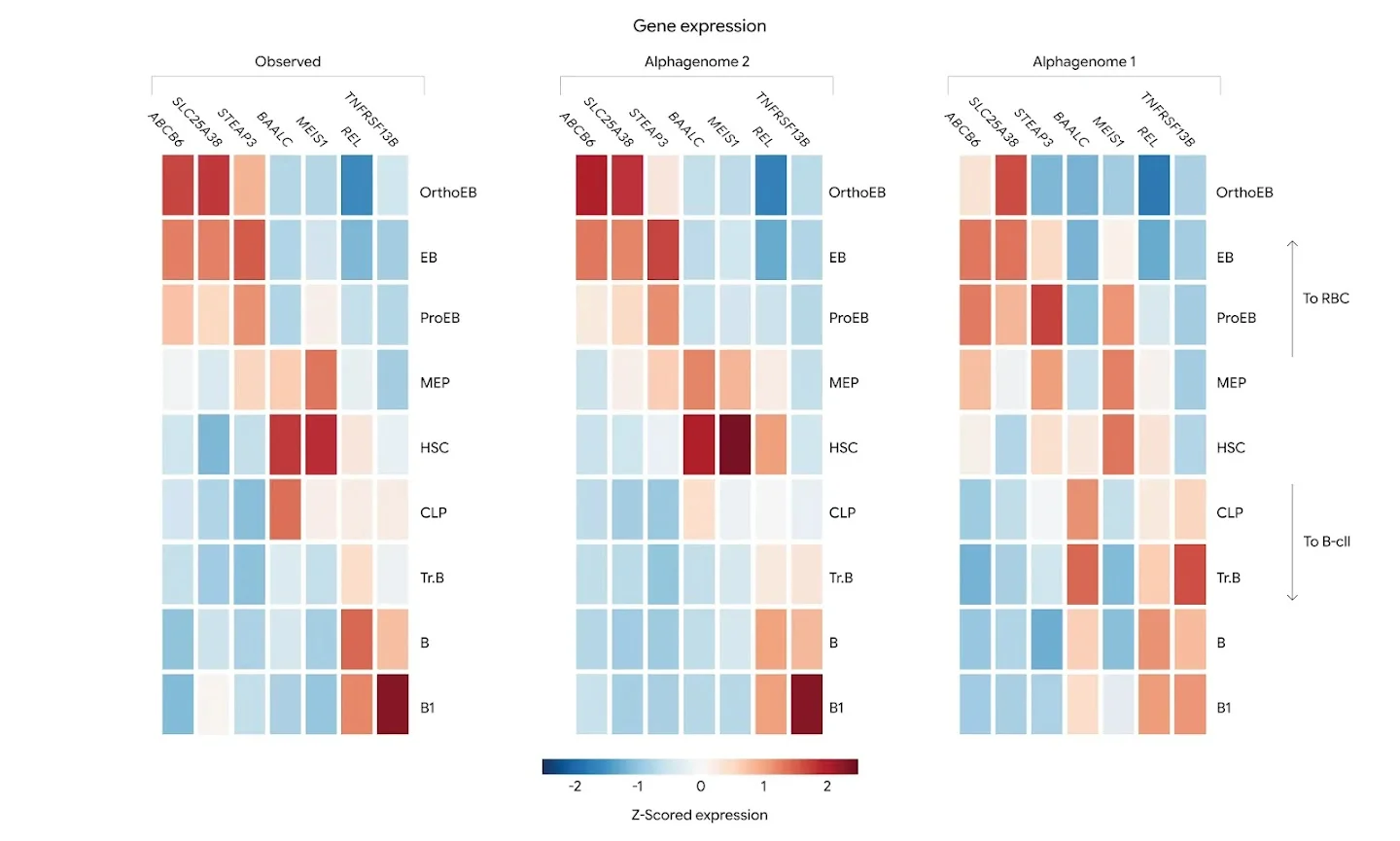 AlphaGenome 2 gene expression heatmap versus observations in hematopoiesis cells
Image: Google DeepMind
The IBD ETS2 macrophage case study is the mechanistic headline: among gut immune types, AlphaGenome 2 singles out a distal regulatory variant that selectively boosts ETS2 in macrophages — matching a recent landmark paper DeepMind cites, but computed across many immune populations.
COVID vaccination example: state-dependent variant effects
DeepMind's mRNA vaccine study walkthrough shows state matters: given unseen single-cell data, AlphaGenome 2 separates vaccine-activated T cells from resting cells, and a severe-COVID-linked variant disrupts activity more strongly in the activated state — an effect invisible if you pool unactivated cells. That is the biological version of context windows in agent design: the same input token (variant) changes meaning under different session state (cell activation).
Precomputed GWAS bridges
To spare teams giant batch jobs, DeepMind precomputed AlphaGenome 2 scores for trait-associated variants across hundreds of cell and tissue conditions, targeting two bottlenecks:
- Enhancer–gene wiring in primary human cell types (for example brain astrocytes), extending maps beyond CRISPR screens in lab lines.
- Causal GWAS variant and direction calls across traits from height to type 2 diabetes.
Genomics plc CEO Peter Donnelly's quote in the post positions sequence models as the path from association to drug-program hypotheses — adjacent to competitions on large atlases like Prima Mente's Alzheimer's challenge.
How to try it and what changes in your stack
- Read the paper linked from DeepMind's announcement (same page footer as the API entry points).
- Request API access for non-commercial work via DeepMind's AlphaGenome API flow — commercial teams join the private preview queue.
- Run Colab tutorials for expression conditioning that DeepMind says ship with the release.
- Watch for Antigravity skills if your workflow already uses agent harnesses for genomics — the September Atlas skill post is the template for how Google packages these models for builders.
If you fine-tune open DNA language models on public corpora, compare against FineDNA on Hugging Face and formal methods work like AlphaProof-adjacent verification research — different layers of the same "trust the sequence model output" problem.
DeepMind asks the community to submit interesting use cases by November 30 for possible extra quota — worth filing if you have a cell-type-specific variant hypothesis sitting in a GWAS hit list.
Research-only boundaries
The footer warning is blunt: not validated for clinical or diagnostic use. Pair model output with orthogonal evidence — orthogonal assays, cohort replication, and clinical pathways explainx.ai covers in Gemini healthcare preview for a different regulated vertical, same caution pattern.
AlphaGenome 1 versus 2 at a glance
| Question | AlphaGenome 1 (prior generation) | AlphaGenome 2 (Nov 11, 2026) |
|---|---|---|
| Conditioning | Parallel tissue and cell-line outputs from one sequence | One cell type/state per forward pass |
| Training emphasis | Broad tissue averages | 100M+ single-cell profiles, 68 tissues |
| New readout | — | DNA methylation predictions |
| Adaptation | Fine-tuning for some single-cell tasks | Cell encoder for new states without full retrain |
| Atlas integration | Atlas skill for genome-wide variant scores | Precomputed GWAS variant scores across hundreds of conditions |
| Builder access | API + Atlas | API non-commercial now; commercial preview |
Use Atlas when you need genome-wide search across billions of single-nucleotide changes. Use AlphaGenome 2 when you have a variant in hand and need the effect distribution across cell types, including states Atlas may not have pre-batched.
Workflow for a computational biology team
A realistic week-one workflow on public API access looks like this:
- Pick the conditioning set. Start from DeepMind's reference catalog if you study a common tissue. Upload a small single-cell snapshot if you study a perturbed state (vaccination response, cytokine stimulation).
- Score candidate variants from your GWAS credible set, not the whole genome, until quota limits are clear from the API onboarding flow.
- Compare directions — up versus down regulation — only where DeepMind reports confident direction calls; treat borderline scores as hypothesis generators.
- Design the wet-lab follow-up using imputed chromatin or methylation tracks to choose assays (ATAC, bisulfite, CRISPR perturbation).
- Log provenance — model version, conditioning vector hash, and API timestamp — so results survive paper revision cycles.
Agent teams should watch the Antigravity skills announcement closely. The September Atlas skill turned variant lookup into an agent tool call; AG2 skills will likely expose conditioning strings and batch variant lists the same way Gemini healthcare connectors expose FHIR-shaped tasks.
What is still unproven
Independent labs have not yet reproduced DeepMind's TenK10K percentage claims on this release day. Cell-type conditioning can overfit rare states if uploads are tiny. Methylation predictions add a modality many cohorts never measured, which helps hypothesis generation but complicates direct validation.
DeepMind's own COVID vaccination example is instructive: the model reported stronger effects in activated T cells. A careless pipeline that pools all T cells would wash that signal out — the same pooling mistake bulk RNA pipelines made for a decade.
If you publish ranked variant lists for collaborators, export the conditioning metadata alongside scores so external labs can reproduce the biological context — not just the hg38 coordinates. Note the API terms you accepted on signup; commercial preview queues may lag behind non-commercial access.